Dr. Rob Dillon, Coordinator


Showing posts with label Alarms. Show all posts

Friday, July 16, 2010

Crisis At Lake Waccamaw?

Editor's Note. This essay was subsequently published as: Dillon, R.T., Jr. (2019d) Crisis at Lake Waccamaw?  Pp 193 - 199 in The Freshwater Gastropods of North America Volume 4, Essays on Ecology and Biogeography.  FWGNA Press, Charleston.

Deep in the cypress swamps shrouding the remote southeast corner of North Carolina lie the mysterious waters of Lake Waccamaw. At roughly 9,000 acres and 4 miles across, Lake Waccamaw is the largest of the “Carolina Bays,” pothole-shaped depressions of unknown origin in an Atlantic Coastal Plain otherwise featureless in its topography. But beyond its unusual size, Lake Waccamaw is distinguished by its exceptional water quality. Groundwater filtering up through layers of sand and Plio-Pleistocene shell arrives in the big lake clear and near-neutral in pH, much in contrast to the acidic and tannin-stained waters prevailing elsewhere throughout the region (1). Although quite young geologically, one might not be surprised to find endemic species (2).

I first visited Lake Waccamaw in 1978, driving south from Philadelphia with Dr. George Davis, my Ph.D. advisor. Our mission was to sample the lake's endemic population of Elliptio waccamawensis for an NSF-funded project on unionid evolution (3). I vividly remember the abundance of the mussels that greeted us that spring morning we waded into the clear shallows together. George and I were able to sample 30 E. waccamawensis in a matter of minutes, with at least four or five other unionid species also moderately common (4). I did not focus on the gastropods that day, but do recall the hydrobiids like pepper on the maidencane.
The entire molluscan fauna of Lake Waccamaw was thoroughly surveyed shortly thereafter by Hugh Porter, working for the North Carolina Wildlife Resources Commission (5). Although I have not seen Porter’s (1985) report, several years ago I had the opportunity of reviewing the extensive collections he deposited in the NC State Museum. Sampling randomly on bottoms of four depth classes with a diver-operated suction dredge, Porter documented strikingly high abundances of the notable Lioplax subcarinata and Gillia altilis, plus the (more mundane) Campeloma decisum, Amnicola limosa, Lyogyrus granum, and the usual pulmonates (6). Especially common in Porter's samples was the little hydrobiid he called “Cincinnatia sp,” but which today is perhaps better referred to the genus Floridobia (7). There has long been speculation that this population may constitute yet another species endemic to Lake Waccamaw (8).

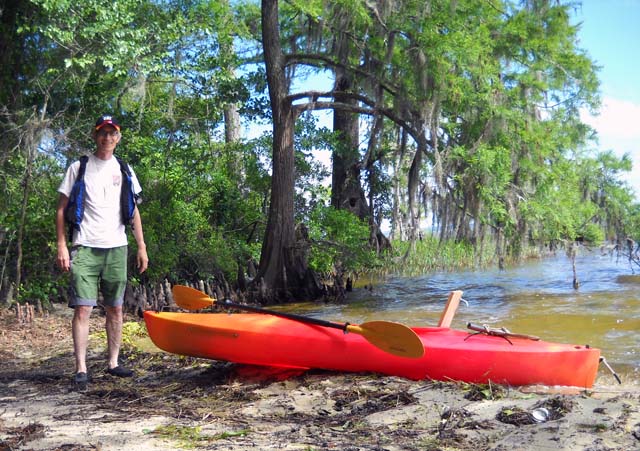
Has the entire diverse and endemic molluscan fauna of Lake Waccamaw now vanished before our eyes? In late May I drove up to the lake from Charleston for a long day of kayaking and puttering about in the shallows. I visited the southern (more exposed) shore near the dam and the northeastern (more protected) shore near the mouth of Big Creek, spending several hours in each area. I examined all wadeable environments and habitats, netted through the entire range of substrates, and found essentially nothing. I observed no more than a couple living unionids all day, and perhaps a handful of empty valves. No Gillia, no Lioplax, not even any Helisoma, and just a few living hydrobiids in the sediments around the macrophytes. I spotted several small Campeloma crawling in the sand, and some Physa bravely clinging to the debris.

I understand that many of the mollusk populations of Lake Waccamaw do not reach their maximum abundance in easily-accessible shallows (9). So the most alarming hours of my visit in late May were spent inspecting the beach drift, which (one might hope) would afford a more random sample of the lake fauna as a whole. In more than an hour of beachcombing on both shores I recovered only perhaps 20-30 tiny Floridobia shells the from grass wrack, 5-10 Amnicola, and a few small Campeloma, period.

Upon my return to Charleston I swapped an email or two with Dr. Diane Lauritsen (10), who has some thirty years of experience at Lake Waccamaw, and spoke with her on the telephone at length. Diane reported that the lake has suffered filamentous algal blooms recently, with an apparently correlated reduction in benthic macrofauna. Diane sent me the photo below.
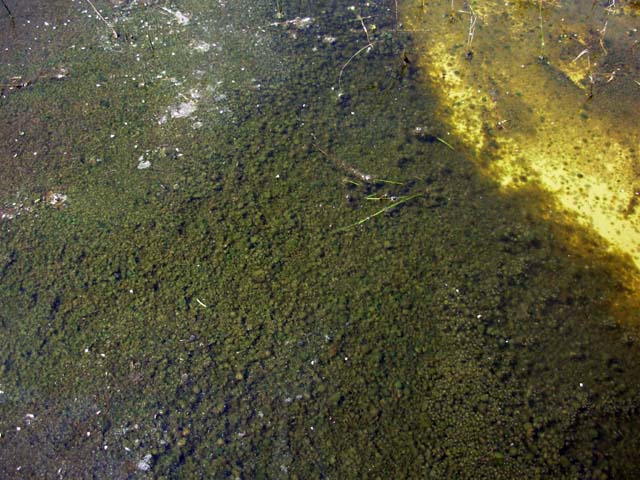
She mentioned that the Corbicula population (11), while never terribly abundant, suffered a "massive die-off probably four years ago." Diane suggested that Corbicula might be a "canary in the coal mine," telegraphing a warning of hypoxia. I was stunned. I had not seen any evidence whatsoever of Corbicula during my entire day on Lake Waccamaw, not one single bleached valve. In what sort of nightmarish environment might the nasty, invasive Chinese clam become a "canary?"

And what can be done? At the risk of sounding like the scientist I am, we need a formal study. Everything I have reported in the preceding seven paragraphs is anecdotal, and cannot constitute a basis for doing much else. Thank heaven the NCWRC had the foresight to commission Hugh Porter’s study in the late 1970s. The first order of business must be to see a study of that caliber repeated.

So in the end, this essay is an appeal to North Carolina natural resource agencies, the regional offices of conservation-minded NGOs, and Waccamaw-area citizens’ groups to renew our mutual interest in the biological treasure that is Lake Waccamaw. I fear this marvelous resource has been neglected in recent years. But I hope I am wrong.


Notes

(1) More about the geology and water balance of Lake Waccamaw here: J. C. Stager & L. B. Cahoon (1987) The age and trophic history of Lake Waccamaw, North Carolina. J. Elisha Mitchell Sci. Soc. 103: 1-13 [html]. S.R. Riggs, D.V. Ames, D.R. Brant, and E.D. Sager (2000). The Waccamaw Drainage System: Geology and Dynamics of a Coastal Wetland, Southeastern North Carolina. NC Division of Water Resources. [pdf or html]

(2) The nominally-endemic fauna of Lake Waccamaw includes three fishes described in 1946 and a caddis fly described by our colleague Jim Glover in 2004, as well as the unionids Elliptio waccamawensis (Lea 1863) and Lampsilis fullerkati Johnson 1984. The specific status of the two mussels has been called into question, however, in a recent MS thesis: Sommer, K. (2007) Genetic identification and phylogenetics of Lake Waccamaw endemic freshwater mussel species. MS Thesis, UNC Wilmington. [html - pdf]

(3) Davis, G. M., W. H. Heard, S. L. H. Fuller & C. Hesterman (1981) Molecular genetics and speciation in Elliptio and its relationship to other taxa of North American Unionidae. Biol. J. Linn. Soc. 15: 131-150.

(4) Porter listed 11 unionid species, but Bogan puts the number as high as 17: Bogan, A.E. 2002. Workbook and key to the freshwater bivalves of North Carolina. North Carolina Museum of Natural Sciences, Raleigh. 101 pp.

(5) Porter, H. J. 1985. Rare and Endangered Fauna of Lake Waccamaw, North Carolina Watershed System: Molluscan Census and Ecological Interrelationships. North Carolina Wildlife Resources Commission, Raleigh. 187 pp. I understand that this work included quite a few original photographs, and is consequently rather hard to get hold of. The methods and a subset of the unionid results did see publication, however, as: Horn, K. J & H. J. Porter (1981) Correlations of shell shape of Elliptio waccamawensis, Leptodea ochracea and Lampsilis sp. with environmental factors in Lake Waccamaw, Columbus County, North Carolina. The Bulletin of the American Malacological Union for 1981: 1 - 4. Porter, H. J. & K. J. Horn (1983) Habitat distribution of sympatric populations of selected lampsiline species in the Waccamaw drainage of eastern North and South Carolina. Amer. Malac. Bull 1:61 - 68.

(6) Porter counted 10 gastropod species in Lake Waccamaw, but I have 12 confirmed in the FWGNA database: Six pulmonates (Physa pomilia, Helisoma trivolvis, H. anceps, Menetus dilatatus, Lymnaea columella, Laevapex fuscus), the two viviparids (Campeloma and Lioplax) and the four hydrobiids (Gillia, Amnicola, Lyogyrus and Floridobia).

(7) Thompson, F. G. & R. Hershler (2002) Two genera of North American freshwater snails: Marstonia Baker, 1926, resurrected to generic status, and Floridobia, new genus (Prosobranchia: Hydrobiidae: Nymphophilinae). The Veliger 45: 269 - 271.

(8) Porter suggested that the Lake Waccamaw fauna might include two endemic hydrobiids, which he called "Cincinnatia species 1" and "Amnicola species 1." He may be right about the former - populations of the little snail called variously Cincinnatia or Floridobia are quite unusual in southern Atlantic drainages. But Porter's samples of "Amnicola species 1" in the NC State Museum looked like unremarkable mixtures of Amnicola limosa and Lyogyrus to me.

(9) The lake bottom is rather heterogeneous, including some regions of (rather malacologically uninteresting) mud and peat, and other sandier regions that can support surprisingly high abundances of bivalves and gastropods. Benthic algae seem to extend to unusual depths in Lake Waccamaw. Or at least they did in the past.

(10) You might recognize Diane’s name from several excellent works Corbicula feeding, for example: Lauritsen, D. (1986) Filter-feeding in Corbicula fluminea and its effects on seston removal. J. N. Am. Benthol. Soc. 5: 165-172.

(11) The Waccamaw Corbicula population has figured in several research projects: Stiven, A.E. & G. A. Arnold (1995) Phenotypic differentiation among four North Carolina populations of the exotic mussel Corbicula fluminea. J. Elisha Mitchell Sci. Soc. 111:103-115. Cahoon, L. B. & D. A. Owen (1996) Can suspension feeding by bivalves regulate phytoplankton biomass in Lake Waccamaw, North Carolina? Hydrobiologia 325:193-200.

Wednesday, March 12, 2008

Red Flags, Water Resources, and Physa natricina

Editor’s Note – This essay was subsequently published as: Dillon, R.T., Jr. (2019d) Red Flags, Water Resources, and Physa natricina.  Pp 153 - 158 in The Freshwater Gastropods of North America Volume 4, Essays on Ecology and Biogeography.  FWGNA Press, Charleston.

This past December brought the publication of a brief paper by our colleagues Christopher Rogers and Amy Wethington synonymizing the federally listed “Snake River Physa” (Physa natricina) under the cosmopolitan P. acuta (1). How a local population of an invasive pest came to be protected under the Endangered Species Act is but one blunder in the sad history of fumbles and missteps that has characterized the record of American Malacology in the Snake River Canyon of southern Idaho. Can anything be learned to prevent such embarrassments in the future?

The misadventure began in the early 1980s, when Idaho Power Company proposed the construction of six new hydroelectric projects on the middle Snake River, perhaps to impound the last free-flowing reaches of a 122 mile section already tightly controlled by 11 dams. Environmental groups rose up in opposition (2), and I would freely confess sympathy for their cause. I have a visceral love of rivers and the lotic biota, and hate impoundments because they are ugly, stinking blights, all too rapidly infested with Bud-swilling bass fishermen.

But insults to the public aesthetic will never be as compelling to the permitting agencies as hydropower, irrigation, and jobs, no matter how egregious the choice of beer. Thus it is not a coincidence that within ten years of the announcements by Idaho Power, five species of endangered freshwater gastropods were discovered in the middle Snake River. Pyrgulopsis idahoensis, Valvata utahensis, Taylorconcha serpenticola, Physa natricina, and the undescribed "Banbury Springs lanx" were added to the federal list of endangered and threatened wildlife on December 14, 1992 (3). The Idaho Power hydro projects were shelved.

About "Pyrgulopsis idahoensis" we have written much in recent years (4). Although originally believed endemic to the Snake River, it proved to be a junior synonym of P. robusta, its actual range extending over four states. Far from being endangered, the Snake River population of P. robusta may be the largest single population of freshwater gastropods on earth. Taylorconcha and V. utahensis are also not rare, and are currently being studied for delisting as well (5). And now published is the paper by Rogers & Wethington sinking Physa natricina.

Physa natricina was described in 1988 by Dwight Taylor, a reclusive millionaire whose 44-page obituary will appear in the next Malacologia (6). Although perhaps better qualified as a paleontologist, Taylor often published on the modern terrestrial and freshwater malacofauna of the American West. He is best remembered for his fanciful treatments of the Physidae (7) and the Cuatro Cienegas hydrobiids (8), imagining more higher taxa than valid biological species actually exist to sort into them.

To be fair, Taylor’s 1988 work (9) conformed to the same 19th century standards of practice under which most elements of America's molluscan fauna have been described. He did distinguish his Physa natricina from P. gyrina, a strikingly different animal which is very common in the Snake River. But the brief comparison he offered between his new species and P. integra, the synonym for P. acuta most commonly applied in the upper Midwest, should have raised a red flag. Taylor wrote that the penial sac of P. integra "is more slender, with a kink near its distal end, and is not bent near the middle." Kinks and bends in mollusk anatomy? Was Taylor nuts? (10) One need not be a malacologist - one need only to have eaten an oyster - to realize that anybody who would distinguish the internal anatomy of a gastropod by reference to kinks and bends is simply unqualified for his profession.

Taylor's work was generally characterized by false precision. For example, in his introductory description of the (entire!) subgenus Physa, he stated that the "spawn capsule...is up to about 10 mm long with 20 eggs." But even under controlled conditions here in my laboratory, we commonly record individual Physa egg masses ranging from over 100 embryos to fewer than 1. Meanwhile, about truly important matters Taylor seems to have been careless at best. His statement that the natricina holotype was deposited in the Los Angeles County Museum ("LACM 2256") seems to have been a fabrication. Christopher Rogers was finally able to track down Taylor's P. natricina holotype at the California Academy of Sciences, where it was not deposited until 1999.

And here's another red flag - the hypothesized rarity of the new species. Taylor's original description was based on but two live-collected animals, "despite arduous effort" to obtain more. But species do not exist as individuals - they exist in populations. Any generally-trained biologist might well wonder how a population as sparse as P. natricina seems to have been for over 20 years could remain viable.
.
In late 2005 I was pleased to accept an invitation from the Bureau of Reclamation to visit the Minidoka Dam (photo above) on the Snake River east of Rupert, Idaho, for a Physa strategy meeting. Also present were our colleagues Amy Wethington, John Keebaugh, Steve Lysne, and several others. The product of that meeting was a consensus that a sequencing project should be undertaken as soon as the next fresh P. natricina individual might be recovered from the river – a day which never arrived (11). But on the basis of what I was able to learn about that elaborately managed river system, together with my own limited observations of the environment and my general experience with the biology of physids, I offer the following hypothesis (12).

I suggest that the two individual P. acuta from which Taylor described his “Physa natricina” in 1988 may have been flushed into the main Snake River from irrigation ditches. In addition to power generation, many of the Snake River dams serve to divert irrigation water to the surrounding farm land. This is done seasonally, and both the peak diversions and the peak release flows back to the river can be high. I suggest that irrigation waters may sporadically carry elements of the canal-dwelling macrobenthos into the Snake River, including occasional individual Physa acuta.

Science is a self-correcting process. It is gratifying to see two of our own, Rogers and Wethington, designing the research program and publishing the paper that has turned us back from our 20-year blunder. But at such a cost! Literally millions of dollars have been wasted monitoring, managing, and protecting a snail that anyone on six continents could find in the ditch behind his local McDonalds, licking special sauce off the hamburger wrappers. Can we avoid even the first step down such paths in the future?

Yes, if we watch for red flags. And the biggest red flag waving over the Physa natricina blunder was not the vacuous description, the false precision, or the biological implausibility of the phantom snail's very existence. The biggest red flag was that this entire research program was motivated, from its very inception, by water resource politics.

You have heard me preach this sermon before - science and politics do not mix. When the two worldviews collide, compromises must be made, and it's always the science that suffers, in my experience. Malacology was corrupted at least four times by water resource politics in the middle Snake River 20 years ago. And science continues to be corrupted in our professional organizations, from the AAAS to the NAS, on matters ranging from global climate to stem cells. But when we see that red flag fly, we must stop.

Notes

(1) Rogers, D. C. & A. R. Wethington (2007) Physa natricina Taylor 1988, junior synonym of Physa acuta Draparnaud, 1805 (Pulmonata: Physidae). Zootaxa 1662: 45-51. A pdf reprint can be requested from the author.

(2) Wuerthner, G. (1992) No Home for Snails. Defenders May/June 92: 8 - 14.

(3) US Fish & Wildlife Service (1992). Endangered and threatened wildlife and plants; Determination of endangered or threatened status for five aquatic snails in south central Idaho. 50 CFR Part 17. Federal Register 57(240)59244-57. (December 14, 1992)

(4) I've offered four previous posts on the Snake River Pyrgulopsis: Idaho Springsnail Showdown [28Apr05], Idaho Springsnail Panel Report [23Dec05], When Pigs Fly in Idaho [30Jan06], and FWS finding on the Idaho Springsnail [4Oct06].

(5) More Snake River Gastropods Studied for Delisting [14June07]

(6) Kabat, A. R. & R. I. Johnson (2008) Dwight Willard Taylor (1932-2006): His life and malacological research. Malacologia 50: 175-218.

(7) Wethington, A. R. & C. Lydeard (2007) A molecular phylogeny of Physidae (Gastropoda: Basommatophora) based on mitochondrial DNA sequences. J. Moll. Stud. 73: 241-257.

(8) Hershler, R. (1985) Systematic revision of the Hydrobiidae (Gastropoda: Rissoacea) of the Cuatro Cienegas Basin, Coahuila, Mexico. Malacologia 26: 31 - 123.

(9) Taylor, D. W. (1988) New species of Physa (Gastropoda: Hygrophila) from the western United States. Malac. Rev. 21: 43-79.

(10) Yes.

(11) See the Bureau of Reclamation's web site for the "Physa Amendment" to its "2004 Biological Assessment and Opinions for Operations and Maintenance of Reclamation Projects in the Snake River Basin above Brownlee Reservoir." There's also an (8/05) "Implementation Plan for Proposed Snake River Physa Surveys" available toward the bottom of the page.

(12) I don’t remember who first advanced this hypothesis – it was very likely in existence long before my introduction to the matter. And I’m pretty sure I’m not the only one who holds it, but I wouldn't presume to speak for anybody else.

Thursday, July 29, 2004

Documenting the Downward Spiral


We were pleased to receive email notification late last week that the proceedings of the Vienna Symposium on Molluscan Biodiversity and Conservation have found their way to press. The table of contents is available as a PDF download from the FWGNA web site:
  • Journal of Conchology Special Publication No. 3 [PDF]
Longtime members of this list may remember that I offered a report on the Vienna Symposium upon my return in September 2001. Although the original symposium did not include any talk specifically dealing with freshwater gastropods, the recently published volume features a paper on the Lake Tanganyika gastropod fauna by Todd and colleagues. It is available as a special publication of the Journal of Conchology, contact Dr. Mary Seddon for the details: Mary.Seddon@nmgw.ac.uk

I do think we've seen increased awareness of molluscan conservation issues in recent years. In fact, I personally have a hard time keeping track of all the books, articles, and other resources documenting the downward spiral. Herewith is a brief bibliography:
  • Lydeard, C. et al. (2004) The global decline of nonmarine mollusks. BioScience 54: 321 - 330. Chuck Lydeard is joined by a gang of 15 coauthors in this general review featuring three "highlighted faunas:" Pacific land snails, unionoid mussels, and spring snails of the Australian outback, as well as conservation strategies.
  • Black, S. H., M. Shepard & M. M. Allen (2001) Endangered invertebrates: the case for greater attention to invertebrate conservation. Endangered Species Update 18: 42 - 50. Scott Hoffman Black is the executive director of the Xerces Society, an advocacy group for invertebrate conservation. One could accuse Xerces of being biased toward insects, but so was God. Scott's article does include references to freshwater mollusks, and may be available in PDF format from the Xerces web site.
  • Neves, R.J., A E. Bogan, J. D. Williams, S. A. Ahlstedt, and P. W. Hartfield (1997) Status of aquatic mollusks in the southeastern United States: A downward spiral of diversity. Chapter 3 in Aquatic Fauna in Peril: the Southeastern Perspective (Benz & Collins, eds.) Southeast Aquatic Research Institute Publication 1. This 42-page work features the most complete review of the conservation status of any regional freshwater gastropod fauna.
  • Lydeard, C. & R. L. Mayden (1995) A diverse and endangered aquatic ecosystem of the southeast United States. Conservation Biology 9: 800-805. This work includes a comprehensive review of the Mobile Basin gastropod fauna, past and present.
If anybody would like to recommend additional resources generally relevant to the conservation of freshwater gastropod faunas, by all means bring them to my attention.