Dr. Rob Dillon, Coordinator


Showing posts with label Phenotypic Plasticity. Show all posts

Tuesday, February 7, 2023

New Clothes for The Emperor

Editor’s Notes - If you’re just joining us, I apologize.  This month’s blog builds from a series of eleven essays on the morphology, systematics, ecology and biogeography of the planorbid genus Helisoma in the southeastern United States, stretching all the way back to 2004, as listed at footnote [1] below.  No, you don’t have to read that entire list, unless you are seriously interested in the science.  But the story below won’t make any sense at all unless my two most recent essays, [6Dec22] and [5Jan23], are fresh in your mind.  Oh, and all that anatomical mishmash I reviewed two years ago, in [9Feb21] will be super helpful for this month’s essay, as well.

This essay was subsequently published as: Dillon, R.T., Jr. (2023c)  New Clothes for The Emperor.  Pp 307 – 317 in The Freshwater Gastropods of North America Volume 7, Collected in Turn One, and Other Essays FWGNA Project, Charleston, SC.

Both Helisoma scalare and Helisoma duryi were described in the 19th century from “The Everglades of Florida.”  Both of their type localities were, however, hundreds of miles north of the ecological region formally recognized as The Everglades here in the 21st.  And none of the 20th century monographers who reviewed the planorbid gastropods in the interim: Henry Pilsbry [2] in 1934, F. C. Baker [3] in 1945, or Bengt Hubendick [4] in 1955, had on his lab bench any live-collected topotypic material for either nominal species.  And as I merged into the eastbound lanes of I-10 on Tuesday morning Feb 23, 2021, Tallahassee in my rearview mirror, neither did I.

Both Pilsbry and Baker based their extensive and detailed redescriptions of Helisoma scalare on a population of planorbids sampled from “Lake Butler, Pinellas County.”  In 1949 the Florida legislature changed the name of that particular body of water to “Lake Tarpon” to mitigate confusion with another Lake Butler elsewhere in The Sunshine State. And so, it was the coordinates of a boat launch in the John Chestnut Park on the SE shore of Lake Tarpon, about 15 miles NW of Tampa, that I had keyed into the GPS on my dash that cloudy February morning.

Helisoma scalare from Lake Tarpon (nee Butler)

And the body of water into which I launched my kayak some four hours later, light drizzle notwithstanding, was a lovely lake of 2,500 acres, average depth 8 feet, clear and cool and blessed with an abundance of macrophytic vegetation of all sorts: floating, emergent, and submerged.  And the weeds of that last-listed category, wafting in the gentle currents at depths of an arm’s length, were laden with Helisoma scalare bearing shells of a most gratifyingly classic morphology, as depicted in the figure above.

The situation in Lake Tarpon (nee Butler) turned out to be quite reminiscent of that I described in The Everglades at the 40-Mile-Bend a couple years ago [5Oct20].  The flat-topped Helisoma seem to reach maximum abundance in the rooted-submerged macrophytes in both places, especially inside beds of eel grass (Vallisneria).  I also noted high densities around the roots of emergent vegetation, such as cat tails (Typha).  The snails do not seem to crawl up those Typha stems to the surface under any circumstance, however.  Their life habit appears exclusively benthic.

Indeed, during the couple hours I waded and kayaked around the margins of Lake Tarpon, I developed the strong impression that no element of the entire population of Helisoma dwelling therein ever, from its birth to its death, rose to enfold an air pocket under its mantle, under any circumstance.  This suggested to me that they would not adapt well to warming or artificial enrichment, or to any perturbation that might cause levels of dissolved oxygen to dip in their lovely lacustrine environment.  Helisoma scalare populations seem to need large volumes of cool, clean, clear water.

Such a situation contrasts strikingly with the typical habitat of Helisoma duryi in my experience, or (indeed) Helisoma trivolvis throughout the remainder of North America.  Populations of more typically-planispiral planorbids are ordinarily found grazing in floating macrophytes in warm, rich ponds or ditches, or on the margins of riverine backwaters, almost always near the surface.
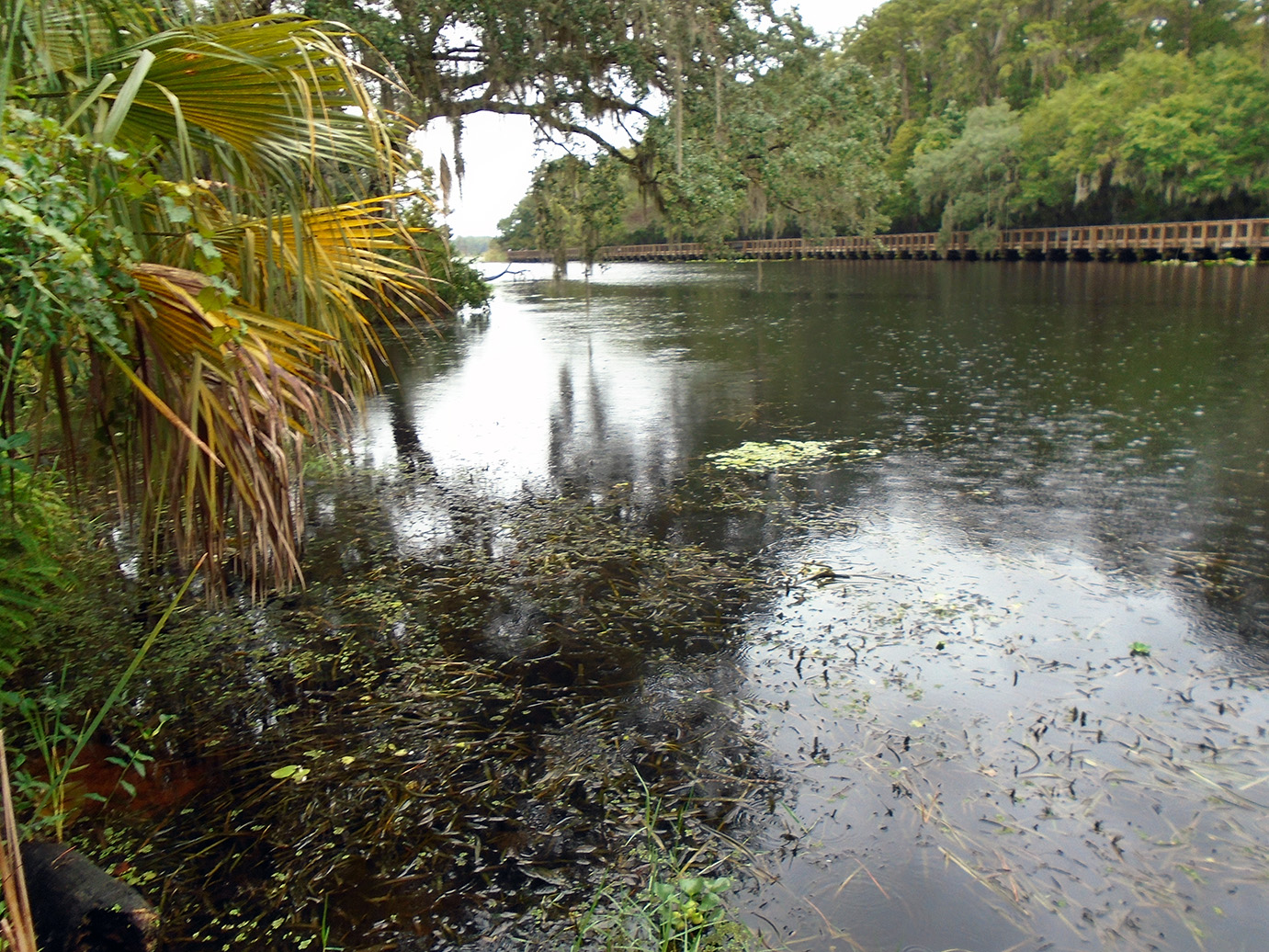
Lake Tarpon

And back wading in Lake Tarpon, I also developed the strong impression that, setting aside their peculiar scalariform morphology, the shells borne by this particular population of pulmonate snails were exceptionally thick, heavy, and robust.  This seemed to imply some special adaptation for defense against crushing predation.  At this suggestion, the schools of bream darting about in the clear waters around my feet seemed to nod their heads in agreement.

The skies were growing leaden over the crystalline waters of Lake Tarpon as I loaded my kayak back into my pickup and pushed the button on my GPS unit for home.  And the next afternoon I dumped my big, fresh sample of H. scalare in an enamel pan on my lab bench and pulled out the big samples of H. duryi I had collected in 2020.  And I opened my well-thumbed copy of Pilsbry 1934 on the left side of my lab bench, and my much-beloved copy of Baker 1945 on the right.  And to refresh everybody’s memory:

In 1934 “The Elderly Emperor” gathered four previously described species of Floridian planorbids into a new subgenus of Helisoma he called Seminolina: scalare (Jay 1839), duryi (Wetherby 1879), and two fossil species of Dall (1890), conanti and disstoni.  Under Helisoma (Seminolina) duryi he recognized six subspecies: the typical H. duryi duryi (Wetherby), intercalare (Pilsbry 1887), preglabratum (Marshall 1926), and three new ones: normale, eudiscus, and seminole.  Together this set of six subspecific nomina described a completely seamless progression from the compressed, tightly-planispiral eudiscus to the typical, loosely-planispiral duryi to the flat-topped, scalariform seminole.

From Pilsbry [5]

But to be clear.  Pilsbry did not subscribe to the modern convention that subspecies demonstrate any sort of geographical isolation.  He wrote:

“In a well-watered region of low relief, like Florida, no barriers to the migration of these snails exist, so that the geographic limits of such races are only vaguely defined. The shell characters are so variable that with single shells or small series the identity may often be in doubt.”

In the image below, clipped from Pilsbry’s Plate 7, the top row of shells (5a – 5f) were all borne by a Helisoma duryi population sampled from “near Lake Apopka,” the second row (6a – 6f) all from a population inhabiting Lake Eustis (Lake Co.), and the third row (7a – 7e) all from the Head of the Miami River.  This entire set of 17 shells he identified as varying subspecies of Helisoma duryi.  There is no difference between shells 5e, 5f, 6e, 6f, and any of the shells I collected from Lake Tarpon.

So again, I ask.  If not the shell morphology, what exactly is the difference between Helisoma duryi – particularly the subspecies that Pilsbry began calling H. duryi seminole in 1934 – and the earlier-described H. scalare?  The distinction that Henry Pilsbry drew in 1934 turned out to be entirely anatomical.  The duryi/scalare situation is very closely analogous to the duryi/trivolvis situation we reviewed at great length back on [9Feb21], involving many of the same anatomical features, and (indeed) the same illustrations of them.  So to refresh everybody’s memory, again:

It was upon Henry Pilsbry’s head that rested the crown of American Malacology, pretty much his entire career, from 1887 to 1957.  Frank Collins Baker, more experienced as a field biologist and more gifted as a scientist, studied under Pilsbry in 1889, and labored in his shadow thereafter, predeceasing his mentor by 15 years.  And to understand what I’m getting ready to tell you about scalare and duryi, you need to understand the relationship between Pilsbry and Baker.  A bit of familiarity with the reproductive plumbing of pulmonate gastropods will also be helpful, but not necessary.

From Pilsbry [2] Plate 7.

When not in use, pulmonate gastropods invert their penis – turn it outside in – to make a bag with the business end inside.  Figure (A) in the montage below shows the structure that Pilsbry (1934) simply called the Helisoma scalare “penis, unopened.”  It’s an (upside down) sack, with an opening in the bottom through which the penis everts for copulation.  The figure I’ve marked (B) shows a Helisoma scalare penis sack opened, Pilsbry’s “V” standing for “verge,” which is a polite name for the business end of the penis during copulation.  And the organ Pilsbry has marked “pg” is the penial gland, which presumably supplies some sort of lubrication during copulation, or stimulation, heaven knows.

So, to distinguish the two nominal species of the subgenus Seminolina, scalare and duryi, Pilsbry focused exclusively upon differences he perceived in the penial gland.  In his description of his new scalariform subspecies H. duryi seminole, he wrote:

“I dissected specimens collected many years ago in Polk Co., Florida, by S. Hart Wright, and similar in shape to fig. 6d of Plate 7. The bodies are brittle, and only the penis was examined (figure C), cylindric, with the upper sac divided off inside by a thin rather high ridge. The stout conic verge projects into the lower sac. The penial gland is oblong with the smooth lateral borders folded in the alcoholic specimens, as in figure (C). This structure is quite unlike that found in H. scalare (B).”

And to reinforce the distinction, here is what Pilsbry said in his redescription of H. scalare:

“In the specimens of H. duryi seminole opened, the penial gland was found to differ [from H. scalare] in important details. It [the duryi penial gland] has a broad oblong face directed toward the cavity, with the lateral borders infolded in alcoholic specimens, as in figure (C). The division between upper and lower sacs of the penis is a single rather high thin ridge. The stouter shape of the verge in H. d. seminole may be due to greater contraction, as the specimens had evidently been killed in strong alcohol.”

Now moving forward ten years.  In addition to the three Pilsbry figures I have reproduced below F. C. Baker’s (1945) figure of the same organ – less artistic but more scientific (D).  Baker did not execute separate drawings for scalare and duryi.  This single figure was offered to represent the entire subgenus Seminolina, including scalare and duryi of all subspecies.

Penial complexes from Pilsbry [2] and Baker [3]

Baker dissected 35 individuals from the “Lake Butler” (now L. Tarpon) population of H. scalare, and populations of H. duryi from seven different sites, representing three subspecies.  Regarding the Lake Tarpon population, Baker was quick to pay homage to the Elderly Emperor:

“The genitalia of Helisoma scalare examined agree perfectly with the figures published by Pilsbry 1934.”

Turning to his H. duryi samples, Baker figured on his Plate 33 the “penial complexes” (Pilsbry’s “penis unopened”) from 12 different H. duryi individuals dissected from four populations of three different subspecies, all pushed, pulled, shrunk and extended into a myriad of diverse, blobby profiles.  And hidden among his observations was this single-line bombshell, directly contradicting the only distinction that Pilsbry had ever drawn between scalare and duryi:

“The penial gland in the duryi complex is of about the same shape as that organ in scalare.”

Poor Frank Collins Baker!  I can still feel the anguish seeping from page 132 of his planorbid monograph, here 80 years later.  The character of the penial gland that Pilsbry called “lateral borders infolded” is trivial at best, entirely artifactual if it ever existed.  Baker couldn’t confirm it in a dozen H. duryi sampled from four populations.  But neither could he risk offending his Emperor.  So, all he could do was to dissemble, which he did, five sentences later:

“The figures of the duryi complex agree with those by Pilsbry (1934).  As Pilsbry remarks on page 36, the anatomical differences are sufficient to separate scalare from duryi and its races.”

The bottom line for us today is, however, that there is no evidence of any morphological distinction whatsoever, shell or anatomical, heritable or otherwise, let alone any evidence of reproductive isolation, between the diverse planorbid populations found throughout Florida and around the world conventionally identified as Helisoma (Planorbella) duryi, and the earlier described planorbid populations of deeper, cooler and cleaner Floridian waters identified as Helisoma (Planorbella) scalareWetherby’s (1879) nomen duryi is a junior synonym of Jay’s (1839) scalaris or scalare [7].

But let’s save duryi at the subspecific level to describe populations of H. scalare bearing planispiral shells, shall we?  I hasten to remind everybody, once again, that the FWGNA has adopted the definition of the word subspecies in currency since the birth of the modern synthesis: “populations of the same species in different geographic locations with one or more distinguishing traits.”  No additively heritable basis for the shell morphological distinction between the typical scalariform morphology and the planispiral duryi morphology is necessary, or implied [8].

And I also hasten to remind my readership that the “different geographic locations” may differ at very small scales in freshwater gastropods.  See my essay of [18Feb05] for an example here in the Charleston area where populations of the duryi subspecies and the typical subspecies are separated by only a few meters.

As we have seen, the most obvious correlation seems to be with the habitat: scalariform populations inhabiting submerged macrophytes and benthic substrates in large, permanent clearwater lakes and springs absent contact with the surface, planispiral populations inhabiting emergent or floating macrophytes on the margins of ponds, ditches and riverine backwaters.

There is also a correlation with predator pressure: the scalariform populations of clearwater lakes suffering more fish predation, the planispiral populations more beset by invertebrate predators like crayfish and leeches.  And trematode parasites, apparently.  For completeness, here’s an interesting observation from Baker, page 134:

“The Helisoma duryi complex includes several races more or less heavily infested with parasitic worms.  These include normale, intercalare, eudiscus, and duryi.  Many specimens were so badly infested that most of the organs, especially the genitalia, were completely obliterated.  Helisoma scalare was the least affected.”

In conclusion.  Nothing I have written in this essay is intended as a criticism of Henry Pilsbry or (heaven forbid!) Frank Collins Baker, both of whose works stand today at the pinnacle of classical American malacology [9].  Pilsbry was The Emperor, and if in his judgement some wrinkle or fold in some gland or tube confirmed the specific status of some gastropod population somewhere, in late pre-modern systematic biology, that settled it.  Baker was a courtier, following in retinue behind.

I’d like to imagine myself in the story as a small boy watching the grand parade, naively observing that even if the margins of some particular gland in some particular snail really were folded in the particular fashion The Emperor decreed, naturally and not the result of some sort of artifact, it just wouldn’t matter anyway.

But alas, The Emperor, his Retinue and his Grand Parade have long, long passed, many years ago.  And I’m just sweeping up behind.


Notes

[1] Here’s a complete list of all essays previously posted on this blog relevant to the argument I am advancing this month:

  • Gigantic pulmonates [29Nov04]
  • Shell morphology, current, and substrate [18Feb05]
  • Juvenile Helisoma [9Sept20]
  • The Flat-topped Helisoma of The Everglades [5Oct20]
  • Foolish things with Helisoma duryi [9Nov20]
  • The Emperor Speaks [3Dec20]
  • Collected in turn one [5Jan21]
  • Dr. Henry A. Pilsbry was a jackass [26Jan21]
  • The Emperor, the Non-child, and the Not-short Duct [9Feb21]
  • In the Footsteps of the Comte de Castelnau [6Dec22]
  • The Helisoma from the Black Lagoon! [5Jan23]

[2] Pilsbry, H. A. (1934) Review of the Planorbidae of Florida, with notes on other members of the family.  Proceedings of the Academy of Natural Sciences of Philadelphia 86: 29 – 66.

[3] Baker, F. C. (1945) The Molluscan Family Planorbidae. University of Illinois Press, Urbana. 530 pp.

[4] Hubendick, B. (1955) Phylogeny in the Planorbidae. Trans. Zool. Soc. London 28: 453-542.

[5] This is quite possibly the most famous figure Pilsbry ever published.  It depicts the only overtly evolutionary thought that ever flickered through The Elderly Emperor’s mind, as far as I know.  It was reproduced on page 280 in Burch [6], and I dredged it up again for my Helisoma essay of [18Feb05].

[6] This is a difficult work to cite.  J. B. Burch's North American Freshwater Snails was published in three different ways.  It was initially commissioned as an identification manual by the US EPA and published by the agency in 1982.  It was also serially published in the journal Walkerana (1980, 1982, 1988) and finally as stand-alone volume in 1989 (Malacological Publications, Hamburg, MI).

[7] Pilsbry re-spelled the feminine scalaris to the neuter scalare to agree in gender with the neuter noun-construct Helisoma.  His Imperial Majesty did not stoop to explain that fine point of Latin grammar himself, however.  My good buddy Harry Lee was much more helpful.

[8] For a complete discussion of the subspecies concept as adopted by the FWGNA project, see:

  • What is a subspecies [4Feb14]
  • What subspecies are not [5Mar14]

[9] Neither Pilsbry nor Baker was touched by the modern synthesis, although I’d like to think that Baker would have been receptive, had he survived beyond 1942.  This makes the 1934 work of Calvin Goodrich [10] all the more impressive, if you think about it, am I right?

[10] For an appreciation of Calvin Goodrich, see his brief bio, then review his 1934 masterwork:

  • The Legacy of Calvin Goodrich [23Jan07]
  • CPP Diary: The spurious Lithasia of Caney Fork [4Sept19]
  • Intrapopulation gene flow: Lithasia geniculata in the Duck River [7Dec21]

Wednesday, September 9, 2020

Juvenile Helisoma

Editor’s Note – This essay was subsequently published as: Dillon, R.T., Jr. (2023c)  Juvenile Helisoma.  Pp 227 – 233 in The Freshwater Gastropods of North America Volume 7, Collected in Turn One, and Other Essays FWGNA Project, Charleston, SC.

Before launching into the subject of this month’s essay, I do want to emphasize that I always enjoy hearing from you.  I’m retired, and bored, and I (honestly!) do not have a whole lot better to do than sit at my computer and correspond with colleagues from around the world, about a subject that has fascinated me since childhood.  So let’s open up the Ol’ Mailbag and see what the postman brings.  Click the captions under the thumbnail jpegs to see the larger, original images:

Greetings Dr. Dillon:

Click caption
We have collected an aquatic snail that has puzzled me for years (photo attached).  At first, it seemed unique enough that we could record it without paying much attention to biogeography.  We used the genus Planorbella (based on Burch’s EPA publication) to document the counts when we collected it during bioassessment work.  Since I began working on aquatic snail distribution, I have tried to get better at snail IDs and to possibly learn a little.

Thanks for any feedback that you might provide!
[Baffled in Missouri]

Hello Dr. Dillon,

Click caption
I hope this email finds you well.  I'm afraid I'm cold-emailing you (if such a thing exists) to ask for advice re: some gastropods I'm keying out as a small cog of a [federally-funded] monitoring program […] Finally, my other big headache is my stubborn inability to feel comfortable IDing to genus the small Planorbidae down to genera.  I had a weird Helisoma this year, with bizarre whorling too. It happens, I guess! […] So I'd like to ask if you'd be kind enough to peek at a few pictures (in .zip form) I've attached of stubborn-to-ID snails.

Much obliged,
[Bothered in Indiana]

Dear Robert,

Click caption
You may remember me. I contacted you about [another question] in 2011.  I have another riddle to submit to you.  We sampled those gastropods in a small river in Quebec.  We’ve never seen that before. It looks like some Amerianna or Planorbella that are not present in our region.  Can you tell me the identification? They can come from an aquarium?

Thanks for your help,
[Bewildered in Quebec]

Dear Baffled, Bothered, and Bewildered,

The snails depicted in all your jpegs are juvenile Helisoma trivolvis.  They don’t look much like their parents, do they?

Their most striking feature is that flat apex, when viewed sinistrally, which is the way you have all depicted them, which is correct.  As the shell grows the later whorls cover up that flat apex, so it it disappears.  The adult shell doesn't seem to have any apex at all, which is another way of saying that the adult shell is "planispiral."  Bottom line is that, several weeks after hatch, juvenile Helisoma trivolvis seem to switch rather dramatically and mysteriously from obviously-sinistral to just-plain-flat.

Helisoma anceps, by contrast, has an indented apex when viewed sinistrally, even as a juvenile.  Indeed, the apex of H. anceps is indented no matter how you look at it, which makes anceps shells pretty darn near perfectly-planispiral.  Just-plain-flat from birth.

Both H. trivolvis and H. anceps can be found in a wide variety of habitats, but H. trivolvis is a better floater, and is more common in lentic environments, especially in macrophytic vegetation.  Helisoma anceps is more common in lotic environments – especially in calm backwaters – generally grazing on solid substrates.  See the figure below for a comparison of juvenile H. trivolvis, H. anceps, and H. campanulatum, from up lakes north, included here for completeness.

Have you ever heard the old saw [1], “Ontogeny recapitulates phylogeny?”  Planorbids evolved from a left-handed ancestor that probably looked something like a modern physid.  Through subsequent selection they have evolved planispiral shells – possibly so that the air bubble enfolded by their shells forms a more stable float – and in the adults of many species it is now difficult to see which way their shells are coiling, left or right.  Usually.  But there’s a big asterisk to that generalization.

More to follow!
Rob

The shells of juvenile Helisoma
At this point in my essay, allow me to speak directly to you, the readership of this blog, rather than as a correspondent to a third party.  I did a bit of a disservice to our colleague Baffled-in-Missouri at the top of this essay.  His email continued with a lot of excellent insights and additional questions, from which I have extracted the following:
“If you have the time and interest to respond, I would like your opinion about the following speculations: Following your modified classification of Hubendick [2], I would lean toward calling the snails in my photo Helisoma scalare, or possibly Helisoma duryi.  Since I now realize that these species are from Florida, I would have to suspect an introduction to Missouri.  There seems to be several scientific journal articles to support the idea of a possible aquarium introduction of these species worldwide. […] The other possibility is one you have written about many times.  Do you think phenotypic plasticity is a possibility?  Many times, we also have co-occurring records of Helisoma sp. that have the more typical form.  This form always seems to be the more mature individuals.  Even if not fully grown, the typical form is always much larger that the Helisoma scalare form.”
Here Baffled-in-Missouri has broadened the subject in an interesting direction – adult shell morphology.  He is referring to an essay I contributed to this blog way back in 2005, sharing my observations on a single Helisoma population inhabiting two strikingly-different environments in the “Wakendaw Lakes” subdivision on the other side of the Cooper River from Charleston [3].  It might help to open that essay in another window and keep my photo of that study area handy [15Feb05].

While the Helisoma inhabiting the little retention pond upstream demonstrate typical shell morphology, those that have colonized rip-rap rocks in the flowing-water environment below the pond retain their flat-topped, obviously-sinistral juvenile morphology into adulthood.  Here’s an improved version of the figure I originally published in 2005, which I fixed up for my 2019 book [4]:

Helisoma population of Wakendaw Lakes
That’s quite a vivid demonstration of ecophenotypic plasticity [5], isn’t it?  Both shells are from adults, photographed at the same scale.  Snails in the pond above the dam are grazing in the macrophytic vegetation, using their shells as buoyant floats, like normal.  Snails below the dam are grazing on rocks, holding their shells low on their backs against the current.

And here is the most interesting thing about this phenomenon, to me, anyway.  The snails on the rocks, retaining their juvenile shell morphology into adulthood as they do, look sinistral, as planorbids actually are.  But the Helisoma inhabiting the pond, have (as is typical for the species) flipped their shells so far across their backs that they seem to have gone beyond planispiral to dextral.  Typical pond-dwelling Helisoma "look correct” the way I have depicted them above.  I’m not sure why this is so, but turn your computer monitor upside down and look at the  pond-dwelling snails again if you don’t believe me.  Or just look back at the original figure in my 2005 post, where the typical Helisoma shell looks like it's upside down.

That, by the way, is why “Planorbella” is (at best) a subgenus under Helisoma.  The distinction (originally drawn by Baker [6]) has to do with whether the adult is apparently right-handed or apparently left-handed, a trait which can vary within a single population, ecophenotypically.

So Baffled-in-Missouri also brought up the question of Helisoma scalaris/scalare and Helisoma duryi, which I myself also touched upon in 2005.  Those are Florida species, primarily distinguished by their flat-topped, sinistral-looking shell morphology carried into adulthood.  What, exactly, are Helisoma scalare and Helisoma duryi?  Tune in next time.


Notes:

[1] That phrase, originally coined by Ernst Haeckel, has pre-Darwinian roots.  It was appropriated by twentieth-century philosophers and charlatans (most notably Stephen Jay Gould) and twisted every way it could possibly be twisted, to the point that nobody knows what it means, much less whether Haeckel’s theory has any validity or not.  Wikipedia has a pretty standard review if you want to google it.

[2] Hubendick, B. (1955) Phylogeny in the Planorbidae. Trans. Zool. Soc. London 28: 453-542.  For a modern elaboration, see:
  • The Classification of The Planorbidae [11Apr08]
[3] More about the Helisoma population of Wakendaw Lakes:
  • Shell morphology, current, and substrate [18Feb05]
[4] My 18Feb05 essay was subsequently published as:
Dillon, R.T., Jr. (2019b)  Shell morphology, current, and substrate.  Pp 121-126 in Freshwater Gastropods of North America Volume 2, Essays on the Pulmonates.  FWGNA Press, Charleston. [FWGNA Publications]

[5] This present essay is the 28th I have published on the ever-fascinating subject of ecophenotypic plasticity in freshwater gastropod shell morphology.  Hit the “Phenotypic Plasticity” label in the margin at right if you don’t believe me.  My series on the stagnicoline lymnaeids is probably the most relevant.  Start at the end, here:
  • The Lost Thesis of Samantha Flowers [3Sept15]
[6] Baker, F. C. (1945) The Molluscan Family Planorbidae. University of Illinois Press, Urbana. 530 pp.  For more about my hero, see:
  • The Legacy of Frank Collins Baker [20Nov06]

Thursday, October 3, 2019

CPP Diary: What is Pleurocera (aka Melania, aka Goniobasis, aka Elimia) ebenum?

Editor’s Note – This essay was subsequently published as: Dillon, R.T., Jr. (2023b)  CPP Diary: What is Pleurocera (AKA Melania, AKA Goniobasis, AKA Elimia) ebenum?  Pp 17 – 24 in The Freshwater Gastropods of North America Volume 6, Yankees at The Gap, and Other EssaysFWGNA Project, Charleston, SC.

Looking back on my long and checkered career as a malacologist, I think I first developed my mental image of Pleurocera ebenum on a brief side trip to the Falls of the Cumberland in the summer of 1988.  There in the Kentucky State Park, above the falls only – not below – I found the rocks covered with pale, large-bodied pleurocerids bearing heavy, triangular shells that I assumed must be P. ebenum [1].  See the example at far right below.

Well, they certainly matched Figure 370 [2] in Burch [3], second from left below.  And Burch must have Goodrich’s collections at his fingertips for reference, yes?  And Goodrich [4] specifically listed “Cumberland River above the Falls” in the range of Goniobasis (aka Elimia, aka Pleurocera) ebenum, yes?

From left: Lea's original figure of M. ebenum [9], Tryon from Burch [2], Branson [6], fresh from the Falls of The Cumberland
So the FWGNA Project began our initial surveys of the Cumberland drainages about ten years ago, and in the last couple years, as we have sewed up the Green River and the Kentucky River further north, The Cumberland has increasingly come into focus.  Branson [5] promised us that P. ebenum would be “common” in Kentucky, publishing the (rather shabby) figure 27 third from left in the figure above.  And this is the description Branson provided in his key to identify it [6]
“Upper whorls without carinae on periphery of whorls; shell obtusely conical, smooth, spire relatively short; aperture often with purplish tinge within; Cumberland River system”
So indeed, as our survey has progressed, we have found populations of pale, large-bodied pleurocerids bearing heavy shells “obtusely conical, smooth, spire relatively short” in mid-sized rivers and streams all over the Bluegrass State, and Middle Tennessee as well.

And almost everywhere we found populations of P. ebenum, we discovered smaller, darker-bodied populations of Pleurocera simplex in small creeks upstream, bearing gracile shells with higher, more slender spires, convex even to the point of being teardrop-shaped in their outline.  Scroll down to Figure J at the bottom of last month’s post to see a typical example.  Upon careful study, we simply have not been able to draw a line between simplex populations upstream and ebenum populations downstream, anywhere.  It has become apparent that the simplex/ebenum relationship must be yet another case of cryptic phenotypic plasticity (CPP), and that ebenum (Lea 1841) is best considered a subspecies [7] of simplex (Say 1825), following the model laid down for us in the Duck River Lithasia by Goodrich [8].

It was only very recently, quite late in the entire process, that I actually read Isaac Lea’s 1843 description [9] of Melania [10] ebenum
“Shell smooth, obtusely conical, thick, black; spire obtuse; sutures small; whorls somewhat convex; aperture rather large, ovate, subangular at base, within purplish”
The “habitat” Lea gave surprised me, a bit: “Robinson County, Tenn. Dr. Currey.”  Tennessee has no constituent “Robinson” County, but a Robertson County was organized in 1796 about ten miles north of Nashville.  The county lies on a plateau draining west to the Red River, entering the Cumberland at Clarksville, about 65 miles downstream from Nashville.  There isn’t much mid-sized riverine habitat especially suitable for P. ebenum in Robertson County.

I was also surprised by Lea’s remarks that his M. ebenum were “very dark-coloured” with “convex” whorls and “usually purplish on the whole of the inside of the aperture.”  Those characters sound much, much more like typical Pleurocera simplex to me.

M = Springfield, N = Tyree Springs, O = Shackle Island
Did Lea have pale, triangular, heavily-shelled specimens on his desk when he described his Melania ebenum in 1841 [9]?  That would make the taxon a subspecies of P. simplex today.  Or were Lea’s specimens indeed dark, gracile, and teardrop shaped?  Is it possible that Lea’s ebenum is just a simple synonym of P. simplex today, rightly consigned to the dustbin?

So the evening of 15May19 found me checking into a cheap motel in Goodlettsville, north of Nashville, with big plans to find Isaac Lea’s type locality on the morrow.  The “Dr. Currey” referred to by Lea must have been Dr. Richard Owen Currey (1816 – 1865), the prominent Nashville physician impeccably credentialed with a Presbyterian heritage and University of Pennsylvania degree.  So, my plan was to survey the rivers and streams of southern and eastern Robertson County first, closest to Nashville, then expand my search area north and west as necessary.

The morning of 16May19 dawned crisp and clear.  And I enjoyed lovely field conditions surveying the pretty little springs and streams of southern Robertson County, taking three good swings, striking out.  So I headed west, and on my second at-bat, made solid contact in Springfield, the county seat (M, above).   I found three species of pleurocerids inhabiting Sulfur Fork at the US 431 bridge in Springfield, although none common: P. laqueata, P. troostiana, and (sure enough) P. simplex of triangular, heavily-shelled ebenum morphology [11].  Could this be Isaac Lea’s type locality?  If so, the subspecies hypothesis would seem justified.

The only misgivings I continued to harbor about the population at Springfield, however, were that the animals, in both shell and body, were pale brown, with white apertures, as (I have always assumed) typical for ebenum.  They were not the “very dark-colour” specified by Lea, nor did they sport “purplish” apertures nor “convex” whorls.  And Springfield is 30 miles north of Nashville.  Is that too far afield in 1841?


In any case, I turned my pickup back toward Nashville, with other field objectives now rising higher on my agenda.  And my route happened to take me south down TN 258, by an historic marker for Tyree Springs.  And there, at Site N, I stumbled upon a very attractive nominee for the type locality of Melania ebenum.

All I know about the history of the place you can read for yourself on the sign (click for larger).  There doesn’t seem to be any evidence of a resort at the site today – just second-growth forest and the little stream that runs under the road at far left in the photo above.  And the rocks of that little stream are covered with pleurocerids bearing thick, black shells, with obtuse spires, small sutures, whorls somewhat convex, and apertures rather large, ovate, and within purplish [12].  In other words, absolutely typical P. simplex.  If Tyree Springs is (indeed) the type locality of Lea’s ebenum, the simple-synonym hypothesis must prevail.

Tyree Springs is a comfortable day trip via horse-and-buggy from Nashville.  It is easy to imagine that a prominent physician such as Dr. Currey would be familiar with such a place in 1841.  There is just one problem.  Tyree Springs are not located in “Robinson” County nor even in Robertson County.  The springs are located in Sumner County.  The Robertson County line is another couple miles north up the ridge.
Topotype nominees: (M) Springfield, (N) Tyree Springs, (O) Shackle Island
Tyree Springs drain south, through Drakes Creek into the Cumberland River above Nashville.  So more out of intellectual curiosity than anything else, I drove downstream to sample Drakes Creek at the little town of Shackle Island [13], marked O on the map above.  And there I found a sparse population of pleurocerids bearing the paler, heavier shells with flat whorls and white apertures I have always considered typical of the ebenum form.  The Drakes Creek population of P. simplex, from headwaters to mouth, demonstrates a textbook case of cryptic phenotypic plasticity.

As I pointed my pickup back toward home on the evening of 16May19, I admit to a bit of frustration.  I wasn’t any closer to answering my questions about Pleurocera ebenum than I had been at the dawn of that long, lovely day.  In fact, the picture was murkier.

And then it occurred to me that the taxonomic situation mirrored rather beautifully the biological situation.  The taxonomic validity of Lea’s (1841) nomen ebenum is precisely as clear as the morphological distinction of those pleurocerid populations to which the name has subsequently been applied.

In the end, I resolved to follow the rule of Sunday afternoon.  The subspecies hypothesis as forwarded to us by Tryon, Goodrich/Burch, and Branson is the call on the field.  Against which there is not enough evidence to overturn.


Notes

[1] Actually, the Pleurocera population at the Falls of the Cumberland is a mixture of P. ebenum and P. semicarinata.  And the two species are difficult to distinguish here.

[2]  The great majority of the figures in Burch [3] are obviously from the pen of Mr. John Tottenham, an accomplished scientific illustrator specifically engaged for the project.  But one of the mysteries of Burch’s work is why many of his pleurocerid figures, in particular, were borrowed from elsewhere.  Burch reproduced his figure of “Elimiaebenum from Tryon’s (1865-66) Monograph of the Family Strepomatidae.

[3] This is a difficult work to cite.  J. B. Burch's North American Freshwater Snails was published in three different ways.  It was initially commissioned as an identification manual by the US EPA and published by the agency in 1982.  It was also serially published in the journal Walkerana (1980, 1982, 1988) and finally as stand-alone volume in 1989 (Malacological Publications, Hamburg, MI).

[4] Goodrich, C. (1940) The Pleuroceridae of the Ohio River drainage system. Occasional Papers of the Museum of Zoology, University of Michigan 417: 1 - 21.

[5] Branson, B.A. and D.L. Batch (1987)  Distribution of aquatic snails (Mollusca: Gastropoda) in Kentucky with notes on fingernail clams (Mollusca: Sphaeriidae: Corbiculidae)  Trans. Ky. Acad. Sci. 48: 62 – 70.

[6] Branson, B. A. (1987)  Keys to the aquatic Gastropoda known from Kentucky.  Trans. Ky. Acad. Sci. 48: 11 – 19.

[7]  I would be most gratified if you purchased my FWGNA Volume III (Prosobranchs) [html] and read pp 77 – 91.  Or you might certainly take the easy route by clicking:
  • What is a subspecies? [4Feb14]
  • What subspecies are not [5Mar14]
[8] Goodrich, C. (1934) Studies of the gastropod family Pleuroceridae - I. Occasional Papers of the Museum of Zoology, University of Michigan 286:1 - 17. For more, see:
  • CPP Diary: The spurious Lithasia of Caney Fork [4Sept19
[9] Isaac Lea published his brief, Latinate description of Melania ebenum in 1841: “New Fresh Water and Land Shells,” Proceedings of the American Philosophical Society 2: 11 – 15.  That paper he followed with a larger paper, offering more complete English descriptions, in 1843: “Description of New Fresh Water and Land Shells” Transactions of the American Philosophical Society 8: 163 – 250.

[10] Isaac Lea originally described ebenum in the genus Melania.  He created his genus Goniobasis in 1862, formally transferring ebenum and scores of additional pleurocerid species into it.  I subsumed Goniobasis under Pleurocera in 2011.  For more, see:
  • Goodbye Goniobasis, Farewell Elimia [23Mar11]
[11] Perceptive readers might note that in Springfield, a pale, robust, heavily-shelled population of the ebenum form seems to inhabit a mid-sized stream without a corresponding dark, lightly-shelled simplex population upstream.  Maybe there is, or was, and I missed it?  Or maybe the Springfield ebenum population has colonized Sulfur Fork from below?

[12]  In the interest of full disclosure, it looks to me as though at least 85% of the pleurocerid population at Tyree Springs are smallish, dark Pleurocera laqueata, and another 10% or so are smallish, dark P. troostiana.  And the apical sculpture on the shells of those two populations is not strong, in many cases.  And even I had a hard time distinguishing the Tyree simplex from the laqueata.  But I refuse to entertain the possibility that Lea’s ebenum might be a junior synonym of Say’s (1829) laqueata or anything else.  Not gonna do it.  Wouldn’t be prudent.

[13] To be only slightly more precise.  My site (O) was located in Drakes Creek at the perfectly-manicured campus of the most grotesque megachurch I have ever seen.  I counted a staff of 18 sweetly-smiling pastors and 3 directors on their website, not counting the office support, building and grounds staff, rock musicians and stagehands.

Wednesday, September 4, 2019

CPP Diary: The spurious Lithasia of Caney Fork

Editor’s Note – This essay was subsequently published as: Dillon, R.T., Jr. (2023b)  CPP Diary: The Spurious Lithasia of Caney Fork.  Pp 9 - 15 in The Freshwater Gastropods of North America Volume 6, Yankees at The Gap, and Other EssaysFWGNA Project, Charleston, SC.

The Duck River is our Galapagos, and Calvin Goodrich our Darwin.  Or possibly our inverse-Galapagos, and our anti-Darwin, I’m not sure.  For the brilliant evolutionary insight that Goodrich glimpsed in 1934 through the lens of this rich, fresh waterway coursing through the heart of middle Tennessee was not more species, but less.

It’s an old, old story [1], but let’s tell it again.  Prior to the dawn of the modern synthesis, North American freshwater malacology recognized at least 12 – 15 species of pleurocerids in the Duck River, probably more.  The lower reaches of the Duck (e.g., Wright Bend site E) were inhabited by heavily-shelled, “obese” populations identified as Lithasia geniculata, distinguished by their shells with prominently-shouldered whorls.  The slightly-less-obese, smooth-shouldered populations of the middle reaches (e.g., US41A, at site C) were identified as Lithasia fuliginosa.  And the headwaters of the Duck River (e.g., Old Fort site B) were inhabited by Anculosa pinguis, lightly-shelled populations without any shoulders on their whorls at all.

CPP in the Lithasia geniculata of the Duck River

In 1934, Goodrich published his “Studies of the Gastropod Family Pleuroceridae I,” in which he synonymized all these forms as subspecies under L. geniculata [2].  He just did it, at the top of the section, without making any sort of declaration, or using any form of the noun “synonym,” as though his unique insight were already an article of established malacological doctrine [3].  He then meticulously documented, town to town and bridge to bridge down the length of the Duck, the gradual transition of the three subspecies from one form to the next.

Even to me, his latter-day apostle, Goodrich’s 1934 intuition about the plasticity of shell phenotype in freshwater gastropods was startlingly profound.  His “Studies in the Gastropod Family Pleuroceridae” series inspired me to coin the term “Goodrichian taxon shift” in his honor in 2007, subsequently generalized to cryptic phenotypic plasticity (CPP) by Dillon, Jacquemin and Pyron in 2013 [4].

So, six years later, Goodrich published a paper reviewing the taxonomy and distribution of the pleurocerid fauna of the Ohio River drainage in its entirety, not just the Lithasia of the Duck River but all species in all seven genera in a vast region touching 14 states [5].  And the only other population of Lithasia geniculata pinguis of which he was aware inhabited the Caney/Collins drainage of the Cumberland River, the headwaters of which interdigitate with the Duck immediately to the east, in the vicinity of McMinnville.


But alas, even in Goodrich’s day the diverse pleurocerid fauna of the Tennessee/Cumberland was rapidly disappearing in the face of impoundment, canalization, and widespread development for navigation and hydropower across the southern interior.  The Caney/Collins system was terribly impacted by the impoundment of Center Hill Lake in the late 1940s, and the same almost happened in the Duck River in the 1970s, themes to which we shall return.  Motivated by longstanding conservation concerns, in 2003 our colleagues Russ Minton and Chuck Lydeard undertook to construct a gene tree for the North American genus Lithasia [7].

Russ and Chuck a good job rounding up samples from 11 of the species and subspecies of Lithasia listed by Goodrich/Burch, 25 populations in all, sequencing in some cases as many as 6 individuals per population.  From the Duck River Russ and Chuck sequenced one population of L geniculata geniculata (1 individual), three populations of L. geniculata fuliginosa (1, 3, and 3 individuals), and one population of L. geniculata pinguis (6 individuals).  And they also included 2 individuals of nominal Lithasia geniculata pinguis from a Caney/Collins population.  And here is their gene tree:

Minton & Lydeard [7] Figure 3, modified.

By now my readership will understand gene trees are dependent variables, not independent variables [8].  You cannot work out the evolution of a set of organisms from a gene tree.  But if you have developed an evolutionary hypothesis from good solid data of some broader sort, you may be able to understand what a gene tree is telling you.

To completely unpack the message being telegraphed to us by the enigmatic arboreal specimen figured above would require at least 6 – 8 blog posts of standard length [9].  But for the present let us focus on just the two little branches labelled “geniculata pinguis” that I have circled in red.  The two sequences obtained from the 6 individuals sampled from the Duck River, D1 and D2, cluster with all the other Lithasia.  And the two sequences obtained from the Caney/Collins system, C1 and C2, are way off with pleurocerids of other genera.  To quote Minton & Lydeard verbatim: “Further work needs to be undertaken to determine the identity and placement of the Collins River taxa.”

Thanks, Captain Obvious! If Calvin Goodrich had enjoyed access to collections from the Caney/Collins system of the same quality and detail that he enjoyed for the Duck, he might well have recognized a gradual progression in the shell phenotype of Pleurocera simplex quite analogous to that he documented for Lithasia geniculata in 1934.

Most of the headwaters of Caney Fork and its tributaries (e.g., site J) are inhabited by rather typical-looking populations of the widespread Pleurocera simplex simplex, no different from those one might find in tributaries of the Holston River around Saltville, VA, from whence the species was described by Thomas Say in 1825 [11].  We featured the P. simplex population inhabiting Pistol Creek at Maryville, TN in a series of essays published in 2016 [12], and the P. simplex population inhabiting Gap Creek, TN, last month [13].  All of these populations are darkly pigmented, and bear gracile, teardrop-shaped shells such as shown in figure J below. 

And all those populations inhabit small creeks and streams primarily of groundwater.  In East Tennessee, populations of Pleurocera simplex do not typically extend into larger rivers [14].

CPP in the P. simplex of the Caney/Collins

But in tributaries of the Cumberland, Kentucky, and Green Rivers, Pleurocera simplex populations often do extend into rivers of substantial size – as long as the currents are good and the rocky substrate they require does not entirely give way to mud.  Here their shells become heavier, chunkier, and more lightly-pigmented.  Goodrich [5] identified paler, heavier-shelled populations such as are found in the Collins River at site K as “Goniobasis ebenum (Lea 1841).”

And in the largest rivers of the Caney/Collins system (e.g., site L), populations of P. simplex are so robustly shelled that they can easily be confused for Lithasia geniculata pinguis.  I speculate it may have been a sample of P. simplex that Minton & Lydeard collected from the Collins River back in 2003, demonstrating intrapopulation morphological variance so extreme as to prompt an (erroneous) identification of Lithasia.

To be clear.  Bona fide populations of Lithasia geniculata pinguis do indeed inhabit the Caney/Collins system, as Goodrich stated.  But they are typically sparse, and often swamped by dense populations of P. simplexPleurocera simplex populations do not range west into the Duck River drainage, however, and so confusions of this sort did not complicate the story Goodrich told us in 1934.

So broadening the subject out through the rest of Middle Tennessee and into Kentucky.  What is this enigmatic taxon described by Isaac Lea in 1841, "Melania" (aka Goniobasis, aka Elimia, aka Pleurocera) ebenum?  Goodrich [5] identified ebenum populations through most of the Cumberland River drainage, from “Cumberland River above the falls” through “Smith’s Shoals, Pulaski County, Kentucky” west beyond Nashville to “springs and small streams” in Dickson County, Tennessee.  Could all these populations that Goodrich called "Goniobasis ebenum" be pale, triangular, robustly-shelled P. simplex?  Stay tuned.


Notes

[1] The best entry into this literature would be to purchase FWGNA Volume 3 [html] and read pages 1 – 10 and 93 – 99.  Or you could click through it piecemeal:
  • The Legacy of Calvin Goodrich [23Jan07]
  • Goodrichian Taxon Shift [20Feb07]
  • Elimia livescens and Lithasia obovata are Pleurocera semicarinata [11July14]
Both of those latter two essays feature scans of Goodrich’s Plate 1, showing the Duck River Lithasia.

[2] Goodrich, C. (1934) Studies of the gastropod family Pleuroceridae - I. Occasional Papers of the Museum of Zoology, University of Michigan 286:1 - 17.

[3] This is actually a bit frustrating.  Looking back on Goodrich’s body of work, there is almost never anything quotable – some “Aha moment” where the fullness of his vision is revealed.  Like Charles Darwin.

[4] Dillon, R. T., S. J. Jacquemin & M. Pyron (2013) Cryptic phenotypic plasticity in populations of the freshwater prosobranch snail, Pleurocera canaliculata.  Hydrobiologia 709: 117-127. [pdf]  For more, see:
  • Pleurocera acuta is Pleurocera canaliculata [2June13]
  • Pleurocera canaliculata and the process of scientific discovery [18June13]
[5] Goodrich, C. (1940) The Pleuroceridae of the Ohio River drainage system. Occasional Papers of the Museum of Zoology, University of Michigan 417: 1 - 21.

[6] This is a difficult work to cite.  J. B. Burch's North American Freshwater Snails was published in three different ways.  It was initially commissioned as an identification manual by the US EPA and published by the agency in 1982.  It was also serially published in the journal Walkerana (1980, 1982, 1988) and finally as stand-alone volume in 1989 (Malacological Publications, Hamburg, MI).

[7] Minton, R.L. & C. Lydeard (2003)  Phylogeny, taxonomy, genetics, and global heritage ranks of an imperiled, freshwater snail genus Lithasia (Pleuroceridae).  Molecular Ecology 12: 75 – 87.

[8] The best entry to this complex and long-running theme would be to read FWGNA Volume 2 [html] in its entirety.  Or for a quick lick at the problem, see my essays:
[9] Actually, I’ve already dedicated one blog post [10] to exegesis of the obovata1/obovata2 branch way down below the Caney Fork sequences.  And maybe in a few months we’ll come back to the geniculata/fuliginosa/duttoniana problem in the Duck River and look at that in more detail.

[10] Dillon, R. T. (2014) Cryptic phenotypic plasticity in populations of the North American freshwater gastropod, Pleurocera semicarinata.  Zoological Studies 53:31. [pdf] For more, see:
  • Elimia livescens and Lithasia obovata are Pleurocera semicarinata [11July14]
[11] Say, Thomas (1825)  Descriptions of some new species of freshwater and land snails of the United States.  Journal of the Academy of Natural Sciences of Philadelphia 5: 119 – 131.

[12] I explored the complex relationship between Pleurocera simplex and P. gabbiana in East Tennessee in a series of three blog posts in 2016:
  • The cryptic Pleurocera of Maryville [13Sept16]
  • The fat simplex of Maryville matches type [14Oct16]
  • One Goodrich missed: The skinny simplex of Maryville is Pleurocera gabbiana [14Nov16]
[13] We opened our series on CPP in Pleurocera simplex last month with:
  • CPP Diary: Yankees at The Gap [4Aug19]
[14] Rocks and riffles in the mid-sized rivers in East Tennessee are often covered bank-to-bank by dense populations of Pleurocera clavaeformis and Leptoxis praerosa, neither of which ranges into drainages of the Cumberland.  I wonder if East Tennessee populations of P. simplex are restricted to smaller creeks and streams by grazing competition?

Sunday, August 4, 2019

CPP Diary: Yankees at The Gap

Editor’s Note – This essay was subsequently published as: Dillon, R.T., Jr. (2023b)  CPP Diary: Yankees at The Gap.  Pp 1 – 7 in The Freshwater Gastropods of North America Volume 6, Yankees at The Gap, and Other EssaysFWGNA Project, Charleston, SC.

I like Cumberland Gap.  Daniel Boone discovered this hidden doorway through the Cumberland scarp in 1775, and decided to build a road through it, and found a new state on the other side, which he named Kentucky, in honor of his favorite recipe for fried chicken.

The Gap assumed tremendous strategic importance during the War Between the States, changing hands four times.  Confederate forces under the command of Gen. Felix Zollicoffer abandoned it to Union forces under Gen. George W. Morgan in June of 1862, who was himself forced out by Gen. Edmund Kirby Smith’s confederates three months later.  Elements of Smith’s army held the gap 12 months, surrendering it a second time in September of 1863.

Detail from Capt. Lyon's Map [1]
It was during the first northern incursion of 1862 that Captain Sidney S. Lyon of the US Topographical Engineers arrived at Cumberland Gap, uninvited.  Captain Lyon was immediately ordered by General Morgan to draft a map “showing the location of the works constructed by the enemy and those erected by the forces of the United States.”  And at some point during the discharge of those duties Capt. Lyon happened to pass along Gap Creek, a lovely little stream of cold, clear water emerging from a spring above the town of Cumberland Gap, TN, and coursing freshly through its precincts at about point A.  And there he alertly stooped to capture an entire squadron of pleurocerid snails, without firing a shot.

These rebel pleurocerids he dutifully posted back behind the lines to Dr. Isaac Lea at the Academy of Natural Sciences in Philadelphia.  And in May of 1863, a scant nine months later, Lea [2] described four new species of Goniobasis “sent to me from Gap Creek and Spring by Capt. S. S. Lyon, U.S. Army,” as follows: Goniobasis aterina, G. cumberlandensis, G. porrecta, and G. vittatella.

The municipality of Cumberland Gap, Tennessee, certainly must have been a busy and exciting place during those years.  But in 1889 the first of several railroad tunnels was blasted out of the mountains above the town, and an automobile tunnel added alongside in 1996, difficult though these engineering feats certainly are to envision, for those who have not seen them.  So the pretty little town is today located down in a deep hole about a half mile below all modern arteries of commerce, as thousands of vehicles pass through tunnels high above, and nobody stops to consider the possibility that anybody might be living way down in there.

P. "aterina" at Gap Creek
I first visited the town of Cumberland Gap in 2006, in connection with a small grant from the Virginia Department of Game and Inland Fisheries to study several potentially endangered pleurocerids in Southwest Virginia.  I found the rocks of Gap Creek covered with a strikingly high density of small, dark, eroded pleurocerids matching Lea’s figures of aterina, mixed with a smattering of small, dark, eroded pleurocerids matching Lea’s figures of porrecta and vittatella [3]. 

The allozyme data collected by John Robinson and myself [6] strongly suggested that Lea’s aterina was a (chubby, dwarfed) local population of the widespread Goniobasis (now Pleurocera) simplex, and that Lea’s nomina porrecta and vittatella were attached to a (not quite as chubby, but still dwarfed) local population of the widespread Goniobasis arachnoidea (now Pleurocera troostiana).

And in fact, had I sampled Gap Creek further downstream into Tennessee in 2006, the elaborate population genetic analysis undertaken by John Robinson and myself might well have been unnecessary.  The figure below compares typical shells collected at Cumberland Gap (site A) to a couple shells I collected in 2019 at site (B), approximately 5 km south at the state route 63 bridge.  Here Gap Creek has slowed, and warmed, and taken on a richer character more typical of the East Tennessee Ridge and Valley Province.  The populations of both P. simplex and P. troostiana under that bridge bear larger, more gracile shells of completely typical shell morphology.

The pleurocerid populations of Gap Creek display the phenomenon for which the term “cryptic phenotypic plasticity” (“CPP”) was coined in 2013.  They demonstrate intrapopulation morphological variance so extreme as to prompt a (erroneous) hypothesis of speciation. Isaac Lea (and George Tryon right behind him, and Goodrich, and Burch) all thought that the eroded, dwarfed pleurocerid populations in the cold, clear, high-velocity headwaters of Gap Creek were different species than the populations in the richer waters downstream.

CPP in P. simplex and P. troostiana of Gap Ck.
In recent years the phenomenon of cryptic phenotypic plasticity has been shown very-nearly universal in the pleurocerid populations of the Eastern United States [7].  Here in the columns of this blog I have documented CPP in Pleurocera clavaeformis, Pleurocera canaliculata, Pleurocera semicarinata, and Pleurocera laqueata [8].  In the next several essays, I will extend such studies to include two of the most widespread pleurocerids in the southeast, P. simplex and P. troostiana.  And perhaps lighten the burden with a few stories along the way?  Stay tuned.


Notes

[1] Map of Cumberland-Gap and Vicinity laid down from Surveys, made by Capt. Sidney S. Lyon, acting Topographical Engineer, under Order of Genl. G. W. Morgan, commd'g. 7th Div., Army of the Ohio. Showing the location of the works constructed by the enemy and those erected by the forces of the United States.  I myself have highlighted Gap Creek in blue.

[2] Lea, Isaac (1863) Descriptions of fourteen new species of Melanidae and one Paludina.  Proceedings of the Academy of Natural Sciences of Philadelphia 15: 154 – 156.

[3]  There are no pleurocerids matching Lea’s figure of cumberlandensis inhabiting Gap Creek as far upstream as Cumberland Gap today.  Tryon [4] synonymized cumberlandensis under Goniobasis adusta.  Goodrich [5] synonymized both adusta and cumberlandensis under the widespread Goniobasis (now Pleurocera) clavaeformis.  And indeed, Gap Creek downstream at site B is inhabited by a P. clavaeformis population of typical shell morphology, as well as the P. simplex and P. troostiana populations that are the subject of the present essay.

[4] Tryon, G. W., Jr. 1873. Land and Freshwater Shells of North America. Part IV, Strepomatidae.  Smithsonian Miscellaneous Collections 253, 435 pp. Washington, D.C

[5] Goodrich, C. 1940. The Pleuroceridae of the Ohio River system. Occasional Papers of the Museum of Zoology, University of Michigan 417:1-21.

[6] Dillon, R. T. & J. D. Robinson (2007a)  The Goniobasis ("Elimia") of southwest Virginia, I.  Population genetic survey.  Report to the Virginia Division of Game and Inland Fisheries.  25 pp.  [pdf]

[7] Dillon, R. T. (2011) Robust shell phenotype is a local response to stream size in the genus Pleurocera (Rafinesque 1818). Malacologia 53: 265-277. [pdf]
Dillon, R. T., S. J. Jacquemin & M. Pyron (2013) Cryptic phenotypic plasticity in populations of the freshwater prosobranch snail, Pleurocera canaliculata.  Hydrobiologia 709: 117-127.  [pdf]
Dillon, R. T. (2014)  Cryptic phenotypic plasticity in populations of the North American freshwater gastropod, Pleurocera semicarinata.  Zoological Studies 53:31. [pdf]

[8] The most convenient entrance into this rather extensive literature would be to read essays 4, 12, 13, 16, 18 and 19 in:  Dillon, R.T., Jr. (2019c) Essays on The Prosobranchs.  Freshwater Gastropods of North America, Volume 3.  FWGNA Press [html].  Or, if you’d prefer to click your way through it piecemeal:
  • Goodrichian taxon shift [20Feb07]
  • Mobile Basin III: Pleurocera puzzles [12Oct09]
  • Pleurocera acuta is Pleurocera canaliculata [3June13]
  • Elimia livescens and Lithasia obovata are Pleurocera semicarinata [11July14]
  • Pleurocera alveare: Another case of CPP? [7Aug18]
  • Is Gyrotoma Extinct? [5Sept18]