Editor’s Note – This essay was subsequently published as: Dillon, R.T., Jr. (2023c) The Mystery Snail Color Genetics Project. Pp 63 – 74 in The Freshwater Gastropods of North America Volume 7, Collected in Turn One, and Other Essays. FWGNA Project, Charleston, SC.
Who among you, my vast and far-flung readership, has not at
least once in your life lingered at the face of a hobbyist aquarium to enjoy a
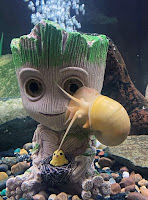
“Mystery Snail?” Show of hands? One or two of you in the back?
 |
| From Ms. Rachel Voss |
OK, a bit of introduction may be helpful before we get down
to business this month. The common name
“mystery snail” is today almost universally
[1] applied to
Pomacea diffusa, the
most popular gastropod in the home aquarium worldwide, a (relatively) small
South American ampullariid domesticated in the late 1960s
[3] for the
international pet trade. Such snails
were generally identified as
Pomacea bridgesii (Reeve 1856) until around 2007,
when a team of our colleagues
[4] suggested that the nomen
diffusa, proposed as
a subspecies of
P. bridgesii by the German biologist Werner Blume in 1957
[5],
might merit recognition at the full species level.
Although small bodied by the standards of the Ampullariidae,
and hence not as voracious of aquarium plants, nor as dangerous as pests upon
escape into the wild [6], Pomacea diffusa are still large enough to have a
personality, which is, in the eyes of many an adoring enthusiast,
charming. Open my essay of [21Dec17] in
a new window for more context, and a bit of additional biological background on
mystery snails in the home aquarium.
Some not-insubstantial fraction of the popularity of mystery
snails derives from their color polymorphism.
Although I have seen at least 15 – 20 named color varieties on the
market, consensus seems to suggest eight distinct phenotypes, some with
multiple names. These are depicted in
Ms. Brookana Ashley Patton’s colorful figure below, with a standard name
suggested for each: gold, jade, ivory, blue, chestnut, brown/black, magenta,
and purple.
A simple Mendelian hypothesis suggests itself immediately,
does it not? Three loci, each with two
alleles, would yield eight phenotypic categories quite splendidly. One of those loci must obviously control body
color, with albinism (a) recessive under pigmented (A), if the pattern seen
almost everywhere [7] throughout the remainder of the animal kingdom is
followed in ampullariid snails.
The other two loci seem to control the coloration of the
shell: background color (Y) and striping or color banding overtop of it
(S). A peculiarity of this system is
that in most other animals, typically, a mutation at the locus assigned to
albinism blocks all color production, everywhere. Three of the eight varieties of mystery
snails, however (gold, chestnut, and magenta), demonstrate colorless bodies but
colored shells.
The invasive pests Pomacea canaliculata and P. maculata have
well-known “golden” variants with a colorless body and plain yellow shell. The shell and the body phenotypes seem to be
inherited together, as a simple Mendelian recessive trait [8]. The “Giant Columbian Rams Horn” Marisa
cornuarietis also has a “golden” variant, inherited as a simple Mendelian
recessive, but in this case the plain, unstriped yellow shell is born by a
snail with a pigmented body [9].
In the mystery snail
Pomacea diffusa, the rainbow of
phenotypes commonly observed in the aquarium suggests one locus analogous to
that seen in
P. canaliculata and
M. cornuarietis, the dominant wildtype allele (
S) encoding dark stripes or bands of pigmentation covering the shell. The recessive (
s) seems to encode no banding or
striping, uncovering the yellow or “golden” background shell color. I am reminded of the banding locus in the
European land snail,
Cepaea, which became such an important model organism in
the early development of population genetics
[10].
As for that second shell color locus, variation in
background color independent of banding above it or body pigmentation below is
unique to
Pomacea diffusa, in my experience.
I have never seen anything like it anywhere in The Mollusca. But two alleles again seem to be involved:
let’s suggest a dominant yellow background (
Y) and a recessive colorless
(
y). The implication of the model is
that as many as three separate biochemical pathways seem to control mystery
snail coloration, yielding eight phenotypes, such that the wildtype brown/black
phenotype is encoded
A_Y_S_ and the completely colorless ivory variety
aayyss. If the model holds.
The three-locus model I have outlined above is not new or
original with me. It seems to have been
a part of the lore of mystery snail husbandry for many years [11]. And there are most certainly some very clever
and resourceful snail breeders somewhere in the world who could confirm it in a
heartbeat. But to this day, no formal
test has ever been published. The
entire, lovely system – all those exciting phenotypes and the
intellectually-gratifying hypotheses that go with them – remain anecdotal,
untested, and undocumented in the world at large.
Because, in all fairness, those clever and resourceful snail
breeders who developed all those lovely gold and purple and jade and ivory
snail varieties have reaped some not-insignificant financial reward for their
time and effort, would like to reap more, and consider the genetics behind
their product a trade secret. I
understand that.
But doggone it, I myself am a professional mollusk
geneticist, retired and bored, with nothing better to do with my life than
science. I have a testable hypothesis
about the inheritance of color polymorphism in a promising freshwater gastropod
model, and I want to see it tested. And
if that hypothesis could be confirmed, all those striking genetic markers could
be powerful tools to answer all sorts of additional questions about the biology
of the Ampullariidae, a fascinating family of God’s critters, like for example,
the consequences of multiple insemination, the potential for sperm competition,
and the capacity for sperm storage, see five paragraphs further down.
The experiments necessary to confirm our three-locus model
for the inheritance of color polymorphism in Pomacea diffusa are not
complicated. But they require time,
patience, attention to detail, and some significant experience with a very
specialized little corner of animal husbandry.
The ampullariid diet is non-trivial.
The egg laying, the hatching, and the rearing of juveniles all require
special techniques. And the experiment
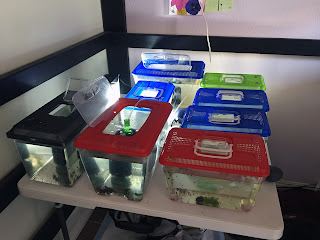
will require space. Mystery snails are
substantial animals – their culture requires relatively large volumes of water.
 |
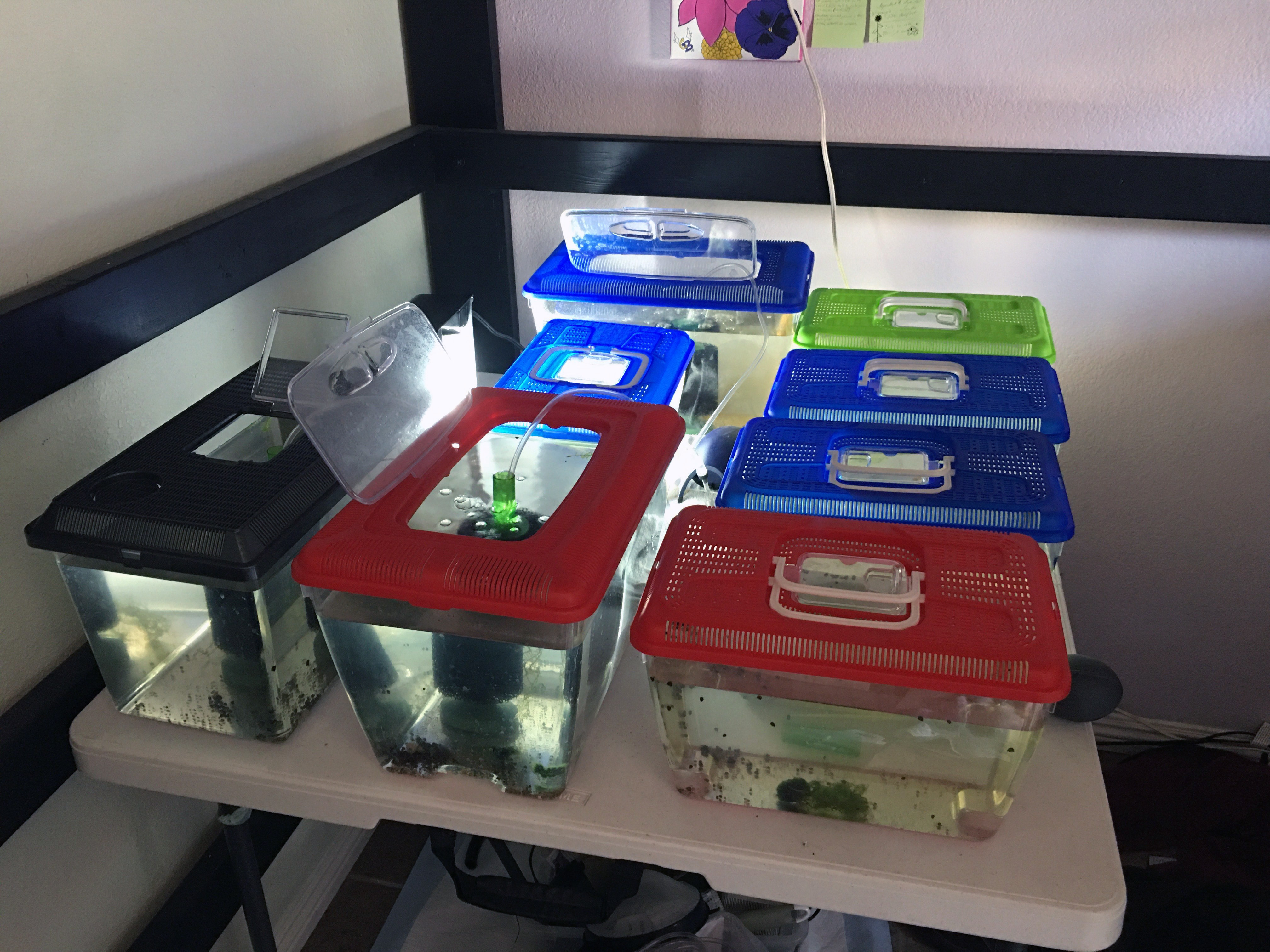
| Kyra's basement, May 2020 |
I cultured Physa and a variety of other pulmonates in my lab
for many years, and a couple prosobranch species as well [12], and was
repeatedly surprised, perhaps even dismayed, by the requirement of simple space
– just open, flat space on shelf and lab bench.
There were times in my career that I was covering hundreds of square
feet culturing snails with a maximum adult size of 30 mg. Adult mystery snails are two orders of magnitude
larger than Physa. Am I going to go hat
in hand and ask my wife for thousands of square feet in our suburban home to
culture Pomacea?
So back in 2017, doing research for a six-part series on
freshwater gastropods in the home aquarium [14], I started lurking about in [15] Facebook
groups formed by mystery snail enthusiasts.
There were at that time 1,818 members of a Facebook group called
“Mystery Snail Addiction,” 3,166 members of a group called “Mystery Snails and
Aquatic Lovers,” and 5,442 members of a group called “Snails, Snails,
Snails.” And an idea dawned on me.
The idea is called “crowdsourcing.” Paging through screenfuls of excited chatter
about mystery snails, with images and videos about every conceivable aspect of
their life habit and zany antics, it occurred to me that I might be able to
attract a large number of talented and enthusiastic volunteers for what I
decided to call “The Mystery Snail Color Genetics Project.”
So, I whipped up a modest website of eleven pages, including
biological background, genetic model, and three pages of experimental
design. In broad outline, I guided
potential collaborators through a trihybrid testcross, starting with an ivory
line (aayyss) and a brown/black (AAYYSS), backcrossing the F1 to the ivory to
test for linkage. The biggest challenge
was that, absent any data on the question, I felt as though we needed to assume
that females store sperm for life, and hence virgin females would be
required. Hit the link below in a new
window to see the website if you are curious.
Or a pdf of the entire website is available as FWGNA Circular Number 7
from footnote [16] below.
MSCGP
Notice in particular that step #1 for all new recruits to
the MSCGP army was to email me. I really
wanted to establish a direct relationship with every volunteer and try to learn
a bit about each of them personally. I
didn’t want to discourage anybody, but I did want to make it clear that what we
are doing together is real science. We
will have standards. No screwing around.
I announced the MSCGP to the three Facebook groups on
November 8, 2018, appealing for volunteers, pointing interested parties to the
website, and inviting email inquiries.
And braced myself at my laptop for the excited torrent of likes, loves,
emojis, comments, questions and wisecracks I felt sure would pour forth.
And in fact, my posts on those three FB sites did reap 6
likes and 4 comments. Zero shares, but I
don’t know what a “share” is, in this context, so that doesn’t matter, does
it? How many followers do I have, I
wondered? Am I an influencer yet?
But I will admit to considerable disappointment when just
one of those 6 likers and 4 commenters emailed me directly, a nice young man in
Australia, who said he would love to become involved, but no ivory mystery
snails were available in his country.
And my posts disappeared off the bottom of the feeds of all three of those FB
sites in a matter of hours, gone without a trace.
I received a second inquiry in January of 2019, a third in
August, and then two more in November of 2019, a year after I posted my appeal
for volunteers. This was not the
response that I was expecting, either in quantity or in quality.
All of these inquiries came from folks who had googled up
the MSCGP website and were curious to hear any results we might have obtained. All were keeping mystery snails as pets, and
had some success in reproduction, and were intrigued by color variation in the
offspring. No results so far, I always
replied cheerily, but would you like to volunteer? And one of them did.
Ms. Kyra Hall, who was one of the two who emailed me in
November of 2019, was the first serious volunteer recruited into the Mystery
Snail Color Genetics Project. She
ultimately pushed the effort further than any other collaborator to the present
day, hatching out quite a few pure ivory sibships and attempting to rear them
in isolation. She actually got to the
point that she needed true breeding wildtype females, to lay clutches of
brown/black offspring with which to cross her ivories. And it was not until this late date, well
into the winter of 2019, that it occurred to me that developing a true-breeding
dominant line might be more difficult than a true-breeding recessive.
 |
| Beach Blvd, Jacksonville. |
We have absolutely no idea on the genetic background of the
mystery snails we find for retail sale in aquarium stores. What would make anybody assume that a snail
demonstrating the dominant phenotype was true-breeding? In fact, it might be more fun if they
weren’t, so that dominant mothers might lay interestingly diverse and colorful
F1 sibships. The more I thought about
it, I could see some argument for the mysterious snail breeders at the Mystery
Snail Factory to purposefully outcross their brown/black stocks before retail
sale, if for no other reason than to prevent competitors from developing such
stocks on their own.
Might a few generations in the wild select out any weirdo
genes bred into Pomacea diffusa stocks for commercial purposes? Might a naturalized population be the best
source of AAYYSS broodstock? Hmmm. Pomacea diffusa populations are not commonly
reported in the wild [17].
I had known the late Bill Frank for many years, primarily as
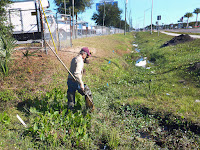
the steward of the quirky and entertaining jaxshells.org website. Bill discovered a naturalized population of
Pomacea diffusa inhabiting drainage ditches by Beach Boulevard in East
Jacksonville in 2006, and posted the discovery on jaxshells.org, and it is
probably my browsing across his black, blue, and wisteria-hued webpage [html] that brought the phenomenon to my attention.
So, I emailed my buddy Bill, and asked him if he had ever
seen any color polymorphism in his Beach Blvd population of P. diffusa. And he said no. And so it came to pass that on December 5,
2019, I pulled into the Denny’s parking lot for my rendezvous with Bill. The man was as colorful as the palate of his
webpages. I cannot remember the last
time I met anybody, at any station young or old, so dedicated, so enthusiastic,
so enthralled by trash snails in a weedy ditch.
This world needs more Bill Franks [18].
And the English thesaurus needs more choices under the noun,
“ditch.” Here at home in the Carolina
Lowcountry, our drainage ditches are dug to carry away stormwater. They are almost always dry. But down in Florida, it is my impression that
most ditches are mostly wet, and often transmit significant volumes of
groundwater. The water in the ditches
that Bill showed me that morning by Beach Blvd was demonstrating some
non-negligible flow, even though it had not rained recently, the water clear
and coolish [19].
Bill and I were able to find a dozen adult
P. diffusa in
about two hours’ effort, combing through the ditches on both sides of the
road. Against the background of his
long-term observations of the population dynamics, Bill considered this result
a very good catch. I carried our fresh
wildstock back to Charleston that evening and sent a subset by overnight
express to Kyra the next day.
The females among them were, in fact, very healthy and fecund,
and Kyra was able to hatch quite a few nice clutches of 100% wildtype
brown/black progeny. But alas, her
efforts to affect an ivory x brown/black cross did not come to fruition.
Kyra had to move into an apartment in late 2020, effectively
bringing to a close her budding career in gastropod genetics. “Life got in the way,” she explained. But as annus horribilis 2020 unfolded, from
worldwide coronavirus panic to nationwide political ignominy, I was somewhat
surprised and really quite gratified to receive an additional nine email
inquiries from potential volunteers, a broad assortment of hobbyists who had
googled for information on the inheritance of color polymorphism in mystery
snails and happened upon the MSCGP website.
And again, although most of those nine did not ultimately
initiate experiments, as far as I know, several of them did, at least one or
two of whom made serious efforts. And in
2021 I received inquiries from another ten potential volunteers, a subset of
whom initiated experiments, a subset of whom made serious efforts. And in 2022 I received seven additional
inquiries. So that, as 2022 came to a
close, I had exchanged at least some correspondence with a total of 31
potential volunteers for the mystery snail color genetics project. I should at this point acknowledge Joanna
Walthuis, Leigh Charest, John Hynes, and Rachel Voss for significant
contributions of time and effort to the MSCGP at intervals during our history.
On February 16, 2023 I sent out a group email to the entire
list of N=31 in my MSCGP address book, just to see what the current status of
our project might be. I received ten
replies, four of which came from volunteers who still have active experiments
underway. The six respondents who have
retired from the field were evenly split, three citing technical difficulties
and three reporting, like Kyra, that “life got in the way.”
 |
| Kyra's Library, February 2020 |
The bottom line remains, however, blank. Here about halfway through the fifth year of
the Mystery Snail Color Genetics Project,
we have yet to record our first
datum. The consensus from the rank and
file seems to reinforce a concern I myself have harbored since I first outlined
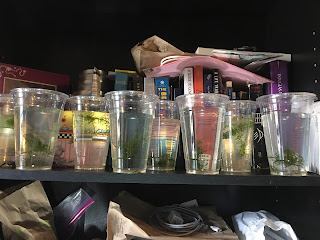
the experimental design back in 2018. Rearing
pairs of snails in cups, even large (20 oz ones) may require an impractical
frequency of water change, and scaling up to one-gallon containers may require
an impractical amount of space. I am
just not sure that the pretty experiment I have outlined on the chalk board can
be conducted in a private residence, by a private citizen with a job other than
snail farming.
Would anybody like to prove me wrong, by proving me
right? Shoot me an email at DillonR@fwgna.org. The MSCGP is still
looking for volunteers!
Notes
[1] In yet another demonstration of the folly of legislating
common names, the official, AFS-sanctioned common name for Pomacea
diffusa/bridgesii is “spike-topped apple snail” [2]. But I suspect that the generic term “apple
snail” has become too closely associated with invasive pests for the comfort of
the aquarium trade. For whatever reason, for quite a few years now the breeders and retailers have been marking “mystery snails”
on their aquaria of Pomacea diffusa. And
if that’s what it says on your sales receipt, that’s what it is when you get
home.
[2] Turgeon, D.D., J.F. Quinn, A.E. Bogan, E.V. Coan, F.G.
Hochberg, W.G. Lyons, P.M. Mikkelson, R.J. Neves, C.F.E. Roper, G. Rosenberg,
B. Roth, A. Scheltema, F.G. Thompson, M. Vecchione, and G.D. Williams (1998)
Common and scientific names of aquatic invertebrates from the United States and
Canada: Mollusks (second edition), American Fisheries Society Special
Publication 26, Bethesda, Maryland, 526 pp.
[3] I am quoting the
“late 1960s” domestication date for P. diffusa from the 1996 book by Perera & Walls,
page 36. Whether all eight color
varieties were available at that early date, I do not know. All varieties were certainly on the market by 1996, as
evidenced by their photos in:
- Perera, G. and J.G. Walls (1996) Apple Snails in The
Aquarium. T.F.H. Publications, Neptune
City, NJ
[4] Rawlings, T.A., K. A. Hayes, R. H. Cowie, and T. M.
Collins (2007) The identity,
distribution, and impacts of non-native apple snails in the continental United
States. BMC Evolutionary Biology 7: 97
[5] Blume, W. (1957) Eine bis heute unbekannte Unterart von
Pomacea bridgesii Rve. Opuscula
Zoologica 1: 1 – 2.
[6] We have directed at least ten or twelve posts on the
blog to invasive apple snails of the P. canaliculata/maculata type over the
last 20 years. For an entry into their
extensive literature, see:
- REVIEW: Global Advances in Apple Snails [24May07]
- Two dispatches from the Pomacea front [14Aug08]
- Pomacea news [25July13]
- Invasive species updates [13June18]
[7] Actually, we have documented two complementing albinism
loci in our own favorite experimental animal, Physa acuta. See:
- Albinism and sex allocation in Physa [2Nov18]
[8] Yusa, Y. (2004) Inheritance of colour polymorphism and
the pattern of sperm competition in the apple snail Pomacea canaliculata
(Gastropoda: Ampullariidae). Journal of Molluscan Studies 70: 43 – 48.
[9] Dillon, R. T.
(1998-99) The inheritance of
golden, a shell color variant of Marisa cornuarietis. Malacological Review
31/32: 155-157. [PDF]
[10] Cain, A.J., P.M. Sheppard, and J.M.B. King (1968) The
genetics of some morphs and varieties of Cepaea nemoralis (L). Philosophical Transactions of the Royal
Society B 253: 383 – 396. For more, see
[11] In 2005 Stijn
Ghesquiere added a “Genetics” page to his world-renowned applesnail.net
website, without attribution, featuring a three-locus, eight phenotype
Mendelian model very clearly developed and demonstrated.
[12] In addition to the Marisa I reared for my 1999 paper
[9], I also had one extended experience with Pleurocera proxima [13], which was
a huge pain in the ass. I know, however,
that I’m exaggerating about the “thousands of square feet” estimate up above. But give it to me – I’m trying to avoid an
argument with my wife here.
[13] Dillon, R.T. (1986) Inheritance of isozyme phenotype at
three loci in the freshwater snail, Goniobasis proxima: Mother-offspring
analysis and an artificial introduction. Biochemical Genetics 24: 281-290. [PDF]
[14] Here’s my entire series on freshwater gastropods in the
home aquarium:
[15] Here's a funny demonstration of how unlearned I am in the ways of social media. In my original essay of 6June23 I used the verb "ghosting" here, to describe reading FB posts without commenting or participating in any way. On 8June23 my MSCGP colleague "Dylan" sent me an email correcting my verb choice to "lurking."
[16] Dillon, R. T., Jr. (2018) Welcome to the mystery snail
color genetics project! FWGNA Circular
7: 1 - 13. [pdf]
[17] The USGS Nonindigineous aquatic species database lists
42 records of P. bridgesii/diffusa, as compared to 2,948 records for “Pomacea cf.
canaliculata/maculata.”
[18] Here is Bill’s obituary: William Michael Frank (18Sep47
– 16Sept22)
[19] In addition to Pomacea diffusa, the "ditches" along Jacksonville's Beach Blvd are inhabited by Pomacea paludosa, Melanoides tuberculata, and Hebetancylus excentricus.




 Posts
Posts


