Dr. Rob Dillon, Coordinator


Showing posts with label Environment. Show all posts

Tuesday, May 6, 2025

Potamopyrgus, water hardness, and the Gatorade hypothesis

Volume 28(1) of Freshwater Mollusk Biology and Conservation hit the newsstands a couple weeks ago with the unwelcome news that populations of the invasive New Zealand mudsnail, Potamopyrgus antipodarum, have been discovered in two small tributaries of the Monongahela River in Allegheny County, Pennsylvania [1]These are the first records of Potamopyrgus in the Ohio drainage.

For as many seasons as I have been watching Invasive Species Baseball from the grandstands, the Commonwealth of Pennsylvania has been a perennial contender for the MVA (Most Vigilant Agency) award.  The Pennsylvania Natural Heritage Program iMapInvasives web-based system is peerless, or almost so [2], anywhere in The East.  And in addition to maintaining the state’s elaborate citizen-friendly tool for online reporting, Ms. Amy Jewitt and her iMapInvasives staff post email alerts, publish a newsletter and a blog, sponsor workshops and webinars, and recently even produced a 44-minute, documentary-style film.

Rarely does a month go by that I don’t hear from Amy.  And I’ve also developed longstanding correspondence relationships with Steven Means of the PADEP and Sean Hartzell of the Pennsylvania Fish and Boat Commission (PFBC), who anchors the scientific side of the enterprise [3]. And more often than not, the subject line of all this correspondence with all these colleagues features the abbreviation “NZMS,” New Zealand mudsnail.

Peters Creek, Allegheny Co, PA

So, when one of my clerks dumped the morning mailbag onto the sorting table in my office back on June 26, 2023, I was not surprised to find a cordial message from my good buddy Sean.  And attached to his message was the usual quota of jpeg images of Potamopyrgus, including the one reproduced above.

But although the news that Sean relayed in his 26June23 message was not surprising, I don’t suppose, it was anything but routine.  Three days previous, a PFBC colleague, Mr. Mike Depew, had collected the gastropod sample depicted on those jpegs from a pair of small direct tributaries of the Monongahela River just upstream from Pittsburgh – Peters Creek and Turtle Creek.  Rats.  The first records of Potamopyrgus in an interior drainage of the Eastern United States [4].

My loyal readership will be quite familiar with Potamopyrgus from many previous posts on this blog; occasional visitors are invited to hit the “Invasive species” label at right for a review.  The first Atlantic drainage NZMS population was reported in a mid-Pennsylvania tributary of the Susquehanna River back in 2013 [19Nov13], with reports from Maryland [13June18] and New Jersey [9July18] following rapidly.

In their newly-published note [1], Sean, Mike, and three additional PFBC colleagues have done an excellent job reviewing the ten-year history of this recent Eastern U.S. range expansion, contributing a very nice map of the current distribution of Potamopyrgus across The Keystone State.  Quoting the authors, “both Peters Creek and Turtle Creek contain sections managed as stocked trout fisheries with public fishing access.”  They suggest that this most recent range expansion likely comes “via angling gear from previously invaded sites.”  We concur.

But returning to June of 2023.  In his original message to me, Sean called my attention to the pitting on the shells of the little snails in his jpegs (clearly visible in the figure at the top of this essay), which he “hadn’t seen in Potamopyrgus antipodarum before.”  I agreed that such pitting is unusual, and we swapped a couple additional emails on the topic.  Quoting myself:

The short answer to your question about shell pitting would be, “soft water.”  Presumably Peter’s Creek and Turtle Creek have lower concentrations of calcium, right?  So anywhere the outer proteinaceous periostracum of the shell gets nicked a little bit, the calcium carbonate core of the shell is exposed to dissolution, forming a pit.

That said.  If you’d like to re-write the paragraph above, and scratch out “soft water,” and substitute “Low pH” or “low alkalinity” or “low carbonate” or “Low buffering capacity” or maybe even overall “low conductivity,” it would all be just as true [5].

My 26June23 hypothesis, however, turned out to be unsupportable.  Even as I was offering it, Sean and his PADEP colleague Matthew Shank were embarking on an extensive, statewide study on the relationship between water chemistry and Potamopyrgus invasion that would find the hardness of Peters and Turtle Creeks perfectly suitable.

The Hartzell & Shank paper, published online "early view" last fall and February in hard copy [6], correlated NZMS presence/absence at 443 sites in Pennsylvania to 57 water chemical parameters, including (of course) all those hardness-related variables I had suggested in 2023.  They plotted their 71 present observations (red) and 372 absent observations (blue) on the simplified geological map of Pennsylvania reproduced below.  The relationship between successful Potamopyrgus invasion and the presence of limestone and dolomite in the drainage is striking, am I right?

From Hartzell & Shank [6]

And indeed, the Hartzell & Shank map does show a pair of red “present” dots in the west corresponding to Peters Creek and Turtle Creek [7], indicating limestone in their drainages as well.  Quoting Sean from our more recent (14Apr25) correspondence:

“Although the area has been (mostly historically) impacted by mining, the pH and conductivity samples we had on file for those streams were not reflective of soft water. Additionally, the statewide water chemistry suitability analyses that my colleague Matthew Shank and I worked on more recently . . . suggests that the two respective HUC12s that the snails were found in contain various highly suitable chemical parameters for this species.”

So what, then, might have been the cause of the shell pitting in the original 2023 samples of Potamopyrgus from Peters and Turtle Creeks?  Again, quoting my good buddy Sean, from our 14Apr25 correspondence:

“When Mike (Depew) sampled these streams (both on the same date) and upon finding the P. antipodarum, he realized he neglected to pack any containers to bring snails back to the lab and so upon improvising, he placed them in half-empty Gatorade bottles that he had on hand. As a result, the snails were submerged in Gatorade for about 24 hours before they were transferred to distilled water. From my understanding, Gatorade is quite acidic (a quick Google search indicates a pH of 2.9 to 3.6 depending on the exact flavor purchased) and so this is likely the cause of the pitting observed in the snails.”

Flavor not being among the 57 parameters analyzed by Hartzell & Shank, however, I fear that we shall never have a conclusive answer to this particular mystery.


Notes


[1] Hartzell, S.M., M.A. Depew, D. Byington, L. Hartman, and R. Pletcher (2025) Collections of the invasive New Zealand mudsnail, Potamopyrgus antipodarum (J.E. Gray, 1843) in the Ohio River basin.  Freshwater Mollusk Biology and Conservation 28: 22 – 25.


[2] To be fair, both New York and Maine also participate in NatureServe's iMapInvasives Network.  But I don't know any of those dedicated folks way up there.  


[3] Recent publications from our good friend Sean:

  • Hartzell, S.M. and N. Macelko. 2022. Range expansion of the invasive New Zealand Mudsnail (Potamopyrgus antipodarum) in the Susquehanna and Delaware River Basins of Pennsylvania.  Journal of the Pennsylvania Academy of Science 96: 36 - 45.
  • Hartzell, S.M. and J.R. Frederick. 2023. First records of the invasive New Zealand mudsnail (Potamopyrgus antipodarum) in the Potomac River Basin.  Northeastern Naturalist 30 (1): N13 - N16.

[4] The USGS Nonindigenous Aquatic Species database does show quite a few records in Wisconsin tributaries of the Rock River, which I think of as being midwestern.


[5] I reviewed the subject of environmental calcium as a factor in freshwater gastropod distribution at great length in Chapter 8 of my book, pp 326 - 338:

  • Dillon, R.T., Jr. (2000) The Ecology of Freshwater Molluscs.  Cambridge University Press.  509 pp.

[6] Hartzell, S.M. and M.K. Shank. 2025.  Chemical variables predicting colonization risk of the invasive New Zealand mudsnail (Potamopyrgus antipodarum) in Pennsylvania's flowing waters.  Hydrobiologia 852: 645 - 658. https://doi.org/10.1007/s10750-024-05711-2.


[7] At the earlier date of the publication of their water quality paper, Hartzell & Shank listed their observations of Potamopyrgus in drainages of The Ohio as “Hartzell et al. unpublished data.”

Monday, January 7, 2013

The Clean Water Act at 40

Editor’s Note. This essay was subsequently published as: Dillon, R.T., Jr. (2019d) The Clean Water Act at 40.  Pp 201 - 205 in The Freshwater Gastropods of North America Volume 4, Essays on Ecology and Biogeography.  FWGNA Press, Charleston.

I was born and raised in the Shenandoah Valley of Virginia, in a geographical oddity known as Waynesboro, 100 miles from everywhere.  But near enough, by happy fortune, to the South River (a tributary of the South Fork Shenandoah) as it cascaded freshly down from the Blue Ridge, and slowed upon entry into the verdant valley below [1].  And I spent some of the happiest days of my youth swimming, fishing, rafting, and grabbing everything slick and squirmy I could grab out of those gentle waters, from snakes and turtles to crayfish, bugs, and (of course!) snails.


In the riffles the benthic macrofauna was dominated by the pleurocerid Leptoxis carinata, with Physa common in the pools, limpets occasional and Helisoma anceps rare.  I remember being frustrated, even at the age of twelve, that I could not identify the freshwater snails of the South River.  I had a tremendous infatuation with the natural world around me, and could find guidebooks to help with the birds and reptiles, the trees and the wildflowers, and most shells – certainly the marine ones.  But not the freshwater snails.

In any case, the economy of Waynesboro was not as agricultural as I have made it sound above.  During the 1920’s two major textile-related plants joined a number of smaller factories already humming in the town – DuPont (manufacturing acetate fibers such as nylon, orlon & lycra) and Crompton (corduroy, velveteen & nylon velvets).  The attractions of this otherwise rural setting included cheap land, an eager work force, good rail transport, and (alas!) the South River to dump crap into.

The DuPont and Crompton plants (and several others, to be fair) stretched by the river for about a mile along the east side of town.  DuPont discharged large quantities of elemental mercury in among a witch’s brew of other chemical wastes generated as a consequence of routine manufacturing processes, over quite a number of years.  The several Waynesboro plants also featured very tall smokestacks that dumped huge amounts of black smoke into the sky.  I didn’t like it – nobody did.  But waste seemed like an inevitable consequence of economic prosperity [Photo below, Note 2].

By now you will have gathered that The Dillons lived upstream from the DuPont plant.  My friends and I occasionally rafted inner tubes a mile or so downstream to the Hicks Bridge, at the south entrance of the plant.  I don’t remember any signs specifically warning us of hazardous conditions further downstream – I think this was generally understood.  But in any case, had I ventured to gather any personal observations regarding the benthic macrofauna of the South River below the Hicks Bridge at any time in my young life, my mother would have found out quite promptly, which would have been hazardous enough, to my backside.

The Clean Water Act was signed into law on October 18, 1972.  I was a senior in high school by that time, and the next summer off to college at Virginia Tech, never to live in Waynesboro again.  Although my wife and I still have family in the area, I have lost that intimate connection I developed with the South River in my youth, carried away by other rivers less gentle.

The rebirth of the river downstream from the Waynesboro plants, in my absence, has been astonishing.  Mercury contamination was discovered in fish samples taken from the South River in 1976, precipitating a legal battle between DuPont and the state ultimately resolved in 1984.  As part of the settlement DuPont agreed to fund a “South River Science Team” [3] to serve as a focal point for technical and scientific issues concerning mercury contamination.  By 1989, the water quality had improved to such an extent that the state began stocking the South River at Waynesboro with brown and rainbow trout.  Waynesboro is now home to two annual celebrations of the South River, the Virginia Flyfishing Festival and the Waynesboro “Riverfest” [4].

Last summer I launched my kayak at the Apple Acres bridge near my childhood home and paddled through the entire City of Waynesboro, passing the DuPont site and the sites of several other industries only slightly less spectacular [5], emerging to call my brother-in-law at Bridge Avenue, about five miles downstream.  The most memorable features of my trip were the fly fishermen quietly angling in the shadows of the industrial smokestacks. 

The river looked pristine to casual inspection – Leptoxis carinata uniformly abundant through the river section I paddled.  Downstream from Waynesboro I pulled out and collected six species: Leptoxis, Physa acuta, Ferrissia fragilis, Helisoma anceps, H. trivolvis and Lymnaea humilis.  So in addition to the four species that have likely recolonized from upstream refugia, we seem to have added two species from downstream.  The freshwater gastropod fauna of the South River is today indistinguishable from that of any other similar-sized river in the upper Shenandoah Valley.

The Clean Water Act worked.  Sometimes I fear that the environmental community has earned a reputation for shrillness – always focusing on impending disaster, prophesying the end of the world.  It might help our credibility a bit if we acknowledged the real successes of the last 40-50 years and admitted, as bad as things might look today, we have seen worse.

This past summer I spent a couple weeks surveying the freshwater gastropods of New Jersey.  So prior to my departure I mapped a grid of sample sites to cover the various physiographic regions and drainages of The Garden State, mixing lotic and lentic habitats, large and small.  I paid attention to access, of course, preferring boat ramps, parks, and public spaces if possible.  Water quality concerns did not, however, enter my mind.

And so the afternoon of September 11, 2012 found me at a public park on the bank of the Raritan River in Manville, NJ.  The water was clear, apparently clean, and inviting.  The luxuriant macrobenthic fauna included 11 gastropod species, making it the second-richest site I was to visit that entire week.  Only a subsequent conversation with a passing fisherman reminded me of the history of that place, the site of the former Johns-Manville manufacturing facilities for asbestos insulation [6].

Happy Birthday, Clean Water Act.  And keep up the good work!


Notes

[1] The black & white photo above is a 1966 image of the South River as it enters Waynesboro.  That’s the old “Apple Acres” bridge in the background.  Scanned from Massie, E.S. and C. Skinner (2009)  Images of America: Waynesboro.  Arcadia Publishing.

[2] The South River runs around the right edge of this photo, from top to bottom.  The DuPont plant is featured in the middle of the photo (on the right descending bank) with the Crompton-Shenandoah plant shown at right, on the left descending bank.  This photo from the South River Science Team site, see note [3].

[3] South River Science Team [html]

[4] Waynesboro Riverfest [html]
The Virginia Flyfishing Festival [html]

[5] The Crompton plant went out of business in 1984, and has now largely been demolished.  DuPont sold its Waynesboro plant to the InVista Corporation a few years ago, and manufacturing operations continue at a reduced scale.

[6] I don’t have any independent knowledge of the Johns-Manville situation on the Raritan River in New Jersey, but here’s a link to the Wikipedia entry [html].

Friday, July 16, 2010

Crisis At Lake Waccamaw?

Editor's Note. This essay was subsequently published as: Dillon, R.T., Jr. (2019d) Crisis at Lake Waccamaw?  Pp 193 - 199 in The Freshwater Gastropods of North America Volume 4, Essays on Ecology and Biogeography.  FWGNA Press, Charleston.

Deep in the cypress swamps shrouding the remote southeast corner of North Carolina lie the mysterious waters of Lake Waccamaw. At roughly 9,000 acres and 4 miles across, Lake Waccamaw is the largest of the “Carolina Bays,” pothole-shaped depressions of unknown origin in an Atlantic Coastal Plain otherwise featureless in its topography. But beyond its unusual size, Lake Waccamaw is distinguished by its exceptional water quality. Groundwater filtering up through layers of sand and Plio-Pleistocene shell arrives in the big lake clear and near-neutral in pH, much in contrast to the acidic and tannin-stained waters prevailing elsewhere throughout the region (1). Although quite young geologically, one might not be surprised to find endemic species (2).

I first visited Lake Waccamaw in 1978, driving south from Philadelphia with Dr. George Davis, my Ph.D. advisor. Our mission was to sample the lake's endemic population of Elliptio waccamawensis for an NSF-funded project on unionid evolution (3). I vividly remember the abundance of the mussels that greeted us that spring morning we waded into the clear shallows together. George and I were able to sample 30 E. waccamawensis in a matter of minutes, with at least four or five other unionid species also moderately common (4). I did not focus on the gastropods that day, but do recall the hydrobiids like pepper on the maidencane.

The entire molluscan fauna of Lake Waccamaw was thoroughly surveyed shortly thereafter by Hugh Porter, working for the North Carolina Wildlife Resources Commission (5). Although I have not seen Porter’s (1985) report, several years ago I had the opportunity of reviewing the extensive collections he deposited in the NC State Museum. Sampling randomly on bottoms of four depth classes with a diver-operated suction dredge, Porter documented strikingly high abundances of the notable Lioplax subcarinata and Gillia altilis, plus the (more mundane) Campeloma decisum, Amnicola limosa, Lyogyrus granum, and the usual pulmonates (6). Especially common in Porter's samples was the little hydrobiid he called “Cincinnatia sp,” but which today is perhaps better referred to the genus Floridobia (7). There has long been speculation that this population may constitute yet another species endemic to Lake Waccamaw (8).

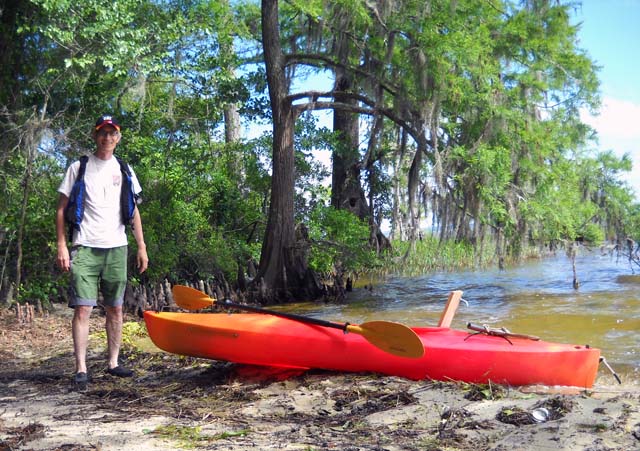
Has the entire diverse and endemic molluscan fauna of Lake Waccamaw now vanished before our eyes? In late May I drove up to the lake from Charleston for a long day of kayaking and puttering about in the shallows. I visited the southern (more exposed) shore near the dam and the northeastern (more protected) shore near the mouth of Big Creek, spending several hours in each area. I examined all wadeable environments and habitats, netted through the entire range of substrates, and found essentially nothing. I observed no more than a couple living unionids all day, and perhaps a handful of empty valves. No Gillia, no Lioplax, not even any Helisoma, and just a few living hydrobiids in the sediments around the macrophytes. I spotted several small Campeloma crawling in the sand, and some Physa bravely clinging to the debris.

I understand that many of the mollusk populations of Lake Waccamaw do not reach their maximum abundance in easily-accessible shallows (9). So the most alarming hours of my visit in late May were spent inspecting the beach drift, which (one might hope) would afford a more random sample of the lake fauna as a whole. In more than an hour of beachcombing on both shores I recovered only perhaps 20-30 tiny Floridobia shells the from grass wrack, 5-10 Amnicola, and a few small Campeloma, period.

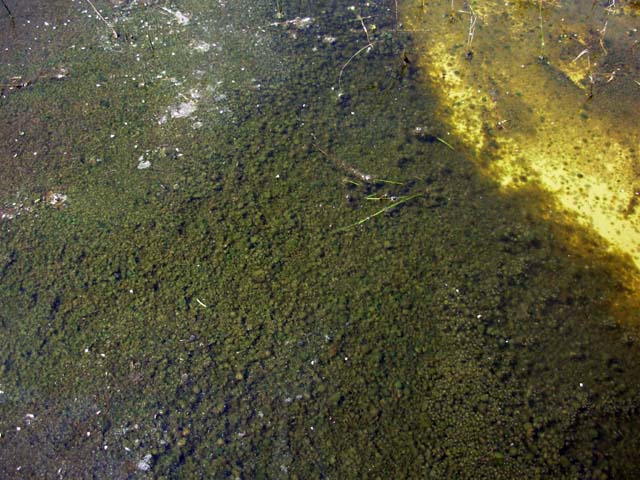
Upon my return to Charleston I swapped an email or two with Dr. Diane Lauritsen (10), who has some thirty years of experience at Lake Waccamaw, and spoke with her on the telephone at length. Diane reported that the lake has suffered filamentous algal blooms recently, with an apparently correlated reduction in benthic macrofauna. Diane sent me the photo below.

She mentioned that the Corbicula population (11), while never terribly abundant, suffered a "massive die-off probably four years ago." Diane suggested that Corbicula might be a "canary in the coal mine," telegraphing a warning of hypoxia. I was stunned. I had not seen any evidence whatsoever of Corbicula during my entire day on Lake Waccamaw, not one single bleached valve. In what sort of nightmarish environment might the nasty, invasive Chinese clam become a "canary?"

And what can be done? At the risk of sounding like the scientist I am, we need a formal study. Everything I have reported in the preceding seven paragraphs is anecdotal, and cannot constitute a basis for doing much else. Thank heaven the NCWRC had the foresight to commission Hugh Porter’s study in the late 1970s. The first order of business must be to see a study of that caliber repeated.

So in the end, this essay is an appeal to North Carolina natural resource agencies, the regional offices of conservation-minded NGOs, and Waccamaw-area citizens’ groups to renew our mutual interest in the biological treasure that is Lake Waccamaw. I fear this marvelous resource has been neglected in recent years. But I hope I am wrong.


Notes

(1) More about the geology and water balance of Lake Waccamaw here: J. C. Stager & L. B. Cahoon (1987) The age and trophic history of Lake Waccamaw, North Carolina. J. Elisha Mitchell Sci. Soc. 103: 1-13 [html]. S.R. Riggs, D.V. Ames, D.R. Brant, and E.D. Sager (2000). The Waccamaw Drainage System: Geology and Dynamics of a Coastal Wetland, Southeastern North Carolina. NC Division of Water Resources. [pdf or html]

(2) The nominally-endemic fauna of Lake Waccamaw includes three fishes described in 1946 and a caddis fly described by our colleague Jim Glover in 2004, as well as the unionids Elliptio waccamawensis (Lea 1863) and Lampsilis fullerkati Johnson 1984. The specific status of the two mussels has been called into question, however, in a recent MS thesis: Sommer, K. (2007) Genetic identification and phylogenetics of Lake Waccamaw endemic freshwater mussel species. MS Thesis, UNC Wilmington. [html - pdf]

(3) Davis, G. M., W. H. Heard, S. L. H. Fuller & C. Hesterman (1981) Molecular genetics and speciation in Elliptio and its relationship to other taxa of North American Unionidae. Biol. J. Linn. Soc. 15: 131-150.

(4) Porter listed 11 unionid species, but Bogan puts the number as high as 17: Bogan, A.E. 2002. Workbook and key to the freshwater bivalves of North Carolina. North Carolina Museum of Natural Sciences, Raleigh. 101 pp.

(5) Porter, H. J. 1985. Rare and Endangered Fauna of Lake Waccamaw, North Carolina Watershed System: Molluscan Census and Ecological Interrelationships. North Carolina Wildlife Resources Commission, Raleigh. 187 pp. I understand that this work included quite a few original photographs, and is consequently rather hard to get hold of. The methods and a subset of the unionid results did see publication, however, as: Horn, K. J & H. J. Porter (1981) Correlations of shell shape of Elliptio waccamawensis, Leptodea ochracea and Lampsilis sp. with environmental factors in Lake Waccamaw, Columbus County, North Carolina. The Bulletin of the American Malacological Union for 1981: 1 - 4. Porter, H. J. & K. J. Horn (1983) Habitat distribution of sympatric populations of selected lampsiline species in the Waccamaw drainage of eastern North and South Carolina. Amer. Malac. Bull 1:61 - 68.

(6) Porter counted 10 gastropod species in Lake Waccamaw, but I have 12 confirmed in the FWGNA database: Six pulmonates (Physa pomilia, Helisoma trivolvis, H. anceps, Menetus dilatatus, Lymnaea columella, Laevapex fuscus), the two viviparids (Campeloma and Lioplax) and the four hydrobiids (Gillia, Amnicola, Lyogyrus and Floridobia).

(7) Thompson, F. G. & R. Hershler (2002) Two genera of North American freshwater snails: Marstonia Baker, 1926, resurrected to generic status, and Floridobia, new genus (Prosobranchia: Hydrobiidae: Nymphophilinae). The Veliger 45: 269 - 271.

(8) Porter suggested that the Lake Waccamaw fauna might include two endemic hydrobiids, which he called "Cincinnatia species 1" and "Amnicola species 1." He may be right about the former - populations of the little snail called variously Cincinnatia or Floridobia are quite unusual in southern Atlantic drainages. But Porter's samples of "Amnicola species 1" in the NC State Museum looked like unremarkable mixtures of Amnicola limosa and Lyogyrus to me.

(9) The lake bottom is rather heterogeneous, including some regions of (rather malacologically uninteresting) mud and peat, and other sandier regions that can support surprisingly high abundances of bivalves and gastropods. Benthic algae seem to extend to unusual depths in Lake Waccamaw. Or at least they did in the past.

(10) You might recognize Diane’s name from several excellent works Corbicula feeding, for example: Lauritsen, D. (1986) Filter-feeding in Corbicula fluminea and its effects on seston removal. J. N. Am. Benthol. Soc. 5: 165-172.

(11) The Waccamaw Corbicula population has figured in several research projects: Stiven, A.E. & G. A. Arnold (1995) Phenotypic differentiation among four North Carolina populations of the exotic mussel Corbicula fluminea. J. Elisha Mitchell Sci. Soc. 111:103-115. Cahoon, L. B. & D. A. Owen (1996) Can suspension feeding by bivalves regulate phytoplankton biomass in Lake Waccamaw, North Carolina? Hydrobiologia 325:193-200.