Dr. Rob Dillon, Coordinator


Showing posts with label How-to. Show all posts

Thursday, December 4, 2014

Spur-Of-The-Moment Workshop


In recent years I have occasionally fielded heart-felt requests to organize some sort of workshop on the biology of freshwater gastropods, especially focusing on identification skills.  I was part of an FMCS committee to conduct one such effort in Tuscaloosa in 2004 (to mixed reviews), and I myself led a workshop more narrowly focused on the Pacific Northwest gastropod fauna in Missoula in 2006 [1].  But we've had nothing in recent years.  At least, not around here.

So in the last couple days I've been swapping emails with a small delegation from Clemson University about hosting a freshwater gastropod workshop here in Charleston.  My schedule is flexible between now and Christmas, and so is theirs, and it just seems to have sort-of come together.

So everybody is invited to a spur-of-the-moment workshop at The College of Charleston next Monday morning, December 15, 9-12:00 noonish.   No paperwork, no registration fees.  Just zap me an email if you’d like to participate.

I’ll bring out my personal reference collection, which is really rather complete for The East.  I’ll also go out and fetch us some living critters.  We’ll do a couple dissections.  It’s not rocket science but there are a couple tricks I’ll be happy to show you.

Looking forward to it!

Notes

[1] Previous workshops:
  • FMCS Gastropod Workshop [19Dec03]
  • Report from Tuscaloosa [23Mar04]
  • Pacific Northwest Gastropod Workshop [23Mar06]


Monday, June 13, 2011

Collecting Freshwater Snails by Kayak

About five or six years ago my family gave me a modest kayak as a Christmas present, and shortly thereafter I began carrying it with me on field trips. The first thing I learned was, "Paddle upstream."

The second thing I learned was, if at all possible, do not try to collect freshwater snails from a kayak. There is almost no space inside, and freedom of movement is very constrained. And even such an elementary operation as, “to pick up a submerged stick” without at least two fixed points against which to pick is a genuine education in basic physics.

But much of the freshwater habitat around Charleston is not really “wadeable.” And it is amazing how rarely the portions of large rivers that are readily accessible by motorized vehicle constitute especially productive freshwater snail habitat. And how often the spot just across the river, upstream 100 meters, looks absolutely perfect, at least staring at it from a boat ramp, with one's hands on one's hips. So I have found my kayak quite useful simply as a mode of transportation, to carry me somewhere better, so I can get out.

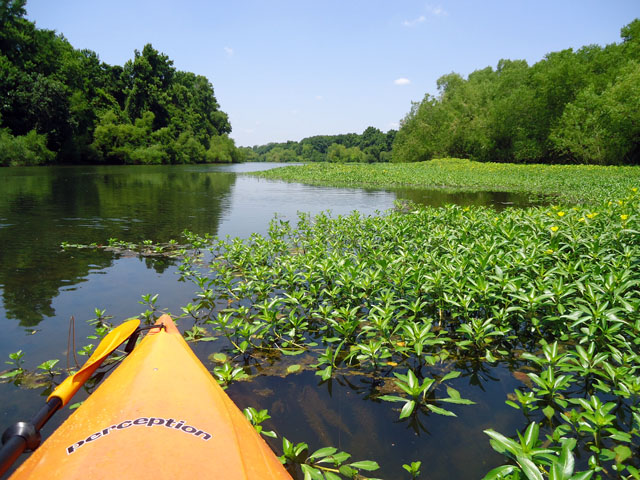
That being said, there are some habitat types that are indeed conveniently sampled by kayak. Swampy areas with soft and flocculent bottoms come to mind, and especially aquatic macrophytes, either the submergents like Elodea and Hydrilla, or floating emergents like water lilies, pondweeds, and Ludwigia (above). Mats of such vegetation can sometimes float over treacherous bottoms, and I can't think of any better method to sample the little pulmonates and hydrobiids they often shelter unless from a low, shallow-draft boat like a kayak.

The idea of tying a dipnet onto the stern of my kayak was pretty obvious. I took a triangular kick net off its pole because it fit under those big black cargo bands on the stern of my particular brand of kayak, but I suppose a D-shaped net head would have advantages as well.

When I brought my first net samples into my kayak, however, I discovered that there was really no place to sort through them except in my lap. And if I was holding my net with one hand and picking through its contents using forceps with the other, where would I perch the little vials I was trying to transfer my little pulmonates and hydrobiids into? And what to do with my paddle?

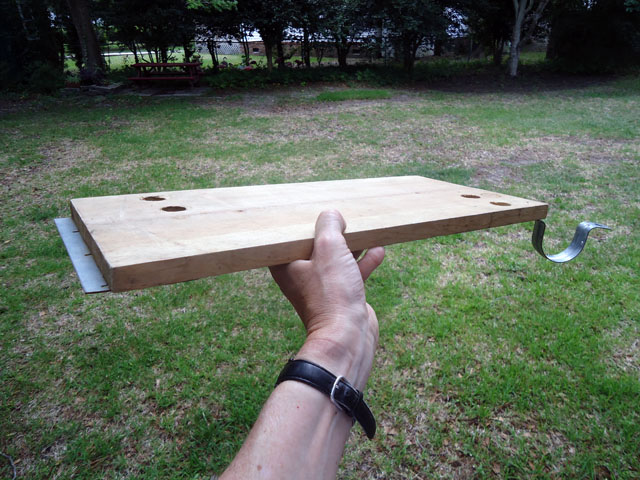
So I cut myself a 20” sorting table out of 1x10” board, and drilled a couple holes in it to hold 21x70 mm vials. On one edge of the board I attached a metal flange, which hooks under the lip of my kayak. And on the other corner I attached a metal bracket, which holds my paddle.

The paddle is actually supported both by the bracket on the corner of my sorting table and by a coat hanger I’ve bent into a hook and attached to the bow of my kayak (visible in the Ludwigia shot above - click for larger). Thus the weight of the paddle on the one edge of my table keeps the metal flange on the other edge firmly hooked under the kayak lip.

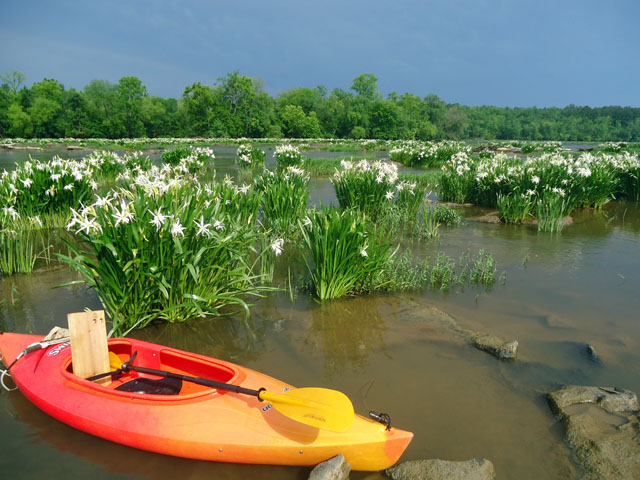
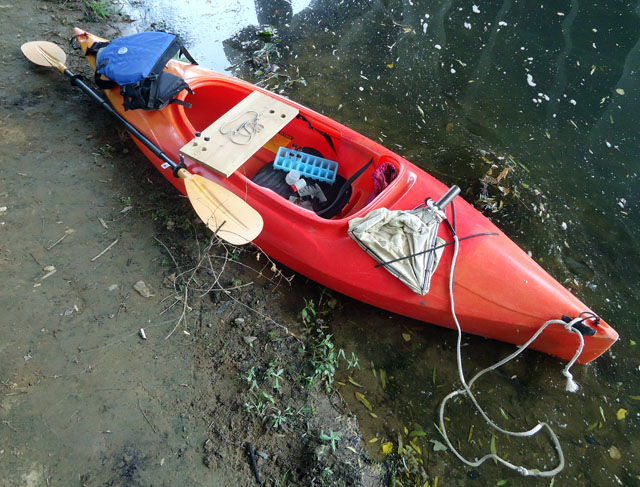
The picture below shows the sorting table in place, counter-weighted by the paddle (click for larger). I keep extra vials in an ice cube tray underneath my seat. I always wear forceps on a string around my neck, regardless of whether I am on land or sea. When I’m not sampling I slide the sorting table behind my seat, where it doubles as a backrest. (I took the factory-installed backrest out of the kayak several years ago.) The nice photo of spider lilies on the Catawba River at the top of this post shows the table in its stowed position.

That's really all the advice I've got, except for the usual, generic reminders about a life jacket, a hat, and sunscreen. Oh, and paddle upstream first. I'm serious about that.

Friday, October 15, 2010

Live Shipping Freshwater Snails

Earlier last month a question was posed to the MOLLUSCA list server on a topic that would seem to be of special interest to our group. Here's the initial query from Dr. Russell Wyeth of St. Francis Xavier University up in Nova Scotia, together with my reply:

I'm curious what advice people have for shipping live Lymnaea stagnalis and their eggs. I've heard that damp paper towels in a plastic box with plenty of holes in the top, and placed inside a cardboard box with little tape is good. Any other suggestions for what has worked (or hasn't worked)?

Thanks,
Russell


Dear Russell,

Yes, the general approach you suggest works very well to ship freshwater snails of all species.

Rather than a "plastic box with plenty of holes in the top," I'd suggest an unbreakable container with a tight-fitting lid. You really don't want water leaking from your paper towels and seeping out of your package. The best containers I've found are those wide-mouthed plastic peanut butter jars.

I admit to being a little bit paranoid about possible leaching from commercial paper towels. So I pre-soak a big wad of paper towels in pond water, wring that out, and then transfer the paper towels in a second (fresh) bucket of pond water, and wring them out a second time.

Stuff a bunch of wet paper towels in the bottom of your peanut butter jar, then the snails, then a bunch more wet paper towels, and then screw the lid on tightly. But be careful with the stuffing! Lymnaeids, as I'm sure you are aware, have very fragile shells. Ideally, you want the snails immobilized, but not crushed.

Yes, pack that peanut butter jar in a larger cardboard box for shipment, with some bubble wrap or packing "peanuts." But no, don't use "little" tape - use "plenty of" tape. You seem concerned that not enough air will get into your snails. Really, just the opposite is the problem - it's drying you need to worry about. Tape that box up well! And spend the extra money for overnight shipment.

Good luck!
Rob

---o---

Dr. Wyeth's question seemed more directed toward the packing, not toward the actual process of shipment, once packed. But some of you may remember my essay on the travails of importing live freshwater snails into the United States back on 17Dec08. I also have a nightmare story about exporting American Helisoma live to a colleague in Italy a couple years ago that I might share one day, if the mood strikes.

In subsequent correspondence, Dr. Wyeth shared with me private replies from of two other colleagues, both offering slight variations on our same theme. One suggested snails -> wet paper towels -> box with holes -> heavy plastic bag with knot. Another offered snails -> wet newspapers -> two layers of plastic bags -> Styrofoam cooler with ice packs.

I agree that the idea of shipping in a Styrofoam cooler has some attraction, depending on the time of year, but might increase the cost substantially.

I also agree with Dr. Wyeth that data on failures might be as useful as data on successes in addressing his question. If anybody has any experience regarding shipments of freshwater snails cooked by excessive heat or dehydrated by leaking containers, feel free to share below!

And keep in touch,
Rob

Wednesday, December 17, 2008

Non-plants, Non-pests, and Non-sense at the USDA

Editor’s Note – This essay was subsequently published as: Dillon, R.T., Jr. (2019d) Non-plants, Non-pests, and Non-sense at the USDA.  Pp 125 - 130 in The Freshwater Gastropods of North America Volume 4, Essays on Ecology and Biogeography.  FWGNA Press, Charleston.

The essay that follows is based on a diary I kept this past summer chronicling my extended efforts to obtain an importation permit for living freshwater snails from Europe. Any of you who anticipate similar needs in the future will find tidbits of helpful advice scattered about below. Otherwise, the piece is humbly offered for your entertainment.

----o----

“Thank heaven I know somebody on the inside,” I remember thinking to myself as I dashed off a quick email to my friend Jim Smith at the USDA-APHIS-PPQ-CHPST-PEREL. “Otherwise this could become a real pain.”

I had just resolved, earlier that afternoon, to try to import a sample of living freshwater gastropods into the United States through the front door. Heaven knows I’ve done it through the back door all my life – sometimes in my luggage, sometimes in brown packages accompanied by less than candid paperwork. I remember smuggling Lymnaea peregra out of Hungary in a 3-dram vial of lake water, tucked into my sock. But this time, I resolved to myself, I am going to do this thing right.

But my initial foray into the forest of American bureaucracy had ended in utter defeat. I knew I needed a permit, but what type, and from where? If Planorbarius corneus, the European snail I wished to import, hosted some medically-important parasite, I should need to go to the CDC. If the snails were endangered I’d need to go to the FWS. And if they were agricultural pests, I’d require a permit from the USDA. But P. corneus (below) has no medical or agricultural importance, nor is it the object of any conservation concern. To what agency would a befuddled biologist turn?
After browsing around the various cabinet-level websites, I resolved to begin my inquiry at the USDA. This brings us to the top of our story, and a series of cordial emails with our good friend Jim Smith of the United States Department of Agriculture – Animal and Plant Health Inspection Service – Plant Protection and Quarantine – Center for Plant Health Science and Technology – Plant Epidemiology and Risk Assessment Laboratory in Raleigh, NC.

Yes, Jim assured me, I’d come to the right agency. And the necessary paperwork would be their PPQ form 526, “Application for Permit to Move Live Plant Pests or Noxious Weeds.” Apparently approval of such an application by the USDA is required to “move” any “live non-vertebrate animal,” regardless of whether such animal is a plant pest or not. I understand that there is an initiative within the USDA-APHIS-PPQ-CPHST-PERAL to rename PPQ-526, “Application for Permit to Move Live Plant Pests and Live Plant Non-pests or Live Non-Plant Pests and Live Non-Plant Non-Pests,” but it’s tied up in red tape.

My buddy Jim indicated that his Permits Unit prefers On-line submission of the Form 526. For this I would need to obtain a “level 2” account through the USDA “eAuthentication” website.
I’m sure all of us have applied for on-line accounts many times in our lives – it’s a regular indignity of life in the 21st century. But the USDA system is the worst I have ever seen. In addition to a username and a PIN, one must specify a 9 – 12 character password with letters and non-letters with caps and non-caps but without dictionary words. The system rejects passwords with even short, unintended dictionary words, so the password must be carefully designed to be entirely non-word. And in addition to supplying one’s mother’s maiden name, one must answer five additional questions about one’s high school and high school mascot and high school mascot’s mother’s maiden name.
The second-most irritating aspect of my application for a on-line account with the USDA was that the agency specified very clearly that my real, genuine name in their system must match the name on my government-issued photo ID (i.e., drivers’ license), but there was no way to make their system accept the suffix, “Jr.”

But the first-most irritating thing about the process was that, after I’d finally entered my personal information and my high school mascot and received a confirming email and replied to that email to “activate my account,” I was still not authorized to conduct electronic business with the USDA. I was instructed to present myself in person with photo ID in hand at a “USDA Service Center.” And I was cautioned, “We recommend that you call ahead to ensure that an employee trained as a Local Registration Authority (LRA) will be available to provide the service at the time you plan to visit the Service Center.”

I’ve been filing my taxes on-line with the IRS for years without ever presenting myself in person. But just for the privilege of applying for a permit to import 30 snails in a plastic coke bottle, I found myself driving 40 minutes to the edge of town for examination by a trained USDA-APHIS-PPQ-LRA. All the while wondering how this person might handle the “Jr” issue.

On that score, I need not have worried. Lenora, the LRA on duty at the USDA North Charleston Service Center was quite efficient and very nice. The most important thing to her was that the address on my photo ID matched the address in their on-line system. This was my home address, not my business address (to which the dangerous snails would be delivered), but if that were to become a problem, I resolved to deal with it later. I felt a twinge of optimism on my 40 minute drive back to The College, printer page identifying me as a “Validated Level 2 Customer” tucked safely into my brief case.
That afternoon I boldly attacked the aphis.usda.gov website, hitting “apply for a permit” then “apply for a PPQ permit” then “apply on-line for a PPQ 526.” This took me to the login screen, which worked! “Welcome to ePermits, your one-stop Source for Agricultural Permitting.” And what might the first screen be? Please enter your address.

The system remembered my simple name (“Robert Dillon”) with no middle initial, my email address, and absolutely nothing else. I had to re-enter all my contact info, telephone numbers, and institutional affiliation. Then “create application” then “Plant Protection and Quarantine” (again) then “PPQ 526” (again!)

The on-line version of the PPQ 526 is called, “Permit to Move Live Plant Pests, Biological Control Agents, Bees, Parasitic Plants, or Federal Noxious Weeds,” a somewhat expanded title that still doesn’t include what I actually wanted it to do. There were seven steps to complete the process, which took me about an hour.

The most interesting step of the application process was entitled, “Articles.” This is the single unmodified noun that the USDA-APHIS-PPQ has adopted to describe all the pests, biological control agents, bees, plants, weeds, non-pests, non-weeds and non-bees that it regulates. Here the applicant finds search boxes that will allow him to “find regulated article by scientific name” or “find regulated article by category.”

On a whim I pulled down the list of categories to “Invertebrate Pests – Mollusks” and found a short and peculiar list of 66 gastropods. Yes, most were indeed pest land snails and slugs. But the marine Strombus spp, Turbo spp, and Cypraea spp? Thank heaven for the USDA, or our shores should become infested with cowries.

And yes, I found a smattering of freshwater gastropods in the “Invertebrate pests – mollusks” list, including Physa acuta and 7 species of Pomacea. And – wonder of wonders – I found the entry “Planorbis corneus!” What is the chance that, in a nearly-random sample of 66 gastropods from a worldwide fauna of ten-to-the-6th, one might find precisely the European freshwater snail species one was interested in? But (Alarm bells dimly ringing!) in 1806 most Europeans seem to have followed Froriep in adding two syllables to the genus nomen. Today my snail is generally identified as “Planorbarius corneus.” Might this tiny discrepancy scotch the deal?

Step 6 of the application was, “Attachments.” My good friend Jim suggested to me that “a separate page describing exactly how you wish to import, the suggested uses of the organism, and why it is not a risk to US environment or agriculture helps speed the process.” So I did.

After clicking the “submit” button Jim went on to suggest that I give the permits unit approximately a week to process my application, then contact Ms. Carmen Soileau of the Biotechnology Regulatory Service (USDA-APHIS-BRS). “She will be the one analyzing your permit, and can answer any questions.” So I did that too.

In comparison with the ordeal of filing an application, the remainder of the process was relatively painless. I did receive (almost immediately) a confirmation that my application number P526-080415-010 had been submitted. No problems developed, and in only 9 days I was alerted to download a “letter of no jurisdiction” from my own little corner of the USDA web site.
 
I received neither a permit, nor a non-permit, from the USDA. Rather, my “letter of no jurisdiction” turned out to be a simple statement, signed by Ms. Soileau, stating that “an import permit is not required.” I was advised to “include this letter with each shipment into the United States, in order to facilitate movement and inspection by Customs and Border Patrol Officers.” If not, I presume, the authorities would not know that the importation of my non-plant non-pests is not non-permitted.

We’ll keep in touch,
Rob

Friday, August 25, 2006

New Book from the AMS

http://universal-publishers.com/book.php?method=ISBN&book=1581129300 To the FWGNA group,

Some of you may remember a cute little booklet published by the American Malacological Union (now the American Malacological Society) entitled "How to Study and Collect Shells." It was born as a 1941 annual report of the AMU, and by its fourth edition of 1974 had grown to 107 pages with two (!) illustrations. The original chapter on freshwater snails was composed by Frank Collins Baker.

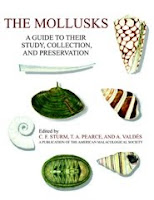
In 1999 the AMS began the process of completely updating and expanding that work, under the able leadership of Charlie Sturm, a research associate in the Carnegie Museum Section of Mollusks. I'm pleased to report that the work is now published:

"The Mollusks: A Guide to Their Study, Collection, and Preservation"C. Sturm, T. Pearce, and A. Valdes (eds.)
Universal Publishers, Inc., Boca Raton, FL. xii + 445 pp. 101 ill.
An early proof copy of my Chapter 21 on freshwater gastropods has been available from the FWGNA web site since 2003. But there are 31 chapters in total, including chapters on collecting and cleaning shells, archival methods, digital and film imaging, dredging, taxonomic methods and molecular techniques. There are chapters covering all seven extant classes of mollusks (yes, even the Aplacophora and Monoplacophora) from all environments, including the fossils. The chapter on freshwater mussels is by Kevin Cummings & Art Bogan, and the chapter on non-unionoid freshwater bivalves is by Alexi Korniushin. No malacological library will be complete without a copy of this book!

The bargain price is just $35.95, or two for $71.90. The American Malacological Society is a not-for-profit organization. Revenue from the book will help defray the costs of our scientific program, student scholarships and grants. The AMS will earn more if the book is ordered from the publisher than through commercial ventures such as Amazon.com or Barnes&Nobles.com. Thus, I would encourage you to order directly from the publisher:

Direct any questions to Charlie Sturm at doc.fossil@gmail.com
Thank you all for your support of American malacology!
And we'll keep in touch,
Rob