Dr. Rob Dillon, Coordinator


Showing posts with label Ancylidae. Show all posts

Friday, February 15, 2019

Dates of Publication

Editor’s Note – This brief post is offered as an appendix to my essay of 6Feb19, “Ferrissia fragilis (Tryon 1863).”

Several of you have pointed out, in separate correspondence with me over the last week, that taxonomic priority is established not by date of oral presentation, but by date of publication.  This does not change the order of the three freshwater limpet descriptions I reviewed in my essay of 6Feb19, nor indeed anything in my essay at all.  But for the record, the precise, formal publication dates of the three limpet taxa I discussed in that essay were: 
  • Gundlachia californica Rowell, (31)May1863
  • Ancylus fragilis Tryon, 13July1863
  • Gundlachia meekiana Stimpson, (31)Dec1863
Our good buddy Dr. Harry Lee, from Jacksonville (FL), is quite the gifted scholar.  Yesterday morning he sent me a thoroughly-researched letter on the subject, together with supporting documentation, which I have made available from the links below: 
  • Letter from H. G. Lee, regarding the nomen Ferrissia fragilis [pdf]
  • Extract from Levinton et al. (2010) [pdf
And to be clear.  Just because I myself am not a priest, nor a scribe, nor a Pharisee does not mean that I don’t value the services they can provide.  Everybody appreciates a scribe now and then.  Thanks, Harry!

Wednesday, February 6, 2019

Ferrissia fragilis (Tryon, 1863)

Editor’s Note – This essay was subsequently published as: Dillon, R.T., Jr. (2023c)  Ferrissia fragilis (Tryon, 1863).  Pp 207 – 214 in The Freshwater Gastropods of North America Volume 7, Collected in Turn One, and Other EssaysFWGNA Project, Charleston, SC.

At 9:30 on the starry but moonless night of April 16, 1863, seven armored gunboats under the command of Admiral David Porter, accompanied by three army transports and a steam ram, began a stealthy voyage down the Mississippi under the guns of Vicksburg.  Water-soaked bales of hay were stacked around their boilers and pilot houses, and coal barges lashed to their starboard flanks.  At 11:10 PM, all hell broke loose [1].

Wikimedia Commons
On the evening of April 20, four days later, the regular biweekly meeting of the California Academy of Natural Sciences convened at 622 Clay Street, San Francisco, seven members present, Dr. Trask in the chair.  Dr. Cooper communicated the description of a new mollusk, recently discovered by Rev. Joseph Rowell in the waters of the Feather River, Gundlachia californica [2].  Images of the little limpet, “length about sixteen one-hundredths of an English inch,” showed a shell apex distinctly different from the embryonic shell origin.  Philip Lutley Sclater, Esq., of London was elected a corresponding member, three species of reptiles from San Mateo added to the cabinet, and the Academy adjourned.

Shortly after 5:00 on the evening of May 2, 1863, the troops on the right flank of General Joseph Hooker’s army at Chancellorsville, VA, stacked their rifles and began to prepare their suppers.  They were amused to see large numbers of deer and rabbits break out of thickets to the west and come bounding toward them.  The men cheered and waved their caps at the startled forest creatures, until the next thing they saw froze the laughter in their throats.  Total casualties at the end of the battle were 3,500 killed and 19,000 wounded.

May 2, Just before dawn.  Wikimedia commons
A bit more than two weeks later, on the afternoon of May 26, 1863, The Academy of Natural Sciences of Philadelphia convened for its regular weekly meeting, 19 members present, Mr. Lea in the chair.  The agenda was lengthy: 9 papers presented and ordered to be published, including an ambitious contribution by T. B. Wilson & J. Cassin proposing a third kingdom of life, the Primalia.  Mr. George W. Tryon read a paper describing seven new species of freshwater gastropods, finishing with Ancylus fragilis [3].  The 4 millimeter limpet, apex elevated, acute and “curved backwards,” had been sent to him from California by Rev. J. Rowell.

On June 3, 1863, General Robert E. Lee began to concentrate his army of 75,000 at Culpeper, in preparation for an invasion northward.  And on the morning of June 8, Union General Alfred Pleasonton probed south across the Rappahannock with six brigades of cavalry, approximately 10,000 horsemen, to gauge Lee’s disposition.  Around noon Pleasonton encountered a roughly equal force of confederate cavalry under Gen. Jeb Stuart at Brandy Station.  Sabers, pistols, and carbines flashing in the sun, the largest cavalry engagement ever fought on American soil was underway.

Cavalry Charge Near Brandy Station, by Edwin Forbes.
Two weeks later, on the afternoon of June 17, the Boston Society of Natural History convened at Tremont Street, Prof. Wyman in the chair.  Mr. Stimpson read a paper on the genus Gundlachia, in which he counted five species, including G. californica, described just two months prior [4].  He went on to describe a sixth species, G. meekiana, collected from the vicinity of Washington DC, similar in all respects to G. californica, but with a less ovate aperture.  One additional paper was read, two communications received, six donations to the museum logged, and the Society adjourned.

Admittedly, the little brown pulmonate limpet that we today call Ferrissia fragilis is not the most striking element of the North American malacofauna.  It is, however, the fourth most common freshwater gastropod in the Eastern United States, behind Physa acuta, Campeloma decisum, and Menetus dilatatus [5].  Populations of Ferrissia fragilis are ubiquitous on aquatic vegetation and organic debris in every lake, pond, and riverine backwater nationwide, Canada to Mexico, sea to shining sea.  Including at the mouth of Pennypack Creek, in north Philadelphia.

Why do you suppose that these exceptionally abundant and wide-ranging little gastropods were completely overlooked by every American biologist working in every puddle of fresh water for half a century, and then simultaneously discovered by three completely separate societies of learned men, meeting in San Francisco, Philadelphia, and Boston, during a single eight-week period of 1863?  What might account for the sudden, passionate interest among young well-born gentlemen of the urban North in freshwater limpets?  I will leave that question to the speculation of my readership.

The Bartow County Yankee Killers [6]
I will, however, take a paragraph to remind you all of several previous essays touching upon Ferrissia fragilis [7].  You may recall, from my essays of 10June09 and 9Nov12, that the freshwater limpets were a particular research interest of Bryant Walker’s (1856 – 1936), and that the definitive monograph was contributed by Paul Basch in 1963 [8].  Both Walker and Basch recognized Ferrissia fragilis as a widespread and important element of the North American malacofauna, and listed californica (Rowell 1863) and meekiana (Stimpson 1863) as junior synonyms of fragilis (Tryon 1863).  And you may also remember my essay of 8Dec10 reviewing the excellent work of Andrea Walther and colleagues [9] synonymizing several additional well-known names under fragilis, including walkeri (Pilsbry & Ferris 1906) and mcneilli (Walker 1925).  So that today, the FWGNA Project recognizes just two species of Ferrissia: rivularis and fragilis.

Up until recently it has been quite easy to ignore the extraordinarily trivial and obscure detail that the meeting of the California Academy which heard the description of G. californica preceded the meeting of the ANSP which heard the description of A. fragilis by five weeks.  And that Rowell's publication preceeded Tryon's by six.  For some reason that I cannot fathom, however, here in 2019 it has become less easy.

The issue of the American Malacological Bulletin freshly arrived on my desk last month included a research note announcing the “discovery of the freshwater limpet, Ferrissia californica (Rowell, 1863)” on the Island of Montserrat [10].  Tryon’s nomen “fragilis” does not appear in title, abstract, key words, or the first five paragraphs of its introduction.

Do systematic biologists of the 21st century feel some heightened sense of obligation to the Rev. Rowell, now asleep in Christ for 100 years?  Have our oaths to uphold the International Code of Zoological Nomenclature suddenly become more solemn?  Is the iron fist of the ICZN Commission grown more fearsome?

I do not know.  I am neither priest nor scribe nor Pharisee, I am a scientist.  The names I assign to populations of freshwater gastropods are hypotheses of evolutionary relationship – my best hypothesis, without compromise.  If I find that more than one name has been assigned to a population or group of populations, each of which conveys the same evolutionary hypothesis, I will select the name that, in my judgement, conveys my hypothesis to the broadest audience. 

The best name for North American freshwater limpets with an eccentric shell apex is Ferrissia fragilis (Tryon, 1863).  The letter of some legalistic code about which I was not consulted, administered by some commission I do not recall electing, does not enter into the calculation.

But let me hasten to make another point, and to make it as forcefully as I have made the previous one.  I would not presume to impose my selection of any scientific name on anyone else.  In fact, I earnestly hope that other scientists will develop other hypotheses about the evolutionary relationships of the populations I refer to Ferrissia fragilis.  Such a situation would be the mark of an active science.  And if it is the judgement of some other worker that Rowell’s nomen californica transmits information more effectively than Tryon’s fragilis, far be it from me to second-guess.

I have no problem with synonyms.  I do not think that taxonomic synonyms necessarily lead to scientific confusion, any more than I expect the college dean to become confused if I tell him to kiss my peachy-pink posterior or my rosy-red ass, on the way out the door.  Synonyms are pervasive in the English language, and we are richer for it.

Indeed, I think it will be a service to preserve both names.  So just this morning I have added Rowell’s “Ferrissia californica” directly under the header “Ferrissia fragilis” at the top of my FWGNA page.  And entered the nomen into the list of synonyms available from the website pull-down.  And written the present essay, wherein both names are connected.  In this fashion, the future generation of graduate students, perhaps naïve about the fragilis/californica situation, will be able to google-up and connect their disparate literatures.

And finally.  Difficult though it may be to understand [11], some non-negligible fraction of my colleagues have, from time to time, associated into committees to develop formal lists of accepted or approved names that we, “the community,” will be sanctioned to apply to the diverse biota of this, our great country.  I would suggest that all members of such committees re-read the first six paragraphs of the present essay.  And get a life, every one of you.


Notes

[1] This account of the action at Vicksburg, together with those of Chancellorsville and Brandy Station following, are extracted from Shelby Foote’s (1963) classic The Civil War, A Narrative.  Volume II, Fredricksburg to Meridian. Vintage Books, 988 pp.

[2] Rowell, J (1863) Description of a new Californian Mollusc.  Proceedings of the California Academy of Sciences Series 1, 3: 21 – 22.

[3] Tryon, G. W. (1863) Descriptions of new species of fresh water Mollusca, belonging to the families Amnicolidae, Valvatidea, and Limnaeidae; inhabiting California.  Proc. Acad. Natl. Sci. Phila. 15: 147 – 150.

[4] Stimpson, W. (1863) Malacozoological Notices No. 1, On the genus Gundlachia.  Proc. Boston Nat. Hist. Soc. 9: 249 -252.

[5] This result is from 18,974 records of 99 species in four regions: the Atlantic, the Ohio, East Tennessee, and (very preliminarily) The Cumberland.  Download the presentation here:
  • The freshwater gastropods of The Ohio: An interim report [27June17]
[6] From left, Daniel, John, and Pleasant Chitwood of Company A, 23rd Georgia Infantry.  Daniel and John were captured at Chancellorsville on May 2, 1863.  This image scanned from Miller, W J. & B. C. Pohanka (2006).   An Illustrated History of the Civil War.  Barnes & Noble.

[7] My previous essays on Ferrissia:
  • Just One Species of Ferrissia [10June09]
  • Two Species of Ferrissia [8Dec10]
  • Bryant Walker’s Sense of Fairness [9Nov12]
[8] Basch, P.F. (1963) A review of the recent freshwater limpet snails of North America (Mollusca: Pulmonata). Bull. Mus. Comp. Zool. Harvard Univ. 129: 399–461.

[9] Walther, A. C., J. B. Burch and D. O’Foighil (2010) Molecular phylogenetic revision of the freshwater limpet genus Ferrissia (Planorbidae:Ancylinae) in North America yields two species: Ferrissia (Ferrissia) rivularis and Ferrissia (Kincaidilla) fragilis. Malacologia 53: 25-45.

[10] Coote, T, K. A. Schmidt, R. E. Schmidt, & E. R. McMullin (2018) Discovery of the freshwater limpet, Ferrissia californica (Rowell, 1863) (Gastropoda: Planorbidae), from streams of Montserrat, West Indies, a new addition to the Caribbean fauna.  American Malacological Bulletin 36: 291 – 295.

[11] I myself probably do understand it, however.  I think committees form to standardize the names of the diverse elements of the American biota to facilitate governmental regulation.  And with governmental regulation comes governmental funding.  I don’t want to be cynical – I’m pretty sure my colleagues on such committees think that they are furthering the cause of conservation, and that whatever taxpayer’s dollars might be expended on their salaries are well-justified.  I used to think that, too.

Wednesday, January 11, 2017

A Previously Unrecognized Symbiosis?

Editor’s Note – This essay was subsequently published as: Dillon, R.T., Jr. (2019d) Everett's Symbiosis.  Pp 101 - 107 in The Freshwater Gastropods of North America Volume 4, Essays on Ecology and Biogeography.  FWGNA Press, Charleston.

Last month’s post on the aerial dispersal of freshwater gastropods [1] turned out to be one of my more popular in recent memory.  Thank you all for your kind emails.  Winning the award for most charming was our colleague Lusha Tronstad of the Wyoming Natural Diversity Database, who sent me the photos below:


And here is the story, verbatim as I received it from Lusha: 
“My son, Everett Tronstad (he just turned 6) caught this beetle (likely Dytiscus gigantus) in our barnyard this past summer.  We live northwest of Laramie, Wyoming in the foothills of the Snowy Mountains.    My son spends hours every day collecting invertebrates, both aquatic and terrestrial.  He caught this beetle on our car who probably thought the shiny paint was water.  Everett picked it up and we immediately saw the limpets attached.  We had just enough time to snap two photos before the beetle took off.  We watched the beetle fly off into the distance and we marveled at how invertebrates can hitchhike on other critters.  The date was 30 July 2016.”
Everett
I also received a cordial email from Chris Davis of the Pymatuning Lab up in Linesville, PA.  He called my attention to a note published by Andrea Walther and a host of colleagues in 2008 [2], with the striking figure reproduced below.

Andrea and her colleagues collected nine water bugs from a pond at the University of Michigan’s Edwin S. George Reserve, two of which bore five limpets each.  Note that the bugs were swimming at the time of their collection.  Andrea wrote, “Given the positioning of the L. fuscus on the dorsal surfaces of the B. flumineum, it is uncertain if the insects were able to lift their hemelytra to take flight.”

So those of you in my email address book [3] may remember the challenge I issued when I announced last month’s post, back on 15Dec16:  “Quick, quick!  How many reports of freshwater limpets on flying water bugs would you expect to find in the published literature?”  The answer I was looking for was 12, the ten listed by W. J. Rees [4] plus the two I found published between 1965 and 1991.  So here are two more [5], making 14.  At some point, a stack of related observations becomes a phenomenon, don’t you agree?

And here’s another remarkable observation, which I’m not sure has at yet been remarked.  There were three Ferrissia on Everett’s dytiscid beetle.  And there were five Laevapex on the back of each of Andrea’s belostomatid bugs.  On surface areas no more than 4 square cm??  I feel sure the densities of limpets on the insects must be orders-of-magnitude greater than their densities in the general environment.  The limpets are almost certainly aggregated on the bugs, don’t you think?

I have developed an hypothesis to account for the phenomenon of high limpet densities on large aquatic beetles and bugs.  This hypothesis depends on one obvious assumption, one commonplace observation, and one trivial fact, with a couple paragraphs of gratuitous speculation plated on the bottom.

The obvious assumption is that large aquatic beetles and bugs must remain motionless for extended periods of time, in contact with limpet habitat.  I have very little first-hand knowledge upon which to draw here, but my (admittedly superficial) google searches have returned the impression that both the dytiscid beetles and belostomatid bugs demonstrate a wide variety of life habits, but that the big species, in any case, often seem to hunt by stealth.  There are a couple YouTube videos [6] showing periods of both active swimming and quiescent waiting.  Belostomatids seem to rest anywhere, in contact with the bottom or the surface, although dytiscids seem to rest primarily at the surface.  Possibly under lily pads?  Lily pads seem to be prime limpet habitat.

My commonplace observation is that freshwater limpets tend to aggregate on smooth surfaces.  Anybody who has ever hunted for them knows that limpets are more common on smooth rocks than on rough rocks, and less common on the parts of waterlogged woody debris covered with bark than on the parts that have lost it.  When I arrive at a collecting site, one of the first items on my agenda is to wade under the bridge and look for beer bottles.  Limpets reach maximum abundance in old bottles, hard plastics, and smooth litter discarded by fishermen and motorists.  In fact, I have developed the abbreviation “bbl” for my field notes, which means “beer-bottle limpets.”  This means that limpets (of whatever species) were so uncommon as to be found only on smooth litter.

I feel sure this is an adaptation for defense.  Limpets are better able to make a seal with the lips of their shells, and indeed better able to create suction with their foot, on a smooth surface than a rough surface.  It is very nearly impossible to remove a limpet from a beer bottle.  They may slide around on the surface of the bottle, but they do not come off.  For this reason, I keep a scalpel in the pocket of my collecting vest (sheathed in an open plastic sample vial).  The only way to remove a limpet from a really smooth surface without damaging it is to insert a scalpel blade and lift.

My obvious assumption that big aquatic beetles and bugs must hold still, plus my commonplace observation that freshwater limpets tend to aggregate on smooth surfaces, plus the trivial fact that the backs of big beetles and bugs are smooth, can yield a symbiotic association between freshwater limpets and large aquatic insects.  I feel pretty sure that the relationship is positive for the limpets, at least initially, since smooth surfaces yield better protection from predators.  I imagine the relationship is slightly negative for the insects, since the limpets must add a bit of weight, and a bit of drag.  More negative for the bug if attached limpets interfere with its ability to fly, as Andrea suggests.

What might the unusually high densities of limpets we sometimes observe on the backs of aquatic insects eat?  It would be lots of fun to imagine that the limpets are commensal with the bugs – sharing or somehow benefiting from the meat diets of their hosts.  Dytiscid beetles seem to be such sloppy eaters [7] that one might hypothesize increased concentrations of bacteria and fungi on their bodies.  The excellent studies of Calow [8] from the mid-1970s, however, convince me that European Ancylus populations graze rather exclusively on periphytic algae, especially diatoms.  I just cannot find any warrant to imagine that limpets straying onto the backs of carnivorous insects might reasonably switch to anything else.

Which means that the limpets rapidly become hungry.  My gratuitous speculation is that they graze every last diatom cell off the backs of their hosts in a matter of hours, and subsequently ride around in sullen misery, regretting their decision to hitchhike, looking for any opportunity to get off.  Which brings us back to the phenomenon that brought us here, which, I seem to recall, was not symbiosis, but rather transport.

So after this brief but (I hope you’ll agree) interesting digression, next month we’ll return to the theme I introduced last month, which was the aerial dispersal, broadly, of freshwater gastropods, generally.

Notes

[1] Freshwater Gastropods Take To The Air, 1991 [15Dec16]

[2] Walther , A. C.,  M. F. Benard, L. P. Boris , N. Enstice , A. Tindauer-Thompson & J. Wan (2008) Attachment of the Freshwater Limpet Laevapex fuscus to the Hemelytra of the Water Bug Belostoma flumineum.  Journal of Freshwater Ecology, 23:2, 337-339, DOI: 10.1080/02705060.2008.9664207.

[3] If you’d like to receive regular alerts from the FWGNA, email me at DillonR@fwgna.org

[4] W. J. Rees (1965) The aerial dispersal of Mollusca.  Proc. Malac. Soc. Lond. 36: 269-282.

[5] Okay, fine, for you sticklers out there!  I understand that the first 13 were records of aquatic Coleopteran beetles, not technically Hemipteran “bugs.”  And I aso realize that the fourteenth wasn’t literally a “flying water bug,” because Andrea collected her Belostoma as they were swimming in the pond.  So technically, the answer to my query of 15Dec16 might still be zero.  I’ll bet you all really irritated your tenth-grade Biology teachers, didn’t you?

[6] Here’s a montage of videos of large belostomatid bugs hunting.  The first one shows a bug holding very still on a bottom of smooth stones (interestingly) waiting for its prey to swim by.  There’s also some footage of another belostomatid hunting from the surface, and then a sequence suggesting ambush from submerged vegetation:
As a bonus, around minute 2:30 there’s a sequence showing a belostomatid capturing and eating a big individual Melanoides.  The bug apparently lunges right by a fat, juicy Helisoma to snatch the bony Melanoides.  I can’t imagine why.

[7] Here’s a YouTube video of a Dytisid making very sloppy work of a minnow:
But we should probably also note simultaneously that belostomatids seem to be very neat eaters, inserting their proboscis and sucking their prey clean from the inside.

[8] Calow, P. (1973) The food of Ancylus fluviatilis Müll., a littoral stone-dwelling, herbivore. Oecologia (Berl.) 13, 113–133.  Calow, P. (1975) The feeding strategies of two freshwater gastropods, Ancylus fluviatilis Müll. and Planorbis contortus Linn. (Pulmonata), in terms of ingestion rates and absorption efficiencies.  Oecologia 20: 33-49.

Friday, September 26, 2014

The Egg Masses of Freshwater Pulmonate Snails

Editor's Note.  This essay was subsequently published as: Dillon, R.T., Jr. (2019b) The egg masses of freshwater pulmonate snails.  Pp 107-111 in The Freshwater Gastropods of North America Volume 2, Essays on the Pulmonates.  FWGNA Press, Charleston.

Faithful readers of this blog will not be surprised to learn that my email inbox typically receives a rather steady stream of inquiries with attached jpeg images of freshwater snails.   But you might be surprised to discover that I also occasionally receive images of things that are not freshwater snails, but could be.

Like blobs of jelly.  Earlier this year, for example, I received an email from Mr. Tom Pelletier of askanaturalist.com, bearing the subject line “gelatinous mass.”  And the attached image was (pretty clearly) a Physa egg mass, sent to Mr. Pelletier by a correspondent who had photographed the underside of a river rock in West Virginia.  I was (of course) pleased to help Mr. Pellatier, and he wrote a very nice essay on the askanaturalist.com website [1], featuring a lot of excellent general information on the life history of Physa acuta, as well as photos and a couple video links as well.

So it has come to my attention that reliable information on the egg masses of freshwater pulmonate snails is a rare commodity on the web.  I tried a google search on a variety of terms and combinations, and was only able to find our colleague Kathryn Perez’ dichotomous key (which is good), but which features drawings, rather than photos, and might benefit by attention to scale [2].

So welcome to “Basommatophoran Pulmonate Egg Masses 101.”  This is an introductory class.  If you are a sophomore or higher in the freshwater gastropod curriculum, feel free to take the rest of this essay off, and I’ll see you next month.

For those of you still with me.  Last week I went down to my local pond and collected adults from the three most common pulmonate populations in the Charleston area – Lymnaea (Pseudosuccinea) columella, Physa acuta, and Helisoma trivolvis.  I isolated individual snails in my standard 10 oz. plastic drinking cups, fed them green flake food, and over the following 48 hours, quite a few laid eggs.  I allowed the eggs to mature for five days, dumped the water from their cups, and trimmed representative egg masses out with a pair of scissors, still attached to their cup walls.  I then photographed one image directly down through each mass, and a second image obliquely (dewatered, propped up in a little finger bowl) to give a feeling for third-dimension thickness. 

The photo above shows a typical lymnaeid egg mass about five days old.  The clear, colorless, elongate, sausage-shaped mass depicted is approximately 12 mm in length, each of the 25 - 30 embryos it contains approximately 0.7 mm in diameter.  It is covered with a relatively tough membrane.  The standard shell length of its mother was 11.5 mm.

The second photo in this series shows a typical planorbid egg mass, also about five days old.  The 25 - 30 embryos are very similar in size to the lymnaeid embryos depicted in the first photo, but the mass is irregularly ovoid in its outline, with a maximum dimension of about 7 mm.  This mass is also covered with a relatively tough membrane.  Its mother bore a shell 13.2 mm in diameter.

Notice, interestingly, that the planorbid egg mass is tinged slightly brown or orange, in contrast with the entirely uncolored lymnaeid mass.  Planorbids are famous for their serum hemoglobin, and it seems likely to me that the slightly orange cast may indicate a bit of heme in the matrix.  The development of Helisoma embryos also seems a bit more advanced at day five than lymnaeid embryos.

The third photo in this series depicts a typical physid egg mass, similar in size and age to the lymnaeid and planorbid masses.  The matrix in the Physa egg mass is obviously much more gelatinous in its character, however, missing the relatively tough outer membrane.  The standard shell length of the mother of this brood was 9.1 mm.

To be complete, I might add a fourth image to the gallery, depicting a singleton egg of the ancylid limpet Ferrissia fragilis [3]Ferrissia reaches maturity at a much smaller size than Lymnaea, Helisoma, or Physa, and hence one might not be surprised to discover they do not lay an egg “mass” at all.  The singleton embryos of Ferrissia are a bit smaller than the embryos of the other pulmonates as well, approximately 0.60 mm diameter, and surrounded by a rather spare capsule.

I will conclude this lesson by noting that the size of freshwater pulmonate egg masses is a function of their number of embryos, which may vary greatly.  In culture it is not uncommon to see Physa egg masses with 60-80 embryos, for example, roughly comparable in total volume to that of their mother.  And production of one such egg mass every 24 hours is not unusual.

Even casual observations such as these cannot fail but impress the student with the potential for great reproductive output mounted by freshwater pulmonate snails.  Might pulmonates “over-reproduce” and expire, like spent salmon?  Readers interested in a comprehensive review of life history strategy in freshwater gastropods generally, together with a consideration of spent-salmon semelparity, are referred to my (2000) book [4].

Thus ends the introductory lecture on the egg masses of freshwater pulmonates.  Coming up next month – advanced topics!


Notes

[1] Pellatier, T. C. (2May14) What are these jelly dots under rocks?    www.askanaturalist.com

[2] Perez, K. E. & G. Sandland.  Key to egg masses of Wisconsin Snails.  www.northamericanlandsnails.com.

[3] This photo was taken by my student Jacob Herman in connection with our paper:
Dillon, R. T., Jr & J. J. Herman (2009)  Genetics, shell morphology, and life history of the freshwater pulmonate limpets Ferrissia rivularis and Ferrissia fragilis.  Journal of Freshwater Ecology 24: 261 – 271. [pdf]

[4] See pp 156 – 168 in:
Dillon, R. T., Jr. (2000) The Ecology of Freshwater Molluscs.  Cambridge University Press.

Friday, November 9, 2012

Bryant Walker's Sense of Fairness

Editor’s Note – This essay was subsequently published as: Dillon, R.T., Jr. (2019c) Bryant Walker's sense of fairness.  Pp 191 - 198 in The Freshwater Gastropods of North America Volume 3, Essays on the Prosobranchs.  FWGNA Press, Charleston.

Bryant Walker was a lawyer.  It is difficult for us to comprehend, looking back on his distinguished career in malacology, which extended over 50 years and 155 publications, that he never held a formal position at any scholarly institution.  And that the second word under Walker’s entry in R. Tucker Abbott’s Directory of American Malacologists [1], after the word lawyer, is “amateur.”

He was born in Detroit in 1856 and died in Detroit in 1936, and will ever be linked most closely with his alma mater, the University of Michigan.  Indeed 25 of Walker’s 155 publications were regional surveys – directed toward the molluscan fauna of the Wolverine State [2].  But he corresponded widely throughout North America, developing especially close friendships with Ortmann in Pittsburgh, Pilsbry in Philadelphia, and such prominent collectors as J. H. Ferriss, A. A. Hinkley, and H. H. Smith.  And he became an international authority on freshwater limpets, publishing important contributions on the ancylids of South America and Africa, as well as revising our own continental fauna here at home [3].

According to Calvin Goodrich [4, 5], whom he recruited to the University of Michigan in 1929, the first entry in Walker’s personal catalog of shells was “made in the back part of a university notebook on physics” in 1874, while he was yet an undergraduate.  He published his first paper in the year of his graduation from Michigan with an A. B. in 1876, and his second paper the year he graduated from the Michigan Law School in 1879.  Thereafter he entered private practice as an attorney in Detroit, turning his “three-storied, high ceilinged, mansard-roofed house” into a museum, “the ground floor dedicated to gastropods, the upper to bivalves.”  Again according to Goodrich, “When the collection was moved in June [of 1936] to the University of Michigan at Ann Arbor, a great pile of boxed shells was discovered in the attic rooms, others on shelves in the basement where some were partly buried under coal.”

Walker’s research interests favored the freshwater gastropods (56 papers), but did not neglect the unionid mussels (29 papers).  In his day he was probably best known for the “Mollusca” chapter he contributed to the first (1918) edition of Ward & Whipple’s influential “Freshwater Biology.”  He expanded that work into a stand-alone “Synopsis of the Classification of the Freshwater Mollusca of North America,” augmented it with “A catalog of the more recently described species, with notes,” and published it as a 213-page “Miscellaneous Publication” of the University of Michigan [6].

I keep a reprint of Walker’s 1918 “Miscellaneous Publication” on the shelf next to my desk, and refer to it often.  The work grew from an extensive system of note cards that he compiled for his personal use over many years, recording not just the descriptions of new species as they were published, but indeed any note or comment regarding any species of North American freshwater mollusk to appear in the literature over several decades.  In cases such as the Physidae, where no monographic treatment was published between Binney’s of 1865 and George Te’s of 1975, Walker’s “Miscellaneous Publication” provides an indispensable bridge from the ancient to the merely old.

Bryant Walker had a lawyer’s sense of fairness.  As the 20th century dawned, the larger and showier freshwater gastropods, such as the lymnaeids, the planorbids, and especially the pleurocerids, had all received more than their fair share of attention.  Thus he focused his research efforts on the smaller and plainer taxa – the hydrobiids, the valvatids, and especially the ancylid limpets.

Among the hydrobiids, the plainest genus is arguably Somatogyrus, which bears a relatively heavy but otherwise nondescript shell and a simple penis.  All the other hydrobiid groups – the Amnicolines, the Nymphophilines, the Fontigentines – have an elaborate penial morphology with accessory lobes and glandular crests and extra ducts and were already, by Walker’s day, split into scores of regional species.  It did not seem fair to Walker that there should be dozens of species of Amnicola in New England, and hundreds of species of pleurocerids in Alabama, but just four species of Somatogyrus, simply because they were so plain.

So in 1904 he described 11 new species of Somatogyrus, including the regional taxa S. pennsylvanicus, S. virginicus, and S. georgianus, as well as 8 species from the Mobile Basin of Alabama [7].  And between 1906 and 1915 he described 14 additional species, most from the Tennessee River and its tributaries in North Alabama [8, 9, 10].

Almost all 25 of these species were, quite plainly speaking, indistinguishable.  Walker described the shell of Somatogyrus virginicus, for example, as “small, globosely conic, and imperforate,” and that of S. pennsylvanicus as “small, obtusely conic, narrowly umbilicate, sometimes imperforate [7].”  The only exception was his Somatogyrus umbilicatus from the Coosa River of Alabama, about which Walker enthused, “This species is remarkable for its depressed, valvata-like form and round, deep umbilicus, which readily differentiates it from all other known species of the genus.”

By 1909 it was beginning to seem unfair to Walker that the genus Somatogyrus should include 21 indistinguishable species (by that point, see note 11) and one that looked different.  So he removed his S. umbilicatus to a separate genus, Clappia, and redescribed it as Clappia clappi, to doubly-ingratiate himself with G. H. Clapp, then curator of mollusks at Harvard’s MCZ [Plate above, see ref 9].  The genus remains valid to this day, although the specific nomen “clappi” was dead aborning [12].

It was Calvin Goodrich’s opinion, however, that Walker’s 25 papers on the Ancylidae “will probably stand as his best work.”  While essentially all of the 16 species-level ancylid taxa he described from North American waters have now disappeared into synonymy [13], Walker's genera Ferrissia, Laevapex, and Rhodacmea survive to this day, albeit with approximately one species each [14].

But with the advantage of 100 years’ perspective, I would suggest that Bryant Walker’s best work was “Malacology at the University of Michigan.”  If there was any interest in mollusks at Ann Arbor prior to Walker, I can find no evidence of it [15].  But after Walker came Goodrich [5], and after Goodrich came van der Schalie, and under van der Schalie trained W. J. Clench, A. R. Solem, P. F. Basch, J. B. Burch, W. H. Heard, and many, many others, including (full disclosure) my own Ph.D. advisor, G. M. Davis. 

Absent the Malacology Department at the UMMZ, the landscape of our discipline in America today would present a far more desolate aspect.  Although I have never seen him accorded the honor, let’s bestow upon Mr. Bryant Walker, lawyer, amateur, the title “Father of Malacology at Michigan,” shall we?  It’s only fair.


Notes

[1] Abbot, R. T. (1973)  American Malacologists.  Published by the author, Falls Church, Va.

[2] Goodrich, C. (1939) The scientific writings of Bryant Walker.  An annotated bibliography.  Occas. Pprs. Mus. Zool. Univ. Mich. 402: 1 - 28. This is also the source of the Walker portrait accompanying the post.

[3] Walker, B. (1917)  A revision of the classification of the North American patelliform Ancylidae, with descriptions of new species.  Nautilus 31: 1 - 10.

[4]  All the anecdotes in paragraph three of this essay come from a very sweet and personal obituary published by Goodrich (1936) in Nautilus 50: 59-64.

[5] Calvin Goodrich ranks very high on my list of professional heros, just behind Darwin, Mendel, and Morgan.  For my personal tribute, see:
  • The Legacy of Calvin Goodrich [23Jan07]

[6] Walker, B. (1918)  A synopsis of the classification of the freshwater Mollusca of North America, North of Mexico, and a catalogue of the more recently described species, with notes.  Univ. Mich. Mus. Zool. Misc. Publ. 6: 1 - 213.

[7]  Walker, B. (1904)  New species of Somatogyrus.  Nautilus 17: 133 - 142.

[8] Walker. B. (1906)  New and little known species of Amnicolidae.  Nautilus 19: 97-100, 114-117.

[9] Walker, B. (1909)  New Amnicolidae from Alabama.  Nautilus 22: 85 - 90.  Walker's "Plate VI" shows Clappia "clappi" shell (1), operculum (4), and radula (7), along with various other Somatogyrus from Alabama.

[10] Walker, B. (1915) Apical characters in Somatogyrus with descriptions of three new species.  The Nautilus 29: 37 - 41, 49 - 53.

[11] Actually there were approximately 30 species of Somatogyrus by 1909, including 8 described by authors prior to Walker.

[12] The specific nomen "clappi" (Walker 1909) immediately became a junior synonym of umbilicata (Walker 1904).  How did the great H. A. Pilsbry, who edited The Nautilus from 1889 to 1958, let Walker make the rookie mistake of naming the same species twice?

[13] The only exception may be Rhodacmaea hinkleyi (Walker 1908), which even if it is distinct, is probably extinct.

[14] I have posted updates on all three of these genera in recent years:
  • Phylogenetic sporting and the genus Laevapex [20July07]
  • Two species of Ferrissia [8Dec10]
  • Rhodacmaea Ridotto [8Aug11]

[15] The first curator of malacology at the University of Michigan was Miss Mina Winslow, whom Walker had some hand in “encouraging” to the job, according to van der Schalie (Bulletin of the AMU 1980: 1 – 5).  I cannot discover when Miss Winslow actually assumed her position, but the date of her first “Occasional Paper” was 1917, a couple years after Walker’s first.

Monday, August 8, 2011

Rhodacmea Ridotto

Editor's Note.  This essay was subsequently published as: Dillon, R.T., Jr. (2019b)  Rhodacmea ridotto.  Pp 149-155 in Freshwater Gastropods of North America Volume 2, Essays on the Pulmonates.  FWGNA Press, Charleston.

The headline news at the AMS meeting in Pittsburgh late last month was the rediscovery of two populations of the rare limpet genus Rhodacmea, together with a reawakening of our collective consciousness regarding this peculiar element of the North American freshwater gastropod fauna. A formal report by Diarmaid O’Foighil and his collaborators in Michigan, Alabama, and Kentucky was published on May 31 in PLos One (1).

In recent years we have often taken note of the excellent research on ancylid limpets issuing from our good friends in Ann Arbor: Diarmaid, Taehwan Lee, Jack Burch, and (until recently) Andrea Walther. Faithful readers will remember the columns we posted in 2007 and 2010 regarding their work on Laevapex and Ferrissia, respectively (2). And just as was the case with those latter genera, the best way to put the new Rhodacmea results into perspective is to back up to the 1963 monograph of another worker with Ann Arbor roots, Paul Basch (3).

Rhodacmea is the most distinctive of the North American ancylids, bearing a shell Basch described as “strangely indented” and a “peculiar” radula with heavy inner cusps as well as the usual (more delicate) outer ones. Basch asserted, “The genus in North America undoubtedly represents a branch of the basic Ancylus stock, related to European Ancylus fluviatilis,” a hypothesis that modern molecular data seem to bear out. He recognized three species: R. filosa (tall, ribby and thin - Basch's figure above), R. eliator (tall, smooth and robust - Basch's figure below), and R. hinkleyi (with a lower apex, not important for our story here). The historic ranges reviewed by Basch centered all three species in big rivers of the Alabama and Tennessee systems, although eliator was originally described from the Green River of Kentucky.

But by 1963 Basch observed,
“The genus is undoubtedly approaching extinction as more and more fast-flowing, larger streams and rivers in the southeastern United States are rendered unsuitable as habitats by dams and pollution… I have collected in dozens of streams in these areas and have located living Rhodacmea only in the Cahaba River near Helena, Alabama.”
Modern records are indeed very scarce (4). The IUCN Red List declared R. filosa extinct in 2000.

Seen in that light, the biggest news from Pittsburgh may have been the rediscovery of viable populations of Rhodacmea in Choccolocco Creek (a Coosa tributary about 100 km east of the Cahaba) by our colleague Paul Johnson, and in the Green River by our colleague Ryan Evans. These are valuable biodiversity resources, and well worthy of conservation.

The glad tidings have been somewhat tarnished, however, by their scientific treatment at the hands of our colleagues in Ann Arbor, which (I fear) expose the rather shabby undergarments of the harlequin we conservation biologists too often seem to play. For both in their AMS presentation this past month, and in their recently published paper, O’Foighil and his colleagues assert that all three of their Rhodacmea populations “merit specific status” separately.

Of course, historically all the freshwater limpet species have been recognized entirely by shell morphological criteria. On that basis, Basch identified the Cahaba population as R. eliator. And Anthony’s (1855) type locality for R. eliator was the Green River of Kentucky. That is why, as I understand it, a directed search was undertaken there. And the formal morphometric study published by O’Foighil and colleagues returned no significant difference between the Cahaba and Green River eliator populations.

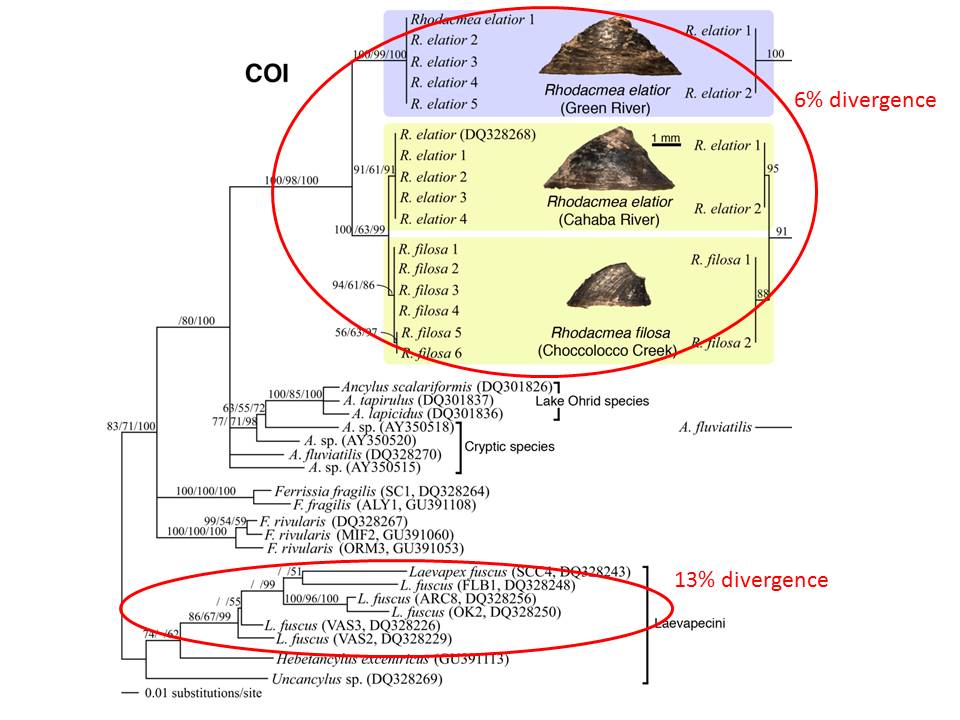
The level of CO1 sequence divergence between Cahaba and Green is also small, when compared to values these same researchers have obtained among conspecific populations of Ferrissia and Laevapex. Judging from the scale bar on their CO1 gene tree (click for larger) the O’Foighil group found perhaps 5-6% sequence divergence among all haplotypes sampled from all three Rhodacmea populations – Cahaba, Green, and Choccolocco. Compare this to the divergence shown among Laevapex fuscus haplotypes – easily in the 10 - 13% range. So given both negligible morphological difference and negligible sequence divergence (5) between the Cahaba and Green River Rhodacmea populations, how can our colleagues assert that they represent different species?

The reasoning offered by O’Foighil et al. to support their three-species hypothesis pirouettes about the Choccolocco population, individuals from which apparently bear sufficient ribs on their shells to support their identification as R. filosa. Our colleagues seem deeply invested in the proposition that this population cannot be conspecific with the previously-known Cahaba population, issuing press releases trumpeting their rediscovery of a unique species in Choccolocco Creek believed extinct for 60 years (6). So since Choccolocco must be a different species from Cahaba (at less than 1% sequence divergence!), the Green population (at 6% divergence) must represent a third.

They further reason that the Green River population must be the true eliator (since that is the type locality) and Cahaba must be a cryptic species Basch did not recognize. The old name cahawbensis seems conveniently available for rescue from synonymy.

But regarding the plasticity of shell characters in freshwater limpets, I can do no better than quote our Ann Arbor colleagues themselves (7): “Shell shape and sculptural features … are unreliable phylogenetic indicators, and they presumably (8) encompass a large ecophenotypic component.” I will also note that the morphometric analysis around which this entire commedia dell' arte turns included just N=2 bona fide individuals from Choccolocco, combined with N=6 museum specimens from a fourth (extinct) population of the author’s own choosing. And does crediting shell characters when they split Choccolocco and Cahaba, but discounting them when they lump Cahaba and Green, seem a trifle disingenuous to anybody else?

Perhaps there is some more profound reason that our colleagues have recognized three species of Rhodacmea, where they have seen only single species in Laevapex and Ferrissia, given similar evidence? A cynic would note that it is easier to get funding for three endangered species than one. But knowing our colleagues as I do, I feel sure that their motivation was the finest – to maximize the likelihood that these populations, by whatever names they may be called, will be conserved into the future. Their ends do not, however, justify their means.


Notes

(1) O'Foighil, D. O., J. Li, T. Lee, P. Johnson, R. Evans, & J. B. Burch (2011) Conservation genetics of a critically endangered limpet genus and rediscovery of an extinct species. PLoS One 6 (5): e20496. [html]

(2) Phylogenetic sporting and the genus Laevapex [20July07]
Two species of Ferrissia [8Dec10]

(3) Basch, P. F. (1963) A review of the recent freshwater limpet snails of North America (Mollusca: Pulmonata). Bulletin of the Museum of Comparative Zoology 129: 399 - 461.

(4) Although there are 1978 collections of R. filosa from Choccolocco Creek in the Florida Museum of Natural History.

(5) I will resist the temptation to preach my "gene trees are not species trees" sermon here. But sinners should prayerfully consider my post of [15July08].

(6) The news seems to have been picked up by Science Daily in early June, and spread to a variety of web-based outlets serving the conservation community, such as terradaily.com, redorbit.com, and batangastoday.com. The headlines in all cases are to the effect that a "Snail Long Thought Extinct Isn't." The Green River population is not mentioned in any of these secondary reports.

(7) Walther, A., T. Lee, J. B. Burch, and D. O'Foighil. 2006. E Pluribus Unum: A phylogenetic and phylogeographic reassessment of Laevapex (Pulmonata: Ancylidae), a North American genus of freshwater limpets. Molecular Phylogenetics and Evolution, 40: 512.

(8) Presumption is not necessary here. I reviewed our common garden experiments with ancylid limpets in my post entitled, “Just One Species of Ferrissia.” [10June09]

Wednesday, December 8, 2010

Two Species of Ferrissia

Editor's Note.  This essay was subsequently published as: Dillon, R.T., Jr. (2019b)  Two species of Ferrissia.  Pp 143-147 in The Freshwater Gastropods of North America Volume 2, Essays on the Pulmonates.  FWGNA Press, Charleston.

Back in June of 2009, when last we touched on the systematics of ancylid limpets in North America, we were standing at a crossroads (1). Paul Basch’s monograph, which has formed the basis of our understanding of the group for many years, lists five species in the widespread genus Ferrissia: rivularis, fragilis, parallela, mcneilli and walkeri (2). But the DNA sequence data of Andrea Walther (at that time unpublished) suggested that only F. rivularis and F. fragilis were at all genetically distinct, subsuming parallela under the former nomen, and mcneilli and walkeri under the latter.

Then in the spring of 2009 came the freshly-published allozyme data of Dillon & Herman (3) demonstrating that South Carolina populations of Ferrissia were reproducing entirely by self fertilization, “voiding the biological species concept, and necessitating a retreat to the morphological.” And along with our allozyme data came the results of common-garden experiments suggesting that the morphological criteria by which F. rivularis and F. fragilis had previously been distinguished were ecophenotypic in origin. So in the absence of evidence that any morphological distinction might have a heritable component, Dillon & Herman synonymized the nomen F. fragilis under F. rivularis, leaving North America with but a single species of Ferrissia.

I am now pleased to report that Andrea Walther, together with her colleagues Jack Burch and Diarmaid O’Foighil, has cast additional light on this situation (4). Writing in the issue of Malacologia currently on the newsstands, the team from Ann Arbor has been able to correlate apparently reliable features of the Ferrissia shell apex with their DNA sequence data, pulling fragilis back out from synonymy under rivularis.

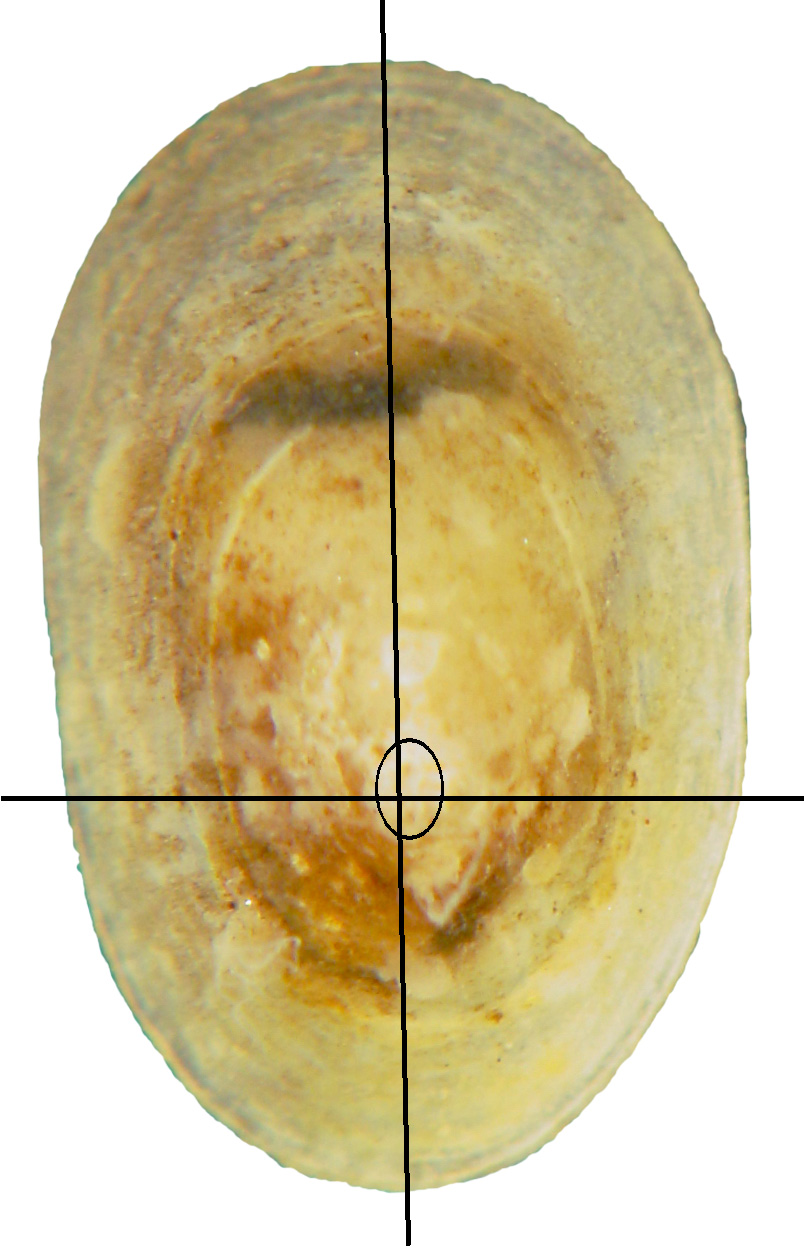
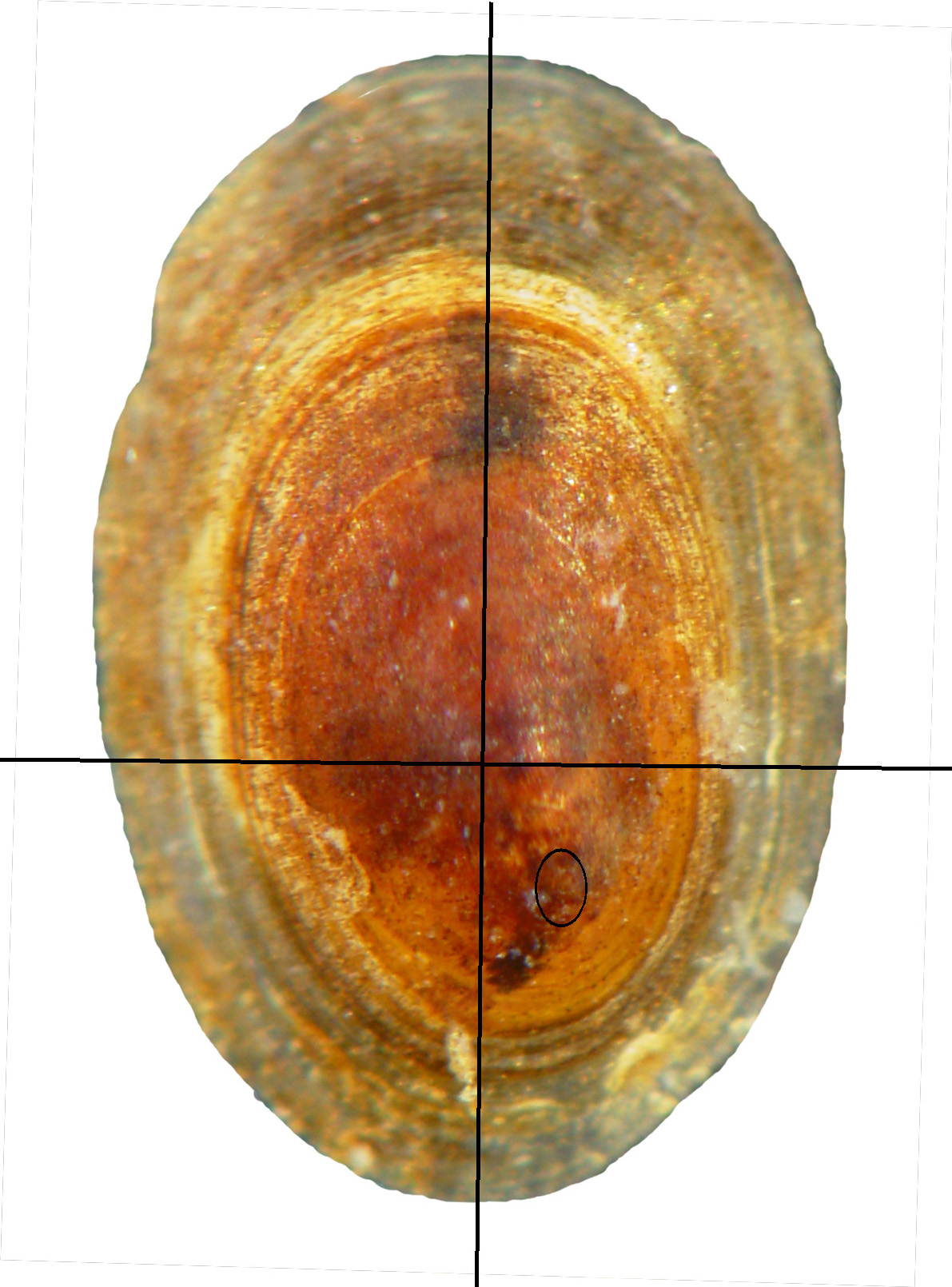
Populations of F. rivularis, in our newly clarified understanding of that taxon, bear shells in which the apex is unambiguous – the cap of the earliest (juvenile) shell remains at the tip of the conical shell of the adult – generally at the midline or very near it [photo at left above - click for larger]. But in populations of F. fragilis, the juvenile shell cap is not at the apex of the adult shell, but rather is located slightly below and to the right of the midline [photo right - click for larger].

Under the older (Basch) concepts of the species (5), populations of F. rivularis were understood to inhabit rocky streams throughout the Blue Ridge ecoregion east into the upper Piedmont of all four southern Atlantic states. Ferrissia fragilis populations were restricted to vegetation and debris in calmer rivers, ditches and swamps in the lower Piedmont and Coastal Plain.

In our newly clarified understanding, however, almost all the Ferrissia populations inhabiting southern Atlantic drainages appear referable to F. fragilis alone, including those bearing quite robust shells inhabiting high-gradient streams in the Blue Ridge.

The only populations of bona fide F. rivularis in southern Atlantic drainages appear to inhabit tributaries of the Potomac River in Northern Virginia, ranging south up the Great Valley into the upper James and Roanoke drainages. This much more restricted range for F. rivularis becomes rather strikingly similar to that of Physa gyrina, another pulmonate snail more characteristic of the American interior, especially in northern latitudes.

Ancylid limpets are among the most common and familiar elements of the North American freshwater macroinvertebrate fauna. It is oddly reassuring to see our understanding of such fundamental aspects of their biology shift in just a few years; indeed, in a matter of months. Our science is an active one. For that, we should be thankful.


Notes
(1) Just One Species of Ferrissia [10June09]

(2) Basch, P.F. (1963) A review of the recent freshwater limpet snails of North America (Mollusca: Pulmonata). Bull. Mus. Comp. Zool. Harvard Univ. 129: 399–461.

(3) Dillon, R. T. and J. J. Herman (2009) Genetics, shell morphology, and life history of the freshwater pulmonate limpets Ferrissia rivularis and Ferrissia fragilis. Journal of Freshwater Ecology 24: 261-271. [PDF]

(4) Walther, A. C., J. B. Burch and D. O’Foighil (2010) Molecular phylogenetic revision of the freshwater limpet genus Ferrissia (Planorbidae:Ancylinae) in North America yields two species: Ferrissia (Ferrissia) rivularis and Ferrissia (Kincaidilla) fragilis. Malacologia 53: 25-45.

(5) To be fair, Basch did notice differences in the apex of his five Ferrissia species. For F. rivularis, his couplet specified "apex in midline or slightly to the right." He attributed "apex subacute, often far in the right posterior quadrant" to F. walkeri. Regarding the apex of F. fragilis, however, he was silent.


Thursday, June 11, 2009

Just One Species of Ferrissia

Editor's Note:  A substantial fraction of the material in this essay was subsequently rendered obsolete by the 2010 research of Walther and colleagues.  See my post of [8Dec10] for more.

I'm pleased to report the publication of a paper by J. J. Herman and myself in this month's Journal of Freshwater Ecology, "Genetics, shell morphology, and life history of the freshwater pulmonate limpets Ferrissia rivularis and Ferrissia fragilis (1)." In this work we offer evidence that populations of the two most widespread limpets in North America reproduce entirely by self fertilization, and that the shell morphological criteria by which they have been distinguished are the result of ecophenotypic plasticity. We suggest that the nomen Ferrissia fragilis is a junior synonym of F. rivularis.


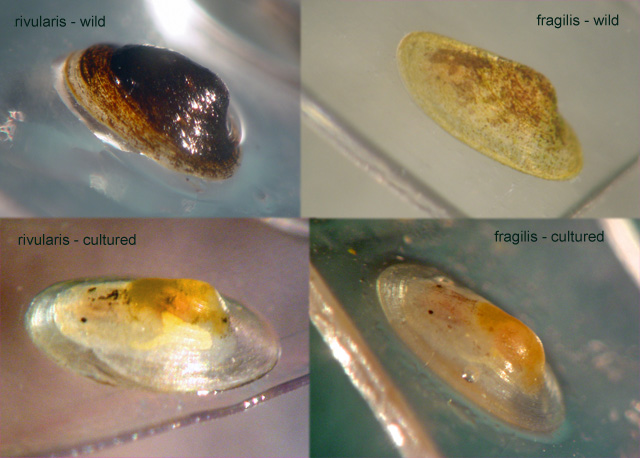
The modern taxonomic history of the North American Ancylidae has been one of consolidation (2). Basch (3) recognized five species of Ferrissia (rivularis, fragilis, parallela, walkeri and mcneilli), noting as he did that "ecological phenotypes are numerous, and plasticity of shell form has been remarked upon many times." (See Basch's charming figure above). More recently Andrea Walther's sequence data have suggested just two Ferrissia lineages, which she has correlated with the rivularis and fragilis phenotypes and life habits (4).

But our discovery of asexual reproduction voids the biological species concept, and necessitates a retreat to the morphological. And since there seems to be no heritable component to the shell characters conventionally used to distinguish rivularis and fragilis (see figure below), it would appear that a single-species model fits the situation best.

I gather that Andrea and her advisor Dairmaid O'Foighil prefer to retain the two species model, under one of the many species concepts based on gene trees. But the limitations of the various phylogenetic and cladistic species concepts are well known (5).

The situation with Ferrissia in North America seems biologically analogous to that of the better-studied Ancylus fluviatilis in Europe. A phenotypically plastic response of shell height and shell thickness to current and substrate has been well known in A. fluviatilis populations for years, and Städler and colleagues (6) documented asexual reproduction in the mid-1990s. More recently Pfenninger and colleagues (7) have reported that 103 populations of A. fluviatilis sampled from across Europe can be grouped into four DNA clades. Yet European workers seem content to identify all their limpet populations by the same nomen, Ancylus fluviatilis.

If there were a reliable correlation between Andrea's gene trees and any criterion by which rivularis and fragilis have been distinguished in the past, an argument could be made for retaining both nomina as labels for asexual lineages. But Andrea misclassified the samples we sent her in 2007 from our North Saluda River population as F. fragilis, even though they were collected from a rocky stream and bore robust, acutely conical shells. One species of Ferrissia it would seem to be.

Notes

(1) Dillon, R. T., Jr. & J. J. Herman (2009) J. Freshw. Ecol. 24: 261-272. [PDF]

(2) See the FWGNA archives of July '07, "Phylogenetic sporting" in the genus Laevapex.

(3) Basch, P.F., 1963. A review of the recent freshwater limpet snails of North America (Mollusca: Pulmonata). Bull. Mus. Comp. Zool. Harvard Univ. 129: 399–461.

(4) Although I have seen some data from Andrea's recent Ph.D. dissertation at the University of Michigan, I have not seen the work itself. This is from my personal communication with Andrea and her advisor, together with the abstracts of talks she has given in recent years.

(5) See the FWGNA archives of July '08: Gene trees and species trees.

(6) Städler, T., M. Loew and B. Streit. 1993. Genetic evidence for low outcrossing rates in polyploid freshwater snails (Ancylus fluviatilis). Proc. R. Soc. Lond. B 251: 207-213. Städler, T., S. Weisner and B. Streit. 1995. Outcrossing rates and correlated matings in a predominantly selfing freshwater snail. Proc. R. Soc. Lond. B 262: 119-125.

(7) Pfenninger, M., S. Staubach, C. Albrecht, B. Streit and K. Schwenk. 2003. Ecological and morphological differentiation among cryptic evolutionary lineages of freshwater limpets of the nominal form-group Ancylus fluviatilis (O. F. Muller, 1774). Molecular Ecology 12: 2731-2745.

Friday, July 20, 2007

Phylogenetic Sporting and the Genus Laevapex

Editor's Note.  This essay was subsequently published as: Dillon, R.T., Jr. (2019b)  Phylogenetic sporting and the genus Laevapex.  Pp 137-141 in TheFreshwater Gastropods of North America Volume 2, Essays on the Pulmonates.  FWGNA Press, Charleston.

Laurels are due to Andrea Walther, Taehwan Lee, Jack Burch and Diarmaid O'Foighil for their exemplary phylogenetic study of the ancylid genus Laevapex, published late last year in MP&E (1). In addition to contributing a thorough survey of DNA sequence variation and shell morphological diversity in this often-overlooked group of freshwater limpets, Andrea and her colleagues at the University of Michigan have posted a model of how modern molecular tools can combine with old-fashioned biology to provide fresh insights to important evolutionary processes.

As most of us are probably aware, the primary reference to the systematics of freshwater limpets in North America has long been the monograph of Paul Basch (2). Basch recognized two species of Laevapex, the ovate L. fuscus and the subcircular L. diaphanus. Andrea sampled 5 populations of the former and 5 populations of the latter. She also included in her analysis three less well-known taxa, L. peninsulae (two populations), L. arkansasensis (two populations) and Bob McMahon's unusual population from Oklahoma (3).

Andrea sequenced three genes: mitochondrial CO1, nuclear 28S, and nuclear ITS-2. Sample sizes were usually only one or two per population, but occasionally 10 - 12 or even as many as 28 individuals per population for the CO1 gene. She also performed an innovative geometric study of the digitized outlines of 76 representative Laevapex shells.

Her headline result was, "E Pluribus Unum." The five taxa of Laevapex were indistinguishable by their 28S and ITS-2 sequences, as well as by their shell morphometrics. They appeared polyphyletic in their CO1 sequences - all taxa generally mingled together on the main branch of the tree. Apparently the North American genus Laevapex comprises but a single polymorphic species, L. fuscus.

Perhaps of more general interest, however, was Andrea's discovery of several extremely divergent CO1 haplotypes in her large sample of Laevapex. The Baysian tree she derived from these data (her Figure 4) showed a highly divergent branch of four haplotypes jutting way off to the side of the main cluster - one diaphanus, one peninsulae, one arkansasensis and one Oklahoma. The CO1 haplotypes sequenced from these limpets were similar (but by no means identical) to one another, apparently bearing substantial nucleotide deletions relative to the 34 haplotypes in the main body of the tree (4).

I downloaded one of Andrea's divergent CO1 sequences from genebank, an L. diaphanus haplotype collected right here in South Carolina (DQ328243), as well as a typical sequence from a Virginia L. fuscus (DQ328225) for comparison. An alignment from the NCBI "Blast two sequences" utility showed that the typical and divergent sequences differed by about 10% of their nucleotides, where they matched. But there was a length of 20 nucleotides in the middle of the typical sequence that showed zero match to 11 nucleotides in the divergent. The CO1 protein being made by the South Carolina Laevapex is apparently deleted by three amino acids!

Horticulturists occasionally find that their trees and various other plants under cultivation produce "sports." These are branches of some obviously different genetic constitution, typically assumed to result from a somatic mutation or chromosomal rearrangement in the mother plant. By analogy, I suggest that the CO1 divergence documented by Andrea Walther and her colleagues in their small set of atypical Laevapex fuscus might be called "Phylogenetic Sporting."

Such sporting is not uncommon. Andrea listed seven previous examples from the freshwater gastropod literature alone, including the work by Bob Frankis and myself documenting 18.7% sequence divergence in a population of Goniobasis proxima (5). Several years ago our colleague Amy Wethington (6) discovered four individual Physa acuta in a local pond differing from the typical CO1 sequence by almost 30%.

What might be the origin of phylogenetic sporting? Again, Andrea and her colleagues did a thorough job of reviewing five possible explanations (7), ultimately unable to pick a single lead hypothesis for Laevapex. But at least one hypothesis can be ruled out quite decisively here, "cryptic speciation."

Sometimes I fear that the widespread application of DNA technology we have seen in systematic biology over the last few years has been more a curse than a blessing. The confusion that sequence data (and the methods developed to analyze it) have brought to the species concept is especially acute. Without question, there are professional evolutionary biologists among us today who would look at Andrea Walther's CO1 tree and conclude that her one limpet from Arkansas, her one limpet from South Carolina, her one limpet from Florida and her one limpet from Oklahoma together constitute an undescribed species. An embarrassment and a shame.

But returning to happier themes. In addition to her 15 populations of Laevapex, Andrea sequenced 11 populations of other ancylids and 4 populations of non-ancylid freshwater pulmonates, bringing her outgroup total up to match the total of her ingroups. I suppose it's not difficult to predict the next direction her research will be taking her.

For her Ph.D. dissertation, Andrea is extending her genetic survey to include Ferrissia, the five nominal species of which constitute by far the most enigmatic group of freshwater limpets in North America (8). In a nice article contributed to the current issue of the AMS Newsletter, Andrea reported preliminary results suggesting that the number of Ferrissia species has long been overestimated as well (9).

We'll keep you posted!
Rob


Notes

(1) Walther, A., T. Lee, J. B. Burch, and D. O'Foighil. 2006. E Pluribus Unum: A phylogenetic and phylogeographic reassessment of Laevapex (Pulmonata: Ancylidae), a North American genus of freshwater limpets. Molecular Phylogenetics and Evolution, 40: 501-516.

(2) Basch, P.F., 1963. A review of the recent freshwater limpet snails of North America (Mollusca: Pulmonata). Bull. Mus. Comp. Zool. Harvard Univ. 129, 399–461.

(3) One could make a strong case that Bob McMahon's incisive morphometric study anticipated the conclusions of Walther and her colleagues by two years. See R. F. McMahon (2004) A fifteen-year study of interannual shell-shape variation in a population of freshwater limpets. Am. Malac. Bull. 19: 101- 109.

(4) I'm simplifying here a bit. One of the four sports did not appear deleted, and one of the "typicals" did. See the actual paper for the nitty-gritty.

(5) Dillon, R. T., Jr. & R. C. Frankis (2004) High levels of mitochondrial DNA sequence divergence in isolated populations of freshwater snails of the genus Goniobasis. Am. Malac. Bull. 19: 69-77.

(6) Wethington, A. R. (2003) Phylogeny, taxonomy, and evolution of reproductive isolation in Physa (Pulmonata: Physidae) Ph.D. thesis, University of Alabama.

(7) Natural selection not among them. It is interesting to see how far evolutionary biology has come since I was a graduate student 25 years ago.

(8) In fact, Andrea and her colleagues have already published two interesting papers on Ferrissia in Europe: Walther, A., T. Lee, J. B. Burch, and D. Ó Foighil. 2006. Acroloxus lacustris is not an ancylid: A case of misidentification involving the cryptic invader Ferrissia fragilis (Mollusca: Pulmonata: Hygrophila). Molecular Phylogenetics and Evolution, 39: 271-275. Walther, A., T. Lee, J. B. Burch, and D. Ó Foighil. 2006. Confirmation that the North American ancylid Ferrissia fragilis (Tryon, 1863) is a cryptic invader of European and East Asian freshwater ecosystems. Journal of Molluscan Studies, 72: 318-321

(9) We here in Charleston have also been doing a bit of research on Ferrissia in the past year as well, with intriguing results not quite ready for dissemination. Stay tuned!