Dr. Rob Dillon, Coordinator


Showing posts with label Population Biology. Show all posts

Tuesday, September 7, 2021

Intrapopulation gene flow: King Arthur's lesson

Editor’s Note – This essay was subsequently published as: Dillon, R.T., Jr. (2023b)  Intrapopulation gene flow: King Arthur's lesson.  Pp 111 – 120 in The Freshwater Gastropods of North America Volume 6, Yankees at The Gap, and Other EssaysFWGNA Project, Charleston, SC.

A frequent visitor to the Malacology Department at Academy of Natural Sciences, during the sweet gauzy years of my graduate education in Philadelphia, was a charming scholar of aristocratic bearing named Prof. Arthur J. Cain [1].  Prof. Cain made his reputation on the study of color polymorphism in the European land snail Cepaea, publishing several very influential papers on the subject in the 1950s and early 1960s [2].  He was a wellspring of stories about E.B. Ford and the good old days of “Ecological Genetics,” stomping about the English countryside, collecting data on the frequencies of the myriad color morphs of Cepaea and their correlation with temperature, ground cover, predation, and so forth [3]

Arthur J. Cain (1921 - 1999)
King Arthur once remarked, “Since the term was coined by the founding fathers of the modern synthesis – I don’t know by whom, and it does not matter – nobody has ever imagined that the concept of panmixia might apply to a natural population of gastropods.”

So I had arrived in graduate school knowing that I wanted to focus my research on the phenomenon of speciation in freshwater snails.  And it was crystal clear to me that in order to understand speciation, I had to understand population divergence.  And before I could understand population divergence, I had to understand genetic variation within populations.  And in order to understand genetic variation within populations, I had to understand all those things that Arthur Cain loved to talk about – barriers to dispersal, isolation-by-distance, gene flow and the lack thereof.  In short, why freshwater gastropod populations are not panmictic.  That was the first thing [4].

Like a good student, I started in the library.  The literature on intrapopulation gastropod dispersal was mind-bendingly huge, even when I first dug into it in the late 1970s.  So I focused on the movement of freshwater gastropods in lotic environments, which was the most directly relevant to my research interest in pleurocerid populations in the Southern Appalachians.  And the first impression I got was the universal tendency for freshwater snails to actively disperse upstream, into currents.  And the second impression I got was the equally-universal likelihood of passive dispersal downstream, by wash-down.  Both of these phenomena are functions of current speed.

The oldest paper in the yellowing folder I still have filed under “Intrapopulation Dispersal” in the cabinet to the right of my desk also turned out to be among the most relevant to my subsequent dissertation research with Pleurocera (“Goniobasis”) proxima – a 1952 study of the Campeloma population inhabiting a small creek in Michigan.  Bovbjerg [5] observed striking aggregations of his large-bodied, burrowing study organism downstream from rocky riffles, which they seemed to have difficulty traversing.  His mark-release study, conducted over six days in a long, sandy region without such obstructions, returned a (surprisingly high) mean upstream dispersal rate of 350 cm per day OTSIWATFA [6], with no downstream dispersal whatsoever.

So the increased population densities Bovbjerg observed downstream from riffles would seem to be consistent with the opposite of dispersal… a barrier, right?  Exactly analogous to the grassy fields and gravel roads that Arthur Cain and the ecological geneticists focused so much of their attention upon in the English countryside, yes?  Back in 1978, I marked Bovbjerg’s paper with a little yellow sticky-tab.
On your mark!  Get set...

Marked with an orange sticky-tab in my intrapopulation dispersal file was a section from the 1978 dissertation of Mancini, involving a Pleurocera (“Goniobasis”) semicarinata population inhabiting a small Indiana stream [7].  Between September 1974 and January 1976, Mancini performed 10 release experiments, each two months in duration, involving 100 marked snails.  The fourth and fifth columns of the author’s Table 7 (reproduced below) show net migration, combining both upstream and downstream movement.  The mean over all five summer values was a modest 4.0 cm per day net upstream movement OTSIWATFA, and the winter mean a very modest +1.9 cm per day.

At the top of my intrapopulation dispersal stack, marked with a red sticky-tab, was the 1966 study of Crutchfield [9] on the Pleurocera proxima population of a North Carolina stream – the same study organism I had targeted for my own dissertation research, in exactly the same environment.  His was a single-release study of 15 week’s duration, between late December and early April of 1958.  Of the 53 snails Crutchfield marked in December, only 5 could be relocated in April, a result the author correlated to rains and high water.  All five snails had moved upstream, at a median distance of 55 feet (16.0 cm/d OTSIWATFA), ranging from 20 feet (5.8 cm/d) to “>100” feet (>29 cm/d)

Perhaps unsurprisingly, however, the best studies of freshwater gastropod dispersal published (as of my years in graduate school) focused on the medically-important planorbid Biomphalaria [10].  Adult Biomphalaria are adapted for lentic waters, not lotic, bearing clunky, bulbous shells typically enfolding an air bubble.  But the mark-release experiments of Paulini (for example), conducted in a ditch with a gentle current of 10 cm/sec, yielded a mean upstream dispersal rate of 130 cm/day OTSIWATFA.  After 6 days, the population mode was 15 meters upstream from Paulini’s release point.

In higher currents, the likelihood of dislodgement seems to become quite significant in Biomphalaria.  Pimentel’s mark-release experiment in a rapid Puerto Rican stream returned a net downstream transport that initially averaged 55 cm/day OTSIWATFA, as against only 36 cm/day upstream, for his first week of observation.  The same downstream-bias continued until observations ended at day 42, although at about half the initial rate.

The most refined study of freshwater gastropod dislodgement of which I am aware is Dussart’s [11] comparison of Biomphalaria with six other pulmonates, conducted in a transparent pipe.  He introduced each snail into a gentle current, allowing them to crawl directly on the PVC walls, and (of course) they all oriented upstream.  Gradually increasing the flow rate, he recorded the time at which each snail became dislodged and calculated a peculiar statistic (cubic centimeter minutes) measuring the total flow to which each snail had been exposed.  The most important variable predicting mean detachment flow (in cc.m) turned out to be profile area of the shell, rather than overall mass or foot size.

From Mancini [7]

One of the more memorable field experiences of my undergraduate education at Virginia Tech took place over the 24 hours I spent with a graduate student named Jim Kennedy sampling macroinvertebrate drift from the New River bridge in Fries, Virginia.  Jim had rigged a battery of plankton nets to suspend in the water column under the bridge, and we checked them every hour through one very cold winter afternoon in 1977, the night, and the morning that followed. 

Freshwater gastropods are recovered from such nets at a surprisingly high frequency.  The most spectacular case of which I am aware was documented by P. C. Marsh [12], working in a small Minnesota Creek draining 17.6 square kilometers of extensively-ditched agricultural lands.  Marsh reported collecting at least a few Physa [13] in his drift nets at each of 10 sampling periods over the course of 20 months.  Heavy rains and high discharge seem to have been responsible for a peak mean of 326 snails/net/day on one sample Marsh collected in early April. 

But in late May a second peak in snail count was observed, this unaccompanied by rain.  Marsh’s average catch of 1,398 snails/net/day translated to an eye-popping 533,000 snails/cubic meter discharge/second, averaged over the entire day of observation.  This figure represented at that time (and may still be) the highest macroinvertebrate biomass ever documented from stream drift sampling.  Marsh speculated that this drift even may have been triggered by crowding and competition in the rapidly-growing Physa population upstream.

Marsh’s literature review found three studies of macroinvertebrate drift published between 1944 – 1980 containing quantitative data on gastropods [14].  Sitting in my carrel at the University of Pennsylvania Library, I was able to add a 1981 paper by Waters [15] and an excellent study by McKillop and Harrison [16] on the Caribbean Island of St Lucia, published in 1982.

New River Bridge at Fries, VA [17]

McKillop and Harrison positioned standard dip nets at the outfalls of several small, enclosed dasheen (or taro) marshes, recording total captures at 06:00 and 18:00 hours for 11 days during the month of April [19].  Summing all 11 samples taken at 18:00 hours, the authors recorded 29 individual Biomphalaria glabrata and 40 individuals of the little hydrobioid Pyrgophorus parvulus.  Totaled across all samples drawn at 06:00, McKillop and Harrison tallied 59 B. glabrata and 114 P. parvulus.  The authors compared the size frequency distributions of drifting Biomphalaria and Pyrgophorus to those of the resident populations and found that drift contained significantly increased frequencies of the smallest size classes.

The data of McKillop and Harrison demonstrate one of the best-documented characteristics of macroinvertebrate drift, diel periodicity.  At night, especially on the new moon, stream organisms actively enter the water column at an increased frequency.  So as was the case with the Physa population in the Minnesota ditches, the data of McKillop & Harrison suggest that at least some of the Biomphalaria and Pyrgophorus inhabiting St. Lucia marshes intentionally release into the water currents.

For eleven years, ecology students at the University of Cape Town, South Africa [20] sampled five sites along the 11 km Liesbeek River nearby.  The first two sites were near the mountainous source of the river, showing average March current velocities of 61 cm/sec and 47 cm/sec.  Sites 3, 4, and 5 were approaching the coast, with average March current speeds of 41, 30, and 13 cm/s, respectively.  The students first collected invasive Physa acuta at site 5 in 1979.  By 1980 the population had spread 3.1 km upstream to site 4, and in 1981 it first appeared at site 3, another 1.8 km upstream.  Thus, over two years, P. acuta displayed a minimum net upstream movement of 4.9 km, or 671 cm/d.  Active dispersal cannot account for such a pace.

The Physa population became established at sites 3, 4, and 5 over the next seven years, in some places reaching densities in the hundreds per square meter, but as of 1988 had not spread upstream to site 2.  These observations are all consistent with an hypothesis that the Liesbeek River Physa population has relied on avian transport, bait bucket hitchhiking, or some similarly passive agency for upstream dispersal.  My readership is referred back to my 2016-17 series of essays on the arial dispersal of freshwater gastropods [21] for further development of this interesting theme.

The bottom line for this month is that the gastropod populations inhabiting lotic environments move.  Their movement upstream is slow but measurable, while their movement downstream is rapid and episodic.  What are the evolutionary consequences?  Might these two processes be sufficient to maintain panmixia, contrary to King Arthur’s lesson?  Tune in next time.


Notes

[1] For more about this “polymath, and one of Britain’s leading evolutionary biologists,” see:

  • Clarke, B.C. (2008) Arthur James Cain, 25 July 1921 – 20 August 1999.  Biographical Memoirs of Fellows of the Royal Society 54: 47 – 57.

 [2] My favorites from Arthur Cain’s bibliography:

  • Cain, A.J. and P.M. Sheppard (1954) Natural selection in Cepaea.  Genetics 39: 89 – 116.
  • Cain, A.J. and P.M. Sheppard (1954) The theory of adaptive polymorphism.  American Naturalist 88: 321 – 326.
  • Cain, A.J. and P.M. Sheppard (1956) Adaptive and selective value.  American Naturalist 90: 202-203.
  • Cain, A.J. and J.D. Currey (1963) Area effects in Cepaea.  Philosophical Transactions of the Royal Society Series B 246: 1 – 81.

[3] The masterful review of J.S. Jones and colleagues might fairly be said to sum up the entire research corpus of the British school of ecological genetics:

  • Jones, J.S., B.H. Leith, and P. Rawlings (1977) Polymorphism in Cepaea: A problem with too many solutions?  Annual Review of Ecology and Systematics 8: 109 – 143.

[4] No, I did not try to work out the phylogeny of the Pleuroceridae in my dissertation!  That is the LAST thing, not the first thing.  I haven't gotten there yet, and it doesn't look like I ever will.

[5] Bovbjerg, R.V. (1952)  Ecological aspects of dispersal of the snail Campeloma decisum.  Ecology 33: 169 – 176.

[6] OTSIWATFA = Of The Snails I Was Able To Find Again.

[7] Eugene Mancini’s 1978 dissertation was an old-school gem packed with great observations on pleurocerid biology.  I first heard about it from Steve Chambers [7], and in March of 1981 wrote a long letter to Dr. Mancini, then working at Woodward-Clyde Associates in California, to request a copy.  He cordially complied in April.  I was so impressed by the 93 page work that I showed it to my mentor George Davis, at that time editor of Malacologia.  George agreed with me that it should be published, and so I wrote a second letter to Mancini, thanking him for his kindness, complimenting him on his work, and offering a prescription of modest edits by which we felt it could be published in Malacologia.  I never heard from him again.

  • Mancini, E.R. (1978)  The biology of Goniobasis semicarinata (Say) in the Mosquito Creek drainage system, southern Indiana.  Ph.D. Dissertation, University of Louisville.  93 pp.

[8] Steve was an important influence on my young career, and a good friend.   See

  • Fred Thompson, Steve Chambers, and the pleurocerids of Florida [15Feb17]

[9] Crutchfield, P.J. (1966)  Positive rheotaxis in Goniobasis proxima.  Nautilus 79:80 -86.

[10] My favorite references on intrapopulation dispersal in Biomphalaria:

  • Pimentel, D., P.C. White & V. Idelfonso (1957) Vagility of Australorbis glabratus intermediate host of Schistosoma mansoni in Puerto Rico.  Am J Trop Med Hyg 12: 191 – 196.
  • Scorza, J.V., J. Silva, L. Gonzalez, & R. Machado (1961) Stream velocity as a gradient in Australorbis glabratus (Say, 1818).  Zeitschrift fur Tropenmedizin und Parasitologie 12: 191-196.
  • Paulini, E. (1963) Field observation on the upstream migration of Australorbis glabratus.  Bull WHO 29: 838 – 841.
  • Etges, F.J. & L.P. Frick (1966) An experimental field study of chemoreception and response in Australorbis glabratus (Say) under rheotactic conditions.  Am J Trop Med Hyg 15(3):434-438.

[11] Dussart. G.B.J. (1987) Effects of water flow on the detachment of some aquatic pulmonate gastropods.  American Malacological Bulletin 5: 65 – 72.

[12] Marsh. P.C. (1980) An occurrence of high behavioral drift for a stream gastropod.  American Midland Naturalist 104: 410 – 411.

[13] Marsh referred to his study organism as “Physa gyrina,” but I’m sure my readership will agree with me that Physa acuta is a much more likely identification.

[14] Papers documenting freshwater gastropod drift, from Marsh [11]:

  • Dendy, J.S. (1944) The fate of stream animals in stream drift when carried into lakes.  Ecological Monographs 14: 333-357.
  • Logan, S.M. (1963)  Winter observations on bottom organisms and trout in Bridger Creek, Montana.  Trans Am Fish Soc 92: 140 -145.
  • Clifford, H.F. (1972) Drift of invertebrates in an intermittent stream draining marshy terrain of west-central Alberta.  Can J Zool 50: 985 – 991.

[15] Waters, T.F. (1981) Drift of stream invertebrates below a cave source.  Hydrobiologia 78: 169 – 175.

[16] McKillop. W. & A. Harrison (1982)  Hydrobiological studies of eastern Lesser Antillean Islands.  VII. St. Luca: Behavioral drift and other movements of freshwater marsh mollusks.  Archiv fur Hydrobiologie 94: 53 – 69.

[17] You are looking at the only straight patch of road in all of Grayson County, Virginia.  Jim and I spent 24 hours living in a van, parked down by the river at left.  About 3-4:00 PM a good old boy, driving a jacked-up Plymouth, stopped by for a chin-wag.  As he departed, he boasted that he could “get rubber in four gears” across that bridge, in the roughly 300 yards from the store at left to the mountain wall at right.  I’m not sure how he knew he could do it [17], but he did it.

[18] But I’ve got a pretty good hunch.

[19] McKillop & Harrison sampled other months, but the diel periodicity is not as dramatic, primarily because of the confounding effects of rain.  Refer to their paper directly for the entire data set.

[20] Appleton, C.C. & G.M. Branch (1989)  Upstream migration by the invasive snail, Physa acuta, in Cape Town, South Africa.  South African Journal of Science 85: 189 – 190.

[21] The phenomenon of aerial dispersal in freshwater gastropods has been reviewed on four occasions in the long history of this blog:

  • Freshwater gastropods take to the air, 1991 [15Dec16]
  • A previously unrecognized symbiosis? [11Jan17]
  • Accelerating the snail’s pace, 2012 [24Apr17]
  • Freshwater snails and passerine birds [26May17]

Monday, November 6, 2017

Loved to Death?

Editor’s Note – This essay was subsequently published as: Dillon, R.T., Jr. (2023c)  Loved to Death?  Pp 29 – 35 in The Freshwater Gastropods of North America Volume 7, Collected in Turn One, and Other EssaysFWGNA Project, Charleston, SC.

Back in 1976, when I first joined the American Malacological Union, the community of shell collectors played an important role in the day-to-day operations of the society.  It seemed to me that the amateurs actually outnumbered the professionals at our annual meetings.  Shell clubs ran the registration table, operated the A/V equipment, and sponsored the receptions.  Receptions, heck – the Houston Shell Club threw a rip-snorting party, with music, and dancing, and pretty girls.  And (then-Treasurer) Connie Boone came through kissing everybody who held still.  Man, those were the days!

My 1974 edition of a 1966 classic
So the climax of the annual meeting of the American Malacological Union in those golden days was always the shell auction, for the benefit of the student fund.  Dick Petit would get half-tuned and wisecrack from lot to lot of colorful specimen shells, offering drop-dead gorgeous little jewels of nature to the highest bidder, and some of the prices paid were eye-popping.

Although I myself never offered any bids for any of the lovely seashells on auction, I felt a strong connection to those who did.  I was quite the hobbyist myself in my youth.  I did collect a lot of marine gastropods and bivalves for their shells, and traded shells with friends all over the world, and (yes) did indeed purchase specimen shells from shell dealers and shell shops, till the day I left home for college.  Shell collecting gave me my start in malacology.

Alas, in 1996 the American Malacological Union threw it all away.  Citing vague conservation concerns, that summer the AMU Council [1] banned the sale or trade of shells at annual meetings, implying strongly as it did that overcollecting by hobbyists posed a threat to natural mollusk populations.  The hobbyists felt as though they had been insulted, which they had, and they left the AMU and never came back.  It was the stupidest thing ever done by a roomful of mollusk people.

So last month we took a peek into the worldwide trade in living freshwater gastropods for the aquarium hobby [2].  Most of the 47 species at least occasionally available from Singapore, the primary wholesale exporter of aquarium stock to the global marketplace, are widespread and trashy, as one might expect.  But our colleague Ting Hui Ng and her coauthors [3] also identified several freshwater gastropod species as “narrowly endemic,” mostly Tylomelania and other Southeast Asian pachychilids, with a viviparid or two thrown in for diverse measure.  Quoting Ting Hui directly, “The rarity of the species may drive increased demand, which may ultimately lead to a decline of the species.”

So what evidence might there be to suggest that hobbyists or collectors might drive populations of gastropods such as these to extinction by overharvest?

The discipline of fisheries management is generally considered to have been born in the early 1930s, with the development of the concept of maximum sustained yield [4].  Stated simply, MSY = Kr/4, where K is the carrying capacity of the environment, and r the intrinsic rate of natural increase.  These are difficult and near-impossible parameters to estimate, respectively, and so the concept of MSY has rarely seen application, even in the management of the most commercially valuable fisheries.  Much less snails.

But, if you’ll allow Captain Obvious to take the helm here, note that the concept of MSY depends on the assumption of density-dependent population regulation.  And, to be quite frank, as your Captain always is, it is my strong impression that essentially all our colleagues with research interests in the ecology of mollusk populations, or indeed with interests in any aspect of the biology of any invertebrate population whatsoever worldwide, carry with us a (near-universally unstated) assumption of density-independence.  In other words, we assume that the size of our study populations is not a function of r and K, but of extrinsic factors such as weather, or floods, or harvest by Indonesian locals who might want to gather up a few small but exotic-looking snails from the lakeshore to sell to feed their families. 

Well, shame on us all.  The tiny little scraps of evidence available today suggest that the regulation of freshwater gastropod populations is as density-dependent as any population of living things on this earth.  The figure below, reproduced from Chapter 5 of my (2000) book, shows the densities of five freshwater gastropod populations over records of 5 – 10 years.  My PBLR test on the longest record available (the Ancylus data set of Russell-Hunter) returned a value of t significant at the 0.01 level, showing strong evidence of density-dependent regulation [5].

Dillon (2000) Figure 5.11
The grand mean density of the Ancylus population in the stream studied by Russell-Hunter, 260 per square meter, can therefore be taken as a rough estimate of carrying capacity.  The grand means of the other populations (per meter squared) were Physa = 77, Lymnaea = 93, Hydrobioides = 41, and Pomacea = 0.11.  The Pomacea estimate did not include juveniles, however.  Shall we take, as a rough estimate of carrying capacity K for freshwater gastropod populations, about 10 per square meter?

Table 5.1 of my (2000) book offers a big compilation of demographic data for 36 populations of freshwater gastropods [5].  The median value for intrinsic rate of natural increase tabulated was around r = 1.5, but the two prosobranch values were systematically lower, just r = 0.09 for Pomacea and r = 0.24 for Melanoides.  Then if we roughly estimate the value of r for freshwater prosobranch populations as r = 0.1 per generation, and carrying capacity K = 10 per square meter, we find MSY = Kr/4 = 0.25 snails per square meter per generation.

My biological intuition suggests that Tylomelania probably mature at around age one year and reproduce continuously thereafter. And the surface area of Sulawasi’s Lake Pozo, where all the Tylomelania live, is approximately 300 square km.  I realize all the lake bottom is not equally inhabitable by snails, but you get the picture.  Back-of-the-envelope estimates suggest that any subtraction of snails by collectors from the Tylomelania populations of Lake Pozo below roughly 10 million snails per year will not ultimately lower the population size, but will be replaced.  And there is zero evidence suggesting otherwise. 

OK, I understand the justification.  My colleagues want grant funding to gather hard data on the size and demographics of Tylomelania populations, so that an informed decision can be made.  In the meantime, since we don’t know, we must err on the side of caution, yes?  Well, I agree with that first sentiment, but not the second one.  Science does not make recommendations based on the premise, “Since we don’t know.”  I understand the fear, but fear is not reason.  Fear is the opposite of reason.

The chairman of my graduate committee 1977 – 1982 was a prominent ecologist named Dr. Robert E. (Bob) Ricklefs.  At some point in my graduate career, he made a point that has stuck with me for 40 years.  Bob observed that if we assume population size is a function of density-independent effects, populations are like drunks on a subway platform, veering left and right randomly until they either go extinct or cover the earth ass deep.  I realize that sometimes it seems extinction is frighteningly common.  But if the size of freshwater gastropod populations were indeed a function of density-independent factors [6], the two phenomena (extinction and ass-deep-coverage) would be equally common, with the frequency of extinction = frequency of coverage = 0.50.  Since that is not the case, density-dependence must prevail.

Well, we’ll return to that ass-deep-earth-coverage thing next month.  But the bottom line for today is that there is no evidence that natural populations of mollusks can be driven to extinction by the love of hobbyists [7].  And a lot of evidence that the love of hobbyists can be beneficial to the work of science.  The birdwatchers are a tremendous asset to ornithology, and the stargazers a tremendous asset to astronomy.  Indeed, the vibrant amateur communities of birders and gazers are where the professional ornithologists and astronomers are born. 

Meanwhile we malacologists are so wrapped up in the remote likelihood that our study organisms might disappear into extinction that we cannot see the imminent extinction of our own profession.  And I strongly suspect the attrition rate in the halls of malacology has been well above Kr/4 for quite a few generations now.


Notes

[1]  I myself was not called to the AMS Council until 1999.  I did campaign heavily for repeal of the shell ban during my 2001-02 presidency, but could not find the votes.  The best I could do was neglect the issue entirely when I redrafted the AMS constitution & bylaws 2002-03.

[2] What’s Out There? [9Oct17]

[3] Ng Ting Hui, Tan SK, Wong WH, Meier R, Chan S-Y, Tan HH, Yeo DCJ (2016) Molluscs for Sale: Assessment of Freshwater Gastropods and Bivalves in the Ornamental Pet Trade. PLoS ONE 11(8): e0161130. https://doi.org/10.1371/journal.pone.0161130

[4] Russell, E. S. (1931). Some theoretical Considerations on the "Overfishing" Problem. ICES Journal of Marine Science. 6 (1): 3–20.
Graham, M. (1935). "Modern Theory of Exploiting a Fishery, and Application to North Sea Trawling". ICES Journal of Marine Science. 10 (3): 264–274.

[5]  Dillon, R. T., Jr. (2000) The Ecology of Freshwater Molluscs.  Cambridge University Press.  All the details for the demographic analyses referenced above are found in Chapter 5, with the material on carrying capacity pp 202 – 207, and intrinsic rate of natural increase on pp 172 – 182.

[6] Or if such populations could be driven to extinction by harvest rates very much above Kr/4.

[7] In fact, it seems unlikely to me that even unregulated commercial harvest could drive marine shellfish populations to extinction.  And I don’t think there’s any evidence that the pearl-button industry was responsible for any of the freshwater mussel extinctions.  The only cases of human overharvest I’ve ever heard of, for any mollusk population in any environment whatsoever, are the occasionally-successful handpicking efforts to control land snail pests.  See:

Simberloff, D. 1997. Eradication. Pages 221–228 in D. Simberloff, D. C. Schmitz, and T. C. Brown, editors. Strangers in paradise. Island, Washington, D.C., USA.

Tuesday, August 5, 2014

Just Before The Bust

Editor’s Note – This essay was subsequently published as: Dillon, R.T., Jr. (2019d)  Just Before The Bust.  Pp 55 - 61 in The Freshwater Gastropods of North America Volume 4, Essays on Ecology and Biogeography.  FWGNA Press, Charleston.

The fall line as it arcs through the midlands of South Carolina is a rather indistinct region of broad shoals and rocky flats, featuring no actual falls, constituting no real line.  The Catawba River enters this region at Great Falls, SC, and, finding nothing especially remarkable, much less great, traces a lazy path about 25 miles south to the vicinity of Camden, changing its name to the Wateree River somewhere along the journey, possibly out of boredom.  Prior to the 20th century, I feel certain that this section of the river presented at least occasional rocky shoals and rapids.  But it was on the last shoal of the Catawba/Wateree, perhaps 6-8 miles north of Camden, that Duke Power built a hydroelectric dam in 1920. 

Undistinguished by its 225 foot height, but stretching a longish 3,380 ft. across the wide river channel and associated flood plain, the Wateree Dam and Hydro Station has a 56 megawatt capacity, typically generating a daily 3-5 foot cycle at the gauge in its tailwaters during the warm months.  Its 13,864 acre reservoir also sees substantial recreational use, Duke Power having thoughtfully provided boat ramps and fisherman’s accesses throughout.
Invasive populations of Bellamya (or Cipangopaludina) japonica have been established in South Carolina since at least 1995 [1].  And indeed, my good friend Bill Poly of the SCDNR alerted me to the introduction of a Bellamya population in the Wateree Dam tailwaters back in June of 2011.  So I was not surprised by the email I received last month from another of my good friends among the ranks of state aquatic biologists, David Eargle of SCDHEC.  But the way he described the gastropod situation downstream from the Wateree Dam piqued my curiosity.  David reported “Unbelievable numbers of Bellamya.  One area I thought at first was a gravel bar was all snails.  Amazing.”

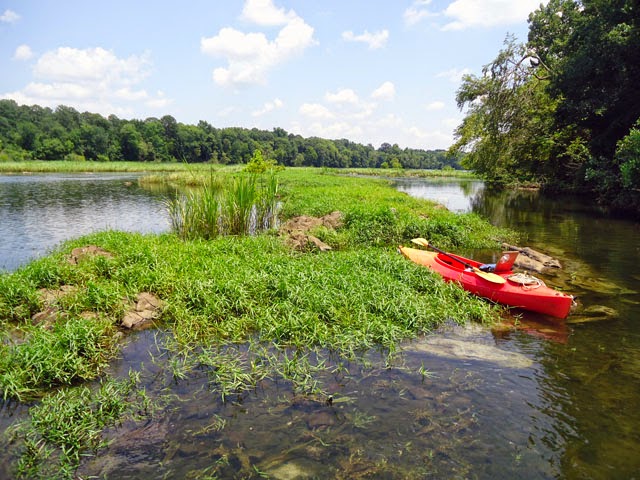
So I picked out a nice Saturday late last month, loaded my kayak into the back of my pickup, and headed up the interstate northwest about 2.5 hours from Charleston to the tailwaters of the Wateree Dam.  And indeed, the adjective “amazing” describes the situation quite well.

The fisherman’s access is on the right (descending) bank of the river.  I launched my kayak and paddled maybe 20 - 30 yards across the main channel about mid-day, to the broad and (in spots) marshy region, dissected by rocky pools and shoals, that extends across the left 90% of the riverbed.  The photo below was snapped in that left-side rocky/marshy region looking downstream.  The photo at the top of this essay was snapped from the same vantage point, looking upstream.
So the third photo in this series is a typical vista looking across one of those rocky pools downstream from the Wateree Dam.  The water levels had been dropping steadily all afternoon on this particular Saturday, reaching an extreme low around 4:30 PM, at which time the horn sounded and the hydro station began to generate.  The photo below was taken around 4:00 PM.
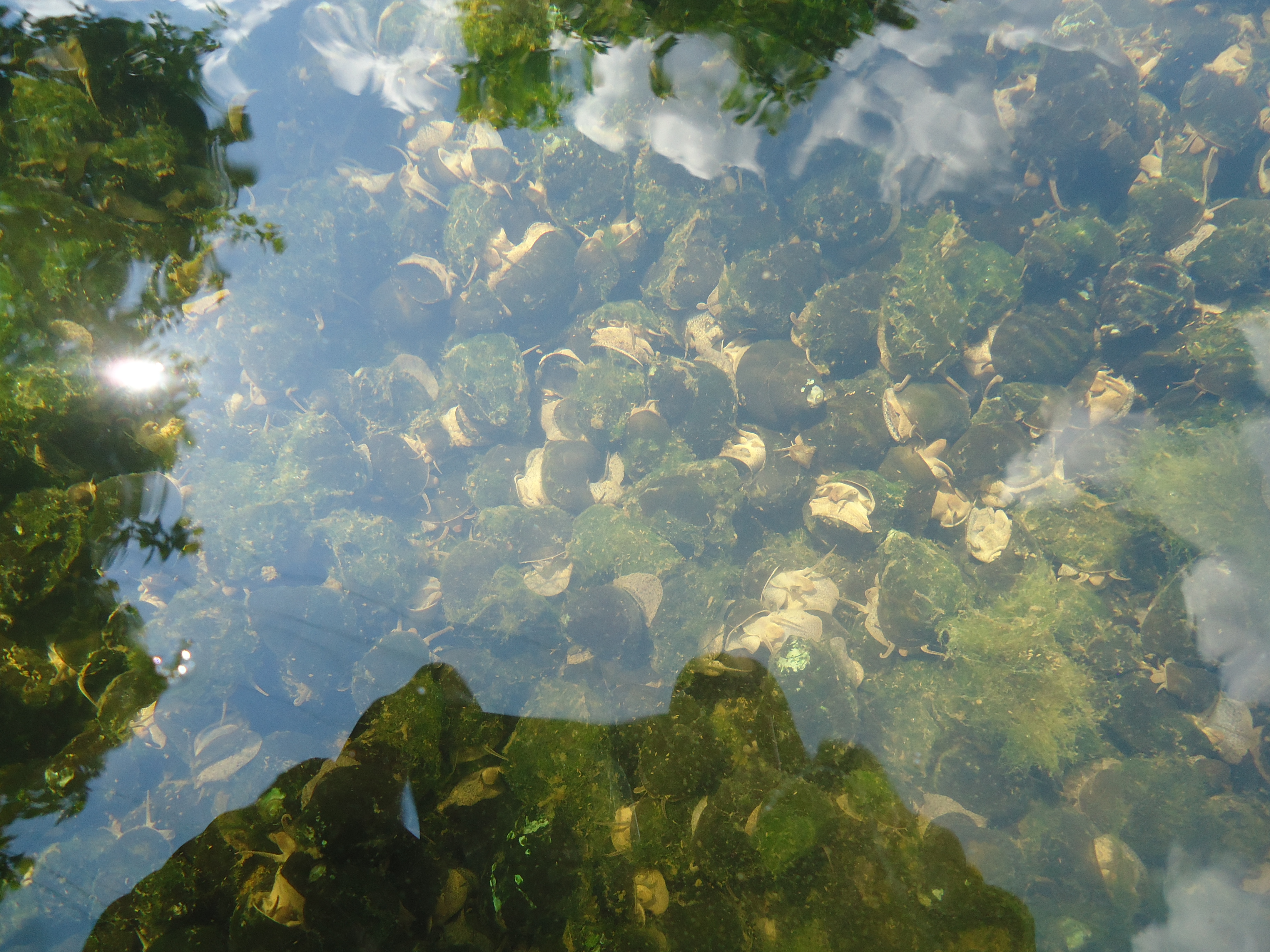
And the next photo was snapped looking directly down through about a foot of clear water, showing that the bottom of a typical channel is essentially a “bed” of gastropods, piled on top of each other, perhaps three or four snails deep.   If you click on the image below you can download a high-resolution (4.5 mb) jpeg, zoom in,  and see that the snails are not grazing.  They are lying on their backs on the bottom of the Wateree River, apparently filter feeding like a bed of mussels.
The ability to filter-feed is fairly well-documented in viviparids [2].  In fact, if you shop in one of those nurseries that specialize in backyard water-gardens, the salesmen will often advise you to purchase “Japanese Mystery Snails” for $1.00 each (or $10 per dozen) to help “clarify” the water in your ornamental lily pond.  Which I think they probably do.

Notice in this next photo that the snails in my net seem to be strikingly uniform in size, all approximately 30 – 40 mm in standard shell length.  It was my impression that the population was comprised almost entirely of the one-year-old age class, probably born in the spring and summer of 2013.  I noticed a few young-of-the-year juveniles the afternoon of my visit, all in the 10 mm size range, and just a couple 60 mm “lunkers,” which must have been 2+ years old.  But overall, the size distribution of the snail population struck me as unusually homogeneous.
So the tide hit dead low at about 4:30 PM, and I started back through the rocky marsh, more dragging my kayak than paddling it.  And I happened to wade through one warm pool with a slightly muddy bottom, apparently not receiving as much current as some of the others.  And when I turned back to look in my wake, this is what I saw:
These are empty shells, of course.  The snail has died and rotted, and the empty shell filled with gas.  I must have kicked up several hundred such “floaters” as I walked back to the channel.

It seems likely to me that the Bellamya population downstream from the Wateree Dam is on the verge of a bust.  Dramatic die-offs of invasive viviparid populations are not uncommon in the southeastern United States [3], occasionally even reaching the attention of the popular press.  I got telephone calls about a stinking Bellamya die-off in Lake Murray on the other side of Columbia a couple years ago, and there was a huge mess on the Neabsco River up in Virginia in 2010, necessitating the deployment of heavy equipment.  But in all cases of my personal experience, the phenomenon is discovered after the crash.  Last month’s observations were the first I have ever personally made during the population flush phase.

The population age distribution was especially interesting to me.  So I loaded my kayak back in my pickup and drove around the fisherman’s access roads to Lake Wateree just above the dam, maybe 300 yards upstream from where I had spent most of the afternoon.  The size distribution of the Bellamya population in the shallows of the reservoir seemed dominated by big lunkers 50-60 mm in shell length, which is normal year-round in the Carolinas, in my experience.  Typically very few animals aged one year and younger will be apparent upon a causal census of a Bellamya population around here.  I took this as evidence that the Bellamya population downstream from the Wateree Dam had reproduced explosively in the last year or so.

“Boom-and-bust” or “flush-crash” population dynamics are a familiar aspect of invasive species biology.  But it is my impression, after a couple hours of poking around the published literature, that about 95% of everything we know is anecdotal [4].  Danielle Haak and her colleagues [5] suggested that a 17-39% die-off of the adult Bellamya population in a Nebraska reservoir was due to “an extreme drought event, which was coincident with abnormally hot weather.”  Moore and colleagues [6] documented the community effects of a Potamopyrgus boom-and-bust cycle in California, reviewing the three most obvious hypotheses to account for the bust (weather, intraspecific competition and predators/pathogens), but not ultimately selecting a favorite [7].

Simberloff and Gibbons [8] conducted an “exhaustive” review of the worldwide literature on population crashes of established introduced species, together with systematic “queries to experts on invasives by particular taxa.”  They observed:
“even quantitative data documenting perceived declines were exceedingly scarce, while the great majority of proposed explanations were simply more-or-less reasonable ad hoc suggestions with no supporting evidence.”
Across the N=17 case studies Simberloff considered the best-documented, four of the putative causes were “competition with other introduced species,” with one case each for “parasitism by subsequently introduced species,” “adaptation by native herbivore,” and “exhaustion of resource.”  And for ten of the 17 best-documented invasive species population busts [9], “there is no strong evidence suggesting a cause.”

One would think, with all the dump trucks full of money being spent to study the causes and consequences of biological invasions worldwide – all the weeds, all the bugs, and all the slugs combined – at least a little funding would be available to study why this problem, at least occasionally, solves itself.  Or am I wrong, again?


Notes

[1] This is the fifth post I have authored in the last ten years on Bellamya invasion.  If you’re interested in digging into the phenomenon, perhaps the best approach would be to first go to the FWGNA pages on Bellamya japonica and the closely-related Bellamya chinensis, read the general biology, and then follow the links from the “Essays” sections at the bottom of those two species pages back to this blog.   So start here:
  • Bellamya japonica [FWGNA]
  • Bellamya chinensis [FWGNA]

[2] See pp 99 – 100 in my book:
Dillon, R. T. (2000) The Ecology of Freshwater Molluscs.  Cambridge University Press.

[3] Invasive viviparids in South Carolina [19Oct03]

[4] The irony that I myself am adding yet another anecdotal report here does not escape me.

[5] Haak, D. M., N. M. Chaine, B. J. Stephen, A. Wong, & C. R. Allen (2013)  Mortality estimate of Chinese mystery snail, Bellamya chinensis in a Nebraska reservoir.  BioInvasions Records 2: 137-139.

[6] Moore, J. W., D. B. Herbst, W. N. Heady and S. M. Carlson (2012)  Stream community and ecosystem responses to the boom and bust of an invading snail.  Biological Invasions 14: 2435-2446.

[7] Have there been similar (local) crashes of Potamopyrgus populations throughout the American West?  This was the impression that I took from the Snake River below Minidoka Dam in 2010, mentioned in footnote #4 here:
  • The Mystery of the SRALP: A Twofold Quest! [1Mar13]

[8] Simberloff, D. & L. Gibbons (2004)  Now you see them, now you don’t – Population crashes of established introduced species.  Biological Invasions 6: 161-172.

[9] Including the giant African land snail Achatina on Pacific islands.