Dr. Rob Dillon, Coordinator


Showing posts with label Genetics. Show all posts

Tuesday, September 23, 2025

Anchored hybrid enrichment, Pleurocerid evolution, and the obovata confirmation

Review: Whelan, N. V., Johnson, P. D., Garner, J. T., Garrison, N. L., & Strong, E. E. (2022). Prodigious polyphyly in Pleuroceridae (Gastropoda: Cerithioidea). Bulletin of the Society of Systematic Biologists, 1(2). https://doi.org/10.18061/bssb.v1i2.8419

Although I myself have never harbored any aspiration to reconstruct a phylogenetic tree [1], I can understand the intellectual appeal of the fancy new whole-genome technique called “Anchored Hybrid Enrichment” (AHE) to the not-insubstantial fraction of my professional colleagues who feel differently.  AHE reminds me of an obsolete technique called single-copy DNA hybridization, which I greatly admired in the 1980s, where pioneering researchers like Sibley & Ahlquist [3] extracted the entire genomic DNA of bird #1 and bird #2, chopped it, melted it to single strands, then cooled it to the temperature that repetitive DNA would reanneal and stick in a hydroxyapatite column, eluting just the single-copy DNA out the bottom.  They would then mark the single-copy DNA of bird #1 with P-32, mix it with a large excess of single-copy DNA of bird #2, melt the mixture again, and gradually elute the mixture back through the hydroxyapatite, cooling slowly, to estimate the similarity of bird #1 and bird #2 across all their single-copy genes together.

The terrible flaw in the technique of single-copy DNA hybridization, as practiced in the 1980s, was that it yielded a matrix of overall genetic similarities across pairs in a set of study individuals, committing the mortal sin of being phenetic.  The Sibley & Ahlquist hypothesis for the evolution of birds disappeared into the footnotes many years ago [4].  If only there were a technique to do exactly the same thing with a bazillion single-character nucleotide differences, that could be sanctioned as cladistic, am I right?

Anchored Hybrid Enrichment [6]

In recent years, the coupling of mind-numbing computer power with high-throughput DNA sequencing technology has spawned a variety of whole-genome phylogenetic techniques (“phylogenomics”) that harken back to the days of Sibley & Ahlquist.  As the name implies, anchored hybrid enrichment [5] depends on the development of “anchors,” DNA probes to target and enrich highly conserved regions within the whole genomes of a set of organisms under study.  The idea is that the regions flanking such probe areas – not the probe areas themselves – are likely to be less conserved, and hence have some utility in phylogenetic construction.

So, in June of 2022 a research group of our own colleagues, headed by Nathan Whelan of Auburn University, published the first application of AHE technology to the reconstruction of a molluscan phylogeny, as far as I know [7].  And it was to the North American Pleuroceridae that their attention was drawn.

Bless their hearts, all five members of the team.  I mean that sincerely.  A lot of what I am getting ready to write over the next couple essays will be critical.  Such is science.  But I do not mean to minimize their innovative spirit, their commendable effort, or their motives, which were the highest.  We really do need a lot more research like this, and a lot more researchers like Nathan Whelan and his colleagues to do it.  Better understanding of the basic evolutionary biology of their living, breathing study animals, before chopping them into massively-parallel chum and high-through-putting them off the stern of a next-generation sauceboat, is all that is wanted.  That, plus some nod toward calibration, for a change.  Oh, and a passing familiarity with the recently published scientific literature on the subject matter would have been really helpful, too.

OK, first.  Regarding the generation of the AHE probes (or “baits”).  Rather than extracting total genomic DNA, the Whelan team extracted mRNA from five pleurocerid species “chosen to maximize phylogenetic diversity,” which we will call “Probe Species A – E.”  Those five mRNA samples were mailed off to Rockville, Maryland, for the generation of transcriptomes, that subset of the genome actually doing something.  I like that.  That’s a good way to factor out junk DNA before stepping up to the starting block.  Ultimately, our colleagues identified 742 baits “present in at least 4 of 5 pleurocerid transcriptomes and larger than 120 bp in length.”

Figure 4 of Whelan et al [7]

These 742 baits were trolled through a school of 192 sharks – and by sharks, I mean the whole genomes of individual pleurocerid snails – representing 92 putative species, with two rays – and by rays, I mean the whole genomes of two individual Juga plicifera from the west coast – to serve as an outgroup.  And I do want to commend the Whelan group for the care and completeness they took in documenting their study sample.  The shells from each of those 194 individual snails were numbered, photographed, and deposited in the USNM.  And complete locality data for all 194 snails were made available in tabular form from the journal website, as well as a big folder of 194 jpeg images.  We who sail in your chum salute you, colleagues.

One could only wish that the actual fishing trip hadn’t turned so fraught with peril.  Total genomic DNA was extracted from those 194 individuals and sent off to Gainesville, Florida, for AHE library prep and sequencing.  Three different datasets were generated by this process, under three different assumptions (masked, probe, and full), and trees generated using two different algorithms (ML and ASTRAL).  The ASTRAL method also involved two assumptions (TaxMap yes or no), yielding N = 9 gigantic, eye-assaulting, headache-inducing phylogenomic trees.  Eight of these trees were consigned to the Supplementary Material.  And the tree that Whelan and colleagues liked best, probe + ASTRAL + TaxMap, was published in the journal article, in circular format, as though we evolutionary biologists were birds looking down upon a tree of sharks, which are actually snails, which the most spectacular mixture of metaphor I have muddled in recent memory.

But when I first laid eyes on Nathan Whelan’s favorite phylogenomic tree for the gastropod family we both so obviously love, I had to smile.  I honestly cannot remember when the result of an evolutionary study gave me more pleasure.

As (I imagine) my loyal readership will remember, in 2014 I published a paper in Zoological Studies [8] extending my research on cryptic phenotypic plasticity to the widespread set of pleurocerid populations variously identified using the specific nomina livescens, semicarinata, and obovata, variously allocated to the genera Pleurocera or Goniobasis or Elimia or Lithasia.  I showed that all of these populations, including those traditionally identified as Lithasia obovata and Elimia semicarinata, are conspecific, their evolutionary relationship obscured by extreme phenotypic plasticity of shell.  See my blog post of [11July14] for a complete review.

The power of a scientific hypothesis is its ability to predict, to yield new information, to give something back that was not put into it.  That Nathan Whelan and his team successfully recovered the close evolutionary relationship between N = 2 snails they identified as “Elimia semicarinata” from the Middle Fork Vermillion River in eastern Illinois and N = 2 snails they identified as “Lithasia obovata” from the Ohio River between Indiana and Kentucky is a demonstration that this new AHE technique can have great power.

Yes, the assumptions that brought us the Whelan et al. phylogenomic tree are as manifold and diverse as shells on the beach, and yes, the opportunities for experimental error were as countably-infinite as the nucleotides.  And yes, the human error introduced into the Whelan study most certainly did reach embarrassing levels at times, as we shall see.

But hiding in the abstract splatter of drab shells and gaily-colored tangle of branches above – yellow Elimia, blue Pleurocera, green Lithasia and purple Leptoxis – is genuinely important insight regarding the evolution of the North American pleurocerid snails.  There is sweet music to be heard in that noise, if one brings an understanding of the biology of those wonderful organisms to the concert.  Which we will do, next time.


Notes:


[1] By way of full disclosure, my colleagues and I did reconstruct a species tree for the Physidae in 2011 [2], which we compared to a gene tree previously published.  But please note that every other treelike diagram I have ever published in my entire career has been a nearest-neighbor or cluster analysis, intended to represent genetic similarities only.  Which I have always oriented sideways, to look as little like a tree as possible.


[2] Dillon, R. T., A. R. Wethington, and C. Lydeard (2011) The evolution of reproductive isolation in a simultaneous hermaphrodite, the freshwater snail Physa.  BMC Evolutionary Biology 11:144. [pdf]


[3] Sibley, C.G. & J.E. Ahlquist (1990) Phylogeny and Classification of birds.  Yale University Press, New Haven.


[4] Prum RO, Berv JS, Dornburg A, Field DJ, Townsend JP, Lemmon EM, and Lemmon AR (2015). A comprehensive phylogeny of birds (Aves) using targeted next-generation DNA sequencing. Nature 526(7574):569-73. doi: 10.1038/nature15697.


[5] For more about Anchored Hybrid Enrichment, see:

  • Lemmon, AR, SA Emme, and EM Lemmon (2012) Anchored hybrid enrichment for massively high-throughput phylogenomics.  Systematic Biology 61: 727 – 744.
  • Lemmon, E.M., and A.R. Lemmon (2013) High-throughput genomic data in systematics and phylogenetics.  Annual Review of Ecology and Systematics 44: 99 – 121.
  • Jones, M.R. and J.M. Good (2016) Targeted capture in evolutionary and ecological genomics.  Molecular Ecology 25: 185 – 202.

[6] This graphical summary is heavily modified from an original illustration by Bas Blankevoort in

Gravendeel, B., D. Bogarin, A. Dirks-Mulder, R. Kusuma Wati, and D. Pramanik (2018) The orchid genomic toolkit.  Cah. Soc. Fr. Orch. 9.


[7] Whelan, N. V., Johnson, P. D., Garner, J. T., Garrison, N. L., & Strong, E. E. (2022). Prodigious polyphyly in Pleuroceridae (Gastropoda: Cerithioidea). Bulletin of the Society of Systematic Biologists, 1(2). https://doi.org/10.18061/bssb.v1i2.8419


[8] Dillon, R. T., Jr.  (2014) Cryptic phenotypic plasticity in populations of the North American freshwater gastropod, Pleurocera semicarinata.  Zoological Studies 53:31. [pdf]. For a review, see:

  • Elimia livescens and Lithasia obovata are Pleurocera semicarinata [11July14]

Tuesday, November 12, 2024

Reticulate Evolution in the North American Pleuroceridae

Last month [15Oct24] we reviewed the evidence that populations of two pleurocerids widespread in the Greater Ohio Drainage, P. laqueata and P. troostiana, hybridize extensively in the rivers and streams of Middle Tennessee.  And our most useful genetic marker was shell plication, a scallop-shaped ridging pattern characteristic of P. laqueata, absent from P. troostiana outside the laqueata range, but variably present in troostiana populations overlapping with laqueata.

Sharing most of those same rivers and streams with both laqueata and troostiana are populations of a third pleurocerid species, P. simplex, our old friend familiar from five previous essays, see footnote [1] below to refresh your memory.  The FWGNA Project recognizes two subspecies of simplex: the typical form found in small streams throughout the greater Tennessee/Cumberland region and a paler, more heavily shelled form common in larger streams of the Cumberland drainage, extending into Central Kentucky, Pleurocera simplex ebenum.

In 1934, Calvin Goodrich [2] published #3 in his “Studies on the gastropod family Pleuroceridae” series, focusing on shell plication.  Here is a verbatim quote from page 5:

G. ebenum (Lea), commonly a smooth species, occurs in the Cumberland River drainage basin. In the upper part of the drainage, material containing plicate shells has been taken. The only lot at hand that can be accepted as a “pure" race of these forms is from New River, Scott County, Tennessee. Of 46 shells from Straight Creek at Pineville, Bell County, Kentucky, 54.4 per cent are plicate. In the Cumberland River a few miles below Pineville, 18 per cent of 72 shells are so sculptured; 74 shells of ebenum taken just above the falls of the Cumberland are 14.8 per cent plicate. The only specimens from the river below the falls which have been seen, taken at Smith's Shoals near Burnside, Pulaski County, Kentucky, are all smooth; so also are shells of all lots of the species ranging as far to the west as streams of Dickson County, Tennessee.”

Yes, all of that is true.  I myself have confirmed at least seven populations of P. simplex ebenum bearing lightly plicate shells scattered about Middle Tennessee, in minor tributaries of the Cumberland, the Harpeth, the Red, and the Duck.  All these populations co-occur with populations of P. simplex bearing normal, smooth shells and populations of (you guessed it) P. laqueata.  The first three shells figured at left below were collected from the backs of pleurocerids inhabiting Brush Creek, a tributary of the Red-Cumberland in Robertson County, NW of Nashville (36.4342, -87.0662): an apparently pure P. simplex, an apparently pure P. laqueata, and what most certainly appears to be a simplex/laqueata hybrid (“castanea”), almost entirely smooth but bearing tiny plications around the apex.

Reticulate evolution in the Pleuroceridae

Exactly as is the case with P. troostiana, P simplex populations inhabiting East Tennessee, where P. laqueata does not occur, never bear plicate shells.  Only where the ranges of P. simplex and P. laqueata overlap in Middle Tennessee does one find pleurocerid populations bearing fat, pear-shaped simplex-looking shells with tiny apical plications.

There is not a shadow of doubt in my mind that P. simplex hybridizes with P. laqueata, just as P. laqueata hybridizes with P. troostiana.  The two shells at right were sampled from Spring Creek east of Nashville, carried over from last month: an apparently pure P. troostiana and a laqueata/troostiana hybrid (“perstriata.”)  This is reticulate evolution.

Digging back through the classic literature, it turns out that Isaac Lea described a Melania castanea in 1841, the shell of which appears to be a perfect match for the simplex/laqueata hybrid populations I have been referring to here.  Lea’s brief Latinate description appeared in that same early work that featured such notables as clavaeformis, ebenum, and edgariana [3], with a longer English description and figure following in 1843 [4].  Lea’s type locality, “Maury County, Tenn.” is in the upper Duck River drainage, where simplex and laqueata are both common.  Calvin Goodrich [5] lowered Lea’s nomen castanea to subspecific status under Goniobasis laqueata in 1940, giving its range as “Headwaters of the Duck River, Tennessee.”

Melania castanea [4]
OK, fine.  Given that we have recognized three subspecific names for laqueata/troostiana hybrids, I suppose it is only fair to recognize a subspecific name for hybrids between P. laqueata and P. simplex.  So, this week I have added a new (sub)species page to the FWGNA website for Pleurocera laqueata castanea (Lea 1841), with corresponding entries in the gallery and dichotomous key for the Tennessee/Cumberland [6].  This is the 135th species or subspecies of freshwater gastropod we have recognized as valid in our 21-state study region.

I am every bit as certain that P. simplex hybridizes with P. semicarinata in Kentucky and Tennessee, although I have no genetic data or photos to enter into evidence.  The two species are only distinguishable by subtle differences in shell shape, the former bearing fatter shells with a larger body whorl, neither demonstrating any sort of shell sculpture (beyond a carinate upper whorl) that might serve as a discrete marker.  The range of P. semicarinata semicarinata overlaps that of P. simplex broadly in the Cumberland, Green, and Kentucky Rivers, and extends much further north, up into Wisconsin, Michigan and New York, where chubby-shelled populations are referred to the subspecies P. semicarinata livescens.

And I am still amazed [7] by the 1994 allozyme study of Bianchi and colleagues [8] demonstrating hybridization between Great Lakes P. semicarinata livescens and the Hudson River population of Pleurocera virginica through the Erie Canal.  Those two species bear strikingly different shell morphologies, have entirely distinct ranges, and could not have shared a common ancestor in many, many millions of years.  Perhaps since the Appalachian Orogeny?
Hybridizing? [9]

Yes, that is my next point.  The architects of the Modern Synthesis generally seem to have considered hybrid zones an unstable and transitory step toward speciation [11].  I am sympathetic with the Darwinian rationale for such an hypothesis, and admit it could certainly hold in many cases.  But more recently the research emphasis seems to have shifted toward hybrid zones that give evidence of stability and permanence [12].

The photo below comes from the 8Mar24 issue of Science [13].  Here’s the caption: “This fish is the hybrid offspring of an alligator gar and a spotted gar – members of genera that last shared a common ancestor at least 100 million years ago.”

The paper reviewed, by Brownstein and colleagues [14], detailed the results of a survey of 1,105 exons over 481 vertebrate species, demonstrating exceptionally slow rates of molecular evolution in gars and sturgeons.  Yet gar species last sharing a common ancestor no later than the Cretaceous still hybridize naturally in the greater Ohio and southern Mississippi drainages today.

Could some cranky, washed-up old crackpot wading those same rivers and streams, throwing snails into a bucket and measuring them with rusty calipers, achieve the same results as an international team of eight scientists from six different institutions with “massive” DNA data sets and ten different sources of funding?

The distribution of pleurocerid snails in the rivers and streams of North America is whispering a story to us in a language that we do not understand.  It is an ancient story of colliding continents and earthquakes and mountains 10,000 feet high, eroding and shifting and washing into the sea.  Most of the pleurocerids of the Greater Ohio drainage, including P. simplex and P. troostiana, range across the entirety of the state of Tennessee, as well as into Kentucky and North Alabama and even into SW Virginia.  Then why are populations of P. laqueata absent East of Chattanooga?  Is their dispersal capability so much poorer than P. simplex and P. troostiana that they are unable to penetrate Walden’s Ridge?  I simply do not think so.  Here is the story that I hear the pleurocerids whispering to me.

The story I hear is that the crest of the ancient Appalachians, at some point in the millions of years of their orogeny, was approximately where Walden’s Ridge lies today, at the eastern edge of the Cumberland Plateau.  Pleurocera laqueata evolved on the west side of that crest, while P. troostiana and P. simplex evolved on the East.  Then the mountains eroded such that the divide shifted east, opening a hole at Chattanooga, switching the flow of the rivers in which troostiana and simplex evolved from east to west, bringing those pleurocerid populations into secondary contact with laqueata.

I have said it many times [15], but I will say it again.  A step off the creek bank in the Southern Appalachians is a step back millions of years.  Look around you, colleagues, look!  Those banks are covered with mosses and liverworts, horsetails and ferns.  The waters team with dragonflies and stoneflies, gars and hellbenders.  And pleurocerid snails jostle each other to graze across every square inch of substrate.

Why does this entire ecosystem seem frozen in time?  My hypothesis calls on three independent sets of factors: environmental, genetic and historical.

First, the freshwater environment is more stable than that of the land.  Water temperatures lag behind and buffer air temperatures.  That buffer is not just seasonal, it is climatological.  The temperature in smaller streams, in particular, typically remains very close to that of the ground, 10 – 15 degrees Centigrade year round.  Such environments are not simply protected from hot Julys, they are protected from ice ages.  And the lower the temperature of the environment, I might add, the slower the generation times of its poikilothermic biota.

Rock Island State Park, TN [16]

Rainfall and storm are similarly buffered.  Droughts obviously have less effect on rivers than on the surrounding land, ditto wind and fire.  The ecosystems of many (especially smaller) bodies of water are based on allochthonous input, rather than primary productivity, and life could more easily survive (let us say) a cometary impact, and a period of worldwide darkness.

Most of the above, it must be admitted, could also be said for the marine environment as well as the freshwater.  This calls upon a second set of factors, which are population genetic.

In two words, marine populations are gigantic and panmictic.  Almost all the mollusks, for example, retain a planktonic larval stage lasting at least a couple weeks, facilitating dispersal over very long distances.  Here on the Atlantic side, the population of commercially important eastern quahogs (“cherrystone” or “littleneck” clams), demonstrates no significant allelic frequency differences at multiple allozyme-encoding loci from Canada to Florida [17].  Ditto oysters, ditto oyster drills, ditto whelks, ditto periwinkles [18].

Consequently, when a beneficial mutation arises in a marine population, it spreads quickly in evolutionary time.  Diseases, predators, and other riders of the apocalypse spread as quickly as the angels.  Speciation is quick, extinction is quick, evolution is quick.  The marine molluscan fauna of the Virginia Pliocene does not look like the marine molluscan fauna of the Virginia Recent.

But for better or worse, freshwater populations are small and fragmented.  Evolution does not stop, of course; the molecular clock keeps ticking [19].  But when adaptations evolve (such as reproductive isolation, for example) they do not spread [20, 21].  The outward appearances of such populations, then, will give the impression of morphological stasis.

So, freshwaters are more environmentally stable than the land, and the populations inhabiting those freshwaters more genetically stable than those inhabiting the sea.  There is a third factor.  History.

The land mass that we today identify as the “Appalachians,” together with the freshwaters that drain those mountains to the ocean, is really, really old.  It is clear that several orogenies have taken place, beginning with the Grenville over one billion years ago, proceeding through the Taconic (500 mybp) and the Acadian (400 mybp), culminating with the Alleghanian Orogeny at the formation of Pangaea 300 mypb.

Did Cerithiacean gastropods crawl from the sea at that time, evolve into the first pleurocerids, disperse and diverge across drainage systems as they existed in the ancient Appalachians hundreds of millions of years ago, and then sit in evolutionary stasis as the mountains wore down around them?  Yes, I think so.

Next month… taxonomic implications.

Postscript:

On 10Feb25 this essay was combined with four companion pieces and published as a pdf separate entitled, "Systematic review of the Pleurocera laqueata/troostiana complex."  That document is available for download as FWGNA Circular No. 8.

Notes:

[1] See the following essays for a review of the biology of Pleurocera simplex, its sibling gabbiana and its subspecies ebenum:

  • The cryptic Pleurocera of Maryville [13Sept16]
  • The fat simplex of Maryville matches type [14Oct16]
  • CPP Diary: Yankees at The Gap [4Aug19]
  • CPP Diary: What is Pleurocera ebenum? [3Oct19]
  • CPP Diary: The spurious Lithasia of Caney Fork [4Sept19]

[2] Goodrich, C. (1934)  Studies of the gastropod family Pleuroceridae – III.  Occasional Papers of the Museum of Zoology, University of Michigan 300: 1 – 11.

[3] Lea, Isaac (1841) Continuation of Mr. Lea's paper on New Fresh Water and Land Shells.  Proceedings of the American Philosophical Society 2: 11 – 15.

[4] Lea, Isaac (1843)  Description of New Fresh Water and Land Shells.  Transactions of the American Philosophical Society 8: 163 – 250.

[5] Goodrich, C. (1940) The Pleuroceridae of the Ohio River drainage system.  Occasional Papers of the Museum of Zoology, University of Michigan  417: 1-21.

[6] Alas, Pleurocera laqueata castanea cannot be retroactively included in the hardcopy FWGNA Volume 5, which came off the presses in the fall of 2023.  In our next edition, however, castanea will be FWGNA species Number 103.2.

[7] See my essay of 3Mar22 for rankings of a broad selection of freshwater gastropod papers by international amazingness units. The paper of Bianchi et al [8] scored a whopping 93.2 iau, good for first place in the population genetics subdivision:

  • The third-most amazing research results ever published for the genetics of a freshwater gastropod population. And the fourth-most amazing, too. [3Mar22]

[8] Bianchi, T. S., G. M. Davis, and D. Strayer 1994.  An apparent hybrid zone between freshwater gastropod species Elimia livescens and E. virginica (Gastropoda: Pleuroceridae).  Am. Malac. Bull. 11: 73 – 78.

[9] From left to right.  Pleurocera simplex simplex from Brush Creek, Robertson Co, TN (see above).  Pleurocera simplex ebenum from the Falls of The Cumberland, Whitley Co, KY [see 3Oct19].  Pleurocera semicarinata semicarinata from Harrison Ck, Nelson Co, KY [see 6Sept17]. Pleurocera semicarinata livescens from Portage Ck, Washtenaw Co, MI [10]. Pleurocera virginica, an especially chubby shell from Deer Ck, Harford Co, MD courtesy R. Aguliar.

[10] “Station 2” of Dazo, B. C. (1965)  The morphology and natural history of Pleurocera acuta and Goniobasis livescens (Gastropoda: Cerithiacea: Pleuroceridae).  Malacologia 3: 1 – 80.

[11] Dobzhansky, T. (1940) Speciation as a stage in evolutionary divergence. American Naturalist 74: 312 – 321.

[12] Barton, N.H. and G.M. Hewitt (1985) Analysis of hybrid zones.  Annual Review of Ecology and Systematics 16: 113-148.

[13] Heidt, A. (2024) Gars truly are “living fossils,” massive DNA data set shows.  Science 383 (6687): 1041.

[14] Brownstein, Chase B, Daniel J MacGuigan, Daemin Kim, Oliver Orr, Liandong Yang, Solomon R David, Brian Kreiser, and Thomas J Near (2024) The genomic signatures of evolutionary stasis.  Evolution 78: 821 – 834. https://doi.org/10.1093/evolut/qpae028

[15] Dillon, R T. and J. D. Robinson (2009)  The snails the dinosaurs saw: Are the pleurocerid populations of the Older Appalachians a relict of the Paleozoic Era?  Journal of the North American Benthological Society 28: 1 - 11.  (Rosemary Mackay Award)  [pdf].  For a review, see:

  • The snails the dinosaurs saw [16Mar09]

[16] The Caney/Collins River system, impounded below Rock Island State Park, was home to at least eight species of pleurocerid snails, including P. simplex [4Sept19], P. troostiana edgariana [5June20] and the pleurocerid megafauna hung in Cousin Bob Winter’s prehistoric necklace as depicted [5Apr22].

[17] The population genetic literature on Atlantic coastal bivalves is very large.  For a review of the Mercenaria case, see:

  • Dillon, R.T. and J.J. Manzi (1992) Population genetics of the hard clam, Mercenaria mercenaria, at the northern limit of its range.  Canadian Journal of Fisheries and Aquatic Sciences 49:2574-2578. [pdf]

[18] For reviews of the genetics of marine gastropod populations on the Atlantic coast, see:

  • Wise, J., M. G. Harasewych, and R. T. Dillon. (2004)  Population divergence in the sinistral Busycon whelks of North America, with special reference to the east Florida ecotone.  Marine Biology 145:1167-1179. [pdf]
  • Dayan, N.S., and R.T. Dillon (1995) Florida as a biogeographic boundary: Evidence from the population genetics of Littorina irrorata. The Nautilus 108: 49-54. [pdf]

[19] An inexorable (but not especially clocklike) accumulation of neutral mutations yields the startlingly high levels of mtDNA sequence divergence often recorded among pleurocerid populations.  And the crazy distribution patterns of those crazy mtDNA sequence markers come from rare long-distance dispersal events which, given hundreds of millions of years of birds wading through these streams and flying off elsewhere, do happen.  For more about my Jetlagged Wildebeest Model of mitochondrial superheterogeneity, see:

  • Mitochondrial superheterogeneity: What we know [15Mar16]
  • Mitochondrial superheterogeneity: What it means [6Apr16]
  • Mitochondrial superheterogeneity and speciation [3May16]

[20] The absence of any correlation between genetic divergence and environmental difference in isolated populations of Pleurocera proxima, together with strong correlations between genetic divergence and geographic distance, supports this hypothesis.  See:

  • Dillon, R.T. (1984) Geographic distance, environmental difference, and divergence between isolated populations. Systematic Zoology 33:69-82. [pdf]

[21] Evidence from Pleurocera proxima transplant experiments is also consistent with the hypothesis that beneficial genomes may be prevented from spread by the isolated character of southern Appalachian streams.  See:

  • Dillon, R.T. (1988) Evolution from transplants between genetically distinct populations of freshwater snails. Genetica 76: 111-119. [pdf]

Tuesday, October 15, 2024

Widespread hybridization between Pleurocera laqueata and P. troostiana in streams of the Tennessee/Cumberland

Editor’s Note – This essay is considerably more data-heavy than we normally post in the columns of this blog.  We apologize in advance.  Readers with the fortitude to slog through a column yard of charts and graphs and regression analyses, however, will be rewarded with a real slam-bang finish next month, I promise you.  So, buck up.

In last month’s essay [18Sept24] we focused on Pleurocera laqueata, a widespread and common inhabitant of streams and rivers in Middle Tennessee, central Kentucky, and North Alabama.  The species was described by Thomas Say in 1829 [1] from specimens collected by Prof. Gerard Troost in the “Cumberland River,” an overly broad region which we ultimately restricted to Browns Creek, running through the state fairgrounds in Nashville.  The topotypic population of P. laqueata bears shells that are variably plicate but never striate, matching Say’s original description.

In direct contrast stands Pleurocera troostiana, also first collected by Prof. Troost [6Dec19] but described a bit later by Thomas Say’s successor at the ANSP, Isaac Lea around 1838 [2].  In its East Tennessee type locality, P. troostiana bears shells that are variably striate, but entirely without plication.  In a painfully detailed and ultimately exhausting series of six essays posted on this blog between December 2019 and July 2020, we reviewed the shell morphological variation demonstrated by populations of P. troostiana across Tennessee, Kentucky, and North Alabama, and the elaborate taxonomy that developed in the 19th century in an attempt to capture it.

So, if you have more than a casual interest in the taxonomy, systematics, and evolution of the North American Pleuroceridae, I would encourage you to go back and click through my 2019 - 20 series on P. troostiana from the links at footnote [3] below and download the pdf summary for your files.  Otherwise, here is a quick summary.

The range of variably-striate-but-never-plicate populations of P. troostiana, which we refer to as P. troostiana troostiana or P. troostiana sensu strictu (s.s.) is shown in blue above.  That is all you will find in East Tennessee.  West of Chattanooga, however, as the Tennessee River breaks through Walden Ridge into Alabama and Middle Tennessee, the range of P. troostiana begins to overlap with the range of P. laqueata, shown as a dashed line.  And populations of P. troostiana bearing shells that are both striate and plicate, variously identified under the subspecific nomina perstriata (yellow), edgariana (red), and lyonii (gray), begin to predominate.  This is not a coincidence.

I have hypothesized that P. troostiana hybridizes with P. laqueata several times previously on this blog, most prominently in my P. troostiana perstriata essay of [15Apr20].  But to show this, we will require a second, independent genetic character of some sort, beyond shell sculpture.  Let me back up a couple steps and refocus this entire essay away from shell sculpture, and toward shell shape.

Quite a few 19th century authorities remarked on the “spire elevation” or slenderness of the P. troostiana shell.  Isaac Lea, in his original description of 1838 [2], remarked that the shell of M. troostiana is “elevated.”  In 1841 Lea described M. teres (a troostiana synonym) as “remarkably elevated, spire much drawn out,” and ditto “spire drawn out” for a second troostiana synonym, M. strigosa [4].  John G. Anthony [5] described his M. arachnoidea (yet another troostiana synonym) as “rather thin, spire slender and much elevated” in 1854.

Now I daresay that no man nor beast who ever held a gastropod shell in hand, nor cracked it open with tooth, nor crushed it with claw, has ever in the history of this wide earth been more sensitive to that portion of the variance in shell shape that is not heritably genetic than the humble author of the present essay [6].  My filing cabinets bulge with papers vividly demonstrating ecophenotypic effects on gastropod shell morphology.  Bulge.  I cannot close them.  They remain ajar, to scar my wife’s shoulders should she dare enter the sanctum sanctorum wherein I lurk, writing quaint and curious blog posts such as this.

Shell shape and shell sculpture in pure populations.

But the heritable component of shell shape in gastropod mollusks is equally undeniable.  Working with Physa acuta in controlled conditions, I have estimated the heritability of simple shell length (SL) as h^2 = 0.429, and that of body whorl length (B) as h^2 = 0.321 [7].  In recent years I have favored the simple regression of shell width on shell length [8], or body whorl height (B) on apex height (SL), as a quick and reliable method of extracting the heritable component of shell morphological variance [9, 10] correcting for the age structure variance inevitable in wild populations.

So, last month I reported the collection of 29 topotypic P. laqueata from Browns Creek in Nashville, mapped as “L” at the top of this essay.  Of those, N = 25 were adults.  I measured total shell length for each (SL) and body whorl height (B), then calculated apex height as SL – B = A.   These data are plotted on the figure above.  The regression of B on A  was A = 0.70B – 1.19 (R = 0.77), a good fit.

I also measured N = 25 shells from a sample of P. troostiana troostiana collected from Steekee Creek at Loudon, Tennessee (35.7252, -84.3482), mapped as “T” way up above [11].  This is the type locality of J. G. Anthony’s (1854) Melania arachnoidea [5], synonymized under Isaac Lea’s Melania troostiana, see my essay of [7Jan20], FWGNA Circular 2 [pdf], or FWGNA Volume 6: 41 – 49 [publications].  The regression of body whorl height on apex height for troostiana was A = 0.98B – 1.11 (R = 0.90), an excellent fit.

Between the two elongated clusters of shell measurements, I have drawn a dashed line corresponding to the function A = 0.7B.  As a convenient approximation, it would appear that the two species can be distinguished by the ratio of shell apex height to body whorl height, greater than 0.7 for P. troostiana and less than 0.7 for P. laqueata.

Example Pleurocera from Spring Creek

So now let’s examine the Pleurocera in habiting Spring Creek (Wilson County, TN), a small tributary of the Cumberland River about 45 km east of the state fairgrounds in Nashville, mapped as “h” way up above (36.1800, -86.2411).  The Tennessee Department of Environment and Conservation took a quantitative sample of the Spring Creek macrobenthos back in August of 2014, using a kick net along three linear meters of creek bank to good effect, returning N = 185 Pleurocera [12].

I subsampled the N = 30 largest adults, measured their shells, and categorized the sculpture on their body whorl, ultimately recognizing (with some head-scratching) N = 9 striate (only), N = 8 plicate (only), and the remainder N = 13 as both striate and plicate.  The result is graphed below.

There is clearly a significant relationship between shell sculpture and shell shape in this sample of 30 pleurocerid snails, such that the fraction bearing smaller body whorls for their apex height (A > 0.7B) tend to bear striation (only) on their body whorl, and the fraction bearing larger body whorls for their apex height (A < 0.7B) bear plication (only) on their body whorl. With just those two open circles misclassified above the dashed line above, the Fisher’s exact probability is p = 0.002 [13].

Shell shape and shell sculpture in Spring Ck.

The most likely explanation for this phenomenon, which we have labeled “character phase disequilibrium” [4Jan22] is nonrandom mating.  The data graphed in the figure above strongly suggest some sort of reproductive isolation between the slender-shelled striate pleurocerid population of Spring Creek and the fat-shelled plicate population.  But the data also suggest that reproductive isolation is incomplete.  The largest fraction of the sample, 13/30 = 43%, seem to be hybrids, bearing both plication and striation on their body whorls.

Pleurocera laqueata and Pleurocera troostiana are distinct, reproductively isolated, biological species that hybridize extensively in rivers and streams throughout Middle Tennessee, southern Kentucky, and North Alabama.  Pleurocera troostiana populations are more common in the small creeks, and P. laqueata in the larger rivers, and the mixed populations in streams of intermediate size may comprise more hybrids than purebreds.

In keeping with taxonomic tradition, let us reserve the name P. laqueata for populations bearing shells entirely without striation, and P. troostiana troostiana for populations entirely without plication.  Then the subspecific nomina perstriata, edgariana, and lyonii will apply to the hybrids, according to their degree of shell sculpture.

OK, fine.  What might such widespread hybridization suggest about the evolution of the Pleuroceridae in North America?  Tune in next time.

Postscript:

On 10Feb25 this essay was combined with four companion pieces and published as a pdf separate entitled, "Systematic review of the Pleurocera laqueata/troostiana complex."  That document is available for download as FWGNA Circular No. 8.

Notes:

[1] Say, T. (1829) Descriptions of some new terrestrial and fluviatile shells of North America.  New Harmony Disseminator of Useful Knowledge 2(18): 275 – 277.

[2] Lea, Isaac (1838-39) Description of New Freshwater and Land Shells.  Transactions of the American Philosophical Society (New Series) 6: 1 – 154.

[3] Dillon, R.T., Jr.  (2020) The four subspecies of Pleurocera troostiana (Lea 1838), with synonymy.  FWGNA Circular 2: 1 - 5. [pdf]  This is a summary document for the observations, arguments, and hypotheses I advanced in a series of six blog posts to the FWGNA Blog:

  • On The Trail of Professor Troost [6Dec19]
  • CPP Diary: The Many Faces of Professor Troost [7Jan20]
  • Huntsville Hunt [15Apr20]
  • A House Divided [10May20]
  • What is Melania edgariana? [5June20]
  • The Return of Captain Lyon [6July20]

[4] Brief Latinate descriptions:

  • Lea, Isaac (1841) Proceedings of the American Philosophical Society 2: 11 – 15.

More complete English descriptions with figures:

  • Lea, Isaac (1843)  Description of New Fresh Water and Land Shells.  Transactions of the American Philosophical Society 8: 163 – 250.

[5] Anthony, J.G. (1854) Descriptions of new fluviatile shells of the genus Melania Lam., from the western states of North America.  Annals of the Lyceum of Natural History of New York 6: 80 -132.

[6] In fact, I have designated an entire topic entitled “phenotypic plasticity” in the list of “labels” at the right margin of the present blog.  If you click that link you will find 24 essays (as of October 2024) touching upon the component of shell phenotype that is not heritably genetic.  Among the most prominent:

  • New clothes for The Emperor [7Feb23]
  • Elimia livescens and Lithasia obovata are Pleurocera semicarinata [11July14]
  • Pleurocera acuta is Pleurocera canaliculata [3June13]
  • The Lymnaeidae 2012: A clue [9July12]
  • Shell morphology, current, and substrate [18Feb05]

[7] Dillon, R. T., Jr. & S. J. Jacquemin (2015)  The heritability of shell morphometrics in the freshwater pulmonate gastropod Physa.  PLoS ONE 10(4): e0121962. [html] [pdf]  For a review, see:

  • The heritability of shell morphology in Physa h^2 = 0.819! [15Apr15]

[8] Wethington, A.R., J. Wise, and R. T. Dillon (2009) Genetic and morphological characterization of the Physidae of South Carolina (Pulmonata: Basommatophora), with description of a new species.  The Nautilus 123: 282-292.  [pdf]

[9] Dillon, R. T. & J. D. Robinson (2016) The identity of the "fat simplex" population inhabiting Pistol Creek in Maryville, Tennessee.  Ellipsaria 18(2): 16-18. [pdf]  For a review, see:

  • The fat simplex of Maryville matches type [14Oct16]

[10] Dillon, R. T. (2016)  Match of Pleurocera gabbiana (Lea, 1862) to populations cryptic under P. simplex (Say, 1825).  Ellipsaria 18(3): 10 - 12.  [pdf]  For a review, see:

  • One Goodrich Missed: The skinny simplex of Maryville is Pleurocera gabbiana [14Nov16]

[11] I would have preferred to do these measurements on a sample of troostiana from Lea’s type locality at Mossy Creek, about  50 miles NE of Steekee Creek, but my sample size is insufficient.

[12] The gallon jug containing this (whole, unsorted) bulk sample was released to me by TNDEC-DWR personnel in Nashville on 14Jan21.

[13]  Here I count cases above the line and striate = 9, above and plicate = 2, below and plicate = 6, below and striate = 0.  The Fisher’s exact probability of that relationship between shell shape and shell sculpture would be p = 0.002.

Wednesday, August 7, 2024

Cytoplasmic Male Sterility in the Snake River Physa

Editor’s Note – This is the fourth installment of my three part series on the Snake River Physa controversy.   So if you’re interested in all the public policy craziness surrounding the nominally endangered Physa natricina, I would recommend that you back up to my posts of [14May24], [11June24], and [2July24] before proceeding.  If you’re just interested in the science, on the other hand, you might want to refresh your memory with  my [9June22] essay on cytoplasmic male sterility.

Last month we reviewed a mtDNA sequence dataset collected by Mike Young and colleagues [1] from “The Twelve Phascinating Physa of Bliss,” a small sample taken by IPC/FWS biologists from the tailwaters of the Bliss Dam in the Snake River of Idaho in 2019.  That sample included N = 4 snails bearing a CO1 sequence so strange and divergent that our buddy Mike hesitated even to assign it to the genus Physa.  He called the four snails bearing that sequence “Snake River Candidate Species 3,” or SRCS3 for short.

Blasting Mike’s SRCS3 sequences against the entire worldwide NCBI GenBank, we confirmed that OK510774 (taken as typical for the set of four) was more similar to a planorbid from Bangladesh than to any other physid sequence ever reported, “with five phascinating exceptions.”  SRCS3 was approximately 93% similar to two Physa sequenced in Singapore [2], and three Physa sequenced in South Africa [3].

With those little scraps of data in front of us last month, I speculated that SRCS3 might be a strain of Physa acuta demonstrating cytoplasmic male sterility (CMS).  And at that point I abruptly shifted focus to a remarkable paper published in 2022 by my good friend Patrice David and colleagues, reporting very similar levels of mtDNA sequence divergence in a French strain of Physa acuta unable to mate in the male role, but nevertheless fully fertile as female [4].  Could the Snake River – Singapore – South Africa sequence signal the existence of a second case of CMS, a mitotype strikingly different both from the normal, simultaneously hermaphroditic (N) strain and the divergent, male-sterile (D) discovered by Patrice and his team?

Yes.  Two days after I posted last month’s essay I sent an email to Patrice, subject line “Shout-out on the FWGNA blog,” the entire body of which simply read, “I thought you might be interested to see how your 2022 paper on cytoplasmic male sterility could have an impact on conservation biology here in the USA.”  And Patrice replied with a pdf reprint that knocked my socks off [5].

The paper was published in Evolution by Patrice’s student Fanny Laugier, working with a team of nine coauthors from Montpellier and Villeurbanne [6].  Although available in preprint since March, it just appeared in the physical journal last month.  But let’s back up two steps before we leap forward three.

Cytoplasmic male sterility is well studied in plants.  And given the accelerated rates of mutation demonstrated by mitochondria hosting CMS genes, I do not suppose it is surprising that natural populations of gynodioecious plants often host multiple, independently evolving CMS lines.

And as I mentioned in my essay of [9June22] natural populations of gynodioecious plants hosting CMS mitochondria have also often evolved nuclear genes that restore male fertility.  This results from the selective advantage that a fully functional hermaphrodite has over other members of its population reproducing strictly as a single sex [7].

So, reasoning from numerous well-documented cases in plants, Fanny and her team returned to the Physa populations around Lyon originally studied by Patrice and his colleagues to look for additional CMS strains.  And sure enough, prospecting around with a clever PCR test, they found seven individual snails in two populations bearing a “mitotype K,” startlingly different from both normal hermaphroditic N and the CMS mitotype D they had reported in 2022.

My readership might also remember from [9June22] that CMS mitotype D was, around the entire mitochondrial genome, approximately 44% different from the normal Physa acuta mitotype N.  The 20% CO1 sequence divergence between those two mitotypes was actually less than average.  So the newly discovered mitotype K ultimately proved to be 35% - 57% divergent from N and 35% - 57% divergent from D (ten genes), with CO1 sequence divergences 23% and 28%, respectively.  This is the phenomenon I have termed “mitochondrial superheterogeneity” in many previous posts on this blog [8].

And can you smell what our French chefs are cooking?  Focusing now on the CO1 sequence, the French CMS strain bearing the newly discovered mitotype K matched Ting Hui Ng’s [2] Singapore sequence and Molaba’s [3] South Africa sequence 100%, almost identically.  And the match with Mike Young’s [1] SRCS3 sequence from the Bliss Rapids was 93%, just as I reported last month.  Fanny Languier, Patrice David, and their colleagues had discovered a strain of Physa acuta bearing a wildly divergent mitochondrion worldwide in its distribution.

Laugier [6] Figs. 1B and 1C, modified.

But that is not the headline news.  Here is the headline.  Mitotype K Physa acuta were not male-sterile!  Our French colleagues cultured up a big batch of Mitotype K Physa and were easily able to cross them with their albino N laboratory line [9], both lines copulating readily in both the male and the female role.

So again, reasoning from many years of accumulated research on cytoplasmic male sterility in plants, Fanny and her team suspected that nuclear genes might have evolved in the mitotype K line to restore male function.  And they launched a 17 – generation introgression experiment to insert mitochondrial lineages derived from their wild-caught (pigmented) K line into the “naïve” nuclear background of their (albino) laboratory line N.

And sure enough!  After just 5 generations of introgression, 69% of the naïve snails bred to bear K-type mitochondria had lost their ability to mate as males, with no such loss whatsoever in control lines bearing the N-type mitochondria.  After 11 generations, the proportion of naïve male-sterile K snails stabilized at around 60%.  No loss in female function was ever detectable in any line.  In my 5July24 email back to Patrice, I wrote:

“Wow, nuclear restorers!  It's a shame we work with crap-brown little trash snails.  If snails were maize, wheat, or rice [10], we'd be rich.”

What wonderful science!  Deductive reasoning, tested by rigorous experimentation carefully designed to proceed from the known to the unknown.  Conducted for the joy of it, for the exploration of evolutionary mechanisms, for the pushing back of the darkness.  The construction of testable hypotheses about the natural world, period, full stop, nothing more and nothing less.  Pure and unsullied science, utterly useless and wonderful!

Laugier [6] Fig. S1, modified.

And yet, it turns out, completely by accident, useful.  Ting Hui’s study in Singapore was directed toward invasive species, the Molaba study in South Africa was parasitological, and Mike Smith’s study on the Snake River directed toward conservation.  Fanny’s results contribute toward an understanding of all those results, and more.

And here is Lesson Number One.  Gene sequences are not species.  A species is a population or group of populations reproductively isolated from all others [11].  Sequence divergence is typically correlated with reproductive isolation [12], of course, no different from morphological divergence.  But gene trees are not species trees, and genes are not species.

So, as I pointed out in last month’s essay [2July24], the Snake River line of Physa acuta that Mike Young and colleagues called SRCS3 is not the same as the French mitotype K.  The two lines are 7% different, as though they arose from a single mutation in some mitochondrial DNA repair gene sometime in the past and have subsequently diverged.  Could such a mutation have occurred more than once in the evolutionary history of the Physidae, here in North America, where Physa seem to have first evolved?  You betcha.

There is no reason that the CO1 gene sequence that Gates, Kerans and colleagues [13] recovered from the stunted Physa below the Minidoka Dam, roughly 15% different from the N line at Bliss (OK510580), couldn’t be evidence of yet another CMS strain in Physa acuta.  Gates and Kerans identified that sequence as “Physa natricina.”  But gene sequences are not species.  Species are defined by reproductive isolation.  And we have no data on reproductive relationships between the Minidoka population and the dirt-common Physa acuta downstream whatsoever.  And plenty of evidence otherwise [14].

Nor is there any reason in the world that the peculiar mitotype shared by Mike Young’s SRF14, the Owyhee Wet Rock Physa of eastern Oregon [15] and scattered in odd lot Physa populations from California to British Columbia couldn’t be evidence of a CMS strain in Physa gyrina.  MtDNA sequence data, and the gene trees we make with them, are (at best) weak null models of population relationships, correlated with speciation, nothing more [16].

Do not misunderstand me.  I am not demanding controlled breeding studies between every pair of the 2.2 x 10^6 species described from Planet Earth.  But for nominally endangered species, such as Physa natricina, before we enact pages of Federal regulations and spend millions of dollars on conservation, we could at least run a couple of $12 allozyme gels and test for evidence of assortative mating [17]  with a nuclear polymorphism or two, am I right?

Notes

[1] Young, M.K., R. Smith K.L. Pilgrim, and M.K. Schwartz (2021)  Molecular species delimitation refines the taxonomy of native and nonnative physinine snails in North America.  Scientific Reports 11: 21739. https://doi.org/10.1038/s41598-021-01197-3

[2] Ng, T.H., Tan, S.K. & Yeo, D.C. (2015) Clarifying the identity of the long-established, globally-invasive Physa acuta Draparnaud, 1805 (Gastropoda: Physidae) in Singapore. BioInvasions Rec. 4, 189–194.

[3] Molaba, G.G. et al. (2023) Molecular detection of Fasciola, Schistosoma and Paramphistomum species from freshwater snails occurring in Gauteng and Free State provinces, South Africa.  Veterinary Parasitology 320: 109978.  https://doi.org/10.1016/j.vetpar.2023.109978

[4] David, Patrice, Cyril Degletagne, Nathanaëlle Saclier, Aurel Jennan, Philippe Jarne, Sandrine Plénet, Lara Konecny, Clémentine François, Laurent Guéguen, Noéline Garcia, Tristan Lefébure, Emilien Luquet (2022) Extreme mitochondrial DNA divergence underlies genetic conflict over sex determination.  Current Biology 32: 2325 - 2333.  https://doi.org/10.1016/j.cub.2022.04.014.  For a review, see:

  • Cytoplasmic Male Sterility in Physa! [9June22]

[5] Patrice went on to apologize “I told my PhD student Fanny a dozen times to send this to you, that you would probably make good use of it because it was solving a controversy, apparently she didn’t, so I do it myself.” Yes, please send me your reprints!  I lost my library privileges when I was banned from campus in 2016.  I really haven’t had access to most of the scientific literature published since.

[6] Laugier, Fanny, Nathanaëlle Saclier, Kévin Béthune, Axelle Braun, Lara Konecny, Tristan Lefébure, Emilien Luquet, Sandrine Plénet, Jonathan Romiguier, and Patrice David (2024) Both nuclear and cytoplasmic polymorphisms are involved in genetic conflicts over male fertility in the gynodioecious snail, Physa acuta.  Evolution 78 (7): 1227–1236. https://doi.org/10.1093/evolut/qpae053

[7] Yes, mitochondria bearing CMS genes are “selfish” in the sense of the Richard Dawkins (1976) classic.   Don’t get me started on Richard Dawkins.

[8] Mitochondrial superheterogeneity (mtSH), where two or more of the members of a single population demonstrate greater than 10% divergence in any single-copy mtDNA gene, not sex linked, seems to be remarkably common in freshwater gastropods.  In pulmonate populations, I wouldn’t be surprised if most or all mtSH is ultimately traceable to CMS.  In prosobranch populations, however, I think mtSH is a signature of great age, plus low-frequency long distance dispersal, the “Jetlagged Wildebison Model.”  Here is a sample of my previous posts on mtSH:

  • The Snails the Dinosaurs Saw [16Mar09]
  • Mitochondrial superheterogeneity: What we know [15Mar16]
  • Mitochondrial superheterogeneity: What it means [6Apr16]
  • Mitochondrial superheterogeneity and speciation [3May16]
  • Mitochondrial heterogeneity in Marstonia lustrica [3Aug20]

[9] Dillon, R.T. and A.R. Wethington (1992) The inheritance of albinism in a freshwater snail, Physa heterostropha. Journal of Heredity 83:208-210. [pdf]  For nice review, see:

  • Albinism and sex allocation in Physa [5Nov18]

[10] The clever manipulation of cytoplasmic male sterility, together with nuclear restorers, has been one of the more important methods by which plant breeders have achieved the outcrossing of normally self-pollinating crop plants.  I am quite sure that a lot of money has been made with that genetic technology.  With Physa acuta, however, the prospects are not as lucrative.

[11] This is the biological species concept, most closely associated with the work of Ernst Mayr.  It should need no restatement, much less a defense.  But the best paper Jerry Coyne ever wrote was a defense of both Mayr and his species concept, here:

  • Coyne, J. A. (1994) Ernst Mayr and the origin of species.  Evolution 48: 19 – 30.

[12] Dillon, R. T., A. R. Wethington, and C. Lydeard (2011)  The evolution of reproductive isolation in a simultaneous hermaphrodite, the freshwater snail Physa.  BMC Evolutionary Biology 11:144. [html] [pdf].  For a review, see:

[13] Gates, K. K., B. L. Kerans, J. L. Keebaugh, S. K. Kalinowski & N. Vu (2013) Taxonomic identity of the endangered Snake River physa, Physa natricina (Pulmonata: Physidae) combining traditional and molecular techniques.  Conserv. Genet. 14: 159-169.  For a review, see:

  • The Mystery of the SRALP: No Physa acuta were found [2May13]

[14] Rogers, D.C. & A.R. Wethington (2007) Physa natricina Taylor 1988, junior synonym of Physa acuta Draparnaud, 1805 (Pulmonata: Physidae).  Zootaxa 1662: 45 - 51.  For a review, see:

  • Red flags, water resources, and Physa natricina [12Mar08]

[15] Moore, A.C., J.B. Burch, and T.F. Duda Jr. (2015) Recognition of a highly restricted freshwater snail lineage (Physidae: Physella) in southeastern Oregon: convergent evolution, historical context, and conservation considerations.  Conservation Genetics 16: 113 – 123.

[16] I have made this argument as many times as the number of essays listed under the label “Gene trees” above.  For an overview, see:

[17] For an explanation of gametic phase disequilibrium, its power to distinguish species, and its extension to character phase disequilibrium, see:

  • What is character phase disequilibrium? [4Jan22]
  • Character phase disequilibrium in the Gyraulus of Europe [4Feb22]
  • Just 125 Species of Pyrgulopsis in the American West [7Sept22]

Wednesday, September 7, 2022

Just 125 species of Pyrgulopsis in the American West

Editor’s Notes - If you are looking for something citable, the gray-literature report upon which the following essay is based can be downloaded as FWGNA Circular #6 from footnote [1] below.  This essay was subsequently published as: Dillon, R.T., Jr. (2023b)  Just 125 species of Pyrgulopsis in the American West.  Pp 233 – 242 in The Freshwater Gastropods of North America Volume 6, Yankees at The Gap, and Other EssaysFWGNA Project, Charleston, SC.

In July [6July22] we reviewed the career of the USNM-Smithsonian’s Dr. Robert Hershler, for over 30 years the undisputed authority on the hydrobioid freshwater gastropods of North America.  Running our finger through the checklist that my buddy Bob published with Hsiu-Ping Liu in 2017 [2], we counted “126 species of Pyrgulopsis inhabiting the waters of the Western United States, 107 of which Bob Hershler was the author.”

Journey back with me now to a bleak Tuesday morning in May of 2020.  The ivory towers of Academia were locked and bolted, the store shelves stripped bare of toilet paper [3], the streets silent save for the rattle of wooden handcarts, and rhythmic appeals to bring out the dead.  And I opened my email inbox and found a message from Hsiu-Ping.  She asked me if I would be “interested in working on a project to determine the species status of Pyrgulopsis vinyardi and P. gibba.”  And here was my reply:

“Well, OK, maybe.  It would take me a while to get up to speed on the Western hydrobioids, and the maximum speed I could ever achieve would look like standing still, next to Bob Hershler.  But Bob’s not taking any more laps around the track, and I am.”

Thus encouraged, sort-of, Hsiu-Ping proceeded to lay out the situation.  Bob had described Pyrgulopsis gibba from the northwestern Great Basin Desert of California, Nevada, and Oregon in a relatively small paper published in 1995 [4] and followed with a description of P. vinyardi endemic to "two springs in the Squaw Valley drainage" of north-central Nevada in his big monograph of 1998 [5].  The two bore shells strikingly different in the relative size of their body whorls, and penises notably different in their morphologies as well.

Pyrgulopsis vinyardi [5] and P. gibba [4]

Regarding penial morphology, see the figure below.  I have marked the part of the penis that actually does the job, really just a simple filament, with the red letter “P.”  Everything else in Bob’s dorsal-and-ventral figures labelled P. vinyardi (boxed), and in his three dorsal-and-ventral figures labelled P. gibba, is the ridiculously enlarged and elaborate penial lobe characteristic of Pyrgulopsis. If you’re curious to see a whole mount of the actual organ itself, look back at my July post [6July22].

The distribution of glandular regions on the surface of this spatulate or blade-shaped lobe has for many years been considered diagnostic of hydrobiid species.  Bob has marked dorsal glands as “Dg,” ventral glands as “Vg” and terminal glands as “Tg.”

Bob wrote in his description of P. gibba: “This species is unique among members of the genus (as of 1995) in having penial ornament of terminal gland, Dg3, and ventral gland.”  He went on to observe, however, “Dg3 often present, either as a small papule (sometimes double) or large raised unit.”  Note the modifier, “often.”  Bob figured one P. gibba penis that had no Dg3 at all.  See the Dg3 regions encircled in red.  And in 1998 he noted that the development of the ventral gland often varies as well.

Penial morphology, modified from Hershler [6]
In his description of P. vinyardi three years later, Bob wrote, “Penial ornament a small terminal gland, large Dg1, small Dg2, small Dg3, additional dorsal gland on lobe, and large ventral gland.”  So, upon dissection, P. vinyardi males are expected to demonstrate the entire smorgasbord of glands, including everything seen on P. gibba plus Dg1 and (usually) Dg2.  He noted later, however, that Dg2 was “rarely absent.”

The obvious analogy is to “lock-and-key” reproductive isolation such as has been widely documented across the Phylum Arthropoda, except that the gastropod lock is a bag, and the gastropod key is a sock.

I'm not buyin' it!
I’m skeptical.  In the case of Physa, with which I do have a great deal of experience, even very different penial morphologies do not preclude mating [7].  There is (indeed) some prezygotic reproductive isolation between biological species of Physa, but it is behavioral (or possibly chemical) on the part of the snail mounted as female.  My personal observations do not suggest that mechanical barriers play a significant role in interspecific copulation in gastropods.

And besides.  Anybody who has walked through the weeds by a pond on a warm summer night, or hell, anybody who has a friend with a male dachshund, you all know.  Males will do it with anything.  Coke bottles.  It just does not matter.

So, both Bob’s 1995 description of P. gibba and his 1998 description of P. vinyardi were published absent any genetic data, before he met Hsiu-Ping.  Between 2003 and 2008 Bob and Hsiu-Ping did, however, publish mitochondrial CO1 gene sequences for three individual P. gibba and one P. vinyardi [9].  And it materialized that gibba and vinyardi are very similar genetically, mtDNA percent sequence divergence ranging just 0.5% to 1.1%.

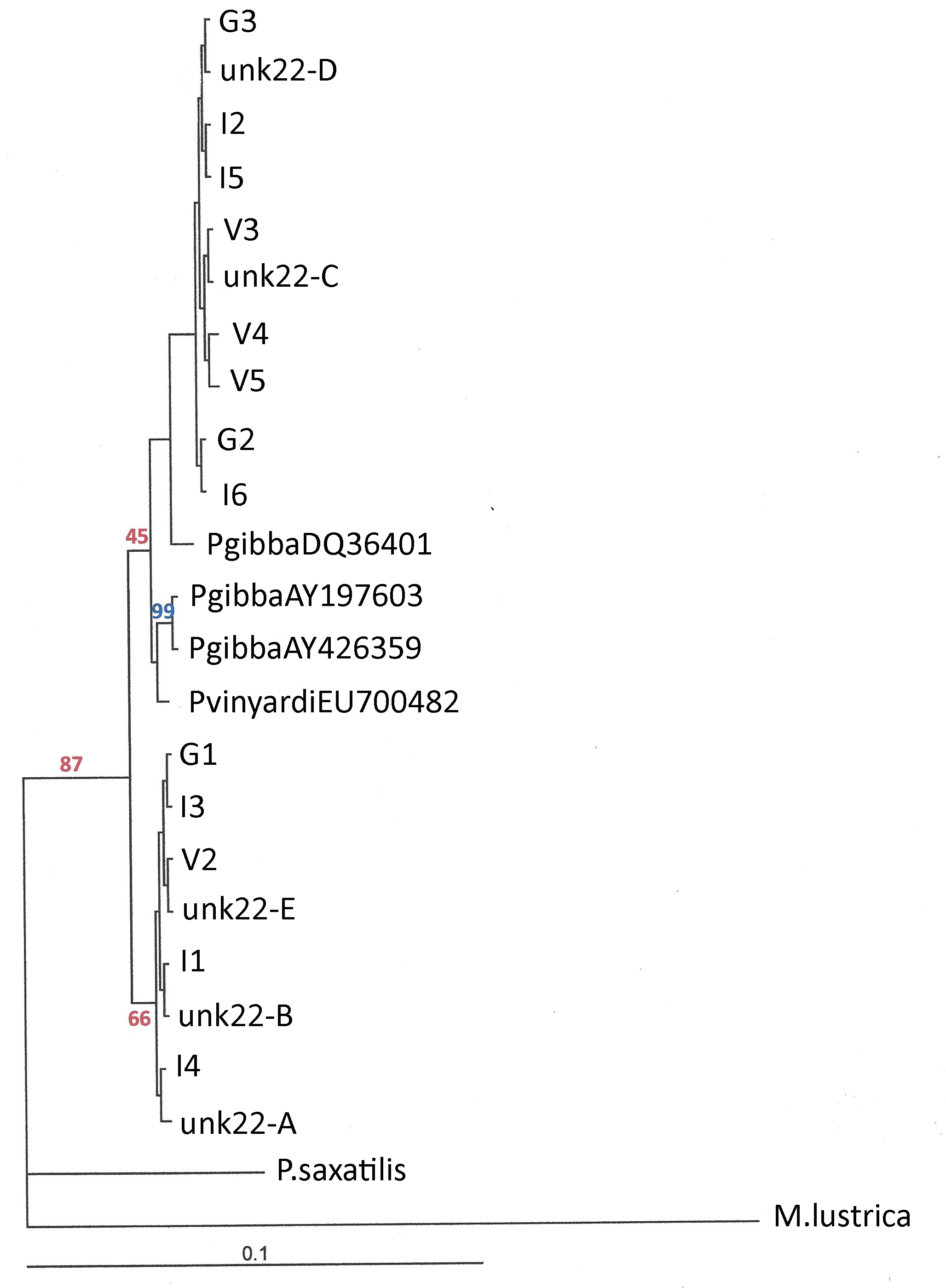
All of which now brings us back up to the dark days of May 2020, and my email exchange with Hsiu-Ping.  Hsiu-Ping explained to me that she had recently agreed to provide molecular identifications for a set of 21 Pyrgulopsis samples [10] collected from northern Nevada by Ms. Diana Eck of the environmental consulting firm, Stantec.  And that she had sequenced the CO1 gene from approximately 4 – 6 individuals from each population, for a total sample size of N = 88.  The Baysian tree below shows the N = 29 unique CO1 haplotypes Hsiu-Ping discovered, with unidentified population number (“unk”), setting aside duplicates.  Also shown are the three control P. gibba sequences from GenBank, and the one control P. vinyardi.

CO1 sequence diversity in N. Nevada Pyrgulopsis

So, the second branch of the tree does indeed divide the control vinyardi from the control gibba, as one might expect.  But look at the samples from unidentified population #22, collected 23 miles NE of Lovelock, Nevada.  Sequences 22-A and 22-B cluster with vinyardi, while sequence 22-C clusters with gibba!  Could this be evidence that Spring #22 is inhabited by both P. gibba and P. vinyardi?  And that the two populations demonstrate reproductive isolation in sympatry?  My knowledge of the vast and weighty literature is far from encyclopedic, but I cannot recall any case of sympatric Pyrgulopsis species ever previously documented in the American West.

Hsiu-Ping and I resolved to test population #22 for character phase disequilibrium [11].  And so it came to pass that in June of 2020 a fresh sample of Pyrgulopsis collected from population #22 arrived on my doorstep, courtesy of Ms. Eck.  My half of the study was to dissect these snails and characterize their penial morphology as either matching P. vinyardi or matching P. gibba.  Then sending the residual tissues to Hsiu-Ping, she would characterize the individuals as either matching vinyardi or matching gibba by their CO1 gene sequence.  A significant relationship between penial morphology and CO1 sequence would suggest reproductive isolation within the sample, confirming the specific distinction between vinyardi and gibba.

Pyrgulopsis from Site 22

And so, I went to work with tiny forceps and even tinier dissecting needles, cracking and dissecting 30 adults [12], identifying 15 females and 15 males.  I ignored dg3, which is an unreliable character.  Then five males demonstrated both dg1 and dg2, matching P. vinyardi.  Three males did not demonstrate either dg1 or dg2, matching P. gibba.  And seven males demonstrated either dg1 or dg2, intermediate between gibba and vinyardi.  And in July of 2020 I forwarded 15 little tubes onward to Hsiu-Ping, 5 marked G for gibba, 3 marked V for vinyardi, and 7 marked I for intermediate.

The Baysian tree below shows Hsiu-Ping’s results for 13 of the 15 snails I dissected (setting aside 2 duplicate sequences), plus all five of the sequences she obtained from Ms. Eck’s original sample, plus the four control sequences from GenBank.  Hsiu-Ping’s analysis did resolve two sort-of distinct clusters of CO1 sequence within population #22, but those two clusters did not correspond to penial morphology, nor indeed, did they correspond especially well to the four CO1 sequences previously deposited in GenBank, three from nominal gibba and one from nominal vinyardi.  There is no pattern in the distribution of samples labelled G, V, and I.

Hence there is no evidence of character-phase disequilibrium between penial morphology and CO1 sequence in Pyrgulopsis population #22.  Hence there is no evidence of reproductive isolation between P. gibba and P. vinyardi.  The gray-literature report we filed with Ms. Eck on 22Oct21, available for download as FWGNA Circular #6 from footnote [1] below, concluded “that P. gibba and P. vinyardi should be synonymized into one species.”  My buddy Bob’s (1995) gibba would have priority over his (1998) vinyardi.

From Liu & Dillon [1]

OK, I know that’s a lot of technical detail for a silly, frivolous blog post.  So come back up to the surface with me and let’s take a big, fresh breath of air together.  Look at those two little shells I figured at the top of this essay, and then look at those four sets of penis diagrams four column inches below.  Both of the shells figured above, and all of those penises, were borne by a single biological species of Pyrgulopsis.

I should conclude this essay, however, emphasizing once again that science is the construction of testable hypotheses about the natural world.  Science is not right, it is testable.  And over the course of a distinguished career spanning almost 40 years, my buddy Bob rigorously constructed 126 testable hypotheses about the Pyrgulopsis fauna of the great American West.  One day, I feel sure, somebody will come behind him and test the 125 that remain. I cannot imagine when, or by whom.  Not it.


Notes

[1] Liu, H-P, and R. T. Dillon, Jr. (2021) Resolving the species status of Surprise Valley Pyrg (Pyrgulopsis gibba) and Vineyard Pyrg (Pyrgulopsis vinyardi).  Report to Stantec Environmental Consulting. FWGNA Circular 6: 1 – 5. [pdf]

[2] Hershler, R. & H-P. Liu (2017) Annotated Checklist of Freshwater Truncatelloidean Gastropods of the Western United States, with an Illustrated Key to the Genera.  US Bureau of Land Management Technical Note 449: 1 – 142.

[3] We always used pine cones when I was growing up, too poor for corn cobs.

[4] Hershler R. 1995. New freshwater snails of the Genus Pyrgulopsis (Rissooidea: Hydrobiidae) from California. The Veliger 38(4): 343-373.

[5] Hershler R. 1998. A systematic review of the hydrobiid snails (Gastropoda: Rissooidea) of the Great Basin, western United States. Part I. Genus Pyrgulopsis. The Veliger 41: 1-132.

[6] The boxed figure of the P. vinyardi penis was scanned from figure 39 of Hershler [5], showing dorsal aspect on the left and ventral aspect on the right.  The remainder of the figure, showing penial morphology for three different P. gibba males, was scanned from figure 12 of Hershler [4].  Again, dorsal aspect on the left, ventral on the right.  Abbreviations Dg = dorsal gland, Vg = ventral gland, Tg = terminal gland, P = penial filament.  The Dg3 region is encircled.

[7] The literature on prezygotic reproductive isolation in Physa is extensive.  Here’s a good entry:

  • Dillon, R.T., A.R. Wethington, and C. Lydeard (2011) The evolution of reproductive isolation in a simultaneous hermaphrodite, the freshwater snail Physa.  BMC Evolutionary Biology 11: 144. [html] [pdf]

[8] Penial morphology of Pyrgulopsis sadai, from Hershler [5], figure 39.

[9] The three CO1 sequences for P. gibba and the one sequence for P. vinyardi were published in four different papers:

  • Hershler, R., Frest, T.J., Liu, H.-P., Johannes, E.J. 2003a. Rissooidean snails from the Pit River basin, California. Veliger 46:275-304.
  • Hershler, R. and Liu, H.P. (2004) A molecular phylogeny of aquatic gastropods provides a new perspective on biogeographic history of the Snake River Region. Mol. Phylogenet. Evol. 32 (3), 927-937.
  • Hershler, R., Liu, H.-P. 2008. Ancient vicariance and recent dispersal of springsnails (Hydrobiidae: Pyrgulopsis) in the Death Valley system, California-Nevada. In: Reheis, M.C., Hershler, R., Miller, D.M., eds. Late Cenozoic drainage history of the southwestern Great Basin and lower Colorado River region: geologic and biotic perspectives. Geological Society of America Special Paper 439:91-101.
  • Hershler, R., Liu, H.-P. and Gustafson, D.L. (2008) A second species of Pyrgulopsis (Hydrobiidae) from the Missouri River basin, with molecular evidence supporting faunal origin through Pliocene stream capture across the northern continental divide. J. Molluscan Stud. 74 (4), 403-413.

[10] Ms. Eck actually sent 22 populations for analysis, but population #11 turned out to be a lymnaeid.  So just 21 populations of Pyrgulopsis.

[11] In January of 2022 I defined character phase disequilibrium as “any violation of independent assortment between one or more morphological characters and one or more characters of demonstrably genetic origin.”  Although CPD can arise from any violation of the assumption of random mating, the most likely explanation in Spring #22 would be reproductive isolation.  See:

  • What is character phase disequilibrium? [4Jan22]
  • Character phase disequilibrium in the Gyraulus of Europe [4Feb22]

[12] Actually I messed up a few, so no count.