Dr. Rob Dillon, Coordinator


Wednesday, May 26, 2004

Somatogyrus in the Southeast - Darkness, Confusion, and a New Hope


I have spent most of my professional career in the company of researchers more knowledgeable of the Hydrobiidae than I. So on the (increasingly frequent) occasions when I collect hydrobiids myself, or have them sent to me by others, or field inquiries from workers around the country regarding this enigmatic family, I have tended to "pass the buck." Or I have done a slapdash job. The purpose of this essay it to record my own personal awakening regarding strikingly similar members of three hydrobiid genera, Amnicola, Gillia, and (especially) Somatogyrus, of considerable conservation interest here in the American southeast. This will be a confession of sorts, addressed to several of my colleagues to whom I have supplied erroneous information in the past, and (I hope) a spur for the reexamination of assumptions that may have been made in similar situations by others elsewhere.

Had I been asked ten years ago for an accounting of the hydrobiid fauna of South Carolina, I would have certainly listed Gillia altilis (the type locality of Gillia being the Santee Canal north of Charleston) and perhaps added Amnicola limosa. The only previously published SC list is that of Mazyck (1913) who includes "Amnicola sp." as well as Gillia. These two vanilla-looking snails are nearly indistinguishable on paper, although Amnicola is smaller, with two ducts on its verge, while the verge of the larger Gillia is single-ducted. But I have always thought of A. limosa as a species of northern lakes, rather than South Carolina swamps, and the NatureServe Explorer database lists Gillia alone.

And in fact, when I first began seriously surveying the freshwater gastropods of this state in connection with the FWGNA project in the mid-1990s, I did begin finding little vanilla-looking hydrobiids with double-ducted verges in slow-moving lowcountry streams which I identified as A. limosa, as well as a smattering of vanilla-looking hydrobiids in the midlands and upstate with single ducts, which I called "Gillia altilis."

The occurrence of Somatogyrus in South Carolina never crossed my mind. The primary reference to Somatogyrus is that of Walker (1904), who described two species from Atlantic drainages further north: S. pennsylvanicus from the Susquehanna River and S. virginicus from the Rapidan River. And the relevant couplet in Burch's key to the Hydrobiidae offers this choice: "Shell generally thick and solid, columella thickened. Mississippi and Gulf of Mexico drainage (except S. pennsylvanicus and S. virginicus) - Genus Somatogyrus" or "Shell rather thin, columella not thickened. Atlantic drainages from NJ to SC - Gillia altilis." This turns out to be a bit misleading, because Thompson described a third Somatogyrus from an Atlantic drainage in 1969 (S. tenax from the Broad River, a tributary of the Savannah) and Krieger added a fourth from the Alcovy and Yellow Rivers (of Georgia's Altamaha System) in 1972. But Fred Thompson himself, in a presentation at the American Malacological Society meeting last June, indicated that he was unaware of any hydrobiids other than Gillia and perhaps Amnicola in South Carolina.


Lower left - Somatogyrus virginicus (Chauga River, SC). Center - Gillia altilis (Charleston Museum specimen, topotypic from the Santee Canal). Upper right - Amnicola grana (Salkehatchie River at Yemassee, SC). Lower right - Amnicola limosa (Salkehatchie R., Bamberg Co., SC).

Looking back, I suppose my awakening began upon hearing Charles Watson's excellent talk at the FMCS meeting in Chattanooga in 1999. Watson reported that he was unable to distinguish among any of the three (nominal) species of Georgia Somatogyrus (tenax, alcoviensis, and rheophilus of the Flint River, a Gulf drainage) "using the characters given in the literature for separating these species." Watson continued, "The supposedly diagnostic characters appear to be subject to more variation than the original authors realized." Watson's paper also highlighted to me how very close the Broad River of Georgia is to the Chauga River of South Carolina, which is inhabited by a population of hydrobiids I'd assumed to be Gillia.

My awakening was completed just last year, when I first critically examined bona fide Gillia in Walker's collection at the University of Michigan. Adult Gillia commonly bear shells in the 7 - 8 mm range, but the snails I'd been calling "Gillia" in SC were rarely much more than 4 - 5 mm. And bona fide Gillia are not heavily shelled, which makes sense for the Carolina lowcountry canal that was the type locality. So the small, very heavily-shelled snails I'd been finding on rocky substrates in the midlands and upstate must be Somatogyrus, not Gillia!

Currently I have records of at least three Somatogyrus populations in SC, inhabiting the Chauga River and Stevens Creek of the Savannah drainage and the Big Cedar Creek of the Broad/Santee drainage near Columbia. And in the course of a larger survey of the southeast currently underway with my colleagues Brian Watson, Tim Stewart, and Will Reeves, we have discovered populations in the Uwharrie, Green, and Eno Rivers of North Carolina. We have unconfirmed reports of Somatogyrus in the James River of Virginia. Just two weeks ago I rediscovered Somatogyrus in the Rapidan River, the type locality of S. virginicus, where it had been feared extinct.

I have compared the morphology of these populations to topotypic S. tenax from the Broad River of Georgia, as well as to S. alcoviensis from the Apalachee River, and found all populations indistinguishable. There are no recorded anatomical differences - all Somatogyrus have simple single-ducted verges with no accessory lobes or crests. Thompson differentiated his S. tenax from S. virginicus by shell character only - "by its smaller size, sloping unshouldered whorls and perforate shell." But the shells born by all populations I have examined show quite variable adult size, shoulder shape and umbilical perforation. It seems clear that a single species of Somatogyrus is widely distributed in piedmont streams from Virginia to Georgia, and that the nomen S. virginicus has priority. It also seems likely to me that this same species extends (or has extended) up to the Susquehanna River in Pennsylvania and down to the Gulf drainages of Georgia, under the aliases S. pennsylvanicus and S. rheophilus.

In retrospect, two factors contributed to the long darkness I suffered regarding hydrobiids in the southeast. One was an over-reliance on historical distribution records, which must reflect collection effort. I assumed that Somatogyrus did not occur in the Carolinas because I could find no record of it, but now it would appear that there is no record of it because nobody has ever really looked. And the second factor was the reliance I have placed on written descriptions, dichotomous keys and published illustrations, rather than on bona fide specimens. Burch's couplet is correct in its first half - the shell of Somatogyrus is indeed much more "thick and solid," and its columella is indeed "thickened" compared to Gillia, and if I had compared shells of genuine Gillia to my specimens, I wouldn't have made mistakes for so many years.

The South Carolina Hydrobiidae are compared above. To be complete, I have included a fourth hydrobiid species from this state, the much-undercollected Amnicola grana. Amnicola grana is as vanilla as the other three local species in shell morphology, but bears an operculum that blossoms from multispiral to paucispiral as it ages, and never reaches much more than 3 mm. I've only recorded it from a few sites in the South Carolina lowcountry, but a rigorous effort would doubtless uncover more.

Somatogyrus alcoviensis has a "global conservation status" of G1 (critically imperiled) on the NatureServe Explorer database, S. virginicus is ranked G1G2 (imperiled) and S. tenax is G2G3 (vulnerable). There's also mention of a "Somatogyrus sp. 1 from North Carolina" in the NatureServe database, with no suggestion regarding conservation status. So the good news is that the single species, S. virginicus, properly understood to range from Virginia to Georgia, is not is not as endangered as some have feared. But the bad news is that Gillia altilis is probably not as widespread as previously believed. I have not seen any specimens recently collected from this state, and its range (almost strictly Atlantic coastal plain, according to Thompson 1984) has been heavily impacted by urbanization. And so the closing moral of this essay is an old one, which bears repeating. The accuracy with which we target our conservation efforts is critically dependent upon an understanding of the distribution, abundance, and taxonomy of the creatures we intend to protect.

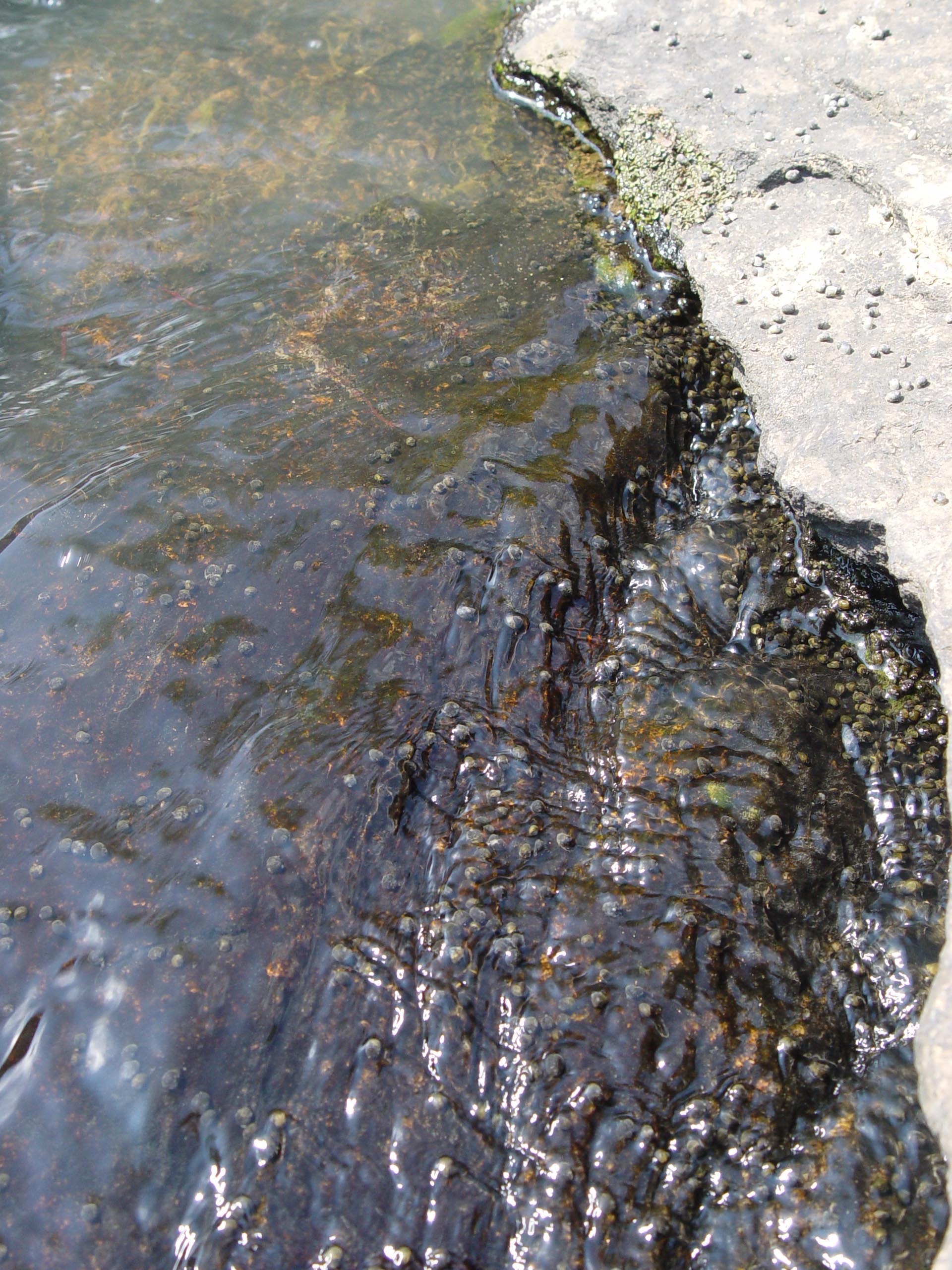
The figure below shows strikingly high densities of Somatogyrus on rocky shoals in the Apalachee River, Georgia, May 2004. Some individuals have been stranded by lowering water levels. Click on the figure and zoom in for a closer look in the cracks.


References

Krieger, K. A. (1972) Somatogyrus alcoviensis, a new gastropod species from Georgia (Hydrobiidae). Nautilus 85: 120 - 125.
Mazyck, W. (1913) Catalog of Mollusca of South Carolina. Contributions from the Charleston Museum, Vol. II. (P. Rea, ed.). Charleston, SC, Charleston Museum. 39 pp.
NatureServe Explorer: http://www.natureserve.org/explorer/index.htm
Thompson, F. (1969) Some hydrobiid snails from Georgia and Florida. Quart. J. Florida Acad. Sci. 32: 241-65.
Thompson, F. (1984) North American freshwater snail genera of the hydrobiid subfamily Lithoglyphinae. Malacologia 25: 109-141.
Walker, B. (1904) New species of Somatogyrus. Nautilus 17: 133-142.
Watson, C. (2000) Results of a survey for selected species of Hydrobiidae (Gastropoda) in Georgia and Florida. In Freshwater Mollusk Symposia Proceedings, Part II, eds. Tankersley, Warmolts, Watters, Armitage, Johnson & Butler, pp. 233 - 244. Columbus: Ohio Biological Survey.

Tuesday, March 23, 2004

Report from Tuscaloosa


I'm pleased to report that registration topped 100 at the FMCS gastropod workshop at the University of Alabama last week. The weather was warm, the facilities adequate, and our hosts most gracious. A good time was had by all.

FMCS president Tom Watters opened the water quality portion of the conference Monday and Ken Brown spoke on the status of freshwater snails in the southeast Tuesday, both talks I was sorry to miss. The meat of the gastropod conference was served on Wednesday, with 9 talks of 30 - 45 minutes each, organized systematically. The nice young folks making the presentations were all well-prepared and thorough, compensating for lack of experience with extra measures of enthusiasm. Perhaps the main message of the day was that identifying freshwater gastropods ain't brain surgery. A bit of background, a key reference or two, patience and willingness to learn are all one really needs. Here's a download of the workshop "Primer":

Perez, Clark, & Lydeard (2004) FMCS Freshwater Gastropod Identification Workshop [PDF]

Most of the Wednesday presenters were, to borrow Kathryn Perez's apt turn of phrase, "channeling Dr. Burch." The two exceptions were Amy Wethington, with her Ph.D. dissertation on the Physidae recently defended, and (of course) Jack Burch himself. Jack used the occasion to repeat his long standing quibbles with Hubendick's (1951) monograph on the Lymnaeidae, arguably the greatest work on any family of mollusks ever published. He prefers a modification of the systematic arrangement of F. C. Baker which, innocent of the modern synthesis, was based almost entirely on shell characters. Jack reviewed some micro-Ouchterlony results he obtained years ago which seem to support the Baker classification. I would love to see these data published in the peer-reviewed literature, where they might be objectively evaluated.

Amy Wethington has 15 years of direct experience with the Physidae and co-authorship of about a dozen peer-reviewed papers on various aspects of their biology. Her classification, based on hundreds of DNA sequences, allozymes, anatomy, reproductive biology and ecology, would reduce the number of North American species from 40 to about 10, and genera from four to two. Oddly, the editors of the meeting's Gastropod Identification Workbook preferred* the 23 - genus classification of Taylor (2003), based on features of penial anatomy only Dr. Taylor can see, which if they exist, are demonstrably immaterial to the snails themselves. Amy paid for a 20-page supplement out of her own pocket, fairly and objectively reviewed all competing classifications of the Physidae, and emerged as the hero of the meeting. Here's a download of Amy's Supplement:

Wethington, A. R. (2004) Family Physidae [PDF]

Thursday's presentations dealt with overarching topics, especially taxonomic methods and ecological applications. The highlight of the day for me was a dispatch from the front lines of freshwater gastropod conservation couriered by Steve Ahlstedt and Paul Johnson. Steve reviewed his many years of transplantation experiments with Io, and Paul reported his more recent successes with captive propagation. I used my presentation on freshwater gastropod distribution and ecology to introduce a new web resource, the Freshwater Gastropods of South Carolina.

A nice variety of freshwater gastropods, both the living and the dead, kept mute witness on the side tables during the two day event. The "show-your-shells" social Wednesday evening was a big hit - I myself learned quite a lot from the interesting assortment of specimens carted to Tuscaloosa from the four corners of this great land. Laurels are due to meeting chairman Chuck Lydeard and his hardworking young colleagues David Campbell, Stephanie Clark, Kathryn Perez and Jeffrey Sides. Well done everybody!


*P.S. Chuck Lydeard has asked me to forward to the group an explanation for his choice of the Taylor classification over the Wethington classification for the Physidae chapter of FMCS Workbook. Apparently it was easier to format the poorer classification to fit strict workbook guidelines.


---------[From Chuck Lydeard 25Mar04]-------------

As co-editor of "A Primer to Freshwater Gastropod Identification" (Perez, Clark, and Lydeard), I would like to explain our decision to opt for Taylor's (2003) classification scheme of the Physidae for the workbook. First, we chose to adopt rather strict guidelines for ALL authors to follow including a brief introduction of the family, a small table giving a few species and their conservation rank, and a general description and illustration for each genus in the family. The oral presentations were also supposed to adhere to the guidelines offered for each family account. Taylor (2003) offers the latest published account of the family. Taylor's anatomical renderings for each genus are very useful and provide an opportunity for the reader to see the entire male reproductive tract with labels. Taylor has about 40 years of experience with freshwater mollusks including physids, so he is certainly knowledgeable about the group. Of course, our use of Taylor (2003) should not be construed as an endorsement of his findings, nor should it be construed as a dismissal of Amy Wethington's dissertation findings. I was Amy's dissertation advisor, so I certainly appreciate and value what she accomplished during her time as one of my graduate students. However, I did not think all the intra-generic details she was willing to provide was necessary for the workbook and certainly would have altered our format appreciably. In closing, we are pleased with the workbook and feel it fulfills its purpose as a primer to gastropod identification reasonably well. We hope you will all look to the future for published phylogenetic studies about various freshwater families of gastropods.

Best,
Chuck Lydeard

Friday, December 19, 2003

FMCS Gastropod Workshop

To The FWGNA Group:

Registration is now open for the Freshwater Mollusk Conservation Society's Gastropod Workshop, to be held in conjunction with a water quality conference at the University of Alabama this March. The Water Quality conference is scheduled for March 15 - 16, with the gastropod workshop to follow on March 17 - 18. A single registration fee gets you into both events!

We'll review the freshwater gastropod families systematically on Wednesday the 17th, with a team of fresh young scientists as our guides (and Jack Burch, as well!) On Thursday we'll turn to the biology and conservation of our favorite critters, wrapping up with a discussion of the nascent "National Strategy" for freshwater gastropod conservation and recovery.

The conference chair is Dr. Paul Johnson and the local arrangements contact is Chuck Lydeard .

See you all there!
Rob

Wednesday, October 29, 2003

Invasive Viviparids in South Carolina

Editor’s Note – This essay was subsequently published as: Dillon, R.T., Jr. (2019d)  Invasive viviparids in South Carolina.  Pp 1 – 5 in The Freshwater Gastropods of North America Volume 4, essays on Ecology and Biogeography.  FWGNA Press, Charleston.

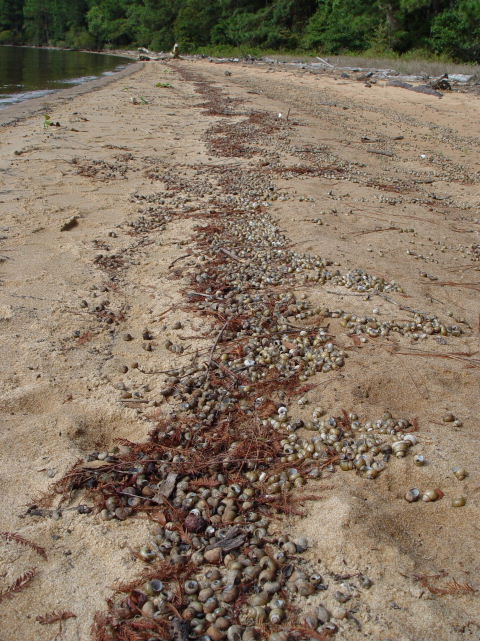
Several weeks ago I had an opportunity to revisit the shores of Lake Marion, a large impoundment of the Santee River about 50 - 60 miles west of Charleston. I was stunned to discover the sandy beaches covered by wracks composed almost entirely of millions of viviparid shells (figure at left). The shells were a striking mixture of approximately 95% Viviparus subpurpureus and 5% V. georgianus. This is, to my knowledge, the first report of V. subpurpureus in an Atlantic drainage, as well as the first report that this species can be invasive.

Lake Marion and its sister, Lake Moultrie, were impounded for hydroelectric purposes in the early 1940s. I have visited them casually every couple years since the early 1980s, and had no observations of viviparids through the mid-1990s. I first noticed Viviparus georgianus in Lake Moultrie in 1997, but didn't think too much about it. Georgianus is a fairly well known invader, distributed from Florida up to Quebec according to Clench & Fuller (in Burch), but "mainly in the Mississippi River system."

Viviparus subpurpureus is a similar animal, although its shell has more flatly-sided whorls and appears more triangular in outline than globose. Subpurpureus is very rarely banded, while the shell of V. georgianus almost always bears color bands. Shells of the two species are compared at right. Burch quotes Clench & Fuller's range for V. subpurpureus as including the Mississippi River system north to Iowa, plus several river systems in Texas, Louisiana & Mississippi.

The co-occurrence of both viviparid species in a single lake is rather spectacular. Mr. Larry Woodward of the USFWS Santee National Wildlife Refuge on the north shore of Lake Marion is a native of the area, and does not recall seeing snails (of any sort) until the lakes suffered record low water in the summer of 2002. At that point, living snails were very common on exposed aquatic vegetation. Large volumes of dead shell only began materializing on the beaches this summer, apparently related to the rise in water level that has occurred over the last 12 months. Mr. Mike Spivey, the Manager of Santee State Park on the south shore of Lake Marion, also first noticed snails in the summer of 2002, and similarly attributes the current abundance of dead shell to the rise in lake levels.

Although most individuals in the small sample of V. georgianus I collected in 1997 were around 30 mm standard shell height, essentially all the beach shells I observed earlier this month, of both species, were in the 13 - 20 mm range. This seems consistent with a year of growth. All were quite clean and beginning to bleach a bit, apparently dead for several months. Both Lakes Marion and Moultrie have suffered serious aquatic weed problems in the recent past. Hydrilla was first discovered in the 1980s, and by the mid-1990s covered more than 40,000 acres of the 156,000 lake system. I think the best hypothesis is that viviparids may have been introduced to the lakes along with the weeds in the early to mid-1990s, but that their population densities remained below detection. Some aspect of the severe drought of 2002, followed by the high waters of 2003, caused viviparid populations to explode to the point that they have called attention to themselves.

To be complete, I should also mention that the large viviparid Bellamya japonica has also been reported in South Carolina recently. My colleague Jim Glover of the SC Department of Health & Environmental Control sent me a specimen collected in June from Lake Greenwood, an impoundment of the Saluda River about 40 miles west of Columbia. Although this was my first record of Bellamya in SC, Jay Cordeiro has called my attention to a 1996 record from the Jonesville Reservoir near Spartanburg.

Bellamya (above, 64.5 mm) reaches a much larger adult size than Viviparus and is another famous invader, native to the orient and apparently spread by "water garden" hobbyists. It is often referred to the genus "Cipangopaludina," but I agree with Doug Smith [Nautilus 114: 31-37] that Bellamya has priority.

I don't know of any obvious adverse environmental consequences attributable to viviparid invasion, and it's tempting to write off big impoundments like Lakes Marion and Moultrie as disturbed environments in any case. But I would be curious to hear from any of my colleagues regarding your observations on invasive viviparids in other regions of the country, especially any other records of V. subpurpureus invasion.


Friday, July 25, 2003

Leptoxis plicata Release

To the FWGNA Group,

As many of you are aware, Paul Johnson (current chairman of the FMCS Gastropod Committee) has been working for several years to artificially propagate Leptoxis plicata, the federally endangered pleurocerid snail endemic to Alabama's Black Warrior drainage. Earlier this week he wrote to inform us of the successful release of almost 5,000 yearlings back to the wild. He suggests that this may be the first release of an artificially cultured endangered freshwater snail in the United States. I think it may be the first anywhere in the world, ever. Congratulations, Paul!

Paul sent us an article from the Sunday edition of the Birmingham (AL) News which offers a pretty good overview of the project and is mostly accurate. [Paul's notations are in brackets.] We join him in thanking Paul Hartfield of the USFWS and Stan Cook of AL-DCNR for making this small but important step possible.

Keep the faith!
Rob


---------[Birmingham News 07/20/03]----------

At a Snail's Place
Scientists release critters to breed in Locust Fork
JERRY BAKER News staff writer

Hoping to reverse a trend that began decades ago, research scientists released 4,876 snails Saturday into the Locust Fork of the Black Warrior River near Kimberly. It was the first of five annual releases planned in hopes of restoring the population of a federally endangered species. Though small, the plicate rocksnail is a cornerstone species upon which all the other animals living in the river depend, said Paul Johnson, a research scientist with the Tennessee Aquarium Research Institute. The snail lives beneath large, flat rocks and eats algae and organic matter; it is food for turtles and fish.

Sixty years ago, the half-inch-long snail was so plentiful in the Locust Fork that a person standing anywhere in the river's shoals would have a couple dozen snails under each foot, Johnson said. Now those snails are almost gone, victims of pollution and sediment washed into the river. Once found along the entire length of the river, their numbers have diminished so much that they are found in only a few shoals along a 20-mile stretch between Interstate 65 and U.S. 78, about 2 percent of their original habitat.

Johnson and several assistants carried the snails to the river in three one-gallon buckets in a cooler. He let the buckets sit for a while in shallow water to adjust their water temperature, then sprinkled the snails in an area where the water was a couple of inches deep. The released snails are the offspring of 100 he collected from the river in March 2002 from shoals near Sayre. Saturday's release is a result of five years of research and development, Johnson said. "This is aimed at trying to develop the techniques for restoring freshwater snails, especially in the Mobile River Basin," Johnson said. The Warrior River is a part of the Mobile River Basin. The basin is one of the most biodiverse in the world, Johnson said. It also is one of the most troubled. Of the 60 species of freshwater snails that have become extinct in North America, 42 of them are from the Mobile River Basin.

Eleven snail species are listed by the U.S. Fish and Wildlife Service as threatened or endangered, and eight of them are from the Mobile River Basin, he said [clarification - 11 listed species in AL only]. Sediment from development and strip mining along the rivers has washed into the streams and covered up the snails' habitat. Pesticides and herbicides also have contributed to snails' dwindling numbers, he said. The release site near Kimberly was chosen because Johnson said he knows snails can survive there. He found one snail after a couple of hours of searching a couple of months ago but came across none in a search last week.

Johnson will visit the river several times a year to monitor the snails. Each is marked with a one-millimeter tag affixed with dental cement, he said. The tags help researchers monitor the progress of the snails and ensure the same ones won't be used for breeding stock every time [clarification - adult broodstock was tagged, not the juveniles]. This fall he will release the 97 survivors of the original 100 he removed last year as breeding stock. He will put those back where they came from near Sayre [error - this was completed last year, and no adult mortality has been associated with 2003 propagation efforts].

Johnson plans to collect more each spring, and later in the summer he will release more. Johnson hopes to improve his technique so that about 10,000 1-and 2-year-old snails will be released each summer.

With conditions along the river improving, Johnson hopes his repopulation efforts will give the snail the boost it needs to survive. "They can take themselves out from the brink of extinction," Johnson said. "We've just got to give them a chance.

------------------------------------------

Wednesday, April 23, 2003

How To Study and Collect Freshwater Gastropods


Some of you may be familiar with the classic AMU publication, "How To Study and Collect Shells." That 100-page booklet, last published (in its fourth edition) in 1974, was very popular among hobbyists and collectors of all backgrounds for years. It featured a nice little chapter on freshwater snails written by F. C. Baker in 1941.

Three years ago Charlie Sturm (of the Carnegie Museum) accepted the task of editing a new, completely updated version of the old chestnut. I was honored to be asked to contribute the freshwater snail chapter, following in the footsteps of one of my heros. I put together about ten pages of general background information on the biology, ecology, and conservation of our favorite animals, with tips on collecting and keeping them in aquaria, all aimed at a very general audience.

Alas, publication of this promising resource has been delayed for several years*. In the interim I have received many requests for information on freshwater gastropods from the public at large, and have occasionally furnished manuscript versions of my chapter to the outreach offices of various natural resources agencies, public school teachers, and so forth. So I've decided (with Charlie's permission) that the time has come to make the chapter generally available.

Dillon, R. T. (in press) Freshwater Gastropods. In Sturm, C.F., T.A. Pierce & A. Valdes (eds.), The Mollusks: A Guide to Their Study, Collection and Preservation. American Malacological Society, Pittsburgh, PA. [PDF]

Feel free to copy and circulate this document wherever it can do some good. It is citable as a chapter from a forthcoming AMS publication. I'll let you all know* when the actual booklet finally hits the presses.


*PS - Ultimately published in 2006:
The Mollusks: A Guide to Their Study, Collection and Preservation
http://universal-publishers.com/book.php?method=ISBN&book=1581129300

Thursday, March 20, 2003

Report from RTP


As many of you are aware, we enjoyed a marvelous three days in Raleigh-Durham at the FMCS meeting. I'm pleased to report that our plan to hold a freshwater gastropod workshop in 2004 has been approved by the FMCS Board. Almost all of the discussion at our gastropod committee meeting lunchtime Monday was devoted to kicking around ideas and plans for this most important event. We did squeeze in a bit of time to elect Paul Johnson as the new chair of the committee, and re-elect Ken Brown as co-chair. Congratulations Paul and Ken!

The following message from Paul is self-explanatory. Please send any feedback to Paul and/or me at your earliest convenience!

Dear FMCS Gastropod Committee Members,

My thanks to John Alderman, Judith Radcliff, the folks at NC-State for the terrific job hosting the 2003 FMCS Symposium. The NC State/DOT/DWRC staff did an outstanding job! I believe the final attendance for the meeting was about 250 people (a terrific total in times of tight state and federal budgets). In regards to the 2004 FMCS Gastropod Workshop, I am sending you this brief communication to obtain your feedback for the final location and program design. Please keep in mind the final program will vary, depending on where we eventually agree to hold the meeting. I need feedback as rapidly as possible, so that we can make the final arrangements. If we are required to hold the meeting in a hotel, we'll need as much time as possible make the reservations / arrangements (in fact, we're already behind the curve on this).

The basic format:
  • A 1-1.5 day session on the identification of NA freshwater gastropods. This would cover the basic identification of NA freshwater gastropods to family and genus (excluding the Hydrobiidae). This would also tentatively include a session on soft anatomy.
  • A half day session on the basic topics (biology, conservation, genetics, ecology etc. 30 min sessions).
  • A session on a draft of the National Strategy for the Conservation of Freshwater Gastropods (30 min presentation - 1 - 2 hour discussion and comment period).
  • Katherine Perez also offered to host a short (beginners) session on terrestrial gastropods.
  • IF YOU HAVE ANYTHING TO ADD/CHANGE TO THIS BASIC FORMAT SPEAK-UP NOW!
Location. We have had five very kind offers to host the meeting - LET ME KNOW WHICH YOU PREFER. (1) Marshall University in Huntington, West Virginia. (2) Kevin Roe has offered to host the workshop at the Delaware State Museum, Wilmington, DE (about 1 hours drive from Philadelphia). (3) Libby Hartfield has offered use of the Mississippi State Natural History Museum in Jackson, Mississippi. (4) Chuck Lydeard has offered to host the meeting at the Univ. of Alabama conference center in Tuscaloosa, AL. (5) US Fish and Wildlife Service, NCTC, Sheperdstown, West Virginia.

Date: TENTATIVELY SET FOR MARCH 2004. If we hold the meeting at NCTC, the dates must be March 2-4, 2004. However, there are not enough rooms at the NCTC so attendees would be required to stay off-site. We will have to arrange the specific date depending on who host's the meeting.

Chuck Lydeard has told me that if we hold the meeting at the Univ. of Alabama - the participants will also be able to receive a "primer" course (pun intended) on phylogenetic sequencing and analysis with a little demonstration. Additionally, the folks at U of A will be happy to show us the computer morphometric analysis they are now using. Additionally a field trip to the Cahaba River could be planned, where you can see several federally listed snail spp. "in action". For several reasons, the U of A offer has my support, but I want to hear from you.

Thanks to all for your participation and input.
pj

Paul D. Johnson
Research Scientist I
Tennessee Aquarium Research Institute
5385 Red Clay Road
Cohutta, GA 30710
Phone (706) 694-4419
Fax (706) 694-3957