Editor's Note. This essay was subsequently published as: Dillon, R.T., Jr. (2019b) Phylogenetic sporting and the genus Laevapex. Pp 137-141 in TheFreshwater Gastropods of North America Volume 2, Essays on the Pulmonates. FWGNA Press, Charleston.
Laurels are due to Andrea Walther, Taehwan Lee, Jack Burch and Diarmaid O'Foighil for their exemplary phylogenetic study of the ancylid genus Laevapex, published late last year in MP&E (1). In addition to contributing a thorough survey of DNA sequence variation and shell morphological diversity in this often-overlooked group of freshwater limpets, Andrea and her colleagues at the University of Michigan have posted a model of how modern molecular tools can combine with old-fashioned biology to provide fresh insights to important evolutionary processes.
As most of us are probably aware, the primary reference to the systematics of freshwater limpets in North America has long been the monograph of Paul Basch (2). Basch recognized two species of Laevapex, the ovate L. fuscus and the subcircular L. diaphanus. Andrea sampled 5 populations of the former and 5 populations of the latter. She also included in her analysis three less well-known taxa, L. peninsulae (two populations), L. arkansasensis (two populations) and Bob McMahon's unusual population from Oklahoma (3).
Andrea sequenced three genes: mitochondrial CO1, nuclear 28S, and nuclear ITS-2. Sample sizes were usually only one or two per population, but occasionally 10 - 12 or even as many as 28 individuals per population for the CO1 gene. She also performed an innovative geometric study of the digitized outlines of 76 representative Laevapex shells.
Her headline result was, "E Pluribus Unum." The five taxa of Laevapex were indistinguishable by their 28S and ITS-2 sequences, as well as by their shell morphometrics. They appeared polyphyletic in their CO1 sequences - all taxa generally mingled together on the main branch of the tree. Apparently the North American genus Laevapex comprises but a single polymorphic species, L. fuscus.
Perhaps of more general interest, however, was Andrea's discovery of several extremely divergent CO1 haplotypes in her large sample of Laevapex. The Baysian tree she derived from these data (her Figure 4) showed a highly divergent branch of four haplotypes jutting way off to the side of the main cluster - one diaphanus, one peninsulae, one arkansasensis and one Oklahoma. The CO1 haplotypes sequenced from these limpets were similar (but by no means identical) to one another, apparently bearing substantial nucleotide deletions relative to the 34 haplotypes in the main body of the tree (4).
I downloaded one of Andrea's divergent CO1 sequences from genebank, an L. diaphanus haplotype collected right here in South Carolina (DQ328243), as well as a typical sequence from a Virginia L. fuscus (DQ328225) for comparison. An alignment from the NCBI "Blast two sequences" utility showed that the typical and divergent sequences differed by about 10% of their nucleotides, where they matched. But there was a length of 20 nucleotides in the middle of the typical sequence that showed zero match to 11 nucleotides in the divergent. The CO1 protein being made by the South Carolina Laevapex is apparently deleted by three amino acids!
Horticulturists occasionally find that their trees and various other plants under cultivation produce "sports." These are branches of some obviously different genetic constitution, typically assumed to result from a somatic mutation or chromosomal rearrangement in the mother plant. By analogy, I suggest that the CO1 divergence documented by Andrea Walther and her colleagues in their small set of atypical Laevapex fuscus might be called "Phylogenetic Sporting."
Such sporting is not uncommon. Andrea listed seven previous examples from the freshwater gastropod literature alone, including the work by Bob Frankis and myself documenting 18.7% sequence divergence in a population of Goniobasis proxima (5). Several years ago our colleague Amy Wethington (6) discovered four individual Physa acuta in a local pond differing from the typical CO1 sequence by almost 30%.
What might be the origin of phylogenetic sporting? Again, Andrea and her colleagues did a thorough job of reviewing five possible explanations (7), ultimately unable to pick a single lead hypothesis for Laevapex. But at least one hypothesis can be ruled out quite decisively here, "cryptic speciation."
Sometimes I fear that the widespread application of DNA technology we have seen in systematic biology over the last few years has been more a curse than a blessing. The confusion that sequence data (and the methods developed to analyze it) have brought to the species concept is especially acute. Without question, there are professional evolutionary biologists among us today who would look at Andrea Walther's CO1 tree and conclude that her one limpet from Arkansas, her one limpet from South Carolina, her one limpet from Florida and her one limpet from Oklahoma together constitute an undescribed species. An embarrassment and a shame.
But returning to happier themes. In addition to her 15 populations of Laevapex, Andrea sequenced 11 populations of other ancylids and 4 populations of non-ancylid freshwater pulmonates, bringing her outgroup total up to match the total of her ingroups. I suppose it's not difficult to predict the next direction her research will be taking her.
For her Ph.D. dissertation, Andrea is extending her genetic survey to include Ferrissia, the five nominal species of which constitute by far the most enigmatic group of freshwater limpets in North America (8). In a nice article contributed to the current issue of the AMS Newsletter, Andrea reported preliminary results suggesting that the number of Ferrissia species has long been overestimated as well (9).
We'll keep you posted!
Rob
Notes
(1) Walther, A., T. Lee, J. B. Burch, and D. O'Foighil. 2006. E Pluribus Unum: A phylogenetic and phylogeographic reassessment of Laevapex (Pulmonata: Ancylidae), a North American genus of freshwater limpets. Molecular Phylogenetics and Evolution, 40: 501-516.
(2) Basch, P.F., 1963. A review of the recent freshwater limpet snails of North America (Mollusca: Pulmonata). Bull. Mus. Comp. Zool. Harvard Univ. 129, 399–461.
(3) One could make a strong case that Bob McMahon's incisive morphometric study anticipated the conclusions of Walther and her colleagues by two years. See R. F. McMahon (2004) A fifteen-year study of interannual shell-shape variation in a population of freshwater limpets. Am. Malac. Bull. 19: 101- 109.
(4) I'm simplifying here a bit. One of the four sports did not appear deleted, and one of the "typicals" did. See the actual paper for the nitty-gritty.
(5) Dillon, R. T., Jr. & R. C. Frankis (2004) High levels of mitochondrial DNA sequence divergence in isolated populations of freshwater snails of the genus Goniobasis. Am. Malac. Bull. 19: 69-77.
(6) Wethington, A. R. (2003) Phylogeny, taxonomy, and evolution of reproductive isolation in Physa (Pulmonata: Physidae) Ph.D. thesis, University of Alabama.
(7) Natural selection not among them. It is interesting to see how far evolutionary biology has come since I was a graduate student 25 years ago.
(8) In fact, Andrea and her colleagues have already published two interesting papers on Ferrissia in Europe: Walther, A., T. Lee, J. B. Burch, and D. Ó Foighil. 2006. Acroloxus lacustris is not an ancylid: A case of misidentification involving the cryptic invader Ferrissia fragilis (Mollusca: Pulmonata: Hygrophila). Molecular Phylogenetics and Evolution, 39: 271-275. Walther, A., T. Lee, J. B. Burch, and D. Ó Foighil. 2006. Confirmation that the North American ancylid Ferrissia fragilis (Tryon, 1863) is a cryptic invader of European and East Asian freshwater ecosystems. Journal of Molluscan Studies, 72: 318-321
(9) We here in Charleston have also been doing a bit of research on Ferrissia in the past year as well, with intriguing results not quite ready for dissemination. Stay tuned!
Friday, July 20, 2007


Thursday, June 14, 2007
More Snake River Gastropods Studied for Delisting
To the FWGNA group:
Last Wednesday the Snake River Office of the US Fish and Wildlife Service announced new comprehensive status reviews for two federally listed freshwater gastropods, the threatened hydrobiid Taylorconcha serpenticola and the endangered Valvata utahensis. Press releases are available as PDF downloads below.
These actions were prompted by petitions to delist the snails from the Idaho Governors Office of Species Conservation, Idaho Power Company, and several state irrigation districts. The petitioners argue that both snail populations are much larger and more broadly distributed than previously believed, that they are not threatened by existing dam and diversion projects, and that the danger of future environmental degradation in the Snake River has been reduced.
The situation is quite reminiscent of Pyrgulopsis idahoensis, which underwent a comprehensive status review in 2005 and was ultimately recommended for delisting by the FWS last fall. That decision was based largely on new genetic and morphological data suggesting that P. idahoensis is not endemic to the Snake River, but rather conspecific with several other nominal Pyrgulopsis species found elsewhere in the Pacific northwest. See my posts of April '05, December '05, and October '06 to jog your memory.
The most recent status reviews have not been precipitated by new genetic data, nor are the petitioners challenging the present range limitations of T. serpenticola and V. utahensis to the Snake River. Rather, they focus on recent reports by Richards et al. (2006) and Hinson (2006) suggesting that Snake River populations of Taylorconcha and Valvata are simply not as rare or as endangered as previously believed.
I have been unable to learn much about the Richards and Hinson reports, or indeed even obtain their full citations. In any case, workers with additional data or other information bearing on the conservation status of T. serpenticola and V. utahensis are encouraged to contact the FWS before the public comment period ends on September 7, 2007.
And even if you've never laid eyes on the Snake River or any element of its controversial gastropod fauna, you may find last Wednesday's FWS press releases to be interesting reads. Both include the complete articles from the Federal Register, feature surprising amounts of biological information, and offer dim windows into the forbidding world of public policy.
We'll keep in touch,
Rob
Press Releases:
Utah Valvata Snail to Undergo Comprehensive Status Review [PDF]
Service to Take Further Look at Delisting Bliss Rapids Snail [PDF]
Last Wednesday the Snake River Office of the US Fish and Wildlife Service announced new comprehensive status reviews for two federally listed freshwater gastropods, the threatened hydrobiid Taylorconcha serpenticola and the endangered Valvata utahensis. Press releases are available as PDF downloads below.
These actions were prompted by petitions to delist the snails from the Idaho Governors Office of Species Conservation, Idaho Power Company, and several state irrigation districts. The petitioners argue that both snail populations are much larger and more broadly distributed than previously believed, that they are not threatened by existing dam and diversion projects, and that the danger of future environmental degradation in the Snake River has been reduced.
The situation is quite reminiscent of Pyrgulopsis idahoensis, which underwent a comprehensive status review in 2005 and was ultimately recommended for delisting by the FWS last fall. That decision was based largely on new genetic and morphological data suggesting that P. idahoensis is not endemic to the Snake River, but rather conspecific with several other nominal Pyrgulopsis species found elsewhere in the Pacific northwest. See my posts of April '05, December '05, and October '06 to jog your memory.
The most recent status reviews have not been precipitated by new genetic data, nor are the petitioners challenging the present range limitations of T. serpenticola and V. utahensis to the Snake River. Rather, they focus on recent reports by Richards et al. (2006) and Hinson (2006) suggesting that Snake River populations of Taylorconcha and Valvata are simply not as rare or as endangered as previously believed.
I have been unable to learn much about the Richards and Hinson reports, or indeed even obtain their full citations. In any case, workers with additional data or other information bearing on the conservation status of T. serpenticola and V. utahensis are encouraged to contact the FWS before the public comment period ends on September 7, 2007.
And even if you've never laid eyes on the Snake River or any element of its controversial gastropod fauna, you may find last Wednesday's FWS press releases to be interesting reads. Both include the complete articles from the Federal Register, feature surprising amounts of biological information, and offer dim windows into the forbidding world of public policy.
We'll keep in touch,
Rob
Press Releases:
Utah Valvata Snail to Undergo Comprehensive Status Review [PDF]
Service to Take Further Look at Delisting Bliss Rapids Snail [PDF]
Thursday, May 24, 2007
REVIEW: Global Advances in Apple Snails
To the FWGNA group:
 The new volume on golden apple snails under review here is a collection of 46 chapters by approximately 100 authors. Most chapters do not report primary research, but rather are themselves reviews of even larger bodies of regional or specialized literature, often from sources unfamiliar here in the West. Without question, anybody whose research involves Pomacea will want a copy of this reference on his shelf. But might those of us who do not encounter an apple snail on a normal business day also find some value in this volume? The quick answer is yes.
Global Advances in Ecology and Management of Golden Apple Snails. R. C. Joshi & L. S. Sebastian (editors). Philippine Rice Research Institute (2006) 600 pp, hardbound. US$ 102.
The large ampullariid "golden apple snail" (Pomacea) has, in the last 25 years, become a significant pest of rice and other lowland crops throughout Asia and the Pacific. A native of South America, the snail was initially spread by Asian peoples who, at least occasionally, include large freshwater gastropods in their diet. Here in the United States, apple snails have been introduced into Florida, south Georgia, and Texas, and have significantly damaged taro crops in Hawaii.
 The new volume on golden apple snails under review here is a collection of 46 chapters by approximately 100 authors. Most chapters do not report primary research, but rather are themselves reviews of even larger bodies of regional or specialized literature, often from sources unfamiliar here in the West. Without question, anybody whose research involves Pomacea will want a copy of this reference on his shelf. But might those of us who do not encounter an apple snail on a normal business day also find some value in this volume? The quick answer is yes.
.
Section 1 (History, Taxonomy and Impacts) includes the eight chapters of most general interest. Members of the FWGNA group will appreciate the contribution on taxonomy by Cowie and colleagues as well as that of Baoanan & Pagulayan. The chapter by Bob Howells and his four colleagues is an excellent review of the ampullariid situation in North America, with ecological notes. The paper by N. J. Cazzaniga entitled "Pomacea canaliculata, harmless and useless in its natural realm (Argentina)" is also packed with good biological information.
.
Section 2 (Country Reports) includes 17 chapters focusing on apple snail invasions and their consequences throughout Asia. Reports are filed from 13 countries, with a nice chapter on the situation in Hawaii contributed by Levin and colleagues. This is the heart of the book. Clearly the environments, habitats, and culture practices to which apple snails have become adapted are extremely diverse. One would expect the variation in their behavior, life history, and other dimensions of their ecophenotypic response to be profound. Thus where the researchers from the diverse countries overlap in the biological data they report, important generalizations begin to emerge.
.
Section 3 (Management Methods) contains seven chapters reporting approaches to apple snail control. I found the contribution by Halwart and colleagues modeling Pomacea population ecology in rice fields to be particularly valuable. Section 4 (Utilization) includes four chapters focusing on apple snails for food, fertilizer, or weed control.
.
Perhaps the most unexpected section was #5 (Electronic Databases), a pair of chapters describing the "Crop Protection Compendium" and the "Asian-Pacific Alien Species Database." Apparently there are so many efforts ongoing throughout the world to electronically catalogue the growing apple snail literature that we need a database of databases.
.
Section 6 (Notes) is an odd lot of eight chapters, apparently bundled together because each is ten pages or less. There are three chapters I would have preferred to see in the section on country reports, two chapters that would have fit in the section on databases, two chapters dealing with utilization, and one chapter on management.
.
So how useful will this 600 page collection be to a general audience of ecologists and evolutionary biologists interested in freshwater gastropods, such as ourselves? I devised an analytical test to answer this question.
.
I picked the single most important life history variable expressed by populations, age or size of maturation, and searched the electronic version of the book on my desktop for instances of "adult" or the two-syllable fragment "matur." I got several hundred hits, which upon direct examination yielded 14 estimates distributed through 11 chapters as follows: 20-80 d, 25-40 d, 59-90 d, 60-85 d, 60-90 d, 60-90 d (25 mm), 60-95 d (30-35 mm), 90 d, 90 d, 90 - 120 d, 107 d (25-40 mm), 20-30 mm, 25 mm, and 35-40 mm.
.
None of these records turned out to be primary - most cited a published source, but some did not. Rather frustratingly, I found the index not to include any entry under the headings adulthood or maturation, and only a single entry under life cycle. The six entries under "reproduction" caught but 5 of the 14 data. Nevertheless, a large amount of information clearly exists regarding the age or size of maturity in Pomacea populations, and the work presently under review can provide a wedge into it.
.
Wow - 25 mm of snail in 20 days, are you kidding me? Even the slower estimates of 60 - 90 days to maturity are impressive for such a large gastropod. Those of us who have spent our professional lives in the higher latitudes may have a hard time wrapping our minds around some of the most fundamental aspects of Pomacea biology.
.
The only caveat I feel compelled to offer has to do with general problems of organization. Shortcomings regarding the chapter arrangement and index have already been touched upon. The work is rather repetitive in spots, featuring two chapters on Taiwan, two on Vietnam, and three on China, as well as two forewords and a preface. Clearly the editors could have boiled this book down and tightened it up into much, much less than 600 pages. But readers with patience and stamina will be rewarded.
.
In summary, it must be a point of great regret to all of us that freshwater gastropod populations have become such terrible pests in the rice and taro fields of Asia and the Pacific. But the experience of science has been that pest species (rats, mice, fruit flies) can prove to be especially useful as model organisms for research into questions of great generality and importance. This volume leads me to expect important advances from the community of Pomacea researchers for many years to come.
.
Keep in touch,
Rob
Monday, April 9, 2007
NABS Meeting in Columbia, Sc
To the FWGNA group,
We here in the Palmetto State are looking forward to hosting the annual meeting of the North American Benthological Society, coming up right around the corner, June 3 - 7! The venue will be the Columbia Metropolitan Convention Center, located in the heart of our capital city, on the edge of the University of South Carolina campus. Read all about it at the NABS meeting web site [link removed].
Advance registration ends April 20, so hurry! Yours truly has volunteered to man the gastropod station at the Taxonomy Fair on Tuesday afternoon, June 5. I'd love to see as many of our friends as are in town. And bring all those pesky freshwater snails you can't identify. I especially like juvenile pulmonates, the smaller the better.... broken if possible.
See you in Columbia!
Rob
We here in the Palmetto State are looking forward to hosting the annual meeting of the North American Benthological Society, coming up right around the corner, June 3 - 7! The venue will be the Columbia Metropolitan Convention Center, located in the heart of our capital city, on the edge of the University of South Carolina campus. Read all about it at the NABS meeting web site [link removed].
Advance registration ends April 20, so hurry! Yours truly has volunteered to man the gastropod station at the Taxonomy Fair on Tuesday afternoon, June 5. I'd love to see as many of our friends as are in town. And bring all those pesky freshwater snails you can't identify. I especially like juvenile pulmonates, the smaller the better.... broken if possible.
See you in Columbia!
Rob
Monday, March 19, 2007
Freshwater Gastropods of Georgia (Atlantic)
I'm very pleased to report that the Freshwater Gastropods of Georgia (Atlantic drainages), by R. T. Dillon, W. K. Reeves, and T. W. Stewart is officially up and open for business! Check it out:
http://www.cofc.edu/~fwgna/FWGGA/ [1]
The database analyzed includes 845 records from 264 sites throughout eastern and central Georgia - primarily from our own original collections or those of the Florida Museum of Natural History in Gainesville. We document 37 species of freshwater gastropods inhabiting the region, 10 new and 27 shared with our sites for South Carolina and North Carolina already on line.
The FWGGA site is designed to integrate smoothly with our pre-existing FWGSC and FWGNC sites. Habitat, distribution, ecology, life history, taxonomy and systematics given are for each species, as well as PDF downloads of range maps. The Georgia site also features a photo gallery, a clickable dichotomous key, and a section on conservation recommendations.
Special notes of appreciation are due to our colleagues Doug Florian for help with the mapping and Steve Bleezarde for his web wizardry. If anybody spots any errors, glitches, or broken links, we'd appreciate a heads-up. Now our undivided attention turns toward Virginia!
Note
[1] This link is obsolete, as of 2010. New link:
http://www.fwgna.org/FWGGA/
Tuesday, February 20, 2007
Goodrichian Taxon Shift
Editor's Note. This essay was subsequently published as: Dillon, R.T., Jr. (2019c) Goodrichian Taxon Shift. Pp. 7-10 in The Freshwater Gastropods of North America Volume 3, Essays on the Prosobranchs. FWGNA Press, Charleston.
I'm pleased to report that an illustrated Key to the Pleuroceridae of Virginia, recently developed by Brian Watson, Tim Stewart and myself, is now available on the FWGNA site. The resource includes notes on habitat, distribution, ecology, life history, taxonomy and systematics for all 12 pleurocerid species inhabiting the Commonwealth. It was made possible by a contract from the Virginia Division of Game and Inland Fisheries, and is part of our larger "Freshwater Gastropods of Virginia" project currently ongoing.
The focus of the VDGIF contract was on the diverse Goniobasis populations that inhabit the Tennessee River tributaries of southwest Virginia, a taxonomically difficult fauna about which some conservation concern has been raised. Our survey of the genetic divergence among 12 populations at 11 allozyme-encoding loci confirmed three species in the region - Goniobasis clavaeformis, G. simplex, and G. arachnoidea (1). We combined our fresh data on the Tennessee drainage pleurocerid fauna with previously-accumulated observations from the New River and Atlantic drainages to construct the statewide key that is now open for business.
The most interesting result of the VDGIF genetic survey was the extreme shell-morphological variation we documented in G. clavaeformis. Typical G. clavaeformis, as described in February of 1841 by Isaac Lea, bear rather vanilla shells of moderate thickness and rounded whorls. Goodrich (2) realized, however, that upstream populations can have more slender shells with a pronounced mid-whorl carination, a form that was originally described as "G. acutocarinata" by Lea, two pages after he described clavaeformis. Interestingly, it was acutocarinata that Pilsbry & Rhoads chose as the type of the genus Elimia, since that nomen appeared first in the alphabetical list of odd-lot taxa gathered into the genus by H. & A. Adams (1854). That acutocarinata was subsequently recognized as a synonym of clavaeformis by Goodrich had no bearing on the taxonomic controversy that ensued (3).
Although I was well aware of the acutocarinata/clavaeformis connection, I must admit to being fooled by the dazzling variety of shell phenotypes that met my eye when I first peered into the clear, cold waters of Indian Creek, a tributary of the Powell River in Lee County, at the southwestern tip of Virginia. I honestly thought I could distinguish six pleurocerid species. In the headwaters I recognized G. carinifera in addition to G. simplex and G. arachnoidea. Further downstream I found Leptoxis praerosa and Pleurocera unciale. And Goniobasis clavaeformis appeared to range throughout Indian Creek, headwaters to mouth, in all manner of shapes and sizes.
The gels soon showed that there was no genetic difference between samples I'd originally identified as G. carinifera and G. clavaeformis. In retrospect, I'm not sure what led me to draw a distinction between carinifera and Goodrich's acutocarinata. But a much greater surprise greeted me when I examined the gels run on samples taken from the mouth of Indian Creek, where it joins the Powell River just over the border in Claiborne County, Tennessee. There is no genetic difference between Goniobasis clavaeformis and downstream samples of Pleurocera unciale (PDF available at Note 4).
The shells borne by snails described as Pleurocera unciale by Haldeman in October of 1841 are broader and heavier than those of G. clavaeformis, their whorls marked with a prominent anterior angulation. Nineteenth-century taxonomists considered such an anterior angulation (and the notch it creates in the shell aperture) so significant that the genus Pleurocera was erected to contain any species distinguished by it. That two samples appearing to represent distinct genera of snails might in fact comprise a single randomly-breeding population seems improbable in the extreme.
But it has been reported before. Last month we reviewed the life and work of Calvin Goodrich, whose 20-year study of pleurocerid diversity in the American South led him to a modern understanding of evolutionary biology much earlier than almost any of his contemporaries (5). And it will be recalled that between 1934 - 1941 Goodrich published a series of papers entitled, "Studies of the Gastropod Family Pleuroceridae," describing extensive intraspecific variation in shell morphology along stream gradients.

In "Studies" Number I (6), Goodrich documented a striking gradient in shell "obesity" (measured as the maximum shell diameter divided by the length of the last two whorls) in the Lithasia geniculata population of the Duck River in central Tennessee. Populations of the typical subspecies L. geniculata geniculata (#14 above) collected downstream showed high obesity, populations from middle reaches (subspecies fuliginosa, #10 above) demonstrated intermediate obesity, and populations from the headwaters (subspecies pinguis, #11 above) were quite slender. In fact, such pinguis populations differed in their shell morphology so greatly from typical Lithasia that they were originally placed by George Tryon in the genus Anculosa.
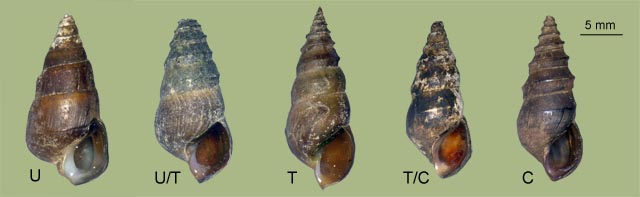
Here I offer a new term, "Goodrichian Taxon Shift," and define it as intraspecific variation in freshwater gastropod shell morphology along an environmental cline of such magnitude as to prompt the erroneous recognition of multiple nominal taxa. And as Exhibit A, I offer the G. clavaeformis population of Indian Creek (see image at Note 7, below). I predict that many additional examples of Goodrichian taxon shift, likely ecophenotypic in origin, will come to light as modern genetic techniques are applied to natural populations of freshwater gastropods in all groups. And I think that Calvin Goodrich would hardly have been surprised.
References
(1) Dillon, R. T. & J. D. Robinson (2007a) The Goniobasis ("Elimia") of southwest Virginia, I. Population genetic survey. Report to the Virginia Division of Game and Inland Fisheries, contract 2006-9308. 25 pp. [PDF]
(2) Goodrich, C. (1940) The Pleuroceridae of the Ohio River system. Occas. Pprs. Mus. Zool. Univ. Mich. 417; 1-21.
(3) See my post, Goniobasis and Elimia [28Sept04]
(4) Dillon, R. T. & J. D. Robinson (2007b) The Goniobasis ("Elimia") of southwest Virginia, II. Shell morphological variation in Goniobasis clavaeformis. Report to the Virginia Division of Game and Inland Fisheries, contract 2006-9308. 12 pp. [PDF]
(5) The Legacy of Calvin Goodrich [23Jan07]
(6) Goodrich, C. (1934) Studies of the gastropod family Pleuroceridae - I. Occas. Pprs. Mus. Zool. U. Mich. 286:1 - 17. Goodrich, C. (1940) The Pleuroceridae of the Ohio River drainage system. Occas. Pprs. Mus. Zool. U. Mich. 417: 1 - 21.
(7) The image below shows Goniobasis clavaeformis from the mouth of Indian Creek, Claiborne County, TN. U = unciale form, U/T = intermediate between unciale and typical, T = typical form, T/C = intermediate between typical and carinate, C = carinate form.

I'm pleased to report that an illustrated Key to the Pleuroceridae of Virginia, recently developed by Brian Watson, Tim Stewart and myself, is now available on the FWGNA site. The resource includes notes on habitat, distribution, ecology, life history, taxonomy and systematics for all 12 pleurocerid species inhabiting the Commonwealth. It was made possible by a contract from the Virginia Division of Game and Inland Fisheries, and is part of our larger "Freshwater Gastropods of Virginia" project currently ongoing.
The focus of the VDGIF contract was on the diverse Goniobasis populations that inhabit the Tennessee River tributaries of southwest Virginia, a taxonomically difficult fauna about which some conservation concern has been raised. Our survey of the genetic divergence among 12 populations at 11 allozyme-encoding loci confirmed three species in the region - Goniobasis clavaeformis, G. simplex, and G. arachnoidea (1). We combined our fresh data on the Tennessee drainage pleurocerid fauna with previously-accumulated observations from the New River and Atlantic drainages to construct the statewide key that is now open for business.
The most interesting result of the VDGIF genetic survey was the extreme shell-morphological variation we documented in G. clavaeformis. Typical G. clavaeformis, as described in February of 1841 by Isaac Lea, bear rather vanilla shells of moderate thickness and rounded whorls. Goodrich (2) realized, however, that upstream populations can have more slender shells with a pronounced mid-whorl carination, a form that was originally described as "G. acutocarinata" by Lea, two pages after he described clavaeformis. Interestingly, it was acutocarinata that Pilsbry & Rhoads chose as the type of the genus Elimia, since that nomen appeared first in the alphabetical list of odd-lot taxa gathered into the genus by H. & A. Adams (1854). That acutocarinata was subsequently recognized as a synonym of clavaeformis by Goodrich had no bearing on the taxonomic controversy that ensued (3).
Although I was well aware of the acutocarinata/clavaeformis connection, I must admit to being fooled by the dazzling variety of shell phenotypes that met my eye when I first peered into the clear, cold waters of Indian Creek, a tributary of the Powell River in Lee County, at the southwestern tip of Virginia. I honestly thought I could distinguish six pleurocerid species. In the headwaters I recognized G. carinifera in addition to G. simplex and G. arachnoidea. Further downstream I found Leptoxis praerosa and Pleurocera unciale. And Goniobasis clavaeformis appeared to range throughout Indian Creek, headwaters to mouth, in all manner of shapes and sizes.
The gels soon showed that there was no genetic difference between samples I'd originally identified as G. carinifera and G. clavaeformis. In retrospect, I'm not sure what led me to draw a distinction between carinifera and Goodrich's acutocarinata. But a much greater surprise greeted me when I examined the gels run on samples taken from the mouth of Indian Creek, where it joins the Powell River just over the border in Claiborne County, Tennessee. There is no genetic difference between Goniobasis clavaeformis and downstream samples of Pleurocera unciale (PDF available at Note 4).
The shells borne by snails described as Pleurocera unciale by Haldeman in October of 1841 are broader and heavier than those of G. clavaeformis, their whorls marked with a prominent anterior angulation. Nineteenth-century taxonomists considered such an anterior angulation (and the notch it creates in the shell aperture) so significant that the genus Pleurocera was erected to contain any species distinguished by it. That two samples appearing to represent distinct genera of snails might in fact comprise a single randomly-breeding population seems improbable in the extreme.
But it has been reported before. Last month we reviewed the life and work of Calvin Goodrich, whose 20-year study of pleurocerid diversity in the American South led him to a modern understanding of evolutionary biology much earlier than almost any of his contemporaries (5). And it will be recalled that between 1934 - 1941 Goodrich published a series of papers entitled, "Studies of the Gastropod Family Pleuroceridae," describing extensive intraspecific variation in shell morphology along stream gradients.
In "Studies" Number I (6), Goodrich documented a striking gradient in shell "obesity" (measured as the maximum shell diameter divided by the length of the last two whorls) in the Lithasia geniculata population of the Duck River in central Tennessee. Populations of the typical subspecies L. geniculata geniculata (#14 above) collected downstream showed high obesity, populations from middle reaches (subspecies fuliginosa, #10 above) demonstrated intermediate obesity, and populations from the headwaters (subspecies pinguis, #11 above) were quite slender. In fact, such pinguis populations differed in their shell morphology so greatly from typical Lithasia that they were originally placed by George Tryon in the genus Anculosa.
Here I offer a new term, "Goodrichian Taxon Shift," and define it as intraspecific variation in freshwater gastropod shell morphology along an environmental cline of such magnitude as to prompt the erroneous recognition of multiple nominal taxa. And as Exhibit A, I offer the G. clavaeformis population of Indian Creek (see image at Note 7, below). I predict that many additional examples of Goodrichian taxon shift, likely ecophenotypic in origin, will come to light as modern genetic techniques are applied to natural populations of freshwater gastropods in all groups. And I think that Calvin Goodrich would hardly have been surprised.
References
(1) Dillon, R. T. & J. D. Robinson (2007a) The Goniobasis ("Elimia") of southwest Virginia, I. Population genetic survey. Report to the Virginia Division of Game and Inland Fisheries, contract 2006-9308. 25 pp. [PDF]
(2) Goodrich, C. (1940) The Pleuroceridae of the Ohio River system. Occas. Pprs. Mus. Zool. Univ. Mich. 417; 1-21.
(3) See my post, Goniobasis and Elimia [28Sept04]
(4) Dillon, R. T. & J. D. Robinson (2007b) The Goniobasis ("Elimia") of southwest Virginia, II. Shell morphological variation in Goniobasis clavaeformis. Report to the Virginia Division of Game and Inland Fisheries, contract 2006-9308. 12 pp. [PDF]
(5) The Legacy of Calvin Goodrich [23Jan07]
(6) Goodrich, C. (1934) Studies of the gastropod family Pleuroceridae - I. Occas. Pprs. Mus. Zool. U. Mich. 286:1 - 17. Goodrich, C. (1940) The Pleuroceridae of the Ohio River drainage system. Occas. Pprs. Mus. Zool. U. Mich. 417: 1 - 21.
(7) The image below shows Goniobasis clavaeformis from the mouth of Indian Creek, Claiborne County, TN. U = unciale form, U/T = intermediate between unciale and typical, T = typical form, T/C = intermediate between typical and carinate, C = carinate form.
Tuesday, January 23, 2007
The Legacy of Calvin Goodrich
Editor's Note. This essay was subsequently published as: Dillon, R.T., Jr. (2019c) The legacy of Calvin Goodrich. Pp 1-5 in The Freshwater Gastropods of North America Volume 3, Essays on the Prosobranchs. FWGNA Press, Charleston.
My essay of November 2006 focused on Frank Collins Baker, a modest man of modest means who rose to prominence in twentieth-century American malacology. This month we'll look at the life and contributions of Calvin Goodrich, a contemporary whose career offers a number of interesting comparisons.
Like Baker, Calvin Goodrich came from a middle class background and held no advanced degree. He was born in Chicago in 1874 and spent his youth in Kansas, graduating from the University of Kansas in 1895. Goodrich then embarked on a career in journalism, serving as a reporter and then editor for The Kansas City Star, The Cleveland Leader, The Toledo Blade, The Detroit Journal, and the Newark Star-Eagle.
It was during his tenure with The Toledo Blade (1908 - 1917) that Goodrich initiated correspondence with the two gentlemen who shaped his second career, A. E. Ortmann of the Carnegie Museum and Bryant Walker of Detroit. Van der Schalie (1) reports that during this period Goodrich began riding the street cars out of Toledo into the surrounding countryside to collect mollusks. And in 1913 he arranged to join Ortmann on a field trip to southwest Virginia, an event that seems to have profoundly affected his life, at age 39. Goodrich began publishing short papers on pleurocerid snails in The Nautilus, obtained appointment as an honorary curator at the University of Michigan Museum of Zoology in 1924, and became a full-time curator at UMMZ in 1926, when he formally retired from the newspaper business.
From 1924 until his (second) retirement from the UMMZ twenty years later, Calvin Goodrich traveled widely in the American south and published about 50 works of scholarship, almost entirely on our mutually favorite family of gastropods (2). Between 1934 and 1941, he published a series of eight remarkable papers which deserve to be better known, his "Studies of the Gastropod Family Pleuroceridae." In those works we see a taxonomist born into 19th-century typology struggling with, and ultimately accepting, a modern understanding of intrapopulation variation.
In "Studies" Number IV (1935), for example, Goodrich focused on the Coosa River of Georgia and Alabama, inhabited by six "forms recognizable as subspecies" of Goniobasis caelatura. He tabulated variation in shell sculpture (two categories of plication and three categories of striation) and in overall shape (ratio of shell diameters measured at two spots). He observed that "In a general sense, the variation from conic to cylindrical shape is in a downstream direction. The same thing is true of variation from smoothness to sculpture." He concluded that "These several forms, however unlike one another they sometimes appear, are nevertheless of the same genetic stock, and they constitute a single, fairly compact group of mollusks." For 1935, such an insight was genuinely prescient.
Today Goodrich's reputation rests primarily on the review of the Pleuroceridae of North America he published as a series of brief works - the first six between 1939 and 1942 "in preparation for a molluscan check list undertaken by the American Malacological Union," the ultimate fate of which I am not aware. Two additional works were added to the series in 1944. These papers are short and spare - they include no descriptions, figures, or indeed biological information of any sort, except ranges. What Goodrich did, however, was to boil something in excess of 500 specific nomena of pleurocerids down into a bit more than 100. Many names were synonymized, without comment, and many others were simply omitted. The 100 nomena recognized by Goodrich have survived in the malacological literature to the present day, while those that Goodrich synonymized or ignored have essentially disappeared, except as dusty labels in the forgotten drawers of historic collections (3).
One might argue that such an approach was arbitrary, and heavy-handed. But Goodrich's judgments were informed by the seven-year study of morphological variation in the Pleuroceridae that preceded them, which he published separately. He was one of the first American malacologists to understand intrapopulation variation, and it was on the basis of his 1934 - 41 "Studies" that his 1939-1944 checklists were compiled.
And Goodrich's review has proven to be of great use to malacologists working in American freshwaters today. My 25 years of research on the population genetics of pleurocerids in the South suggests to me that the total number of biological species in this country will prove to be far less than 500, and indeed less than 100. I haven't found a biological species that Calvin Goodrich missed.
Goodrich's career followed that of F. C. Baker by almost exactly a half generation - he was born seven years after Baker and trailed him in death by 12 years, in 1954. This was an important half-generation. Because from the late 1930's to the mid-1950's, the architects of the "modern synthesis" were fashioning the stones cut by Darwin and Mendel into the science of evolutionary biology as we know it today. Frank Collins Baker, for all his tremendous talent, training, and experience, always considered species to be the subjective constructs of taxonomists such as himself. Any new specimen not matching a previously-described type was, to Baker, a new species. But Goodrich was beginning to think of species as populations or groups of populations, not as individual types. And populations vary. And with that revelation came the dawn of modern evolutionary science.
Keep in touch,
Rob
Notes
(1) Van der Schalie, H. (1955). Calvin Goodrich 1874 - 1954. Nautilus 68: 135-142.
(2) Goodrich's complete bibliography published by Rosewater J. (1959) Calvin Goodrich; a bibliography and catalogue of his species. Occas. Pprs. Mollusks, Mus. Comp. Zool., Harvard 2(24): 189-208. A partial bibliography is available from Kevin Cuming's website at INHS
(3) For a complete catalogue of pleurocerid names, see Graf, D. L. (2001) The cleansing of the Augean Stables, or a lexicon of the nominal species of the Pleuroceridae (Gastropoda: Prosobranchia) of recent North America, north of Mexico. Walkerana 12 (27) 1 - 124.
My essay of November 2006 focused on Frank Collins Baker, a modest man of modest means who rose to prominence in twentieth-century American malacology. This month we'll look at the life and contributions of Calvin Goodrich, a contemporary whose career offers a number of interesting comparisons.
Like Baker, Calvin Goodrich came from a middle class background and held no advanced degree. He was born in Chicago in 1874 and spent his youth in Kansas, graduating
 from the University of Kansas in 1895. Goodrich then embarked on a career in journalism, serving as a reporter and then editor for The Kansas City Star, The Cleveland Leader, The Toledo Blade, The Detroit Journal, and the Newark Star-Eagle.
It was during his tenure with The Toledo Blade (1908 - 1917) that Goodrich initiated correspondence with the two gentlemen who shaped his second career, A. E. Ortmann of the Carnegie Museum and Bryant Walker of Detroit. Van der Schalie (1) reports that during this period Goodrich began riding the street cars out of Toledo into the surrounding countryside to collect mollusks. And in 1913 he arranged to join Ortmann on a field trip to southwest Virginia, an event that seems to have profoundly affected his life, at age 39. Goodrich began publishing short papers on pleurocerid snails in The Nautilus, obtained appointment as an honorary curator at the University of Michigan Museum of Zoology in 1924, and became a full-time curator at UMMZ in 1926, when he formally retired from the newspaper business.
From 1924 until his (second) retirement from the UMMZ twenty years later, Calvin Goodrich traveled widely in the American south and published about 50 works of scholarship, almost entirely on our mutually favorite family of gastropods (2). Between 1934 and 1941, he published a series of eight remarkable papers which deserve to be better known, his "Studies of the Gastropod Family Pleuroceridae." In those works we see a taxonomist born into 19th-century typology struggling with, and ultimately accepting, a modern understanding of intrapopulation variation.
In "Studies" Number IV (1935), for example, Goodrich focused on the Coosa River of Georgia and Alabama, inhabited by six "forms recognizable as subspecies" of Goniobasis caelatura. He tabulated variation in shell sculpture (two categories of plication and three categories of striation) and in overall shape (ratio of shell diameters measured at two spots). He observed that "In a general sense, the variation from conic to cylindrical shape is in a downstream direction. The same thing is true of variation from smoothness to sculpture." He concluded that "These several forms, however unlike one another they sometimes appear, are nevertheless of the same genetic stock, and they constitute a single, fairly compact group of mollusks." For 1935, such an insight was genuinely prescient.
Today Goodrich's reputation rests primarily on the review of the Pleuroceridae of North America he published as a series of brief works - the first six between 1939 and 1942 "in preparation for a molluscan check list undertaken by the American Malacological Union," the ultimate fate of which I am not aware. Two additional works were added to the series in 1944. These papers are short and spare - they include no descriptions, figures, or indeed biological information of any sort, except ranges. What Goodrich did, however, was to boil something in excess of 500 specific nomena of pleurocerids down into a bit more than 100. Many names were synonymized, without comment, and many others were simply omitted. The 100 nomena recognized by Goodrich have survived in the malacological literature to the present day, while those that Goodrich synonymized or ignored have essentially disappeared, except as dusty labels in the forgotten drawers of historic collections (3).
One might argue that such an approach was arbitrary, and heavy-handed. But Goodrich's judgments were informed by the seven-year study of morphological variation in the Pleuroceridae that preceded them, which he published separately. He was one of the first American malacologists to understand intrapopulation variation, and it was on the basis of his 1934 - 41 "Studies" that his 1939-1944 checklists were compiled.
And Goodrich's review has proven to be of great use to malacologists working in American freshwaters today. My 25 years of research on the population genetics of pleurocerids in the South suggests to me that the total number of biological species in this country will prove to be far less than 500, and indeed less than 100. I haven't found a biological species that Calvin Goodrich missed.
Goodrich's career followed that of F. C. Baker by almost exactly a half generation - he was born seven years after Baker and trailed him in death by 12 years, in 1954. This was an important half-generation. Because from the late 1930's to the mid-1950's, the architects of the "modern synthesis" were fashioning the stones cut by Darwin and Mendel into the science of evolutionary biology as we know it today. Frank Collins Baker, for all his tremendous talent, training, and experience, always considered species to be the subjective constructs of taxonomists such as himself. Any new specimen not matching a previously-described type was, to Baker, a new species. But Goodrich was beginning to think of species as populations or groups of populations, not as individual types. And populations vary. And with that revelation came the dawn of modern evolutionary science.
Keep in touch,
Rob
Notes
(1) Van der Schalie, H. (1955). Calvin Goodrich 1874 - 1954. Nautilus 68: 135-142.
(2) Goodrich's complete bibliography published by Rosewater J. (1959) Calvin Goodrich; a bibliography and catalogue of his species. Occas. Pprs. Mollusks, Mus. Comp. Zool., Harvard 2(24): 189-208. A partial bibliography is available from Kevin Cuming's website at INHS
(3) For a complete catalogue of pleurocerid names, see Graf, D. L. (2001) The cleansing of the Augean Stables, or a lexicon of the nominal species of the Pleuroceridae (Gastropoda: Prosobranchia) of recent North America, north of Mexico. Walkerana 12 (27) 1 - 124.
Subscribe to:
Posts (Atom)


 Posts
Posts


