Friday, February 1, 2008
Semisulcospira II: A Second Message from The East
Last month we reviewed the experiments of Urabe (1998, 2000) vividly demonstrating that shell morphology in the East Asian pleurocerid genus Semisulcospira has a substantial non-genetic component. Since the taxonomy of this important group is based almost entirely on its shell, such results suggest that the true number of biological species in the genus Semisulcospira may be much different from the number of nomina conventionally applied.
This month we’ll update that message with a second chapter from Taehwan Lee, Dairmaid O’Foighil, and two colleagues from Pai Chai University in Daejon, South Korea (1). What might the application of modern molecular techniques add to our understanding of evolution in this enigmatic genus from The East?
The range of Semisulcospira libertina extends from Japan onto the Korean Peninsula, where it shares rivers and streams with ten other nominal Semisulcospira species, as judged by their shell morphology. Lee and his colleagues sampled eight of those species from nine sites – libertina (four populations), coreana (two populations), extensa (two populations), and single populations of forticosta, gottschei, multicincta, nodiperda, and tegulata. They sequenced two genes, the mitochondrial 16S and the nuclear 28S ribosomal genes, in most cases just one individual per population but in some cases up to ten or even twenty per population. They built phylogenetic trees using three different methods (maximum parsimony, maximum likelihood, and Baysian) to mollify all constituencies among their reviewers (2), with a couple other genera of Korean pleurocerids added as outgroups (3).
It should come as no surprise, to all of us familiar with Urabe’s work, that the phylogenetic trees obtained by Taehwan, Dairmaid and their colleagues showed a mish-mash of nominal species bearing almost no relationship to the traditional taxonomy based on shell. Only Semisulcospira extensa appeared monophyletic. Populations of the other seven species displayed a genetic structure we have seen much of recently (4) – heterogeneous mixtures with numerically predominant modal clades and the scattered highly-divergent genotypes that (in my post of 7/07) I have called "sports."
Not only were the nominal species polyphyletic, the populations and even the individual snails were polyphyletic. I am ashamed to confess that I was entertained by the author’s discovery of a single S. libertina individual heterozygous at the 28S locus. I should have been compassionate – analysis of this individual snail was apparently a real pain in the can. Taehwan and colleagues had to clone the PCR products amplified from this individual in plasmid vectors and sequence a bunch of recombinant bacterial colonies. The two alleles turned out to differ by 23 nucleotides, leaving the single individual S. libertina that bore them splayed across opposite ends of their 28S maximum likelihood tree. I think I may read phylogenetic systematic research for the same reason I watch NASCAR - the wrecks (5).
Taehwan, Dairmaid and their colleagues reviewed the same list of explanations for this phenomenon that they previously examined in their paper on Laevapex with Andrea Walther in the lead (6) – paralogous mt markers, cryptic species, introgression, and (their choice) retention of ancestral polymorphism through incomplete lineage sorting (7). They concluded with the recommendation that coreana, forticosta, gottschei, multicincta, nodiperda, and tegulata all be synonymized under the single, phenotypically variable biological species Semisulcospira libertina, broadly distributed across East Asia.
In summary, the messages borne to us this month by Taehwan, Dairmaid and their colleagues from The East are that “biologists interested in freshwater cerithiodean molecular phylogenetics approach these taxa as potential morphospecies complexes,” and that in the future “meaningful phylogenetic study of these organisms may well require the use of both mitochondrial and nuclear markers together with population level samples of all nominal taxa within regional drainages.” Message received, guys! And in other news … Ronald Reagan elected President (8).
Notes
1) Lee, T., H. C. Hong, J. J. Kim and D. O’Foighil (2007) Phylogenetic incongruence involving nuclear and mitochondrial markers in Korean populations of the freshwater snail genus Semisulcospira (Cerithioidea: Pleuroceridae). Molec. Phylog. Evol. 43: 386-397.
2) The tiny fringe group who prefers neighbor-joining techniques is not likely to read MP&E, much less referee their manuscripts.
3) It will be recalled from last month’s essay that Semisulcospira is ovoviviparous. As outgroups, Lee et al. selected four species from two strictly oviparous genera of Korean pleurocerids - Hua and Koreoleptoxis.
4) The parallel between these findings and our own (2004) results is striking, although perhaps not of the same magnitude. Dairmaid tells me that the sequence divergence ranged up to 8.9% within his Semisulcospira populations, while we reported up to 14.5% intrapopulation 16S sequence divergence in American Goniobasis. See Dillon & Frankis, Amer. Malac. Bull 19:69-77.
5) With Joe Gibbs running Toyotas in 2008, it may not be too much longer until Sprint Cup fans receive our own “message from The East.”
6) Walther, A., T. Lee, J. B. Burch, and D. Ó Foighil. 2006. E Pluribus Unum: A phylogenetic and phylogeographic reassessment of Laevapex (Pulmonata: Ancylidae), a North American genus of freshwater limpets. Molecular Phylogenetics and Evolution, 40: 501-516.
7) That’s close, but I don’t think exactly right. The likelihood that an ancestral polymorphism will be preserved in a pair of sorted lineages decreases with internodal time, which may be great in populations as old as these. I think such polymorphisms may not the product of incomplete lineage sorting, but rather have evolved endogenously in large, ancient, and isolated populations. And I think independently-evolved genes may converge on the same adaptive peak, or may be collected outside the population cluster in which they evolved by long branch attraction.
8) Dillon, R. T. and G. M. Davis (1980) The Goniobasis of southern Virginia and northwestern North Carolina: Genetic and shell morphometric relationships. Malacologia 20: 83-98.


Sunday, January 6, 2008
Semisulcospira Research: A Message from The East
'Tis the season for Messages from The East. And in recent years I have taken some inspiration from research conducted on Semisulcospira, a genus of pleurocerid snails widespread throughout Japan, Korea, Taiwan and eastern China. As a potential intermediate host for the lung fluke Paragonimus westermani, Semisulcospira has become one of the better-studied of all the freshwater prosobranchs.
In many of the details of its general biology, life history, and habitat, Semisulcospira reminds me a great deal of our North American Goniobasis or Elimia. Scores of species have been described (30 from Japan alone, according to Davis, note 1), almost entirely on the basis of shell morphology. The most striking difference between Goniobasis and Semisulcospira is that the latter is a brooder - holding eggs in a modified pallial oviduct until hatch. But although ovoviviparity is often associated with parthenogenesis in freshwater gastropods, I'm not aware of any evidence of asexual reproduction in Semisulcospira (2).
Ovoviviparous reproduction does, however, facilitate laboratory rearing studies. And in 1998 and 2000, Misako Urabe (of Nara Womens' University) published a pair of papers describing a set of experiments directly exploring the heritability of shell morphology in Semisulcospira that deserve to be more widely known.
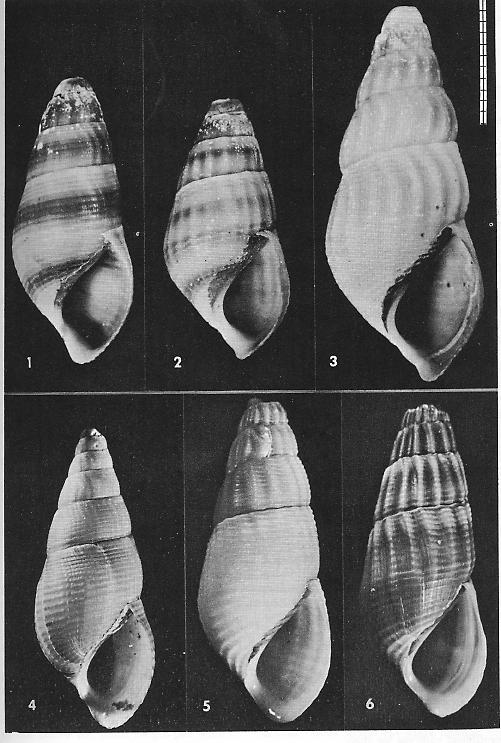 Urabe worked with Semisulcospira reiniana, an extremely variable species co-occurring with (and sometimes indistinguishable from) the more widely distributed S. libertina in the Kamo River of Kyoto. The plate at left (from Davis, see Note 1) shows both S. libertina (figs 1-4) and S. reiniana (figs 5 & 6) from several Japanese populations (scale bar in mm).
In the 1998 work, Urabe (3) used mother/offspring regression to estimate the heritability of the three shell shape parameters of Raup (4): S (the roundness of the generating curve), W (the rate of whorl expansion), and T (the rate of whorl translation). In the wild, snails collected from more rapid currents tended to have larger W and smaller T, that is, larger body whorls and lower spires (5). But lab experiments showed the heritabilities of all three shell shape parameters to be nonsignificant - no different from zero.
In the 2000 work, Urabe (6) reared juveniles to 6.8 mm under standard conditions, marked sibships with waterproof tags, and then divided them into two aquaria - one with a sand substrate and the other with pebbles. After one year, snails were scored by their "rib intensity," a 0/1 coding system for shell sculpture developed by the author. Urabe showed both that mothers with stronger shell ribbing tended to produce higher percentages of ribbed offspring, but that snails grown to maturity in the tank with the sand substrate tended to form ribbed shells more frequently than those grown on pebbles.
Quite a few researchers have directly demonstrated shell phenotypic plasticity using pulmonate snails as models. Amy Krist published a nice experiment showing that crayfish predation can affect aperture shape in Goniobasis livescens a couple years ago (7). But the experiments of Urabe are the best demonstrations of phenotypic plasticity in freshwater prosobranchs of which I am aware.
So to what extent might we expect Urabe's conclusions for Semisulcospira to generalize to the pleurocerids of North America? The evidence is all around us that they do. I've seen populations of Goniobasis catenaria inhabiting Piedmont streams in North Carolina, for example, that intergrade seamlessly from strongly carinate shells to shells almost entirely smooth, apparently in correlation with the substrate (8). And I dedicated my entire post in February 2007 to a phenomenon I called "Goodrichian Taxon Shift," the broadening and thickening of shell morphology demonstrated by populations of North American pleurocerids as rivers widen, deepen, and slow. Which brings us to our "Message from The East."
In recent years, modern research programs have led to substantial taxonomic revisions in the Asian Pleuroceridae. At least 17 of the 30 specific nomina of Semisulcospira described from Japan on the basis of shell character had been synonymized under S. libertina by 1972, according to Davis (9). The clear implication of Urabe's work, that such trends will continue, has recently been borne out, as we shall see. And might the long-benighted pleurocerid fauna of North America also be overdue for a taxonomic revision along similar lines? Again, said the Zen Master, we will see.
Notes
(1) Davis, G. M. 1969. A taxonomic study of some species of Semisulcospira in Japan (Mesogastropoda: Pleuroceridae). Malacologia 7: 211-294.
(2) Males seem to occur in high frequency in all populations.
(3) Urabe, M. 1998. Contribution of genetic and environmental factors to shell shape variation in the lotic snail Semisulcospira reiniana (Prosobranchia: Pleuroceridae) J. Moll. Stud. 64: 329-343.
(4) Raup, D. M. 1966. Geometric analysis of shell coiling: general problems. J. Paleontol. 40: 1178-1190.
(5) To be quite precise - snails active in fast currents at night tended to show the shell shape relationship best. Apparently Semisulcospira populations are nocturnal, much like the Melanoides in my goldfish bowl. Urabe suggested that, since shell growth only occurs when the mantle edge is flush with the aperture, "it is only the environment that a snail experiences when it is active at night-time that affects shell formation." Interesting!
(6) Urabe, M. 2000. Phenotypic modulation by the substratum of shell sculpture in Semisulcospira reiniana (Prrosobranchia: Pleuroceridae). J. Moll. Stud. 66: 53-59.
(7) Krist, A. C. 2002. Crayfish induce a defensive shell shape in a freshwater snail. Invert. Biol. 121: 235-242.
(8) The smooth form is given the subspecific name "dislocata," while the strongly carinate form is G. catenaria s.s.
(9) Davis, G. M. 1972. Geographic variation in Semisulcospira libertina (Mesogastropoda: Pleuroceridae). Proc. Malac. Soc. Lond. 40: 5-32.
Wednesday, December 5, 2007
Symposium at NABS '08
To the FWGNA group,
Our good friend Bill Clark is co-organizing symposium on sampling low-density populations for the annual meeting of the North American Benthological Society next year in Salt Lake City, May 25 - 30. See Bill's message below. His [PDF] flier is available from the FWGNA site.
Bill and his colleague Leska Fore have been working on the endangered freshwater gastropods of the Snake River. They're hoping to share new methods, discuss unique sampling issues related to benthic species, and perhaps even break into a spontaneous discussion of the future of the ESA. Bill invited any of us who might wish to contribute a paper to this symposium to get in touch with Leska at the contact information below. Looks like a great opportunity!
We'll keep in touch,
Rob
-------------
Subject: Symposium announcement
Date: Mon, 19 Nov 2007 13:32:16 -0500
From: "Clark, William" WilliamClark@idahopower.com
To: "Dillon Jr, Robert T."
Hi Rob:
I wonder if you could send this information for a symposium announcementout to your FWGNA group mailing list? I've attached a one page flyer and the basic information is also presented below in the email.
Thank you very much,
Bill Clark (and Leska Fore)
William H. Clark,
Macroinvertebrate Biologist
Idaho Power Company
P.O. Box 70
Boise, Idaho 83707 USA
tel: 208-388-2689
FAX: 208-388-6902
email:WilliamClark@idahopower.com
______________________________
Quantitative Methods for Evaluating the Status of Threatened Species
Organizers: Leska S. Fore, Statistical Design, Inc. & William H. Clark,Idaho Power Co.
Contact: Leska Foreleska@seanet.com
206 632-4635
Leska S. Fore
Statistical Design
136 NW 40th St.
Seattle, WA 98107
(206) 632-4635 phone
(206) 632-3752 fax
www.seanet.com/~leska
Our good friend Bill Clark is co-organizing symposium on sampling low-density populations for the annual meeting of the North American Benthological Society next year in Salt Lake City, May 25 - 30. See Bill's message below. His [PDF] flier is available from the FWGNA site.
Bill and his colleague Leska Fore have been working on the endangered freshwater gastropods of the Snake River. They're hoping to share new methods, discuss unique sampling issues related to benthic species, and perhaps even break into a spontaneous discussion of the future of the ESA. Bill invited any of us who might wish to contribute a paper to this symposium to get in touch with Leska at the contact information below. Looks like a great opportunity!
We'll keep in touch,
Rob
-------------
Subject: Symposium announcement
Date: Mon, 19 Nov 2007 13:32:16 -0500
From: "Clark, William" WilliamClark@idahopower.com
To: "Dillon Jr, Robert T."
Hi Rob:
I wonder if you could send this information for a symposium announcementout to your FWGNA group mailing list? I've attached a one page flyer and the basic information is also presented below in the email.
Thank you very much,
Bill Clark (and Leska Fore)
William H. Clark,
Macroinvertebrate Biologist
Idaho Power Company
P.O. Box 70
Boise, Idaho 83707 USA
tel: 208-388-2689
FAX: 208-388-6902
email:WilliamClark@idahopower.com
______________________________
Quantitative Methods for Evaluating the Status of Threatened Species
Organizers: Leska S. Fore, Statistical Design, Inc. & William H. Clark,Idaho Power Co.
Contact: Leska Foreleska@seanet.com
206 632-4635
Many of the benthic freshwater species identified to be at risk for extinction, e.g., mussels, clams, and snails, may be rare, unevenly distributed, or hard to detect. The focus of this session is on the quantitative methods used to assess population size, condition, orchange, such as mark-recapture, multi-stage survey sampling, and adaptive sampling. The goal of this special session is to bring together practitioners working with at risk populations to compare the limitations and advantages of various methods for different geographic settings and different types of organisms. Results from these studies can have enormous economic impact; for example, when power generation is limited at hydroelectric facilities to protect a threatened species. This session is not limited to any particular species group or any particular method of population assessment. General methods papers related to sampling are also welcome. Of greatest interest are studies in which the scientific results are embedded in the decision process forspecies conservation and protection.--
Leska S. Fore
Statistical Design
136 NW 40th St.
Seattle, WA 98107
(206) 632-4635 phone
(206) 632-3752 fax
www.seanet.com/~leska
Wednesday, November 14, 2007
Ducks, Snails, and Worms - When Invasive Species Conspire!
Editor’s Note – This essay was subsequently published as:
Dillon, R.T., Jr. (2019d) Ducks, snails, and worms - When invasive species conspire! Pp 11 - 14 in The Freshwater Gastropods of North America Volume 4, essays on Ecology and
Biogeography. FWGNA Press, Charleston.
Freshwater snails have suffered a spate of bad press in the upper Midwest recently. Late last week our friend Henry Fieldseth sent us an article from the Minneapolis Star Tribune (6Nov07, pasted below) attributing the death of thousands of waterfowl in a local lake to infections by trematode worms, with the "banded mystery snail" (Viviparus georgianus) indicted as a co-conspirator. This is not the first mass murder rap to be pinned on a digenean trematode or an invasive gastropod henchman, nor will it be the last, I fear.
Massive late-summer mortalities of waterfowl attributable to trematodiasis have been reported at least since the 1960s, when thousands of ducks were apparently killed by mixed infections of the digeneans Cyathocotyle bushiensis and Sphaeridiotrema globulus in the St. Lawrence River south of Quebec. Hoeve & Scott (1) linked these deaths to ingestion by the ducks of the invasive European gastropod Bithynia tentaculata. In 1997, tens of thousands of coots were killed in Wisconsin's Shawano Lake by a third digenean worm, the European Leyogonimus polyoon, again carried by Bithynia (2). And since 2002, all three worms have been implicated in massive waterfowl mortalities around Lake Onalaska, a backwater of the upper Mississippi River near La Crosse (3). All three of these digenean trematodes, the introduced Leyogonimus as well as the natives.
.
Cyathocotyle and Sphaeridiotrema, display Type III life cycles – entering their ultimate (vertebrate) host by ingestion of an infected meal (4). The vertebrate host sheds eggs through
 its feces, which hatch into ciliated miricidia and penetrate the first intermediate host, a freshwater gastropod. (The photo of Bithynia tentaculata at left was taken by Lars Peters.) The miricidium develops numerous sack-like rediae in its first intermediate host, each of which gives rise to many cercariae. Then the cercariae swim out of the snail to find a second intermediate host, which may be selected from among a wide variety of aquatic animals – a second snail or an aquatic insect, for example. (Typically substantial specificity is demonstrated for the first intermediate host, but not for the second.) The definitive vertebrate host (a duck or coot in this case) becomes infected with mature worms when it ingests the second intermediate host.
Trematodes do not typically kill their definitive hosts. The massive mortalities we have seen scattered through diverse waterfowl populations in the upper Midwest are most likely attributable to unusually high rates of snail ingestion as well as to double or exotic infections. So since the ducks (with their digenean parasites) disperse readily on continent-level scales, federal and state agencies have signaled their intent to focus their efforts to control the trematodiasis by controlling the snails (5).
Thus last week's discovery of the massive waterfowl mortality attributable to Cyathocotyle and Sphaeridiotrema in Minnesota's Lake Winnibigoshish is especially bad news. For if the initial reports hold up, here the first intermediate host of the worm is not Bithynia, but rather Viviparus georgianus (6). Viviparus georgianus is a native of the American southeast, and is much more widely distributed throughout the United States than Bithynia. And if the problem trematodes can infect Viviparus, they would also seem likely to be able to exploit Bellamya (Cipangopaludina) and Campeloma, and in so doing expand their potential ranges nationwide.
I am often asked about the potentially negative effects of artificially-introduced freshwater gastropod populations. My usual response has been that such effects are difficult to establish. Very few studies have ever demonstrated community or ecosystem effects attributable to exotic freshwater gastropods – they seem to invade environments that are already disturbed and compete rarely (if ever) with native populations.
But here splashed across our morning newspapers we read that "carcasses dropped by eagles hung in the trees on the island, and feathers littered the shore" (LaCrosse Tribune 28Oct07, link removed). This is a dramatic example of unfortunate environmental consequences directly attributable to the spread of exotic freshwater gastropods. And at this point I don't think that snail control will solve the problem. And I really wish I could think of any other alternative.
We'll keep in touch,
Rob
Notes
(1) Hoeve, J. and M. E. Scott (1988) Ecological studies on Cyathocotyle bushiensis (Digenea) and Sphaeridiotrema globulus (Digenea), possible pathogens of dabbling ducks in southern Quebec. J. Wild. Diseases 24: 407 - 421.
(2) Exotic parasite causes large scale mortality in American coots. USGS-NWHC Fact Sheet 6/2001. [PDF]
(3) Exotic parasite of American coot discovered in exotic snail in Lake Onalaska. USGS-NWHC Bulletin 07-01. [PDF]
(4) See my Chapter 6 of Dillon (2000) for a more complete review of trematode life cycles, from the standpoint of the gastropod. Although most of that chapter (perhaps unsurprisingly) focuses on Type I Fasciola and Type II Schistosoma, there is a bit about Type III Echinostoma as well.
(5) Finding the exotic faucet snail (Bithynia tentaculata): Investigation of waterbird die-offs on the upper Mississippi River National Wildlife and Fish Refuge. USGS-NWHC report 2007-1065. [PDF]
(6) Scaup and Coot die-off at Lake Winnibigoshish. Minnesota DNR:
http://www.dnr.state.mn.us/hunting/waterfowl/scaup.html
------[Minneapolis Star Tribune 6Nov07]---------
Nov. 6: Parasite has killed thousands of scaup
The deadly organism has infected snails at Lake Winnibigoshish and has been picked up by the ducks, who dive below water to feed. The DNR is concerned the parasite might spread to other lakes.
By Doug Smith, Star Tribune
Last update: November 08, 2007 – 4:49 PM
A parasite has killed thousands of ducks on Lake Winnibigoshish in northern Minnesota, and could kill many more before the fall migration is over."We picked up 1,000 dead scaup [also known as bluebills] on Saturday," said Steve Cordts, Minnesota Department of Natural Resources waterfowl specialist.
He saw many other scaup still alive but unable to fly, or to fly far. "You could boat right up to them," Cordts said. Perhaps 3,000 ducks, mostly scaup, and some coots have died in the past week. "I'm sure there's more dead birds," Cordts said Tuesday.The ducks apparently are dying from trematodes, a tiny 1-millimeter intestinal parasite or fluke that has infected snails in the lake. Scaup -- a duck that dives below water to feed -- eat the snails, then are infected. "They essentially bleed to death," Cordts said.
The parasite was confirmed in scaup and coots sent to the National Wildlife Health Center in Madison, Wis. Similar die-offs caused by trematodes have occurred spring and fall since 2002 on the Mississippi River near La Crosse, Wis., killing about 40,000 ducks and coots since then. Die-offs again are occurring there this fall.
Cordts said he's not sure how the trematodes made it to Winnie. They apparently have infected a snail called the banded mystery snail, which was first found on Winnie about eight years ago. They are infecting the faucet snail on the Mississippi.
Officials aren't sure how many ducks might eventually die on Winnie, or what impact, if any, it will have on the scaup population. But Cordts is concerned that the snails and parasites might spread to other Minnesota waters. Other duck species also could eat the snails and become infected, he said.
There is concern because the continental scaup population has been declining since 1984 and hit an all-time low last year at about 3 million. Hunters annually kill about 300,000. Minnesota hunters killed about 20,000 last year. Lake Winnibigoshish is a major scaup resting area during migration. "We could have 20,000 scaup show up on Winnie right now," Cordts said. "If that happens, they'd pretty much all be at risk."
Cordts plans to check the lake again today, but he won't collect any more dead ducks. Instead, carcasses will be left to decompose or be eaten by scavengers. The parasite apparently is not a threat to other species, including humans, but Cordts said hunters shouldn't eat sick waterfowl.
Doug Smith • dsmith@startribune.com
© 2007 Star Tribune. All rights reserved.
Friday, October 12, 2007
The Classification of the Physidae
Editor's Note. This essay was subsequently published as: Dillon, R.T., Jr. (2019b) The classification of the Physidae. Pp 189-192 in The Freshwater Gastropods of North America Volume 2, Essays on the Pulmonates. FWGNA Press, Charleston.
I'm pleased to report that Amy Wethington's excellent 2004 dissertation has, at long last, found its way to publication (1). "A molecular phylogeny of Physidae (Gastropoda: Basommatophora) based on mitochondrial DNA sequences" is now available as a PDF download from the link below. Our congratulations go to Amy and to her advisor, Chuck Lydeard, for a job well done!
Amy sequenced fragments from both the CO1 and 16S mitochondrial genes (summing to 1,200 bp) from a sample of 65 individual physids, representing 28 nominal taxa (2). The results of her phylogenetic analyses dovetail nicely with her anatomical observations, as well as with the growing body of experimental evidence demonstrating little reproductive isolation among many physid populations formerly considered specifically distinct. Amy and Chuck propose a return to the simple two-genus classification system favored by Thiele and Zilch - Physa and Aplexa - the former with about ten species and the latter with but one.
Although their sample size within any single physid population was kept small by the exigencies of scale, Amy and Chuck demonstrate in their analysis the appreciation for interpopulation variation that characterizes all good evolutionary science. Amy has published at least 14 papers on the genetics, ecology, behavior, and reproductive biology of Physa over the last 15 years. She first familiarized herself thoroughly with her organism, then sequenced its genes and cranked out her phylogenetic trees. It shows.
Amy is currently an assistant professor at Chowan University in Murfreesboro, North Carolina (3). We'll look forward to many additional contributions from her in the future!
And keep in touch,
Rob
Notes
(1) Wethington, A.R., & C. Lydeard (2007) Journal of Molluscan Studies 73: 241 - 257. [PDF]
(2) Amy's sample of taxa was primarily North American, but did include fontinalis from The Netherlands, marmorata from Guadeloupe, and acuta from several spots around the world.
(3) Email Amy at wethia@chowan.edu
I'm pleased to report that Amy Wethington's excellent 2004 dissertation has, at long last, found its way to publication (1). "A molecular phylogeny of Physidae (Gastropoda: Basommatophora) based on mitochondrial DNA sequences" is now available as a PDF download from the link below. Our congratulations go to Amy and to her advisor, Chuck Lydeard, for a job well done!
Amy sequenced fragments from both the CO1 and 16S mitochondrial genes (summing to 1,200 bp) from a sample of 65 individual physids, representing 28 nominal taxa (2). The results of her phylogenetic analyses dovetail nicely with her anatomical observations, as well as with the growing body of experimental evidence demonstrating little reproductive isolation among many physid populations formerly considered specifically distinct. Amy and Chuck propose a return to the simple two-genus classification system favored by Thiele and Zilch - Physa and Aplexa - the former with about ten species and the latter with but one.
Although their sample size within any single physid population was kept small by the exigencies of scale, Amy and Chuck demonstrate in their analysis the appreciation for interpopulation variation that characterizes all good evolutionary science. Amy has published at least 14 papers on the genetics, ecology, behavior, and reproductive biology of Physa over the last 15 years. She first familiarized herself thoroughly with her organism, then sequenced its genes and cranked out her phylogenetic trees. It shows.
Amy is currently an assistant professor at Chowan University in Murfreesboro, North Carolina (3). We'll look forward to many additional contributions from her in the future!
And keep in touch,
Rob
Notes
(1) Wethington, A.R., & C. Lydeard (2007) Journal of Molluscan Studies 73: 241 - 257. [PDF]
(2) Amy's sample of taxa was primarily North American, but did include fontinalis from The Netherlands, marmorata from Guadeloupe, and acuta from several spots around the world.
(3) Email Amy at wethia@chowan.edu
Wednesday, August 22, 2007
Cave Snail Adventure
Editor’s Note – This essay was subsequently published as:
Dillon, R.T., Jr. (2019c) Cave Snail Adventure. Pp 217 - 222 in The Freshwater Gastropods of North America Volume 3, Essays on the
Prosobranchs. FWGNA Press, Charleston.
Last month I enjoyed one of the grander adventures of my professional career, an expedition in search of the (nearly-endemic) cave snail of southwest Virginia, Holsingeria unthanksensis (1). The essay that follows is a travelogue of my experiences and observations. In addition, as an innocent-abroad newly introduced to cave biology, I picked up a couple unexpected insights of a more general ecological nature on the expedition, which I humbly offer here for your interest.
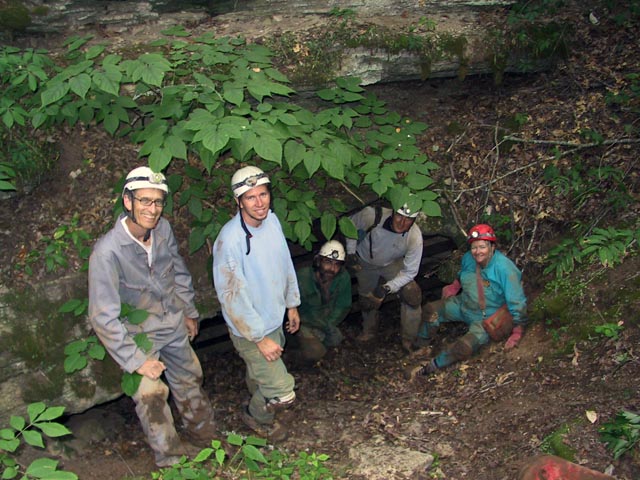
Unthanks Cave, with about 7.3 miles of mapped passages, was purchased by The Nature Conservancy several years ago and has recently been deeded over to the Commonwealth of Virginia. The leader of our expedition was Wil Orndorff, coordinator of karst protection for the Virginia Department of Conservation & Recreation (DCR). There were two other DCR personnel on the trip with us, Carol Zokaites and Bill Dingus, as well as Brian Watson and Melanie Stine from the Virginia Department of Game & Inland Fisheries and myself. Melanie took the photo (below) of me, Brian, Wil, Bill, and Carol.
.
The cave is roughly Y-shaped (about as rough as the letter Y could possibly be) with a base of perhaps 100 meters, a right prong extending perhaps a mile to pools wherein the Holsingeria dwell, and a left prong extending many miles, intersecting along its course a small underground stream. No Holsingeria were previously known from this left prong.
The six of us entered the cave through a locked gate, descended a rocky slide, and headed down the right prong about 10:00 one steamy mid-July morning, half climbing over boulders and half crawling in the mud. It was real exciting. Some of the wetter rooms featured lovely stalactites, aprons, flowstones, and all manner of classic cave formations. But most of the rooms were dry(ish), and hence the walls and ceilings were bare, although often towering to great height or falling to inky darkness.
Closer to the mouth of the cave we saw a couple species of very pretty salamanders and cave crickets with long, spidery legs. As our journey progressed we saw blind isopods and amphipods, planarians, and beetles. None of these populations was large - all seemed to be sparse inhabitants of tiny habitat patches in a vast expanse of black nothingness.
Around noon we arrived at the end of the right prong of the cave, and a series of small shallow pools of crystal-clear water. I don't think there were more than 10-12 such pools, some just a few feet long, generally no more than a few inches deep. And on the small cobbles in these pools, if one got on one's knees and made a careful inspection, very occasionally
 one could spy tiny white snails no more than perhaps 4 mm in maximum dimension - Holsingeria unthanksensis. The photo at left was taken by Wil.
My first impression was that, surely, this can't be the entire habitat, nor all the snails. My general experience has led me to expect hydrobiid populations, especially in springs, to look like grains of sand on the beach. But I'd guess that the six of us spent 15 - 20 minutes on our knees just observing, and I don't think we saw more than 20 - 30 animals in total. Wil collected three.
I was also impressed, oddly enough, by the shells of dead land snails scattered about this particular little region of the cave. I do not know how far we were under the surface at this point, but I don't think we were very deep. After our initial descent through the cave mouth our journey was more-or-less horizontal, and occasionally the ceilings were quite high, 30 meters or more. I should guess that the energy input to this system comes from fine organic debris raining from the surface. And I think land snails quite often, burrowing deeply into the rocky hillside above, slip and plummet to their deaths on the cave floor below.
Wil had visited this particular spot on at least two previous occasions, and his strongest impression was that the water levels were strikingly low. Southwest Virginia had been suffering a drought for many weeks, with the Powell River at about 10% of its historic daily flow. Wil was also surprised not to find any of the second species of hydrobiid documented from this site, Fontigens nickliniana. Bob Hershler's original description of the environment mentioned that Holsingeria was found together with Fontigens, a much more widespread taxon, locally very common in above-ground springs. Wil had also noticed the Fontigens on his earlier trips. But on this day, no Fontigens were in evidence.
These observations led me to the first of what I should characterize as an "unexpected revelation." Yes of course, cave environments are generally more stable than surface environments. But that doesn't mean that caves don't change. There was plenty of evidence in the cave of water levels much higher than those we observed - some levels lasting long enough to form "rimstone" around the pools, and some levels simply evidenced by damp marks. It can't be too many years before any such tiny population of aquatic snails must go extinct, right?
We next decided to walk back almost to the entrance of the cave and explore the left prong, our objective being the small river about a mile further down this second passage, from which no aquatic gastropods have ever been observed, by John Holsinger (2) or by anybody else. It was Wil's hypothesis that snails do not inhabit this river because the environment is too flashy - perhaps too variable in temperature or too closely in contact with the surface. But about 10-15 minutes of searching by four of us did uncover one (individual!) Holsingeria at the left prong river. A range extension!
In fact, Holsingeria unthanksensisis not endemic to Unthanks Cave. The species has been collected in at least four other caves scattered about southwest Virginia, with an enigmatic population (3) documented from Skyline Caverns as well, perhaps 300 miles north down the Shenandoah Valley. These caves all lie in Ordovician Limestone that reaches the surface in ribbons and patches through the ridge and valley province that extends from Tennessee to Pennsylvania.
So the second "unexpected revelation" I took away from my big adventure to Unthanks Cave was that what we were doing, essentially, was dropping a tiny bucket dredge on the bottom of splattery ocean many hundreds of miles long. My colleagues in the marine biology community understand that, if they find 30 snails in dredge #1 and zero snails in dredges #2 - 10, it doesn't mean that the snails were endemic to site #1, and that their total population size was 30. Rather, they interpret such data as the consequence of a patchy distribution, the degree of apparent patchiness being a function of sample volume (4). And the snails may not be rare, nor their extinction imminent.
Our stalwart party emerged from Unthanks Cave around 4:30 that afternoon, blinking in the light, baking in the heat, exhausted, muddy, and sore. What a great day! My special thanks go to Wil Orndorf (VaDCR) and Brian Watson (VaDGIF) for directing and producing this, our brief peek through a tiny window, into another world.
Keep in touch!
Rob
Notes
(1) Hershler, R. H. (1989) Holsingeria unthanksensis, a new genus and species of aquatic cavesnail from eastern North America. Malac. Rev. 21: 93-100.
(2) I should like to meet Dr. John R. Holsinger, the cave biologist who first brought Bob Hershler's attention to the little snails that bear his name. Holsinger, who has a tremendous reputation in the local caving community, was the primary author of the cave map Wil used to guide our expedition.
(3) The taxonomic status of the Skyline Caverns snail is unsettled at this point. Hershler considers it "a probable congener" of H. unthanksensis.
(4) I'm not sure that ecologists are as conscious of sampling as we once were. My favorite reference on dispersion patterns and spatial distributions is an older one - Chapter 4 of R. W. Poole's (1974) Introduction to Quantitative Ecology (McGraw-Hill).
Friday, July 20, 2007
Phylogenetic Sporting and the Genus Laevapex
Editor's Note. This essay was subsequently published as: Dillon, R.T., Jr. (2019b) Phylogenetic sporting and the genus Laevapex. Pp 137-141 in TheFreshwater Gastropods of North America Volume 2, Essays on the Pulmonates. FWGNA Press, Charleston.
Laurels are due to Andrea Walther, Taehwan Lee, Jack Burch and Diarmaid O'Foighil for their exemplary phylogenetic study of the ancylid genus Laevapex, published late last year in MP&E (1). In addition to contributing a thorough survey of DNA sequence variation and shell morphological diversity in this often-overlooked group of freshwater limpets, Andrea and her colleagues at the University of Michigan have posted a model of how modern molecular tools can combine with old-fashioned biology to provide fresh insights to important evolutionary processes.
As most of us are probably aware, the primary reference to the systematics of freshwater limpets in North America has long been the monograph of Paul Basch (2). Basch recognized two species of Laevapex, the ovate L. fuscus and the subcircular L. diaphanus. Andrea sampled 5 populations of the former and 5 populations of the latter. She also included in her analysis three less well-known taxa, L. peninsulae (two populations), L. arkansasensis (two populations) and Bob McMahon's unusual population from Oklahoma (3).
Andrea sequenced three genes: mitochondrial CO1, nuclear 28S, and nuclear ITS-2. Sample sizes were usually only one or two per population, but occasionally 10 - 12 or even as many as 28 individuals per population for the CO1 gene. She also performed an innovative geometric study of the digitized outlines of 76 representative Laevapex shells.
Her headline result was, "E Pluribus Unum." The five taxa of Laevapex were indistinguishable by their 28S and ITS-2 sequences, as well as by their shell morphometrics. They appeared polyphyletic in their CO1 sequences - all taxa generally mingled together on the main branch of the tree. Apparently the North American genus Laevapex comprises but a single polymorphic species, L. fuscus.
Perhaps of more general interest, however, was Andrea's discovery of several extremely divergent CO1 haplotypes in her large sample of Laevapex. The Baysian tree she derived from these data (her Figure 4) showed a highly divergent branch of four haplotypes jutting way off to the side of the main cluster - one diaphanus, one peninsulae, one arkansasensis and one Oklahoma. The CO1 haplotypes sequenced from these limpets were similar (but by no means identical) to one another, apparently bearing substantial nucleotide deletions relative to the 34 haplotypes in the main body of the tree (4).
I downloaded one of Andrea's divergent CO1 sequences from genebank, an L. diaphanus haplotype collected right here in South Carolina (DQ328243), as well as a typical sequence from a Virginia L. fuscus (DQ328225) for comparison. An alignment from the NCBI "Blast two sequences" utility showed that the typical and divergent sequences differed by about 10% of their nucleotides, where they matched. But there was a length of 20 nucleotides in the middle of the typical sequence that showed zero match to 11 nucleotides in the divergent. The CO1 protein being made by the South Carolina Laevapex is apparently deleted by three amino acids!
Horticulturists occasionally find that their trees and various other plants under cultivation produce "sports." These are branches of some obviously different genetic constitution, typically assumed to result from a somatic mutation or chromosomal rearrangement in the mother plant. By analogy, I suggest that the CO1 divergence documented by Andrea Walther and her colleagues in their small set of atypical Laevapex fuscus might be called "Phylogenetic Sporting."
Such sporting is not uncommon. Andrea listed seven previous examples from the freshwater gastropod literature alone, including the work by Bob Frankis and myself documenting 18.7% sequence divergence in a population of Goniobasis proxima (5). Several years ago our colleague Amy Wethington (6) discovered four individual Physa acuta in a local pond differing from the typical CO1 sequence by almost 30%.
What might be the origin of phylogenetic sporting? Again, Andrea and her colleagues did a thorough job of reviewing five possible explanations (7), ultimately unable to pick a single lead hypothesis for Laevapex. But at least one hypothesis can be ruled out quite decisively here, "cryptic speciation."
Sometimes I fear that the widespread application of DNA technology we have seen in systematic biology over the last few years has been more a curse than a blessing. The confusion that sequence data (and the methods developed to analyze it) have brought to the species concept is especially acute. Without question, there are professional evolutionary biologists among us today who would look at Andrea Walther's CO1 tree and conclude that her one limpet from Arkansas, her one limpet from South Carolina, her one limpet from Florida and her one limpet from Oklahoma together constitute an undescribed species. An embarrassment and a shame.
But returning to happier themes. In addition to her 15 populations of Laevapex, Andrea sequenced 11 populations of other ancylids and 4 populations of non-ancylid freshwater pulmonates, bringing her outgroup total up to match the total of her ingroups. I suppose it's not difficult to predict the next direction her research will be taking her.
For her Ph.D. dissertation, Andrea is extending her genetic survey to include Ferrissia, the five nominal species of which constitute by far the most enigmatic group of freshwater limpets in North America (8). In a nice article contributed to the current issue of the AMS Newsletter, Andrea reported preliminary results suggesting that the number of Ferrissia species has long been overestimated as well (9).
We'll keep you posted!
Rob
Notes
(1) Walther, A., T. Lee, J. B. Burch, and D. O'Foighil. 2006. E Pluribus Unum: A phylogenetic and phylogeographic reassessment of Laevapex (Pulmonata: Ancylidae), a North American genus of freshwater limpets. Molecular Phylogenetics and Evolution, 40: 501-516.
(2) Basch, P.F., 1963. A review of the recent freshwater limpet snails of North America (Mollusca: Pulmonata). Bull. Mus. Comp. Zool. Harvard Univ. 129, 399–461.
(3) One could make a strong case that Bob McMahon's incisive morphometric study anticipated the conclusions of Walther and her colleagues by two years. See R. F. McMahon (2004) A fifteen-year study of interannual shell-shape variation in a population of freshwater limpets. Am. Malac. Bull. 19: 101- 109.
(4) I'm simplifying here a bit. One of the four sports did not appear deleted, and one of the "typicals" did. See the actual paper for the nitty-gritty.
(5) Dillon, R. T., Jr. & R. C. Frankis (2004) High levels of mitochondrial DNA sequence divergence in isolated populations of freshwater snails of the genus Goniobasis. Am. Malac. Bull. 19: 69-77.
(6) Wethington, A. R. (2003) Phylogeny, taxonomy, and evolution of reproductive isolation in Physa (Pulmonata: Physidae) Ph.D. thesis, University of Alabama.
(7) Natural selection not among them. It is interesting to see how far evolutionary biology has come since I was a graduate student 25 years ago.
(8) In fact, Andrea and her colleagues have already published two interesting papers on Ferrissia in Europe: Walther, A., T. Lee, J. B. Burch, and D. Ó Foighil. 2006. Acroloxus lacustris is not an ancylid: A case of misidentification involving the cryptic invader Ferrissia fragilis (Mollusca: Pulmonata: Hygrophila). Molecular Phylogenetics and Evolution, 39: 271-275. Walther, A., T. Lee, J. B. Burch, and D. Ó Foighil. 2006. Confirmation that the North American ancylid Ferrissia fragilis (Tryon, 1863) is a cryptic invader of European and East Asian freshwater ecosystems. Journal of Molluscan Studies, 72: 318-321
(9) We here in Charleston have also been doing a bit of research on Ferrissia in the past year as well, with intriguing results not quite ready for dissemination. Stay tuned!
Laurels are due to Andrea Walther, Taehwan Lee, Jack Burch and Diarmaid O'Foighil for their exemplary phylogenetic study of the ancylid genus Laevapex, published late last year in MP&E (1). In addition to contributing a thorough survey of DNA sequence variation and shell morphological diversity in this often-overlooked group of freshwater limpets, Andrea and her colleagues at the University of Michigan have posted a model of how modern molecular tools can combine with old-fashioned biology to provide fresh insights to important evolutionary processes.
As most of us are probably aware, the primary reference to the systematics of freshwater limpets in North America has long been the monograph of Paul Basch (2). Basch recognized two species of Laevapex, the ovate L. fuscus and the subcircular L. diaphanus. Andrea sampled 5 populations of the former and 5 populations of the latter. She also included in her analysis three less well-known taxa, L. peninsulae (two populations), L. arkansasensis (two populations) and Bob McMahon's unusual population from Oklahoma (3).
Andrea sequenced three genes: mitochondrial CO1, nuclear 28S, and nuclear ITS-2. Sample sizes were usually only one or two per population, but occasionally 10 - 12 or even as many as 28 individuals per population for the CO1 gene. She also performed an innovative geometric study of the digitized outlines of 76 representative Laevapex shells.
Her headline result was, "E Pluribus Unum." The five taxa of Laevapex were indistinguishable by their 28S and ITS-2 sequences, as well as by their shell morphometrics. They appeared polyphyletic in their CO1 sequences - all taxa generally mingled together on the main branch of the tree. Apparently the North American genus Laevapex comprises but a single polymorphic species, L. fuscus.
Perhaps of more general interest, however, was Andrea's discovery of several extremely divergent CO1 haplotypes in her large sample of Laevapex. The Baysian tree she derived from these data (her Figure 4) showed a highly divergent branch of four haplotypes jutting way off to the side of the main cluster - one diaphanus, one peninsulae, one arkansasensis and one Oklahoma. The CO1 haplotypes sequenced from these limpets were similar (but by no means identical) to one another, apparently bearing substantial nucleotide deletions relative to the 34 haplotypes in the main body of the tree (4).
I downloaded one of Andrea's divergent CO1 sequences from genebank, an L. diaphanus haplotype collected right here in South Carolina (DQ328243), as well as a typical sequence from a Virginia L. fuscus (DQ328225) for comparison. An alignment from the NCBI "Blast two sequences" utility showed that the typical and divergent sequences differed by about 10% of their nucleotides, where they matched. But there was a length of 20 nucleotides in the middle of the typical sequence that showed zero match to 11 nucleotides in the divergent. The CO1 protein being made by the South Carolina Laevapex is apparently deleted by three amino acids!
Horticulturists occasionally find that their trees and various other plants under cultivation produce "sports." These are branches of some obviously different genetic constitution, typically assumed to result from a somatic mutation or chromosomal rearrangement in the mother plant. By analogy, I suggest that the CO1 divergence documented by Andrea Walther and her colleagues in their small set of atypical Laevapex fuscus might be called "Phylogenetic Sporting."
Such sporting is not uncommon. Andrea listed seven previous examples from the freshwater gastropod literature alone, including the work by Bob Frankis and myself documenting 18.7% sequence divergence in a population of Goniobasis proxima (5). Several years ago our colleague Amy Wethington (6) discovered four individual Physa acuta in a local pond differing from the typical CO1 sequence by almost 30%.
What might be the origin of phylogenetic sporting? Again, Andrea and her colleagues did a thorough job of reviewing five possible explanations (7), ultimately unable to pick a single lead hypothesis for Laevapex. But at least one hypothesis can be ruled out quite decisively here, "cryptic speciation."
Sometimes I fear that the widespread application of DNA technology we have seen in systematic biology over the last few years has been more a curse than a blessing. The confusion that sequence data (and the methods developed to analyze it) have brought to the species concept is especially acute. Without question, there are professional evolutionary biologists among us today who would look at Andrea Walther's CO1 tree and conclude that her one limpet from Arkansas, her one limpet from South Carolina, her one limpet from Florida and her one limpet from Oklahoma together constitute an undescribed species. An embarrassment and a shame.
But returning to happier themes. In addition to her 15 populations of Laevapex, Andrea sequenced 11 populations of other ancylids and 4 populations of non-ancylid freshwater pulmonates, bringing her outgroup total up to match the total of her ingroups. I suppose it's not difficult to predict the next direction her research will be taking her.
For her Ph.D. dissertation, Andrea is extending her genetic survey to include Ferrissia, the five nominal species of which constitute by far the most enigmatic group of freshwater limpets in North America (8). In a nice article contributed to the current issue of the AMS Newsletter, Andrea reported preliminary results suggesting that the number of Ferrissia species has long been overestimated as well (9).
We'll keep you posted!
Rob
Notes
(1) Walther, A., T. Lee, J. B. Burch, and D. O'Foighil. 2006. E Pluribus Unum: A phylogenetic and phylogeographic reassessment of Laevapex (Pulmonata: Ancylidae), a North American genus of freshwater limpets. Molecular Phylogenetics and Evolution, 40: 501-516.
(2) Basch, P.F., 1963. A review of the recent freshwater limpet snails of North America (Mollusca: Pulmonata). Bull. Mus. Comp. Zool. Harvard Univ. 129, 399–461.
(3) One could make a strong case that Bob McMahon's incisive morphometric study anticipated the conclusions of Walther and her colleagues by two years. See R. F. McMahon (2004) A fifteen-year study of interannual shell-shape variation in a population of freshwater limpets. Am. Malac. Bull. 19: 101- 109.
(4) I'm simplifying here a bit. One of the four sports did not appear deleted, and one of the "typicals" did. See the actual paper for the nitty-gritty.
(5) Dillon, R. T., Jr. & R. C. Frankis (2004) High levels of mitochondrial DNA sequence divergence in isolated populations of freshwater snails of the genus Goniobasis. Am. Malac. Bull. 19: 69-77.
(6) Wethington, A. R. (2003) Phylogeny, taxonomy, and evolution of reproductive isolation in Physa (Pulmonata: Physidae) Ph.D. thesis, University of Alabama.
(7) Natural selection not among them. It is interesting to see how far evolutionary biology has come since I was a graduate student 25 years ago.
(8) In fact, Andrea and her colleagues have already published two interesting papers on Ferrissia in Europe: Walther, A., T. Lee, J. B. Burch, and D. Ó Foighil. 2006. Acroloxus lacustris is not an ancylid: A case of misidentification involving the cryptic invader Ferrissia fragilis (Mollusca: Pulmonata: Hygrophila). Molecular Phylogenetics and Evolution, 39: 271-275. Walther, A., T. Lee, J. B. Burch, and D. Ó Foighil. 2006. Confirmation that the North American ancylid Ferrissia fragilis (Tryon, 1863) is a cryptic invader of European and East Asian freshwater ecosystems. Journal of Molluscan Studies, 72: 318-321
(9) We here in Charleston have also been doing a bit of research on Ferrissia in the past year as well, with intriguing results not quite ready for dissemination. Stay tuned!
Subscribe to:
Posts (Atom)


 Posts
Posts


