Dr. Rob Dillon, Coordinator


Monday, October 12, 2009

Mobile Basin III: Pleurocera Puzzles

Editor's Note - The research results telegraphed below were ultimately published by Dillon (2011) in Malacologia 53: 265 - 277.

Last month (1) we made passing reference to the Awakening of Calvin Goodrich, that 1934-41 period during which he published “Studies of the Gastropod Family Pleuroceridae” I – VIII (2). During this stage of his career, our hero developed his thesis that the characters upon which most pleurocerid taxonomy had been based - shell dimensions, coloration, ornamentation and so forth - are highly plastic and subject to environmental influence (3). In 2007 I coined the term “Goodrichian taxon shift” to describe situations where a single population of pleurocerids might vary down an environmental gradient to such an extent that taxonomists have recognized two different species (4). Or perhaps even two different genera?

I realize that the heading at the top of this essay is “Mobile Basin III.” But I beg your indulgence for the next three paragraphs to stray one drainage north, to the headwaters of the Tennessee River.
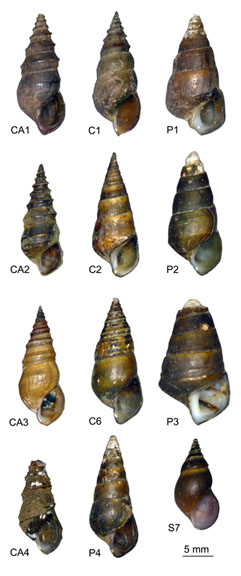
In my "Goodrichian" essay of 20Feb07 I reported unpublished observations on variation at two allozyme loci in a population of Goniobasis from Indian Creek, a tributary of the Clinch/Powell in southwest Virginia (5). In the headwaters, this single population of pleurocerids bore shells that were strongly carinate (historically referred to "G. acutocarinata" CA1), in middle reaches their shell morphology was smooth and typical of G. clavaeformis (C1), and upon joining the main Powell River, their shells became chunky and angulate, showing the morphology generally assigned the nomen “Pleurocera unciale” (P1).

In the last couple years I have extended this research program down the width of East Tennessee, to include populations from the Little River drainage near Maryville (figs CA2, C2, P2 at left), the Conasauga/Hiwassee near Etowah (figs CA3, C6, P3), and the Coahulla/Oostanaula/Coosa in North Georgia (figs CA4, P4). I have also sampled populations of G. simplex from each of these four regions to calibrate expected levels of interpopulation divergence at the 10 allozyme loci examined (fig S7).

The results of my 2007 study in Indian Creek are confirmed (6). Each of the four samples of “Pleurocera” was more genetically similar to the Goniobasis population just upstream than to any other sample of Pleurocera. Apparently taxonomists have been misled by ecophenotypic variation to identify populations of a single, widespread species under two different genera.

This result extends from the rivers of Tennessee into the Coosa drainage of North Georgia. Tradition has always held that elements of the Mobile Basin fauna are treated as endemic, even when indistinguishable from the fauna of neighboring drainages. Thus Goniobasis populations from small creeks in the Alabama/Coosa drainage showing the strongly carinate shell morphology are typically identified as “Goniobasis carinifera,” and those with heavier, smoother shells downstream as “Pleurocera vestitum.” Interestingly, if carinifera/vestitum is indeed conspecific with clavaeformis/unciale, the oldest name for the entire, sprawling species, from Virginia to Alabama, would be the Coosa name Goniobasis carinifera (Lamarck 1822).

In August we kicked this series off with news that the US Fish & Wildlife Service has proposed Alabama populations of pleurocerids identified as “Pleurocera foremani” for listing under the Endangered Species Act (7). According to the notice posted in the Federal Register, P. foremani is found today at only two locations, the lower Coosa River below Wetumpka Shoals and lower Yellowleaf Creek, a tributary of the Coosa (8). I understand from colleagues with field experience in this region that, sampling upstream, P. foremani is replaced by Pleurocera prasinatum in the smaller rivers, and that P. prasinatum is replaced by Pleurocera vestitum, and that vestitum is replaced by Goniobasis carinifera in the creeks.

In 1944, the mature Calvin Goodrich wrote regarding the Coosa species of Pleurocera, "On close study and comparison, they resolve themselves into four forms, and even these are not very distinctive. The specific names, in short, are to be considered conveniences in sorting rather than clean-cut differentiations" (9). He then went on to list P. vestitum "especially common in head streams," P. prasinatum "in the middle and lower Coosa," and P. foremani, which he distinguished by shell sculpture that "in one locality of the Cahaba is plainly a reversion, the same thing may be true of the shells of the Coosa.

"I have not seen the dissertation of Jeffrey Sides. But again referring to the 29Jun09 Federal Register (8), his sequence data suggested that P. foremani "was genetically more closely allied to a co-occurring species in the genus Elimia (Goniobasis)" than to any other species in the genus Pleurocera. Really? Even though double-digit sequence divergence is not uncommon within even conspecific populations of pleurocerids (10), the divergence between P. foremani and the local upstream Goniobasis appears to be of minor consequence?

Is the foremani/prasinatum/vestitum/carinifera taxon continuum in Alabama nothing but a unciale/clavaeformis/acutocarinata Goodrichian taxon shift, one state south? Has the US Fish and Wildlife service proposed federal protection for a local ecophenotypic variant of the most widespread pleurocerid in the American southeast? Pleurocera puzzles, indeed!

Stay tuned for more ...
Rob


Notes

(1) "Mobile Basin II: Leptoxis Lessons." Post of September '09 .

(2) A nice Goodrich bibliography is available from Kevin Cummings' website at the INHS

(3) "The Legacy of Calvin Goodrich." Post of January '07.

(4) "Goodrichian Taxon Shift." Post of February '07.

(5) Dillon, R.T. & J. D. Robinson (2007) The Goniobasis ("Elimia") of southwest Virginia, II. Shell morphological variation in Goniobasis clavaeformis. Report to the Virginia Division of Game and Inland Fisheries, contract 2006-9308. 12 pp. [pdf]

(6) I presented this research at a NABS symposium this May in Grand Rapids. A manuscript is currently in preparation. Dillon, R. T. (in prep) Genetic and morphological divergence among populations of pleurocerid snails inhabiting rivers of the Southern Appalachians: Evidence of a two-stage process.

(7) "Mobile Basin I: Two Pleurocerids Proposed for Listing." Post of August '09.

(8) Follow the link from the FWS Press Release: Service Proposes Endangered Species Status and Critical Habitat Designations for the Georgia Pigtoe Mussel, Interrupted Rocksnail, and Rough Hornsnail.

(9) Goodrich, C. 1944. Pleuroceridae of the Coosa River basin. Nautilus 58(2):40-48.

(10) "The Snails the Dinosaurs Saw." Post of March '09.

Tuesday, September 15, 2009

Mobile Basin II: Leptoxis Lessons

Editor's Note.  This essay was subsequently published as: Dillon, R.T., Jr. (2019c) Mobile Basin II: Leptoxis legacy.  Pp. 27-33 in The Freshwater Gastropods of North America Volume 3, Essays on the Prosobranchs.  FWGNA Press, Charleston.

Through the early history of American malacology, the freshwater gastropod fauna of the Mobile Basin was not seen as exceptionally diverse. Isaac Lea, T. A. Conrad, and J. G. Anthony described about 20 species of Leptoxis (1) from the Mobile Basin from 1834 - 1860, for example, which Tryon (1873) boiled down to about 12 (2). This would not seem to be a significantly greater tally than the approximately 20 species of Leptoxis described from the Tennessee River system during that era.

Indeed, the apparent diversity of the Mobile Basin mollusk fauna may not so much be a consequence of evolutionary history, but rather history of a very human sort. It is best, perhaps, understood as the story of my professional hero, Calvin Goodrich (3).

Some of my audience may recall that Calvin Goodrich began his career as a newspaperman, and that he was influenced by A. E. Ortmann to take up malacology around the years 1913 - 1917. One of Ortmann's closest professional colleagues was Herbert H. Smith, who retired in 1903 from the Carnegie Museum in Pittsburgh to become curator of the Alabama State Museum in Tuscaloosa. When H. H. Smith died in 1919, a review of Smith's collections of Alabama pleurocerids was passed by Ortmann to Goodrich.

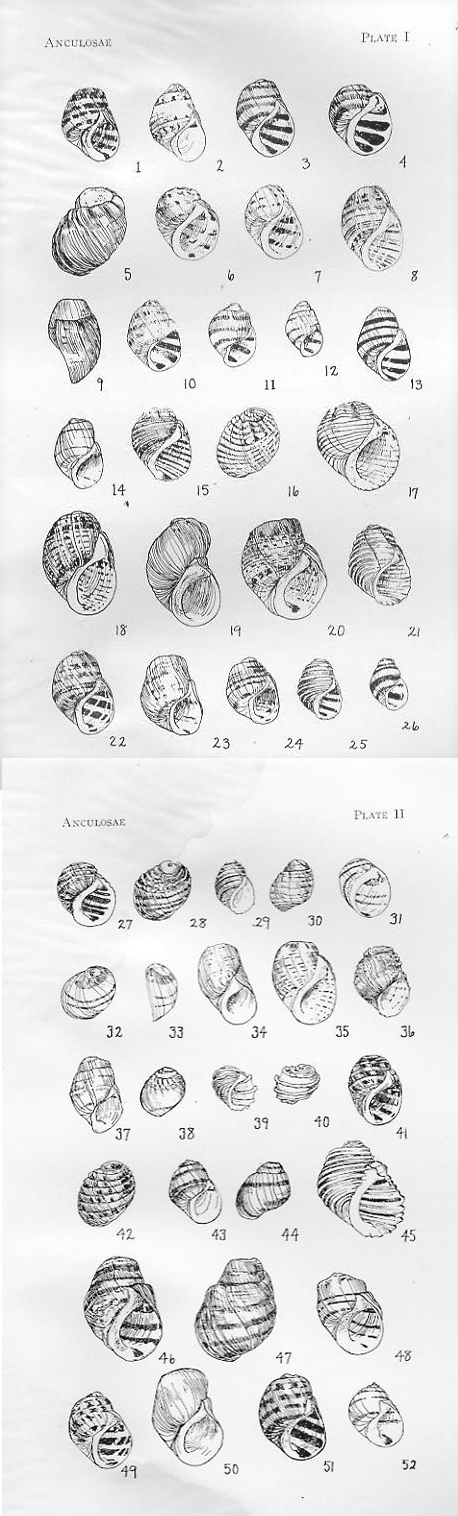
"The Anculosae of the Alabama River Drainage" was Calvin Goodrich's first substantial contribution to science (4). It is essentially a tribute to Smith (and indirectly to Ortmann), adding 11 new H. H. Smith nomina to a list of 14 transferred forward from Conrad, Lea, and Anthony. Goodrich described one new species himself, Anculosa smithi (named for guess who), bringing the total inventory up to 26 Leptoxis for the drainage. A concatenation of Goodrich's Plates I and II, illustrating all 26 species (5), is shown at left (and click to enlarge).

This work long predated Goodrich's (1934-41) "Studies on the Pleuroceridae," in which our hero came around to an understanding of the ecophenotypic nature of the shell morphological characters upon which pleurocerid taxonomy has historically been based. It also (of course) predated his (1939-1944) reviews of the Pleuroceridae of North America, in which Goodrich synonymized a huge fraction of the old 19th century taxonomy, combining (for example) the 26 nomina of Leptoxis (1) described from the Ohio/Tennessee basin down to nine (6). But apparently the old newspaperman could not edit his own copy. When he came back to the "Pleuroceridae of the Coosa River Basin" twenty years later (7), he preserved 18 Leptoxis species, saying, "A re-examination in 1943 has confirmed most of the decisions of 1922" (8).

By the 1940s, however, Calvin Goodrich's editorial skills were of little consequence to the Mobile Basin Pleuroceridae. Because as early as 1914 the first of seven dams was closed on the Coosa River, covering miles of the rocky rapids which were the habitat of Leptoxis with silty slackwater. And over the next 53 years, as the Coosa was almost completely impounded by Alabama Power, the Corps of Engineers was improving navigation on the Alabama River downstream with channelization, locks and dams.

Entering the 1990s, Leptoxis populations were believed to have survived in only four regions of the Mobile Basin - one tributary of the Black Warrior River (7), the upper reaches of the Cahaba River, the lower reaches of three mid-sized tributaries of the Coosa, and (amazingly) the main Alabama River downtream from the Claiborne Lock and Dam. Perhaps not surprisingly, conventional wisdom accorded snails from these four regions four different specific nomina - Leptoxis plicata, L. ampla, L. taeniata, and L. picta (respectively). The first three of these species were approved as candidate species in 1995, and after study and comment, entered the Federal lists in 1998 - L. plicata as endangered, L. taeniata and L. ampla as threatened (9). Leptoxis picta was not considered for listing.

We interrupt this extended history lesson for a brief spasm of science. I was sent large samples of all four of these nominal species (8 populations, 30 individuals per population) by our colleague Chuck Lydeard in 1996. The sample of L. picta I received was of larger, older, and more heavily-shelled animals (10), but otherwise no morphological difference between L. picta, L. ampla, and L. taeniata was apparent. My sample of Leptoxis plicata was distinctive by their higher-spired shells, bearing slight carination.

I did a proper allozyme study, comparing divergence at 9 loci among the 8 populations to 3 populations of Leptoxis praerosa, the common and well-characterized species widespread in Tennessee drainages to the north (11). The levels of genetic divergence among the picta, ampla, and taeniata populations were negligible. So it was quite clear, as of 1996, that all the Leptoxis populations known to have survived in the Alabama/Coosa River system were conspecific, L. picta being the oldest name for the group. Leptoxis plicata (of the Tombigbee/Black Warrior system) would appear to be a valid biological species.

So in summary, two of the three nominal species of Leptoxis currently on the US endangered species list are junior synonyms of a third species, which is not listed. What lessons can be learned from this mess?

Once again we see a vivid demonstration that science and public policy are two entirely different things. Most of you have heard me preach this sermon before, so I won't preach it again (12). Scientists have a language, culture, value system, and assumptions about the world that are completely different, no better or worse, from the language, culture, values, and assumptions brought by politicians, lawyers, and the natural resource managers who put laws into practice.

The adjective "endangered" is not scientific - it can't be measured, quantified, verified, or falsified. A designation of endangerment is the result of a political process, and by that process Leptoxis plicata (for example) is endangered and Leptoxis picta is not.

Now we read that yet another nominal species of Leptoxis from the Mobile Basin has been proposed for protection under the US Endangered Species Act (13). Field surveys undertaken in the upper Coosa in the late-1990s led to the discovery of a pleurocerid population in the Oostanaula River of North Georgia that has been identified as Leptoxis downei or L. foremani. In the last ten years, this population has become the target of an extensive recovery effort, our colleague Paul Johnson initiating a captive propagation program at the Tennessee Aquarium Research Institute in 2000, which he carried with him to the Alabama Aquatic Biology Center in 2005 (14).

But is Leptoxis foremani a valid biological species? Tryon synonymized foremani under L. picta in 1873, and the taxon was only resurrected by Goodrich in 1922 on the slenderest of threads (15). So given the tortured history of Leptoxis systematics in the Mobile Basin through 150 years, are we surprised that so much time, money and effort has been spent on conserving "L. foremani," while no effort whatsoever has apparently been directed toward establishing its biological reality? Nope. Science and public policy are two entirely different things.

Notes

(1) I'm going to fight the urge to digress into a discussion of the genus-level taxonomy here. Maybe one day soon. In the mean time, for the purpose of this essay, I'm lumping Anculosa and Nitocris/Mudalia together under Leptoxis.

(2) Tryon G. W. (1873) Land and Freshwater Shells of North America. Part IV, Strepomatidae. Smithsonian Miscellaneous Collections 253: 1 - 435.

(3) "The Legacy of Calvin Goodrich" See my Post of January '07.

(4) Goodrich, C. (1922) The Anculosae of the Alabama River Drainage. Misc. Publ. Univ. Mich Mus. Zool. 7: 1-57.

(5) The suviving taxa depicted on Goodrich's (1922) Plates I and II are as follows: Figs 3 - 5 are L. ampla, Figs 18-19 are L. foremani, Figs 34 - 35 are L. picta, Figs 36-38 are L. plicata, Figs 46 - 49 are L. taeniata.

(6) Goodrich, C. (1940) The Pleuroceridae of the Ohio River drainage system. Occas. Pprs. Mus. Zool. Univ. Mich 417:1 - 21.

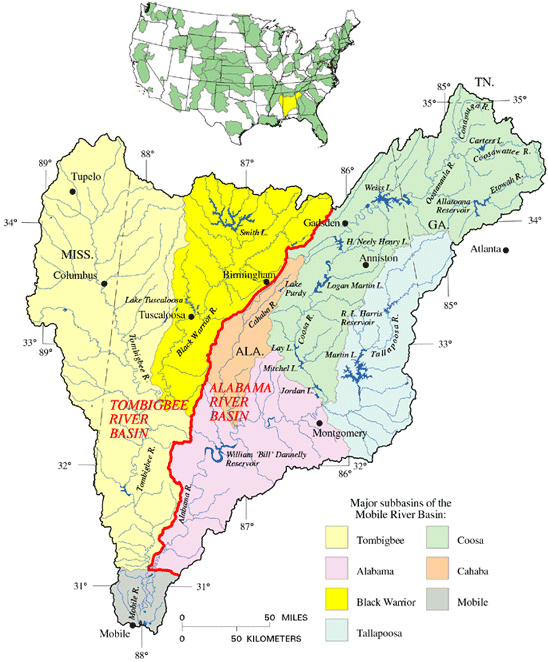
(7) Here's another digression I hate to take. The Mobile Basin is composed of two halves - the Alabama/Coosa and the Tombigbee/Black Warrior. Most of the literature we are reviewing here is for subsets. Goodrich's (1944) "Pleuroceridae of the Coosa River Basin" would include just a geographical (not taxonomic) subset of his (1922) "Anculosae of the Alabama River," for example, and neither work would include populations like L. plicata of the Black Warrior. A map of the Mobile Basin is available [here].

(8) Goodrich, C. (1944) Pleuroceridae of the Coosa River basin. Nautilus 58: 40-8.

(9) Endangered status for three aquatic snails, and threatened status for three aquatic snails in the Mobile River Basin of Alabama. 63 FR 57610-57620 [PDF]

(10) Goodrich himself prominently noted the relationship between river size and pleurocerid shell morphology on many occasions. See my post of February '07, "Goodrichian Taxon Shift." We will return to this subject very soon.

(11) Dillon, R.T., and C. Lydeard (1998) Divergence among Mobile Basin populations of the pleurocerid snail genus, Leptoxis, estimated by allozyme electrophoresis. Malacologia 39: 111-119. [PDF]

(12) For example, "Idaho Springsnail Panel Report" (December '05), or "Red Flags, Water Resources, and Physa natricina." (March '08).

(13) Mobile Basin I: Two pleurocerids proposed for listing. Post of August '09.

(14) Interrupted Rocksnail Reintroduced to the Coosa River. Outdoor Alabama, February 2004, p. 33 [PDF]

(15) "In shell characters this species (L. foremani) is closer to A. picta Conrad than is A. formosa Lea. But while the operculum of picta and formosa are much alike, that of foremani is like the operculum of neither. The similarity of the shells of formosa and foremani, picta out of consideration, varies strangely with locality, the resemblances and differences seeming to play a game of see-saw as the collector travels down the Coosa River." (Goodrich 1922: 18).

Monday, August 24, 2009

Mobile Basin I: Two Pleurocerids Proposed for Listing

Editor's Note.  This essay was subsequently published as: Dillon, R.T., Jr. (2019c) Mobile Basin I: Pleurocera puzzles.  Pp 23-26 in The Freshwater Gastropods of North America Volume 3, Essays on the Prosobranchs.  FWGNA Press, Charleston.

The fauna of the Mobile Basin has become a cause célèbre - perhaps the cause célèbre - of freshwater gastropod conservation in North America. I am aware of four general calls-to-arms issued in recent years that have focused on the plight of this famously diverse biota, inhabiting creeks and rivers through the length of Alabama, edging into East Mississippi and North Georgia (1). The review of Neves and his colleagues, for example, cataloged 118 freshwater gastropod species in the Mobile Basin in ten families, suggesting that as many as 38 may have been lost to extinction in the 20th century, with another 70 threatened. Yet only seven of the species remaining are currently protected under the US Endangered Species Act: four pleurocerids (Leptoxis ampla, L. plicata, L. taeniata, Goniobasis crenatella), two viviparids (Tulotoma magnifica and Lioplax cyclostomaformis) and one hydrobiid (Lepyrium showalteri).Now after a hiatus of over ten years, in late June the US Fish and Wildlife Service announced a proposal to list two new Mobile Basin pleurocerids: Leptoxis foremani and Pleurocera foremani (2). The comment period ends this Friday, August 28. Any of our colleagues on this list who might wish to offer "comments, suggestions, and any additional information on biology, threats, range, distribution, population size, or current or planned activities and the activities' possible impacts on these species or their proposed critical habitats" will find instructions on the FWS website [here].

But what do we actually know about the freshwater gastropods of the Mobile Basin? Their taxonomy almost entirely predates the Modern Synthesis. We have seen that Calvin Goodrich, for example, seemed to have second thoughts about the 26 species of Leptoxis he catalogued in 1922 (3), later coming around to the realization that much of the shell variation expressed in North American pleurocerids may be ecophenotypic in origin (4). A bit of digging into the 6/29 issue of the Federal Register that formally proposes the new pleurocerids for listing will reveal a reference to the recent dissertation of Jeffrey Sides, reporting negligible sequence difference between P. foremani and a co-occurring species of an entirely different genus, Goniobasis ("Elimia"). What gives?

This is the first in what will probably turn out to be a sporadic series of essays on the freshwater gastropod fauna of the Mobile Basin. Between the undeniably fascinating evolutionary biology of this unique fauna and the complications of politics, personalities, and public policy there are, no doubt, many lessons to be learned.

Notes

(1) Brown, K. M & P. D. Johnson (2004) Comparative conservation ecology of pleurocerid and pulmonate gastropods of the United States. Amer. Malac. Bull. 19: 57-62. Lydeard, C. et al. (2004) The global decline of nonmarine mollusks. BioScience 54: 321 - 330. Neves, R.J., A E. Bogan, J. D. Williams, S. A. Ahlstedt, and P. W. Hartfield (1997) Status of aquatic mollusks in the southeastern United States: A downward spiral of diversity. Chapter 3 in Aquatic Fauna in Peril: the Southeastern Perspective (Benz & Collins, eds.) Southeast Aquatic Research Institute Publication 1. Lydeard, C. & R. L. Mayden (1995) A diverse and endangered aquatic ecosystem of the southeast United States. Conservation Biology 9: 800-805.

(2) Service Proposes Endangered Species Status and Critical Habitat Designations for the Georgia Pigtoe Mussel, Interrupted Rocksnail, and Rough Hornsnail: http://www.fws.gov/southeast/news/2009/r09-035.html

(3) Goodrich, C. (1922) The Anculosae of the Alabama River drainage. Misc. Publ. Mus. Zool. Univ. Mich., 7, 1-57

(4) "The legacy of Calvin Goodrich." FWGNA post of January '07. "Goodrichian Taxon Shift." FWGNA post of February '07.

Tuesday, July 14, 2009

Megapetitions of the Old West


There's a new posse riding the plains, and they're aiming to make the American West safe for all its law-abiding citizens, including the malacological ones. And on their hips, they're toting sawed-off scatterguns.

The Center for Biological Diversity (CBD) is celebrating its twentieth anniversary this year. There's a beautifully-formatted booklet available for download from their web site packed full of dramatic tales such as "A bare-knuckled trio takes on Big Timber" and "Sprawl Showdown." With a main office in Tucson, and field offices in eight other states, their staff of 60 (including 17 lawyers) works "to secure a future for all species, great and small," with a "vision and a solar-powered fax machine.

"Their efforts thus far have been impressive. In recent years CBD gunslingers have prevailed in shootouts over Pyrgulopsis roswellensis, Juternia kosteri and Assiminea pecos in New Mexico, as well as P. morrisoni in Arizona. Their web site (accessed 10July09) catalogues 86 listing petitions, 5 critical habitat petitions, and 9 species status reviews along with scores of "research papers."

Recently the CBD posse seems to be dramatically expanding its efforts on behalf of our favorite creatures with a couple petitions along an unusual line of approach. Taking advantage of the 1994 FWS policy encouraging "Multi-species listings…when several species have common threats, habitat, distribution, landowners, or features that would group the species and provide more efficient listing and subsequent recovery,” in 2008 the CBD filed "Petition to list 32 mollusk species from freshwater and terrestrial ecosystems of the northwestern United States as Threatened or Endangered under the Endangered Species Act." [PDF, 2.0 MB] Then in February of this year they let loose with an even bigger blast, "Petition to list 42 species of Great Basin Springsnails from Nevada, Utah, and California as Threatened or Endangered under the Endangered Species Act." [PDF, 1.7 MB]

The 2008 volley, weighing in at 85 pages, proposed 17 freshwater snails of three familes for protection: 14 hydrobiids (11 Fluminicola, 3 "Lyogyrus"), 2 pleurocerids (Juga), and one planorbid (a Vorticifex), as well as 15 land snails of diverse groups. The taxonomy was a complete mess, and the document an embarrassment (1). The causes of three valid species (Fluminicola seminalis, F. potemicus, and Colligyrus convexus) were buried under the weight of 14 spurious taxa proposed in various unpublished reports by the late Terry Frest. I hope that the poor FWS biologist sitting behind the desk on which this dead coon is currently stinking can find it in his heart to forgive us.

So the 2009 petition, tipping the scales at 133 pages, could only be better. The 42 hydrobiid species it proposes for protection include 37 Pyrgulopsis and 5 Tryonia, all endemic to single springs or sets of springs in Nevada or closely adjoining regions (For example, the spring at Point of Rocks figured above, in the Ash Meadows National Wildlife Refuge, NV). All 42 species have been recently monographed by (in fact, mostly described by) Bob Hershler (2). I don't have any personal experience in this part of the world, but from my seat on the corral fence, if these diminutive citizens of the Old West don't need a bit of protection, I don't know who does.

The advantage of a megapetition approach ought to be in speed and efficiency. The 2009 petition features just one (collected) section entitled "Natural History and Ecology" for the entire list of 42 species, and I think this is justifiable. Treating all these populations together where possible ought to yield substantial savings in time and manpower for the CBD to research, and the FWS to process - savings which should translate into quicker results.

But on the downside, weakness in any element of a megapetition may translate to the whole. It's hard to sell a bag of 17 apples and 15 oranges, when 14 of the apples are rotten.

Both the 2008 and 2009 petitions called the attention of the Secretary of the Interior to laws "placing definite response requirements on the FWS and very specific time constraints on those responses." Apparently federal regulations require that the FWS respond to petitions such as these in 90 days. Well, I don't think anybody actually expected that to happen. The FWS simply does not have the staff or the expertise to evaluate documents of this heft at time scales marked in days. I understand that it generally requires a minimum of 15 months to obtain a 90-day finding, 15 months being the earliest point at which a "timeline suit" can be filed.

So it looks like our little snails will be holding off the development desperados by themselves a little bit longer. In the meantime, we'll keep an ear to the rail, and an eye toward the sunset.

Notes

(1) I am not criticizing the CBD here. Their proposal can only be as strong as the science on which it is based.

(2) Hershler, R. & D.W. Sada (1987) Springsnails (Gastropoda: Hydrobiidae) of Ash Meadows, Amargosa Basin, California-Nevada. Proc. Biol. Soc. Wash. 100: 776-873. Hershler, R. (1994) A review of the North American freshwater snail genus Pyrgulopsis (Hydrobiidae). Smithsonian Contrib. Zoology 554: 115 p. Hershler, R. (1998) A systematic review of the hydrobiid snails (Gastropoda: Rissooidea) of the Great Basin, Western United States. Part I. Genus Pyrgulopsis. Veliger 41: 1-132.

Thursday, June 11, 2009

Just One Species of Ferrissia

Editor's Note:  A substantial fraction of the material in this essay was subsequently rendered obsolete by the 2010 research of Walther and colleagues.  See my post of [8Dec10] for more.

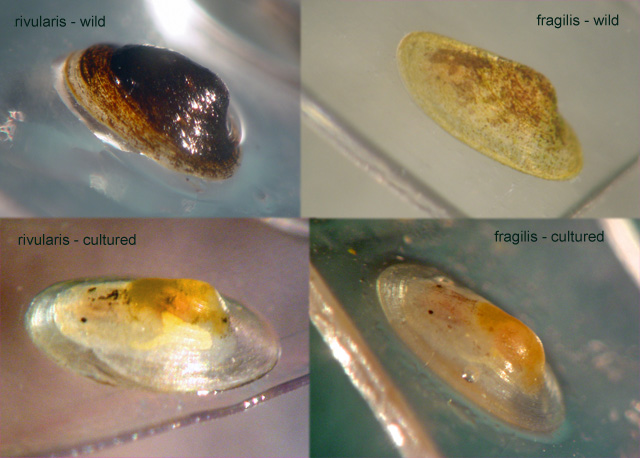
I'm pleased to report the publication of a paper by J. J. Herman and myself in this month's Journal of Freshwater Ecology, "Genetics, shell morphology, and life history of the freshwater pulmonate limpets Ferrissia rivularis and Ferrissia fragilis (1)." In this work we offer evidence that populations of the two most widespread limpets in North America reproduce entirely by self fertilization, and that the shell morphological criteria by which they have been distinguished are the result of ecophenotypic plasticity. We suggest that the nomen Ferrissia fragilis is a junior synonym of F. rivularis.


The modern taxonomic history of the North American Ancylidae has been one of consolidation (2). Basch (3) recognized five species of Ferrissia (rivularis, fragilis, parallela, walkeri and mcneilli), noting as he did that "ecological phenotypes are numerous, and plasticity of shell form has been remarked upon many times." (See Basch's charming figure above). More recently Andrea Walther's sequence data have suggested just two Ferrissia lineages, which she has correlated with the rivularis and fragilis phenotypes and life habits (4).

But our discovery of asexual reproduction voids the biological species concept, and necessitates a retreat to the morphological. And since there seems to be no heritable component to the shell characters conventionally used to distinguish rivularis and fragilis (see figure below), it would appear that a single-species model fits the situation best.

I gather that Andrea and her advisor Dairmaid O'Foighil prefer to retain the two species model, under one of the many species concepts based on gene trees. But the limitations of the various phylogenetic and cladistic species concepts are well known (5).

The situation with Ferrissia in North America seems biologically analogous to that of the better-studied Ancylus fluviatilis in Europe. A phenotypically plastic response of shell height and shell thickness to current and substrate has been well known in A. fluviatilis populations for years, and Städler and colleagues (6) documented asexual reproduction in the mid-1990s. More recently Pfenninger and colleagues (7) have reported that 103 populations of A. fluviatilis sampled from across Europe can be grouped into four DNA clades. Yet European workers seem content to identify all their limpet populations by the same nomen, Ancylus fluviatilis.

If there were a reliable correlation between Andrea's gene trees and any criterion by which rivularis and fragilis have been distinguished in the past, an argument could be made for retaining both nomina as labels for asexual lineages. But Andrea misclassified the samples we sent her in 2007 from our North Saluda River population as F. fragilis, even though they were collected from a rocky stream and bore robust, acutely conical shells. One species of Ferrissia it would seem to be.

Notes

(1) Dillon, R. T., Jr. & J. J. Herman (2009) J. Freshw. Ecol. 24: 261-272. [PDF]

(2) See the FWGNA archives of July '07, "Phylogenetic sporting" in the genus Laevapex.

(3) Basch, P.F., 1963. A review of the recent freshwater limpet snails of North America (Mollusca: Pulmonata). Bull. Mus. Comp. Zool. Harvard Univ. 129: 399–461.

(4) Although I have seen some data from Andrea's recent Ph.D. dissertation at the University of Michigan, I have not seen the work itself. This is from my personal communication with Andrea and her advisor, together with the abstracts of talks she has given in recent years.

(5) See the FWGNA archives of July '08: Gene trees and species trees.

(6) Städler, T., M. Loew and B. Streit. 1993. Genetic evidence for low outcrossing rates in polyploid freshwater snails (Ancylus fluviatilis). Proc. R. Soc. Lond. B 251: 207-213. Städler, T., S. Weisner and B. Streit. 1995. Outcrossing rates and correlated matings in a predominantly selfing freshwater snail. Proc. R. Soc. Lond. B 262: 119-125.

(7) Pfenninger, M., S. Staubach, C. Albrecht, B. Streit and K. Schwenk. 2003. Ecological and morphological differentiation among cryptic evolutionary lineages of freshwater limpets of the nominal form-group Ancylus fluviatilis (O. F. Muller, 1774). Molecular Ecology 12: 2731-2745.

Wednesday, May 27, 2009

Freshwater Gastropod Databases Go Global!


Last month we reviewed the not-insubstantial progress that many of our larger national and regional research museums have made with electronic data capture, evaluating their on-line holdings of North American freshwater snails. Among the many nice comments I received from that post were several calling my attention to the Global Biodiversity Information Facility, a remarkable data network hosted in Copenhagen. Some of our colleagues feel strongly that the GBIF “Portal” represents the future of online museum databases worldwide.

The system is administered by a governing board, 30 participating countries, and 20 associate countries. It hosts (as of 26May09) over 174 million records across the diversity of eukaryotic life, contributed by 289 data providers worldwide. My query for “Campeloma” entered into the single, simple search box returned an impressive 3,210 records, as follows:

1,414 Florida Museum of Natural History
852 Academy of Natural Sciences, Philadelphia
498 North Carolina State Museum
145 University of Colorado Museum
127 US National Museum
55 Yale (Peabody) Museum
116 (Nine other institutions)

The FLMNH, ANSP, and USNM numbers are reassuringly close to the figures I obtained from my queries to their local on-line datbases, as reported last month. I didn’t think to look at the NCSM last month (Shame on me!) but the (rather impressive) 498 records I retrieved from the GBIF also closely approximate the results I would have gotten from a query to their local site, had I visited. I also didn’t think to look at the Peabody Museum last month, but in this case, the 55 records available from the GBIF are significantly improved over the 15 I would have come away with from a visit to their local on-line database. And the University of Colorado Museum records are a bonus – the UCM no longer maintains a local site, so it’s Copenhagen or nothing. The power of the GBIF idea is undeniable.

The GBIF portal features a gee-whiz mapping function for your results, which plots the occurrence of your taxon of interest on one-degree cells, with the capability of zooming to 0.1 degree and exploring. It also offers the option of exporting search results in several vanilla types of file formats, which you can download, sort and subsample to your heart's content.

So I've added a link to the Global Biodiversity Information Facility from the FWGNA information resources page, and I expect to be hitting that link with increased frequency in the coming years.

Wednesday, April 15, 2009

Progress in the Museums

To the FWGNA group:

It's been several years since we last took an electronic tour around the major systematic collections of North American freshwater mollusks. And it's nice to see such good progress being made in on-line database access. When the FWGNA project kicked off in 1998, only two national or regional collections of freshwater gastropods were effectively searchable on line: The Florida Museum and the ANSP. Today that small club has been joined by eight other museums. I'm impressed!

Databasing efforts are, of course, an ongoing project in all active systematic collections. But I thought it might be useful for our group if I took a snapshot of the distributional information available on-line for North American freshwater gastropods, as of April 2009. Developing an independent metric by which to evaluate and compare ten disparate databases was, however, something of a challenge.

My first thought was to query each database for all records of a common and widespread freshwater gastropod family, such as the Physidae. But alas, many of the ten databases are not searchable by family - only by genus or species. And most of the lower taxa are regional in their distributions and taxonomically unstable - not the best targets for a comparative search.

After some head-scratching, I've decided to evaluate the ten on-line databases by the number of Campeloma records currently retrievable. Campeloma is the most widespread and stable genus of North American freshwater gastropods I can think of, although its distribution does introduce a bias against museums with predominantly western holdings. The California Academy of Sciences ranks #8 by Campeloma, but would certainly rank above the Field Museum (#6) by physid records, if all the collections were rankable using that criterion. But for what it's worth:

(1) University of Michigan Museum of Zoology
Campeloma = 2,456
Searchable by Family = No

(2) Florida Museum of Natural History
Campeloma = 1,414
Searchable by Family = Yes (Physidae = 2,063)

(3) Academy of Natural Sciences, Philadelphia
Campeloma = 890
Searchable by Family = Not effectively

(4) Museum of Comparative Zoology, Harvard
Campeloma = 488
Searchable by Family = Yes (Physidae = 1,033)

(5) National Museum of Natural History, Smithsonian
Campeloma = 127
Searchable by Family = Yes (Physidae = 793)

(6) Field Museum of Natural History
Campeloma = 88
Searchable by Family = Yes (Physidae = 149)

(7) Illinois Natural History Survey
Campeloma = 62
Searchable by Family = No

(8) California Academy of Sciences
Campeloma = 2
Searchable by Family = Yes (Physidae = 290)

(9) Los Angeles County Museum
Campeloma = 1
Searchable by Family = Yes (Physidae = 3)

(10) Bailey-Matthews Shell Museum
Campeloma = 1
Searchable by Family = Yes (Physidae = 0)

All of these on-line databases, I'm pleased to report, are searchable by double criteria, such as species AND state/province. Two databases were able to handle my (rather complicated) "Physa OR Physella" query, by which I was trying to eliminate the double-counting of records where Physella is a subgenus but not a genus: MCZ and LACM.

Kudos to all our hard-working colleagues in the ten museums listed above! And for our colleagues working at the museums listed below - a word of encouragement. I know funding is tight, but we're all in this together. So hang in there, get those grants, we're rooting for you!

Other Museums visited, Collections not on line at present:
American Museum of Natural History
Canadian Museum of Nature
Carnegie Museum (Pittsburgh)
Delaware Museum of Natural History
Ohio State Museum

And keep in touch, everybody!
Rob