Dr. Rob Dillon, Coordinator


Wednesday, November 10, 2010

Joe Morrison and the Great Pleurocera Controversy

Editor's Note.  This essay was subsequently published as: Dillon, R.T., Jr. (2019c) Joe Morrison and the great Pleurocera controversy.  Pp. 11-18 in The Freshwater Gastropods of North America Volume 3, Essays on the Prosobranchs.  FWGNA Press, Charleston.

One of the more vivid memories I carry with me from my early days in this profession comes from the 1979 meeting of the American Malacological Union in Corpus Christi, Texas. The paper I had just presented that August morning was essentially the first chapter of my dissertation – an allozyme survey of twelve Goniobasis populations from the mountains of Virginia and North Carolina (1). And up from his seat in the back of the room jumped “Old Joe” Morrison, red-faced and shivering with rage.

J. P. E. Morrison was 72 years old in the summer of 1979, retired from the Smithsonian for about four years, but nevertheless a large and imposing figure (2). He launched into a rambling but passionate tirade about the meaning of the generic nomen “Pleurocera,” oscillating wildly from 19th century historical chronologies to egg mass morphologies, glowering at me and daring me to defy him. I don’t remember the details of my response, but I do remember beginning with, “Easy, big fella.”

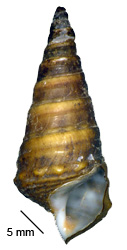
Old Joe’s passion was, for me at the time, difficult to comprehend. But in subsequent years I have come to realize that we were witnessing a rehearsal of The Great Pleurocera Controversy, a conflict rooted deeply in the parent rock of American Malacology, passed to Morrison (and me!) through many generations of malacologists gone before. Our story begins in 1818, when the eccentric polymath Constantine S. Rafinesque (3) published the nomen Pleurocera” as a genus to contain six species of freshwater prosobranch gastropods, none of which he described. Then in 1819 Rafinesque proposed “Oxytrema” as a genus to contain a second set of species including what we have some reason to think may have been what is known today as Pleurocera canaliculata [Photo at right].
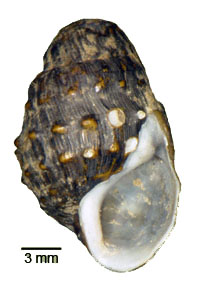
Joe Morrison strongly felt that the actual text of Rafinesque’s 1818 description (4) most closely fit the chunky, bumpy shell morphology of what is known today as Lithasia verrucosa [Photo below]. But by common use through the 19th century and into the 20th, the generic nomen “Pleurocera” became attached to (or perhaps transferred to?) snails bearing smooth, skinny shells like what is known today as Pleurocera canaliculata, or (biologically equivalent, see Note 5) Pleurocera acuta. And the chunky-bumpies became Lithasia, and the nomen “Oxytrema” fell into disuse. And the family name that ultimately prevailed for the entire group of freshwater snails was based on the smooth-skinny concept of the genus, “Pleuroceridae.”
Despite the ancient origins of this confusion, however, the Great Pleurocera Controversy was very much a phenomenon of the 20th century. It sparked in 1912, when Harold Hannibal designated the chunky-bumpy verrucosa as type of the genus Pleurocera, and burst into flame in 1917, when Henry Pilsbry agreed with Hannibal, and Bryant Walker [15] rose to defend the cause of the smooth-skinnies (6). Pilsbry appealed to the International Commission on Zoological Nomenclature for a ruling in 1925.

The case simmered in court for 55 years (7), during which time Calvin Goodrich pretty much monographed the entire North American Pleuroceridae in bits and pieces, using the nomen Pleurocera in its smooth-skinny sense, essentially deciding the issue (8). Along the way, comments supporting the smooth-skinny concept of Pleurocera were filed by Joshua Bailey, Emilio Berio, Arthur Clarke, Joe Rosewater, Henry van der Schalie, Billy Isom, and George Davis. Comments supporting the chunky-bumpy concept were filed by Dave Stansbery, Carol Stein, and Joe Morrison.

The historical minutiae around which the case ultimately revolved were complex. Toward the end of the controversy, some of the arguments made by Morrison and his allies were so arcane that one commissioner complained that they looked “suspiciously like sabotage.” But Morrison was not to prevail. On 4Nov1981 the ICZN handed down Opinion 1195, ruling in favor of the smooth-skinny concept of Pleurocera by a vote of 19-3 (9).

So was it simply a question of taxonomic priority between two Rafinesque names of 1818 and 1819 that brought Old Joe to his feet on that August morning in 1979, red-faced with rage? Rafinesque had been in his grave for 139 years, and does not seem to have cared which of his names was used during his own lifetime, in any case. And I had not even mentioned the genus Pleurocera during my entire 15 minute presentation – my paper was about Goniobasis only.

No. To fully appreciate the issues at stake in The Great Pleurocera Controversy, we must roll the clock back once again to 1954, and the publication of what may have been Joe Morrison’s most important contribution to science, “The Relationships of Old and New World Melanians” (10).

Morrison’s (1954) work can only be appreciated through 19th century goggles. His introduction began with a statement of his hypothesis as an unquestionable fact, and a dismissal of any other hypothesis as “biological absurdity.” Morrison asserted that there are three freshwater cerithiacean families, each of which has evolved separately from marine ancestors: the Pleuroceridae from the Cerithidae, the Thiaridae from the Planaxidae, and the Melanopsidae from the Modulidae. He then reviewed the entire worldwide fauna of freshwater cerithiacean snails in 28 pages of text, focusing first on their taxonomy, and second on their reproductive biology, especially egg laying habit. He concluded his paper with a single plate of original observations, almost entirely external right-side sketches of extended females, showing egg laying grooves or brood pouches.

This was a tremendously ambitious work – the first worldwide review of the freshwater cerithiacean gastropods. By the standards of such contemporaries as Bengt Hubendick (11), it was embarrassingly slapdash. But in comparison with the much older, regional monographs it sought to review and synthesize, such as that of Tryon 1873, it was an improvement.

And to my eyes, the most significant innovation that Morrison introduced to the classification of the freshwater cerithiacean fauna worldwide in 1954 was his concept of a genus that he called “Oxytrema.” Morrison advocated combining all the sexually reproducing freshwater cerithiaceans bearing tall skinny shells … not just the species that Walker & Goodrich assigned to Pleurocera but also those they called Goniobasis (and Juga from the American West, and even many East Asian species) into this single gigantic genus on the basis of female reproductive habit. He wrote:
Oxytrema Rafinesque is the earliest and correct name for one of the most widespread "Melanian" genera in the world. This genus includes numerous North American species whose ranges extend from the Atlantic to the Pacific coasts and from southern Canada to Florida and Texas. It also includes North American fossils, as well as a number of Recent species from southeast Asia (Korea, China, and Thailand). All the species called "Pleurocera" by Bryant Walker, and other authors who followed him blindly, and the species called "Goniobasis" (with very few exceptions) belong to this genus. Their eggs are laid in a single row in a close, irregularly spiral group, in apparent flat clusters of 3 to 10 egg capsules in each small egg mass, the whole covered with sand grains."
So now we understand, at long last, how a 24-year old graduate student could incur the Wrath of Joe on an August morning in 1979 simply by referring to a genus named “Goniobasis.” Morrison needed the 1819 Rafinesque nomen Oxytrema to legitimize a massive, worldwide taxonomic revision, pushing Goniobasis underneath it, even as he needed to save the name Pleurocera by pushing it aside for another use.

Old Joe died in 1983. I remain, to this day, unable to assess the validity of his taxonomic arguments, but in the wake of the 1981 decision of the ICZN, they have become moot (12). Portions of his biological argument, however, seem to have considerable merit on the basis of much more than eggs. A paper supporting the combination of Pleurocera (as we know it today) and Goniobasis had already been published in 1965 by B. C. Dazo, hailing from Ann Arbor (of all places), the home of Walker and Goodrich. And Dazo’s results have more recently been confirmed and expanded by Ellen Strong (13).

And faithful readers of this blog may remember my posts of 20Feb07 and 12Oct09, demonstrating that shell morphology within a single population of pleurocerids can range from Goniobasis-like to Pleurocera-like as a correlate of stream size, probably a consequence of ecophenotypic variation (14). Might a measure of posthumous vindication for Old Joe Morrison yet be in store?

Stay tuned…
Rob


Notes

(1) Subsequently published as: Dillon, R. T., Jr & G. M. Davis (1980) The Goniobasis of southern Virginia and northwestern North Carolina: Genetic and shell morphometric relationships. Malacologia 20: 83-98. [pdf]

(2) The photo of Morrison above was downloaded from what amounts to his obituary, although it was not advertised as such: Rosewater, J. (1984) A bibliography and list of taxa of Mollusca introduced by Joseph P. E. Morrison Dec 17, 1906 – Dec. 2, 1983. The Nautilus 98: 1-9.

(3) The life of C. S. Rafinesque (1783 - 1840) is the stuff of legend. Google his name and see what I mean. An (1864) work by W. G. Binney and G. W. Tryon entitled, "The Complete Writings of Constantine Smaltz Rafinesque on Recent & Fossil Conchology" is available from the Biodiversity Heritage Library website, if you're hungry for more.

(4) From Binney & Tryon: "Univalve. Shell variable oboval or conical, mouth diagonal crooked, rhomboidal, obtuse and nearly reflexed at the base, acute above the connection, lip and columella flexuose entire. Animal, with an operculum membranaceous, head separated from the mantle inserted above it, elongated, one tentaculum on each side at its base, subulate acute, eyes lateral exterior at the base of the tentacula."
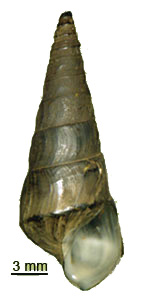
(5) Although populations of the snails identified as Pleurocera acuta today [photo right] are biologically quite similar to populations of the snails we currently identify as P. canaliculata, the specific nomen “acuta” became almost as entangled taxonomically as the generic nomen “Pleurocera.” Ultimately “Pleurocerus acutus” was chosen as the type of the genus. See Opinion 1195 (Note 9) for the gory details.

(6) Pilsbry, H. A. (1917) Rafinesque's genera of freshwater snails. Nautilus 30: 109-114. Walker, B. (1917) The type of Pleurocera Rafinesque. Occas. Pprs. Mus. Zool. Univ. Mich. 38: 1 - 10.

(7) Secretary R. V. Melville offered a detailed apology for the extraordinary delays suffered in the resolution of the Pleurocera question in Opinion 1195 (Note 9).

(8) For more see my previous blog post: The Legacy of Calvin Goodrich [23Jan07]

(9) Melville, R. V. (1981) Opinion 1195. Pleurocera Rafinesque, 1818 (Gastropoda): The type species is Pleurocerus acutus Rafinesque in Blainville, 1824. Bulletin of Zoological Nomenclature 38: 259-265.

(10) Morrison, J. P. E. (1954) The relationships of Old and New World Melanians. Proc. U. S. Nat. Mus. 103: 357- 394.

(11) For more about Bengt Hubendick, see my previous blog posts: The Classification of the Lymnaeidae [28Dec06] The Classification of the Planorbidae [11Apr08]

(12) But it is not a stretch to view the ongoing Goniobasis/Elimia taxonomic controversy as a consequence of the Pleurocera controversy that preceded it. J. B. Burch rationalized his decision not to apply to the ICZN for conservation of the more familiar Walker & Goodrich nomen Goniobasis over the Pilsbry Elimia by referring to the "inordinate amount of time" required to reach an opinion on Pleurocera. For more see my post on Goniobasis and Elimia [28Sept04].

(13) Dazo, B. C. (1965) The morphology and natural history of Pleurocera acuta and Goniobasis livescens (Gastropoda: Cerithiacea: Pleuroceridae). Malacologia, 3: 1-80. Strong, E. E. (2005) A morphological reanalysis of Pleurocera acuta Rafinesque, 1831, and Elimia livescens (Menke, 1830) (Gastropoda: Cerithioidea: Pleuroceridae). Nautilus, 119: 119-132.

(14) See my previous blog posts: Goodrichian Taxon Shift [20Feb07] Mobile Basin III: Pleurocera Puzzles [12Oct09]

[15] Note added subsequently.  In my post of [9Nov12] I elaborate at some length on Bryant Walker's Sense of Fairness.

Friday, October 15, 2010

Live Shipping Freshwater Snails

Earlier last month a question was posed to the MOLLUSCA list server on a topic that would seem to be of special interest to our group. Here's the initial query from Dr. Russell Wyeth of St. Francis Xavier University up in Nova Scotia, together with my reply:

I'm curious what advice people have for shipping live Lymnaea stagnalis and their eggs. I've heard that damp paper towels in a plastic box with plenty of holes in the top, and placed inside a cardboard box with little tape is good. Any other suggestions for what has worked (or hasn't worked)?

Thanks,
Russell


Dear Russell,

Yes, the general approach you suggest works very well to ship freshwater snails of all species.

Rather than a "plastic box with plenty of holes in the top," I'd suggest an unbreakable container with a tight-fitting lid. You really don't want water leaking from your paper towels and seeping out of your package. The best containers I've found are those wide-mouthed plastic peanut butter jars.

I admit to being a little bit paranoid about possible leaching from commercial paper towels. So I pre-soak a big wad of paper towels in pond water, wring that out, and then transfer the paper towels in a second (fresh) bucket of pond water, and wring them out a second time.

Stuff a bunch of wet paper towels in the bottom of your peanut butter jar, then the snails, then a bunch more wet paper towels, and then screw the lid on tightly. But be careful with the stuffing! Lymnaeids, as I'm sure you are aware, have very fragile shells. Ideally, you want the snails immobilized, but not crushed.

Yes, pack that peanut butter jar in a larger cardboard box for shipment, with some bubble wrap or packing "peanuts." But no, don't use "little" tape - use "plenty of" tape. You seem concerned that not enough air will get into your snails. Really, just the opposite is the problem - it's drying you need to worry about. Tape that box up well! And spend the extra money for overnight shipment.

Good luck!
Rob

---o---

Dr. Wyeth's question seemed more directed toward the packing, not toward the actual process of shipment, once packed. But some of you may remember my essay on the travails of importing live freshwater snails into the United States back on 17Dec08. I also have a nightmare story about exporting American Helisoma live to a colleague in Italy a couple years ago that I might share one day, if the mood strikes.

In subsequent correspondence, Dr. Wyeth shared with me private replies from of two other colleagues, both offering slight variations on our same theme. One suggested snails -> wet paper towels -> box with holes -> heavy plastic bag with knot. Another offered snails -> wet newspapers -> two layers of plastic bags -> Styrofoam cooler with ice packs.

I agree that the idea of shipping in a Styrofoam cooler has some attraction, depending on the time of year, but might increase the cost substantially.

I also agree with Dr. Wyeth that data on failures might be as useful as data on successes in addressing his question. If anybody has any experience regarding shipments of freshwater snails cooked by excessive heat or dehydrated by leaking containers, feel free to share below!

And keep in touch,
Rob

Tuesday, September 14, 2010

Valvata utahensis and Hypothesis #2 (of 3)

Editor’s Note – This essay was subsequently published as: Dillon, R.T., Jr. (2019d) Valvata utahensis and Hypothesis #2 (of 3).  Pp 159 - 163 in The Freshwater Gastropods of North America Volume 4, Essays on Ecology and Biogeography.  FWGNA Press, Charleston.

Late last month, after many years of research, consultation, and study (1), the US Fish & Wildlife Service announced a finding that Valvata utahensis no longer warrants protection under the federal endangered species act. Quoting directly from the 25Aug10 press release (2), “The decision was made based on new scientific information that demonstrates the snail is more widely distributed and occurs in more habitat types than was known at the time the species was listed.”

Valvata utahensis was one of five freshwater gastropods from southern Idaho to enter the federal list on December 14, 1992. (Image at left from the USDA Rocky Mt. Res. Station). At the time, it was believed to occur “in a few springs and mainstem Snake River sites in the Hagerman Valley and at a few sites below American Falls Dam” in “deep pools adjacent to rapids or in perennial flowing waters associated with large spring complexes” (3). But subsequent status surveys have documented a range extending down 255 miles of the Snake River and across much greater variety of habitat types (4). In fact, V. utahensis seems to be found more abundantly in the impoundments behind the reservoirs than in the free-flowing river itself.

In many respects this episode has been quite similar to that involving the Snake River population of Pyrgulopsis robusta, which entered the US Endangered Species list on the same date as V. utahensis, preceding its removal by three years. Originally listed as “Pyrgulopsis idahoensis,” the Idaho Springsnail was believed to occur “at a few sites from the headwaters of C. J. Strike Reservoir at river mile 518 upstream to approximately river mile 553” (3). But several years of directed surveys found the Pyrgulopsis population actually extending over 80 river miles at an average density of 130/m2, making it one of the largest freshwater snail populations ever documented. And broader systematic research showed that the Snake River Pyrgulopsis was not endemic, but rather ranged across portions three other western states, under several older aliases (5).

Our understanding of the Snake River Pyrgulopsis progressed through a complete three-hypothesis evolution, from (#1) narrow endemic to (#2) regional endemic to (#3) non-endemic, as information accumulated. It appears that progress in Valvata research will be attenuated at Hypothesis #2, which is something of a shame. R. E. Call originally described utahensis as a variant of the much more widely-distributed Valvata sincera (6), and the shell characters on the basis of which Walker elevated utahensis to the specific level (7) are notoriously variable. But with the species delisted on the basis of Hypothesis #2, I fear that the interest of funding agencies in the more evolutionarily-interesting Hypothesis #3 will inevitably wane.

Meanwhile, our understanding of the “Snake River Physa” skipped from the hypothesis of narrow endemicity directly to non-endemic, without ringing the doorbell of Hypothesis #2 at all. After entering the list on 14Dec92 as “Physa natricina,” research on these enigmatic populations suffered an extended period of neglect, due both to the difficulty that field workers have encountered distinguishing it from commonplace Physa gyrina, and to the assumption that no Physa of any interest could easily be sampled from the shallows. So in December of 2007 the Snake River Physa hopped directly from narrowly endemic in deep water and strong currents from “Grandview (RM 492) upstream through the Hagerman Reach (RM 573)” to synonymy under the cosmopolitan Physa acuta, common in marginal and shallow habitats across six continents (8).

This was also a bit of a shame, from the standpoint of academic malacology. Although not anybody’s favorite hypothesis, it is certainly possible that some physid bearing a type-C penial morphology, but not correctly identified as either P. natricina or as P. acuta, might inhabit rivers of the Pacific Northwest. Judging from secondary sources, there seem to be at least two names that might apply to physids of the acuta type in the Snake/Columbia River system regionally, Physa concolor Haldeman 1843 (type locality = “Oregon”) and Physa columbiana Hemphill 1890 (type locality = Columbia R. at Astoria, OR). If we’d spent a few years exploring Hypothesis #2 for the Snake River physids, at least we’d have a bit more information about the ecology and evolution of the pulmonate fauna in an otherwise benighted part of the world.

It may yet happen. “Physa natricina” remains on the federal list of endangered species today, three years after its synonymization under P. acuta. And the “species profile” maintained by the FWS (9) contains an enigmatic reference to a population “as far downstream as Ontario, Oregon (RM 368).” Heaven knows what sort of elaborate processes would be required to effect the delisting of P. natricina (10), and whether it will prove to anybody’s political interest to undertake the task. I am quite certain, however, of one thing.

Over the last 20 years, literally thousands of man hours have been spent on surveys of the Snake River narrowly focused on particular target species, first Pyrgulopsis and more recently Valvata, and Taylorconcha serpenticola, which was also listed in 1992 and also spent many subsequent years in limbo (11). Hundreds of river miles have been traced and retraced and re-retraced, and nobody over all these years as far as I can determine has ever picked up a Physa. If some agency now finds it in the budget to fund yet another survey of the Snake River, this time for the physids, it would be helpful if the biologists involved were to sample the complete gastropod fauna, common and rare, for God’s sake, for a change. And share those results with the entire community.

Twenty years of wandering in the malacological wilderness of southern Idaho were touched off in 1992 by boneheaded spot-sampling (12). One might hope that we would, eventually, learn.

Notes

(1) I first featured the ongoing FWS “Comprehensive Status Review” of V. utahensis back in 2007:
More Snake River Gastropods Studied for Delisting (14June07)

(2) U.S. Fish and Wildlife Service finds Utah (Desert) Valvata Snail No Longer Needs Protection [PDF]

(3) Endangered and threatened wildlife and plants; Determination of endangered or threatened status for five aquatic snails in south central Idaho. Federal Register 57(240): 59244-57. (December 14, 1992) [PDF]

(4) Endangered and threatened wildlife and plants; Removal of the Utah (Desert) Valvata snail from the federal list of endangered and threatened wildlife. Federal Register 75(164): 52272-82. (August 25, 2010) [PDF]

(5) I posted four essays on the Snake River Pyrgulopsis controversy as it unfolded:
Idaho Springsnail Showdown (28Apr05)
Idaho Springsnail Panel Report (23Dec05)
When Pigs Fly in Idaho (30Jan06)
FWS Finding on the Idaho Springsnail (4Oct06)

(6) Call, R. E. (1884) On the Quaternary and recent Mollusca of the Great Basin, with descriptions of new forms. U.S. Geol. Survey Bulletin 11: 1-64.

(7) Walker, B. (1902) A revision of the carinate valvatas of the United States. Nautilus 15; 121-125.

(8) See my 2008 review of the “Snake River Physa” controversy in:
Red flags, water resources, and Physa natricina (14Mar08)

(9) See the main FWS page for the Snake River Physa [html]

(10) Actually, there’s a flowchart outlining the process in a document entitled “Delisting a Species” available from the Idaho FWS website. [PDF]

(11) The FWS announced a five year review of T. serpenticola (the “Bliss Rapids Snail”) in July 2004, but ultimately decided to preserve its threatened status:
Endangered and Threatened Wildlife and Plants; 12-Month Finding on a Petition to Remove the Bliss Rapids Snail (Taylorconcha serpenticola) From the List of Endangered and Threatened Wildlife. Federal Register 74(178): 47536-45. (Sept. 16, 2009) [html]

(12) I’m being charitable here. There is some real possibility that the interests spearheading the 1992 listing process were not innocent naïfs, but cynically manipulating the endangered species act for politics and profit. The essay of [14Mar08] referenced in note (8) above was written in one of my less-charitable moods.

Friday, August 20, 2010

Introducing fwgna.org!

The Freshwater Gastropods of North America project is pleased to announce one of the biggest steps forward in our twelve-year history, http://www.fwgna.org/. Come visit us again, for the first time!

Returning users will immediately appreciate the fresh look and feel of our new website, brought to us by talented designer Steve Bleezarde. Like previous versions of our site, fwgna.org may be entered geographically, by any of the four states currently covered. Users now also have the option of accessing our web resources taxonomically, through either an alphabetical index or a systematic index. The former index includes an extensive list of synonyms, both generic and specific. The latter is sortable by state. Try both of these new portals to see what we mean!

Perhaps a less striking improvement, but certainly as important, is the significant upgrade to our coverage of Virginia. Over 500 new records and six species have been added, bringing the total species indexed on the site to 65. For each of the species confirmed (or reported) for Virginia Atlantic drainages, we have developed one-page species accounts and made them available as pdf downloads. The present renovation of our site was made possible by funding from the Virginia Department of Game and Inland Fisheries, to whom we offer our sincere thanks.

Users entering through the old front door at cofc.edu will be routed directly to the new fwgna.org index page for the foreseeable future. But direct links to older versions of any of the (several hundred!) internal pages will eventually expire, and I’m not sure we’ll be able to redirect users very efficiently. So update your bookmarks!

And keep in touch,
Rob

Friday, July 16, 2010

Crisis At Lake Waccamaw?

Editor's Note. This essay was subsequently published as: Dillon, R.T., Jr. (2019d) Crisis at Lake Waccamaw?  Pp 193 - 199 in The Freshwater Gastropods of North America Volume 4, Essays on Ecology and Biogeography.  FWGNA Press, Charleston.

Deep in the cypress swamps shrouding the remote southeast corner of North Carolina lie the mysterious waters of Lake Waccamaw. At roughly 9,000 acres and 4 miles across, Lake Waccamaw is the largest of the “Carolina Bays,” pothole-shaped depressions of unknown origin in an Atlantic Coastal Plain otherwise featureless in its topography. But beyond its unusual size, Lake Waccamaw is distinguished by its exceptional water quality. Groundwater filtering up through layers of sand and Plio-Pleistocene shell arrives in the big lake clear and near-neutral in pH, much in contrast to the acidic and tannin-stained waters prevailing elsewhere throughout the region (1). Although quite young geologically, one might not be surprised to find endemic species (2).

I first visited Lake Waccamaw in 1978, driving south from Philadelphia with Dr. George Davis, my Ph.D. advisor. Our mission was to sample the lake's endemic population of Elliptio waccamawensis for an NSF-funded project on unionid evolution (3). I vividly remember the abundance of the mussels that greeted us that spring morning we waded into the clear shallows together. George and I were able to sample 30 E. waccamawensis in a matter of minutes, with at least four or five other unionid species also moderately common (4). I did not focus on the gastropods that day, but do recall the hydrobiids like pepper on the maidencane.

The entire molluscan fauna of Lake Waccamaw was thoroughly surveyed shortly thereafter by Hugh Porter, working for the North Carolina Wildlife Resources Commission (5). Although I have not seen Porter’s (1985) report, several years ago I had the opportunity of reviewing the extensive collections he deposited in the NC State Museum. Sampling randomly on bottoms of four depth classes with a diver-operated suction dredge, Porter documented strikingly high abundances of the notable Lioplax subcarinata and Gillia altilis, plus the (more mundane) Campeloma decisum, Amnicola limosa, Lyogyrus granum, and the usual pulmonates (6). Especially common in Porter's samples was the little hydrobiid he called “Cincinnatia sp,” but which today is perhaps better referred to the genus Floridobia (7). There has long been speculation that this population may constitute yet another species endemic to Lake Waccamaw (8).

Has the entire diverse and endemic molluscan fauna of Lake Waccamaw now vanished before our eyes? In late May I drove up to the lake from Charleston for a long day of kayaking and puttering about in the shallows. I visited the southern (more exposed) shore near the dam and the northeastern (more protected) shore near the mouth of Big Creek, spending several hours in each area. I examined all wadeable environments and habitats, netted through the entire range of substrates, and found essentially nothing. I observed no more than a couple living unionids all day, and perhaps a handful of empty valves. No Gillia, no Lioplax, not even any Helisoma, and just a few living hydrobiids in the sediments around the macrophytes. I spotted several small Campeloma crawling in the sand, and some Physa bravely clinging to the debris.

I understand that many of the mollusk populations of Lake Waccamaw do not reach their maximum abundance in easily-accessible shallows (9). So the most alarming hours of my visit in late May were spent inspecting the beach drift, which (one might hope) would afford a more random sample of the lake fauna as a whole. In more than an hour of beachcombing on both shores I recovered only perhaps 20-30 tiny Floridobia shells the from grass wrack, 5-10 Amnicola, and a few small Campeloma, period.

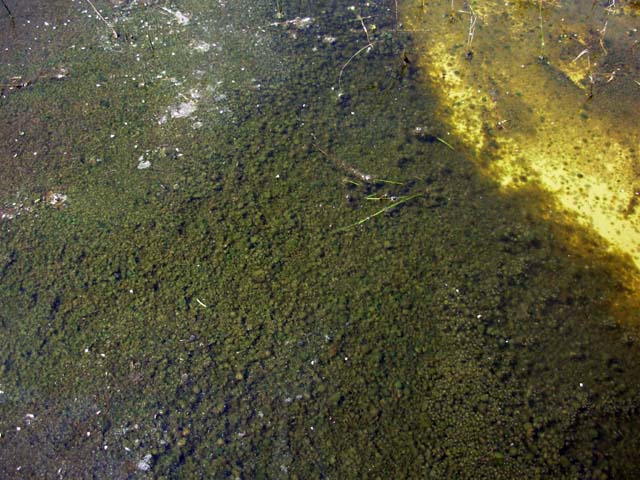
Upon my return to Charleston I swapped an email or two with Dr. Diane Lauritsen (10), who has some thirty years of experience at Lake Waccamaw, and spoke with her on the telephone at length. Diane reported that the lake has suffered filamentous algal blooms recently, with an apparently correlated reduction in benthic macrofauna. Diane sent me the photo below.

She mentioned that the Corbicula population (11), while never terribly abundant, suffered a "massive die-off probably four years ago." Diane suggested that Corbicula might be a "canary in the coal mine," telegraphing a warning of hypoxia. I was stunned. I had not seen any evidence whatsoever of Corbicula during my entire day on Lake Waccamaw, not one single bleached valve. In what sort of nightmarish environment might the nasty, invasive Chinese clam become a "canary?"

And what can be done? At the risk of sounding like the scientist I am, we need a formal study. Everything I have reported in the preceding seven paragraphs is anecdotal, and cannot constitute a basis for doing much else. Thank heaven the NCWRC had the foresight to commission Hugh Porter’s study in the late 1970s. The first order of business must be to see a study of that caliber repeated.

So in the end, this essay is an appeal to North Carolina natural resource agencies, the regional offices of conservation-minded NGOs, and Waccamaw-area citizens’ groups to renew our mutual interest in the biological treasure that is Lake Waccamaw. I fear this marvelous resource has been neglected in recent years. But I hope I am wrong.


Notes

(1) More about the geology and water balance of Lake Waccamaw here: J. C. Stager & L. B. Cahoon (1987) The age and trophic history of Lake Waccamaw, North Carolina. J. Elisha Mitchell Sci. Soc. 103: 1-13 [html]. S.R. Riggs, D.V. Ames, D.R. Brant, and E.D. Sager (2000). The Waccamaw Drainage System: Geology and Dynamics of a Coastal Wetland, Southeastern North Carolina. NC Division of Water Resources. [pdf or html]

(2) The nominally-endemic fauna of Lake Waccamaw includes three fishes described in 1946 and a caddis fly described by our colleague Jim Glover in 2004, as well as the unionids Elliptio waccamawensis (Lea 1863) and Lampsilis fullerkati Johnson 1984. The specific status of the two mussels has been called into question, however, in a recent MS thesis: Sommer, K. (2007) Genetic identification and phylogenetics of Lake Waccamaw endemic freshwater mussel species. MS Thesis, UNC Wilmington. [html - pdf]

(3) Davis, G. M., W. H. Heard, S. L. H. Fuller & C. Hesterman (1981) Molecular genetics and speciation in Elliptio and its relationship to other taxa of North American Unionidae. Biol. J. Linn. Soc. 15: 131-150.

(4) Porter listed 11 unionid species, but Bogan puts the number as high as 17: Bogan, A.E. 2002. Workbook and key to the freshwater bivalves of North Carolina. North Carolina Museum of Natural Sciences, Raleigh. 101 pp.

(5) Porter, H. J. 1985. Rare and Endangered Fauna of Lake Waccamaw, North Carolina Watershed System: Molluscan Census and Ecological Interrelationships. North Carolina Wildlife Resources Commission, Raleigh. 187 pp. I understand that this work included quite a few original photographs, and is consequently rather hard to get hold of. The methods and a subset of the unionid results did see publication, however, as: Horn, K. J & H. J. Porter (1981) Correlations of shell shape of Elliptio waccamawensis, Leptodea ochracea and Lampsilis sp. with environmental factors in Lake Waccamaw, Columbus County, North Carolina. The Bulletin of the American Malacological Union for 1981: 1 - 4. Porter, H. J. & K. J. Horn (1983) Habitat distribution of sympatric populations of selected lampsiline species in the Waccamaw drainage of eastern North and South Carolina. Amer. Malac. Bull 1:61 - 68.

(6) Porter counted 10 gastropod species in Lake Waccamaw, but I have 12 confirmed in the FWGNA database: Six pulmonates (Physa pomilia, Helisoma trivolvis, H. anceps, Menetus dilatatus, Lymnaea columella, Laevapex fuscus), the two viviparids (Campeloma and Lioplax) and the four hydrobiids (Gillia, Amnicola, Lyogyrus and Floridobia).

(7) Thompson, F. G. & R. Hershler (2002) Two genera of North American freshwater snails: Marstonia Baker, 1926, resurrected to generic status, and Floridobia, new genus (Prosobranchia: Hydrobiidae: Nymphophilinae). The Veliger 45: 269 - 271.

(8) Porter suggested that the Lake Waccamaw fauna might include two endemic hydrobiids, which he called "Cincinnatia species 1" and "Amnicola species 1." He may be right about the former - populations of the little snail called variously Cincinnatia or Floridobia are quite unusual in southern Atlantic drainages. But Porter's samples of "Amnicola species 1" in the NC State Museum looked like unremarkable mixtures of Amnicola limosa and Lyogyrus to me.

(9) The lake bottom is rather heterogeneous, including some regions of (rather malacologically uninteresting) mud and peat, and other sandier regions that can support surprisingly high abundances of bivalves and gastropods. Benthic algae seem to extend to unusual depths in Lake Waccamaw. Or at least they did in the past.

(10) You might recognize Diane’s name from several excellent works Corbicula feeding, for example: Lauritsen, D. (1986) Filter-feeding in Corbicula fluminea and its effects on seston removal. J. N. Am. Benthol. Soc. 5: 165-172.

(11) The Waccamaw Corbicula population has figured in several research projects: Stiven, A.E. & G. A. Arnold (1995) Phenotypic differentiation among four North Carolina populations of the exotic mussel Corbicula fluminea. J. Elisha Mitchell Sci. Soc. 111:103-115. Cahoon, L. B. & D. A. Owen (1996) Can suspension feeding by bivalves regulate phytoplankton biomass in Lake Waccamaw, North Carolina? Hydrobiologia 325:193-200.

Wednesday, July 7, 2010

Western Workshop 2010

Our good friend Bill Clark has invited us all to a freshwater mollusk identification workshop out in Idaho this October, with bivalves and gastropods from throughout western North America on the lab benches. Download his flyer from the FWGNA site for all the details:

Idaho Workshop 2010 [PDF]

Bill's contact information is below. He tells me that his organizing committee has not set a firm registration deadline, but that they will need to have a good estimate of attendance sometime in September for planning purposes. "First come, first served."


-----Original Message-----
From: Bill Clark [mailto:clarkfam1@mindspring.com]
Sent: Thursday, June 24, 2010 2:28 PM
To: Dillon, Robert T
Cc: Steven J. Lysne; Bill Bosworth; Richard A. Salisbury; Robert Hershler; Jack Burch
Subject: Mollusk Workshop - Idaho
Hi Rob,
I'm attaching a flyer announcing our October 28-30 Mollusk Workshop here in Idaho. I'd appreciate it very much if you could please send this out to your NA Gastropod Group mailing lists.
Thank you so much,
Bill Clark

-----------------------
William H. Clark, Director
Orma J. Smith Museum of Natural History
The College of Idaho
Caldwell, ID 83605 USA
208-459-5507, 208-375-8605
bclark@collegeofidaho.edu
clarkfam1@mindspring.com
http://www.collegeofidaho.edu/campus/community/museum
.

Tuesday, June 22, 2010

Unlocking the Keystone State

Editor’s Note. This essay was subsequently published as: Dillon, R.T., Jr. (2019d) Unlocking the Keystone State.  Pp 219 - 222 in The Freshwater Gastropods of North America Volume 4, Essays on Ecology and Biogeography.  FWGNA Press, Charleston.

The Commonwealth of Pennsylvania spans every aquatic habitat that one might characterize as "northeastern," across the Delaware, Chesapeake, Ohio, and Great Lakes drainages, both the glaciated and the not. The Keystone State also includes two large and important cities, Philadelphia and Pittsburgh, each with a fine natural history museum. The diverse waters of Pennsylvania have been sporadically but professionally surveyed for almost 200 years.

In 2008 our colleagues Ryan Evans and Sally Ray published a thorough review of museum holdings in Pennsylvania freshwater gastropods, not just at the Academy of Natural Sciences in Philadelphia and the Carnegie Museum in Pittsburgh, but through the electronic databases of 9 other institutions as well (1). Perhaps not surprisingly, they found records of an impressive 63 species.

Now in the most recent American Malacological Bulletin, Evans and Ray have published the results of the first modern survey of The Keystone State, "Distribution and environmental influences of freshwater gastropods from lotic systems and springs in Pennsylvania, with conservation recommendations (2)." The authors sampled 398 sites selected to cover the range of USGS "hydrologic units" encompassed by the state (3), measuring water chemistry variables and extracting a variety of landscape variables using GIS techniques. And the number of species they have confirmed by field collection was ... 37.


Has there been some catastrophic extinction? Almost as alarming as the complete absence of 26 specific nomina from Evans and Ray's field survey were the details of their Table 1, which reported 7 of the 37 species actually recovered at but single sites, of the 398. Has a meteor smashed into the Keystone State in the last 200 years, leaving no trace but the bleached shells of 52% of the freshwater gastropod fauna?

Of course not. We must not overlook the fact that Evans and Ray focused their fieldwork almost entirely upon wadeable streams and springs, excluding marshes, ponds and lakes, and gave very little coverage to large rivers. And natural lakes and ponds are not common in Pennsylvania in any case; the Erie/Ontario drift and lake plains ecoregion just barely nips the northwest corner of the state.

So downloadable from Note (4) below is a spreadsheet listing the 63 freshwater gastropod species that Evans and Ray documented from Pennsylvania in 2008, ranked by the number of sites at which they were recovered by the field survey of 2010. The 26 missing species are listed at the bottom, with number of sites = 0.

Subtracted in Column D are 13 specific nomina with taxonomic problems, leaving 50 species I wouldn't question. Then in Column E I have listed 17 species as "Northern Lentic" - primarily characteristic of lakes, ponds, and marshes, becoming much more common north of Pennsylvania. This subset includes 11 of the 26 species missing from Evans and Ray's 2010 field survey, and 3 of the species collected at but single sites.

Column F subtracts five species for "other sampling problems" as noted by Evans and Ray themselves, and Column G subtracts six introduced species. The bottom line seems to suggest that just two Pennsylvania freshwater gastropod species may warrant conservation concern if viewed from a larger perspective - Lioplax subcarinata (5) and Gillia altilis.

Think Continentally, Act Regionally. It is clear that the conservation implications of the data collected by Evans and Ray can only be interpreted in the context of the larger freshwater gastropod faunas north, south, and west. But it is equally clear that the field survey that brought us these marvelous data was funded by the Pennsylvania Department of Conservation and Natural Resources, an organization with no mandate outside the state lines. Evans and Ray and the PaDCNR are to be highly commended for this effort. If the FWGNA project can only be built one stone at a time, they have contributed a key.


Notes
(1) Evans, R. R. & S. J. Ray (2008) Checklist of the freshwater snails (Mollusca: Gastropoda) of Pennsylvania, USA. Journal of the Pennsylvania Academy of Science 82: 92-97. [PDF]

(2) Evans, R. R. & S. J. Ray (2010) Distribution and environmental influences of freshwater gastropods from lotic systems and springs in Pennsylvania, USA, with conservation recommendations. Am. Malac. Bull. 28: 135-150. [PDF]

(3) The EPA "Surf your Watershed" website lists 58 eight-digit HUCs for Pennsylvania: Surf Pennsylvania

(4) Download an excel spreadsheet analyzing Evans and Ray's (2008, 2010) freshwater gastropods of Pennsylvania. [FW-gastropods-PA.xls]

(5) Evans and Ray "did not feel that adequate survey data were available to give a conservation status recommendation for Lioplax subcarinata."