Dr. Rob Dillon, Coordinator


Monday, December 12, 2011

Toward the Scientific Ranking of Conservation Status - Part I

Editor’s Note. This essay was originally published in FWGNA Circular No. 1 (19Mar12).  It was subsequently published as: Dillon, R.T., Jr. (2019d) Toward the scientific ranking of conservation status.  pp 223 - 227 in The Freshwater Gastropods of North America Volume 4, Essays on Ecology and Biogeography.  FWGNA Press, Charleston.

Last month I got an email from a colleague in the South Carolina Department of Natural Resources, asking for my help updating the state wildlife conservation plan. I told him I'd be willing to pitch in with the 2011-12 effort, just as I helped in 2004-05 [1]. But I continue to harbor deep misgivings about the entire process.

In Part I of the essay that follows, we debride a nasty sore on the left butt cheek of American environmental science - the unscientific (possibly pseudoscientific) method by which we prioritize our biota for conservation purposes. And in Part II of this series, to follow next month, we will begin the process of suturing that wound back up.

Like all other states with which I am familiar, South Carolina’s wildlife plan relies upon a subjective system of conservation status ranks, as follows:
S1 - Critically imperiled state-wide because of extreme rarity or because of some factor(s) making it especially vulnerable to extirpation.
S2 - Imperiled state-wide because of rarity or factor(s) making it vulnerable.
S3 - Rare or uncommon in state.
S4 - Apparently secure in state.
S5 - Demonstrably secure in state.
The spreadsheet my DNR colleague sent me for my input [2] had a column for species number (N=32 freshwater snails in South Carolina), scientific name, common name, legal status, conservation status rank (as above), and an (astonishing!) 19 additional data columns, more about which later. My colleague asked me to complete this massive 32x24 matrix by January 15, indicating as he did that the results would (ultimately) be forwarded onward to the nonprofit organization, NatureServe.

The origin and evolution of the conservation ranking system in general currency around the United States is shrouded in mystery. According to documents available from the NatureServe website [3], the notion of a state "natural heritage inventory" arose from collaboration between the nonprofit Nature Conservancy and my very own South Carolina back in 1974, with the first (A-B-C) system of conservation status ranking appearing in 1978. The current five-tier system was developed in 1982. In 1994 a group of state natural heritage program directors formed a related but independent nonprofit organization called the "Association for Biodiversity Information" to catalog the rising flood of inventory and status ranking data, which (in some complex fashion) led The Nature Conservancy to spin off "NatureServe" in 2001.

The 1982 system featured ranking at three scales: Global (G-ranks), National (N-ranks), and Sub-national (S-ranks), based on eight "factors" scored by anonymous participants. The number of factors taken into consideration has increased over the years, as has the number of participants, as has the elaboration of the technique by which the body of anonymous opinion is reputedly converted into a system of conservation status ranks.

For example, the 19 columns on the right side of the matrix my SCDNR colleague sent me last month included
  • Knowledge of the species population status - "High" if we know the status throughout the species range, "Medium" if we know the status in select areas, "Low" if we know little to none.

  • State Threats - "A" if very threatened, "B" if moderately threatened, "C" if not very threatened, "U" if unthreatened.

  • Feasibility Measure - How likely is it that conservation activities can make a difference for this species (High, medium, low).
Any reader curious regarding the actual analytical technique by which standard international ignorance units (SIIUs), state threat quotients (STQs), feasibility metrics (FMs), and 16 similarly baffling variables counted and scored for each species are converted into the critical-imperilment-demonstrable-security scale on the global conservation status gauge is invited to peruse the voluminous documentation available from the NatureServe website [4].
This is obviously not science. Conservation status ranks, as they have been propagated throughout the entire natural resources community for 30 years, are not testable, verifiable or falsifiable. The entire system is, at its very foundation, anonymous, unaccountable, subjective opinion.

Are conservation status ranks merely unscientific, or are they pseudoscientific? Pseudoscience is “a claim, belief, or practice which is presented as scientific, but which does not adhere to a valid scientific method [5].” Thus the difference between harmless non-science and execrable pseudoscience is in its presentation.

To the extent that the conservation status ranks arising from this system are presented honestly, as an opinion poll of mysterious parameter, I think they can be excused as (at worst) innocent claptrap. Is there any better solution to the genuine challenge of prioritizing species for conservation? Are we not doing the best that we can in a difficult situation? This is America - take a vote. Fine.

But if there is any effort or intent to present conservation status ranks as scientific, then we as a community will be guilty of promulgating pseudoscience. The elaborate machinations of NatureServe, which have developed over the years into a byzantine system of coding and computation, look suspiciously like dressing a pig in a ball gown, especially when standing behind a velvet rope, looking towards the sty.

And when we scientists make use of conservation status ranks, we give the appearance of endorsing the process that brought them, turning nonscience into pseudoscience by the very act. Surely we wouldn't reproduce conservation status ranks in our peer-reviewed journals, would we? Surely, surely we scientists wouldn't gin up some "crisis" on the basis of such a system, in a self-serving ploy to attract funding for our own research programs, would we? To do so would be to commit pseudoscience of a high and aggravated nature.

I absolutely understand why natural resource agencies personnel rely on conservation status ranks for their state wildlife action plans. The state of South Carolina cannot launch inventories of every bug, slug, and butterfly within its vastly triangular borders every five years to meet the data requirements of each fresh wave of federal regulation [6].
But as scientists, we must be very clear that the current system of conservation status ranking, as implemented by NatureServe, cannot be endorsed.

The FWGNA project has now developed a large database with objective estimates of the abundance of all 57 species of freshwater snails inhabiting the Atlantic drainages of the southeast. In the next installment of this series, I will propose a new method to rank these 57 species into five categories of abundance for conservation purposes. But while this approach is designed to mimic the existing system of status ranking currently in favor throughout American conservation biology, it has a theoretical basis and will be rigorously objective.

Stay tuned...
Rob

Notes
[1] I reviewed the 2005 South Carolina wildlife plan together with the plans of nine other southeastern states in my essay, "Freshwater Gastropods in State Conservation Strategies - The South." [26May06]

[2] The header indicated that this particular data matrix has been developed in collaboration with North Carolina and Georgia. I was peripherally involved in the Virginia process back in 2004, and it wasn't quite as elaborate.

[3] See the brief history of NatureServe on its "Tenth Anniversary" page.
[4] NatureServe Conservation Status Assessments:
Methodology for Assigning Ranks

[5] This is from Wikipedia, which is the first hit one gets, if one googles it.

[6] I’m surrendering to reality here. In fact, the FWGNA has surveyed most of five states for less than $20k in total grant support. I suppose the entire country could be done for $200k. Land snails and bivalves for similar figures? Each order of insects? We’re probably talking several million dollars to inventory the biota of the entire country. I suppose that’s too much to ask.

Wednesday, November 9, 2011

The Freshwater Gastropods of Tennessee

The FWGNA project is pleased to announce the launch of our new web-based resource, "The Freshwater Gastropods of Tennessee," by R. T. Dillon and Martin Kohl. This brings to five the number of states currently covered by the project.

Our study area extends only over the eastern third of the state at the present time, to cover the Tennessee River and its tributaries upstream from the Alabama line just south of Chattanooga. But the area also includes 8 counties in southwest Virginia, 15 counties in western North Carolina, and 7 counties in north Georgia, for a total catchment of approximately 57,000 square kilometers.

A total of 38 freshwater gastropod species are documented from 766 sample sites, with distribution maps, taxonomic notes, a dichotomous key, a photo gallery, and conservation recommendations. Here’s the direct link:
The Freshwater Gastropods of Tennessee
.
Pleurocerid snails often dominate the macrobenthos in this part of the world, especially in the smaller rivers and creeks that have escaped impoundment by the TVA. The spectacular morphological diversity demonstrated by the East Tennessee pleurocerid fauna led 19th-century authors to recognize at least 140 specific nomina, which Calvin Goodrich pared down to approximately 31 in 1940. Our review suggests that a better estimate of the biological species of pleurocerid snails inhabiting East Tennessee would be (a still impressive) 15.

Against this background, perhaps the most interesting finding of the present survey is the discovery of one valid biological species of pleurocerid snail that seems to have been entirely missed, in 200 years of shooting, 140 rounds fired. A formal description of this new "skinny simplex" species is currently in manuscript.
.
Our appreciation is due (once again) to the Virginia Department of Game & Inland Fisheries for support of this work, as well as to the Office of Inventory and Monitoring at the Great Smoky Mountains National Park.

Friday, October 7, 2011

Megapetitions III: The 17-month, 90-day finding

On 27Sept11, the US Fish and Wildlife Service published "Partial 90-Day finding on a petition to list 404 species in the southeastern United States as endangered or threatened with critical habitat (1)." Cradled deep in the bottom of this stupendous ark-full of creatures were 43 species of freshwater gastropods: 15 Mobile Basin pleurocerids, 9 Tennessee Basin pleurocerids, 10 Florida hydrobiids, and 9 miscellaneous. A pdf with the specifics is downloadable from note (2) below. Any of us with "scientific and commercial information" relevant to the listing of these 43 species is requested to transmit such data to the FWS by November 28.

What a dramatic turn of events! In the first episode of our long-running series (3), we were introduced to the Center for Biological Diversity, a posse of lawmen riding out of the American West "with a vision and a solar-powered fax machine," filing megapetitions to list 32 miscellaneous gastropods from the Pacific Northwest in 2008 and 42 Great Basin springsnails in 2009. In our second episode (4), the CBD gunslingers upped the ante with their (2010) "Petition To List 404 Aquatic, Riparian And Wetland Species From The Southeastern United States" even as the lily-livered WildEarth Guardians, an outfit with similar goals if not similar fortitude, was settling with the FWS black hats.

Now we learn that the standoff between the CBD and the FWS was resolved on July 12, and that a federal judge has approved a settlement of the case on September 9 (5). And that the CBD has declared an "historic victory (6)."

And in today's episode, sure enough, the FWS seems to have run its finger lightly through the CBD Southeastern list, trimmed 30 species (most already under consideration - Note 7) and forwarded the remaining 374 to us for comment in a lightning-fast 16 days. Presumably we will see similar "notices of review" regarding the 32 Pacific Northwest and 42 Great Basin species published in the Federal Register shortly. Those of you with expertise in western faunas are hereby alerted to be on the lookout.

Throughout the saga thus far, the matters at contest have been entirely legal. The endangered species act specifies a strict timetable: 90 days from the receipt of a petition to the publication of a "Notice of Review," 12 months of "status review" to decide whether a species warrants listing, another 12 months (if warranted) to publish a proposed rule, and another 12 months of hearings and fussings to publish the final rule. The CBD has not been suing the FWS over any scientific question, but simply to have a legal timetable enforced.

So at this point, it has taken 17 months for our 374 southeastern species to advance through the first 90 days of the process. (And of course, the Pacific Northwest and Great Basin species have been in the pipeline for several years without reaching their 90-day marks as yet.) How long might the next step of this process take? Quoting directly from the FWS Headquarters press release of 26Sept11, "At this time, however, the 12-month findings are not scheduled to be completed within the next six years due to the priorities detailed in this court-approved work plan (8)."

There it is. This reminds me of one of my favorite lines from one of my favorite movies, Mary Poppins. Early in the movie, Mr. Banks comes home and demands to know where his children are. To which Katie Nanna replies, "The children, to be precise, are not here."

So our 12-month status review, to be precise, will not be complete within six years. A tip of the Stetson to Sheriff Noah Greenwald, and all his posse at the CBD, for an "historic victory" indeed.

But let's not get ahead of ourselves. Meanwhile, back at the ranch, the FWS has given us ordinary cowpokes precisely 60 days to submit the "best scientific and commercial data" we've got regarding the 43 southeastern freshwater gastropod species listed in Note (2). That 28Nov deadline is looming large. Hurry, everybody.


Notes

(1) Endangered and Threatened Wildlife and Plants; Partial 90-day finding on a petition to list 404 species in the southeastern United States as endangered or threatened with critical habitat. Federal Register 76(187): 59836-62. [PDF]

(2) The 44-1 freshwater gastropod species listed in the 27Sept11 FWS finding are tabulated in the pdf document below. This document is modified and updated from a similar excel spreadsheet I posted on 18May11: [CBD-southeast-endangered.pdf]

(3) Megapetitions of the Old West [14July09]

(4) Megapetitions II: Armistice Day? [18May11]

(5) The best collection of documents related to the lengthy legal battles between the FWS, the CBD, and the WEG seems to be available from the FWS website:
Improving ESA Implementation

(6) Here's the announcement from the Center for Biological Diversity:
Historic Victory: 757 Species Closer to Protection

(7) Among the 30 species trimmed from CBD's original 404 was "Elimia" (or Leptoxis, or God-knows-what) melanoides from Alabama's Black Warrior River. That particular taxon has already been on the formal candidate list maintained by the FWS since 2006.

(8) FWS Virtual News Room - US Fish and Wildlife Service Finds 374 aquatic-dependent species may warrant endangered species act protection. [26Sept11]

Monday, September 12, 2011

Dispatches From The Viviparid Front

The notes, emails, and news items that our many friends send us from around the Americas often include interesting tidbits about the progress of freshwater gastropod invasions. But it occurs to me that it's been a few years now (1) since we've shared any of these updates with the group. So below is a sample from the old mailbag regarding the invasive viviparids, offered for general edification.

Citizens' Watch. Earlier this year our good friend Joan Jass of the Milwaukee Public Museum called my attention to a citizen-based invasive species monitoring program in Wisconsin. The Wisconsin "Citizen Lake Monitoring Network" (2) involves (the rather more ordinary) water quality and remote sensing components as well as a formal watch for a variety of invasive weeds, zeebs, the rusty crayfish, spiny waterfleas, jellyfish, Potamopyrgus (not arrived in Wisconsin as yet) and the invasive viviparids. Chapter 7 of the WI-CLMN Training Manual is a genuinely impressive 18-page "Mystery Snail Monitoring Protocol" (3) packed with good info on both Bellamya and Viviparus georgianus, which our good friend Pieter Johnson (4) seems to have been involved in developing.

Although many states apparently sponsor citizens' monitoring programs of their aquatic environments, it is my impression that invasive species components may be very unusual. Joan sent me links to the programs of Minnesota, Iowa, Illinois (5) and Michigan, but I didn't see invasive species specifically mentioned in any of them. And here in The South, the artificial impoundments into which viviparids have been introduced are inhabited almost nothing but invasive species, including us. It would be easier to tally the native species in South Carolina lakes, and monitor the invasive species by subtraction.

The image of the pretty watercolor above (6) comes to us from artist Aleta Karstad by way of Frederick Schueler, her husband and colleague at the Bishops Mills Natural History Center in Bishops Mills, Ontario.

Citizens Arise! A couple weeks ago our good friend Fred Schueler (7) reported to us that he had joined a small band of citizens from the vicinity of Winchester, Ontario, in an attempt to "control" a population of Bellamya chinensis inhabiting a three kilometer length of stream by dint of hand collection. Actually Fred tended to refer to this small tributary of the South Nation River as a "drain" in the extensive field notes he sent me, as it is managed by the municipality to drain land for agriculture. Although its large Bellamya population seems to have come to the attention of the South Nation Conservation Authority (which organized the event) only in 2010, subsequent conversations with the landowners suggest that the invasion itself may have occurred as much as 15 years ago.

The field conditions that Fred and his colleagues encountered were most trying. The accessible portions of the stream were apparently quite marshy or muddy, and a substantial fraction of the snail population apparently burrowing. The weather did not cooperate. Fred described the two-day event as "bound to be a token effort." Nevertheless, the team hand-collected, removed and measured a total of 1,260 adult B. chinensis from eight sites along the 3 km "drain." The fate of the Winchester 1,260 was still to be determined at last report. I suggested to Fred that he might mark at least some fraction of his catch, return them to the drain, and repeat the process next year. Fred was looking for recipes. We'll keep you posted.

ITIS Irritation. Last month I also swapped a couple emails with a Sea Grant outreach specialist at the NOAA Great Lakes Environmental Research Laboratory. It is the duty of this particular public servant to track invasive species for the Great Lakes region, and I was sent a couple photos of B. chinensis to confirm, which I was happy to do. So when I replied with my identification, I was informed that, "We are currently listing Chinese mystery snails as Cipangopaludina chinensis malleata (Reeve 1863). We use ITIS as our primary authority for nomenclature - ITIS does not accept the shift to Bellamya."

I certainly do understand why the Gubmint finds it expedient to maintain an "Integrated Taxonomic Information System," I really do. And I also understand why, once a name is assigned to a thing, they don't want to change it. And I understand that ITIS follows the Turgeon et al (1998) AFS Special Publication #26 (8), which in turn follows the freshwater gastropod names current in the 1980s, when Burch's work was published. But I hope our colleagues at ITIS don't go home at night and tell their children that mommy or daddy is a scientist. Because the names that evolutionary biologists assign to populations of organisms are scientific hypotheses, and to "not accept" a new hypothesis is worse than unscientific, it is anti-scientific.

Barbarians at the South Gate. Back in June of 2010 I got a nice email from our good friend Gabriela Cuezzo at the Universidad Nacional de Tucuma'n in Argentina. She reported that she had discovered a population of large snails that might be Bellamya japonica in the central Argentinian province of Cordoba, and as gastropods of the family Viviparidae are entirely absent from the native fauna of South America, she was anxious to have her identification confirmed. Her small shipment took over a month to arrive here in Charleston via "snail-mail," but when I unwrapped the specimens I was surprised to discover neither of the big Bellamya species that have spread over so much of North America, but rather a somewhat smaller-bodied viviparid I think is probably Bellamya (or Sinotaia) quadrata (above). Gabriella reported this invasion at the VIII CLAMA meeting in Puerto Madryn in June of 2011 (9).

I suppose it's only a matter of time until there is but one single, homogeneous, worldwide biota, zoned identically from pole to equator, mirrored north and south. When all the local faunas are outcompeted and extinct, our friends at ITIS should be pleased to find many fewer species to "not accept" research on.


Notes
(1) Our last news bulletin on viviparid invasion was "Bellamya (Cipangopaludina) News," way back on [6Oct05]

(2) Wisconsin Citizen Lake Monitoring Network
(3) All the chapters are conveniently downloadable as separates directly from the WI-CLMN publications page [here], including the "Chinese and Banded Mystery Snail" Chapter 7, which is indeed impressive, once you get beyond the sinistral stylommatophoran on the cover page.

(4) Pieter played a leading role in the research group who elucidated the "Community Consequences of Bellamya Invasion" [14Dec09].

(5) Actually, the Illinois Ecowatch Network website seems to have been taken down recently, and a lot of Minnesota links seem to be missing as well. State budgetary woes, perhaps? Minnesota does seem to fund Invasive Species Prevention "Grants and Partnerships," however.

(6) Karstad Biodiversity Paintings: Adventures in the Color of Canada [29Aug11]

(7) Fred Schueler seems to be a fellow-traveller in the blogosphere. He also made a guest appearance in Aydin Orstan's post "Cepaea nemoralis at Bishop's Mills." See Snail's Tales [24Aug11]

(8) To some extent, I blame myself for the Turgeon debacle. I vividly remember when the American Malacological Union was approached about collaborating with the AFS on the 1998 "Common and Scientific Names" of mollusks publication. I did not participate, largely because I thought it absurd for a bunch of PhD scientists to fabricate "common" names. But had I realized that AFS Special Publication #26 would become enshrined as the sacred list of all allowable names, scientific as well as common, for the entire American mollusk fauna forever, I would have done more than sit idly by. I would have fought the entire concept itself tooth and nail.

(9) VIII CLAMA - Congreso Latinoamericano de Malacologia 2011, Puerto Madryn, Argentina. Gabriella's abstract is on page 226 of the "Libro de Resumenes" available from the site.

Monday, August 8, 2011

Rhodacmea Ridotto

Editor's Note.  This essay was subsequently published as: Dillon, R.T., Jr. (2019b)  Rhodacmea ridotto.  Pp 149-155 in Freshwater Gastropods of North America Volume 2, Essays on the Pulmonates.  FWGNA Press, Charleston.

The headline news at the AMS meeting in Pittsburgh late last month was the rediscovery of two populations of the rare limpet genus Rhodacmea, together with a reawakening of our collective consciousness regarding this peculiar element of the North American freshwater gastropod fauna. A formal report by Diarmaid O’Foighil and his collaborators in Michigan, Alabama, and Kentucky was published on May 31 in PLos One (1).

In recent years we have often taken note of the excellent research on ancylid limpets issuing from our good friends in Ann Arbor: Diarmaid, Taehwan Lee, Jack Burch, and (until recently) Andrea Walther. Faithful readers will remember the columns we posted in 2007 and 2010 regarding their work on Laevapex and Ferrissia, respectively (2). And just as was the case with those latter genera, the best way to put the new Rhodacmea results into perspective is to back up to the 1963 monograph of another worker with Ann Arbor roots, Paul Basch (3).

Rhodacmea is the most distinctive of the North American ancylids, bearing a shell Basch described as “strangely indented” and a “peculiar” radula with heavy inner cusps as well as the usual (more delicate) outer ones. Basch asserted, “The genus in North America undoubtedly represents a branch of the basic Ancylus stock, related to European Ancylus fluviatilis,” a hypothesis that modern molecular data seem to bear out. He recognized three species: R. filosa (tall, ribby and thin - Basch's figure above), R. eliator (tall, smooth and robust - Basch's figure below), and R. hinkleyi (with a lower apex, not important for our story here). The historic ranges reviewed by Basch centered all three species in big rivers of the Alabama and Tennessee systems, although eliator was originally described from the Green River of Kentucky.

But by 1963 Basch observed,
“The genus is undoubtedly approaching extinction as more and more fast-flowing, larger streams and rivers in the southeastern United States are rendered unsuitable as habitats by dams and pollution… I have collected in dozens of streams in these areas and have located living Rhodacmea only in the Cahaba River near Helena, Alabama.”
Modern records are indeed very scarce (4). The IUCN Red List declared R. filosa extinct in 2000.

Seen in that light, the biggest news from Pittsburgh may have been the rediscovery of viable populations of Rhodacmea in Choccolocco Creek (a Coosa tributary about 100 km east of the Cahaba) by our colleague Paul Johnson, and in the Green River by our colleague Ryan Evans. These are valuable biodiversity resources, and well worthy of conservation.

The glad tidings have been somewhat tarnished, however, by their scientific treatment at the hands of our colleagues in Ann Arbor, which (I fear) expose the rather shabby undergarments of the harlequin we conservation biologists too often seem to play. For both in their AMS presentation this past month, and in their recently published paper, O’Foighil and his colleagues assert that all three of their Rhodacmea populations “merit specific status” separately.

Of course, historically all the freshwater limpet species have been recognized entirely by shell morphological criteria. On that basis, Basch identified the Cahaba population as R. eliator. And Anthony’s (1855) type locality for R. eliator was the Green River of Kentucky. That is why, as I understand it, a directed search was undertaken there. And the formal morphometric study published by O’Foighil and colleagues returned no significant difference between the Cahaba and Green River eliator populations.

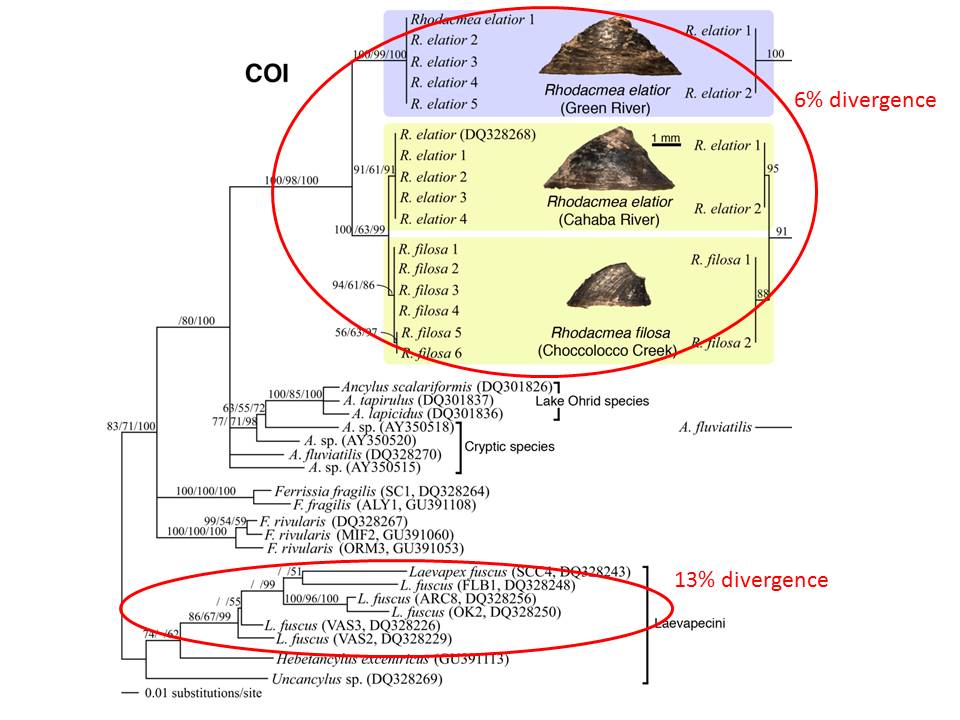
The level of CO1 sequence divergence between Cahaba and Green is also small, when compared to values these same researchers have obtained among conspecific populations of Ferrissia and Laevapex. Judging from the scale bar on their CO1 gene tree (click for larger) the O’Foighil group found perhaps 5-6% sequence divergence among all haplotypes sampled from all three Rhodacmea populations – Cahaba, Green, and Choccolocco. Compare this to the divergence shown among Laevapex fuscus haplotypes – easily in the 10 - 13% range. So given both negligible morphological difference and negligible sequence divergence (5) between the Cahaba and Green River Rhodacmea populations, how can our colleagues assert that they represent different species?

The reasoning offered by O’Foighil et al. to support their three-species hypothesis pirouettes about the Choccolocco population, individuals from which apparently bear sufficient ribs on their shells to support their identification as R. filosa. Our colleagues seem deeply invested in the proposition that this population cannot be conspecific with the previously-known Cahaba population, issuing press releases trumpeting their rediscovery of a unique species in Choccolocco Creek believed extinct for 60 years (6). So since Choccolocco must be a different species from Cahaba (at less than 1% sequence divergence!), the Green population (at 6% divergence) must represent a third.

They further reason that the Green River population must be the true eliator (since that is the type locality) and Cahaba must be a cryptic species Basch did not recognize. The old name cahawbensis seems conveniently available for rescue from synonymy.

But regarding the plasticity of shell characters in freshwater limpets, I can do no better than quote our Ann Arbor colleagues themselves (7): “Shell shape and sculptural features … are unreliable phylogenetic indicators, and they presumably (8) encompass a large ecophenotypic component.” I will also note that the morphometric analysis around which this entire commedia dell' arte turns included just N=2 bona fide individuals from Choccolocco, combined with N=6 museum specimens from a fourth (extinct) population of the author’s own choosing. And does crediting shell characters when they split Choccolocco and Cahaba, but discounting them when they lump Cahaba and Green, seem a trifle disingenuous to anybody else?

Perhaps there is some more profound reason that our colleagues have recognized three species of Rhodacmea, where they have seen only single species in Laevapex and Ferrissia, given similar evidence? A cynic would note that it is easier to get funding for three endangered species than one. But knowing our colleagues as I do, I feel sure that their motivation was the finest – to maximize the likelihood that these populations, by whatever names they may be called, will be conserved into the future. Their ends do not, however, justify their means.


Notes

(1) O'Foighil, D. O., J. Li, T. Lee, P. Johnson, R. Evans, & J. B. Burch (2011) Conservation genetics of a critically endangered limpet genus and rediscovery of an extinct species. PLoS One 6 (5): e20496. [html]

(2) Phylogenetic sporting and the genus Laevapex [20July07]
Two species of Ferrissia [8Dec10]

(3) Basch, P. F. (1963) A review of the recent freshwater limpet snails of North America (Mollusca: Pulmonata). Bulletin of the Museum of Comparative Zoology 129: 399 - 461.

(4) Although there are 1978 collections of R. filosa from Choccolocco Creek in the Florida Museum of Natural History.

(5) I will resist the temptation to preach my "gene trees are not species trees" sermon here. But sinners should prayerfully consider my post of [15July08].

(6) The news seems to have been picked up by Science Daily in early June, and spread to a variety of web-based outlets serving the conservation community, such as terradaily.com, redorbit.com, and batangastoday.com. The headlines in all cases are to the effect that a "Snail Long Thought Extinct Isn't." The Green River population is not mentioned in any of these secondary reports.

(7) Walther, A., T. Lee, J. B. Burch, and D. O'Foighil. 2006. E Pluribus Unum: A phylogenetic and phylogeographic reassessment of Laevapex (Pulmonata: Ancylidae), a North American genus of freshwater limpets. Molecular Phylogenetics and Evolution, 40: 512.

(8) Presumption is not necessary here. I reviewed our common garden experiments with ancylid limpets in my post entitled, “Just One Species of Ferrissia.” [10June09]

Tuesday, July 12, 2011

What Is A Species Tree?

Editor's Note.  This essay was subsequently published as: Dillon, R.T., Jr. (2019b)  What is a species tree?  Pp 199-206 in The Freshwater Gastropods of North America Volume 2, Essays on the Pulmonates.  FWGNA Press, Charleston.

Back in July of 2008 (1) we reviewed the relationship between gene trees and species trees, a subject that has become fashionable at the highest levels of evolutionary science. The phenomenon that leads to differences between the two types of evolutionary tree is usually called “lineage sorting” by phylogenetic systematists, who otherwise ignore it, hoping it will go away. But population geneticists, who tend to run their gene trees backward and call the phenomenon "coalescence," have pointed out that the differences in a set of gene trees can be used to date divergence events in a species tree. This may be the one thing that gene trees are actually good for.

But what is a "species tree?" Wayne Maddison, in his seminal 1997 paper on the subject (2), had in mind a phylogeny of bona fide biological species, "when reproductive communities are split." But reproductive isolation need not evolve between a pair of populations for lineage sorting to commence in their gene pools. The clock starts ticking on the gene trees as gene flow becomes disrupted for any reason between any pair of populations, reproductively isolated or not. So although the scientific community most actively involved in this area of research has always used the term "species tree" to describe the phylogeny they are comparing to their gene trees (3), the term "population tree" would clearly be much more accurate.

Genuine species trees turn out to be surprisingly difficult even to visualize, much less to work out. I did not appreciate the difficulty myself until I tried to draw one, or actually a set of them, for the paper Amy Wethington, Chuck Lydeard, and I recently published in BMC Evolutionary Biology (4).
Our new paper summarizes over ten years of research we've conducted on the evolution of reproductive isolation in Physa, including papers we've published comparing Charleston P. acuta, P. gyrina, P. pomilia, and P. carolinae (5). Brand new for 2011 we've added a second population of P. acuta, sampled from Philadelphia.

Here's an obvious attribute of the word "species" that I think we may all take too much for granted. The word "species" is relational, like the word "brother." It is not a point-character that can be measured on an OTU and cast simply on a phylogenetic tree. So when Amy, Chuck, and I undertook to add a second population of P. acuta to the species tree we had been building for years, we added a row to our triangular matrix. Between acuta, carolinae, pomilia and gyrina there are 3+2+1=6 sets of pairwise mate choice tests to be completed, and 6 corresponding sets of no-choice hybridization experiments. Adding the Philadelphia acuta population added 4 more sets of both, almost doubling our effort. A pain in the butt.

And here’s another bullet point we might profitably highlight before drawing our first species tree. The single, original population at the base of our hypothetical tree was (of course) reproductively compatible with itself. What evolves, as a species tree splits, is reproductive incompatibility. So (to borrow a term from cladism, which I hate) retention of reproductive compatibility is a "symplesiomorphy." I can still remember the day back in the early 1980s when an ANSP ichthyologist first called my attention to a paper by Donn Rosen rejecting the biological species concept because an ideologically pure classification cannot be based on symplesiomorphy (6). I'm still pissed off about that.

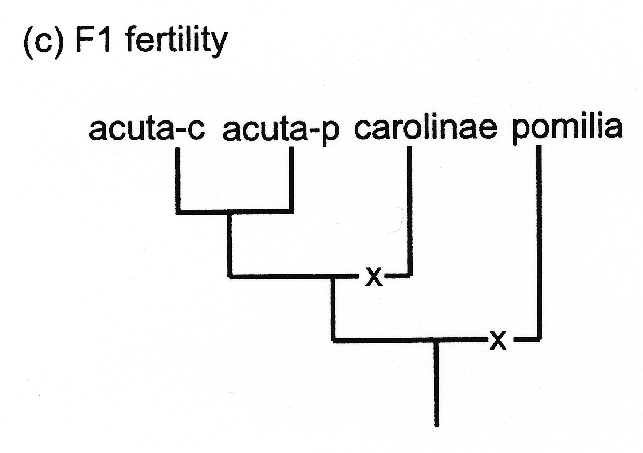
In any case, I should think that most of us, if we were to visualize a bona fide species tree, would begin with something like tree (c) at left for F1 fertility in Physa. No hybrids were recovered from any of the no-choice experiments testing gyrina against any of the other four populations, so gyrina is not shown in tree (c). At least some hybrids were born in the other 3+2+1 experiments, the ones between Charleston acuta-c and Philadelphia acuta-p proving perfectly fertile, the other 3+2 categories of hybrids not. So starting with hybrid fertility at the base of the tree, the situation may have been as simple as two separate mutations evolving at a single locus, from fertile to sterile. The actual phenomenon in Physa is almost certainly controlled by multiple loci, but our observations can be modeled very simply, as just the one.

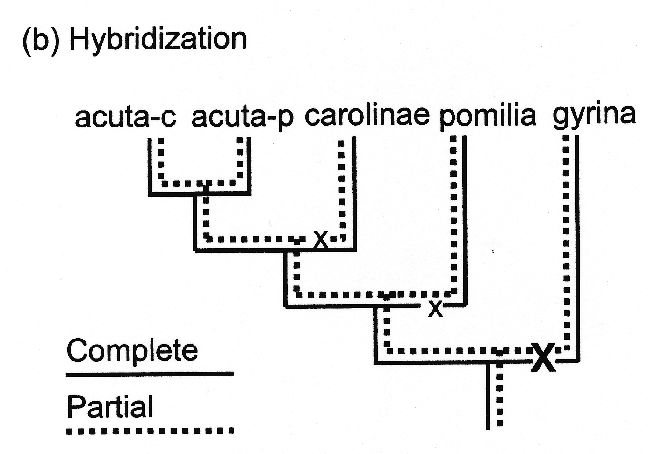
The situation cannot be so simple for hybridization, however. Of course the Charleston acuta-c and the Philadelphia acuta-p will hybridize, and as we just noted, gyrina does not hybridize in our experimental conditions with any of the other species at all (7). Our Physa carolinae population freely hybridizes with either population of acuta, while P. pomilia partially hybridizes with either population of acuta, yielding mixtures of selfed and outcrossed F1 progeny. Our carolinae x pomilia no-choice experiments have not yielded any hybrids.

My best effort to depict this messy set of relationships is shown in tree (b) at right above. Our model suggests two loci, a "complete" locus J and a "partial" locus K, at which unique compatibility alleles segregate, locus J epistatic over locus K. See the text of our paper for the details. The bottom line is, however, that the simplest model I can conceive of for the evolution of barriers to hybridization in Physa is not especially simple.

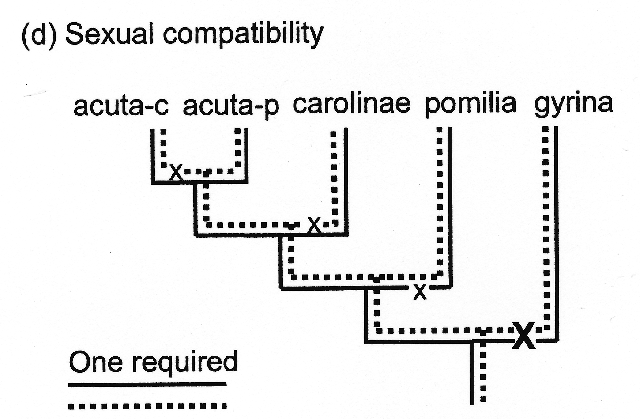
Nor is the situation on the evolution of sexual incompatibility simple, at all. Although our mate choice tests did show prezygotic reproductive isolation between P. carolinae and Charleston acuta-c, no behavioral barriers seem to be in place to lower the frequency of copulation between carolinae and Philadelphia acuta-p. Those observations seem to require another two-locus model (tree d), again see our paper for the gory details.

Our paper has a very mild conclusion, given the years of sturm und drang through which we passed to arrive upon it. The three species trees shown above, with their minimum of five genes for reproductive isolation as postulated, do indeed match the CO1+16s mtDNA gene trees previously published by Wethington & Lydeard and Wethington et al (8). I was kind-of hoping that they would not, because our conclusions would have been cooler. But (try as I might) I cannot rearrange the three species trees shown above to make them any simpler, to not match the gene tree.

I'm sure this isn't the first time in the history of science that the relationship between gene trees and bona fide species trees has ever been tested, but I don't know of any other. And the match seems to be a good one, darn it. But I am not issuing a warrant to all you gene tree jocks out there to get cocky.


Notes

(1) Gene Trees and Species Trees [15July08]

(2) Maddison, W. 1997. Gene trees in species trees. Systematic Biology, 46, 523-536.

(3) For example see Hudson, R. R. (1992) Gene trees, species trees, and the segregation of ancestral alleles. Genetics 131: 509-512. Wakeley, J. (2008) Coalescent Theory, An Introduction. Roberts & Co., Greenwood Village, CO 326 pp. Degnan et al. (2009) Properties of consensus methods for inferring species trees from gene trees. Syst. Biol. 58: 35-54.

(4) Dillon, R. T., Jr., A. R. Wethington & C. Lydeard (2011) The evolution of reproductive isolation in a simultaneous hermaphrodite, the freshwater snail Physa. BMC Evolutionary Biology 11:114.
Online clickable version [html]
Standard [pdf]

(5) Dillon, R.T., Jr., Robinson, J. & Wethington, A. 2007. Empirical estimates of reproductive isolation among the freshwater pulmonate snails Physa acuta, P. pomilia, and P. hendersoni. Malacologia, 49, 283-292. [pdf] Dillon, R. T., Jr., Earnhardt, C. & Smith, T. 2004. Reproductive isolation between Physa acuta and Physa gyrina in joint culture. American Malacological Bulletin, 19, 63-68. [pdf] Dillon, R. T., Jr. 2009. Empirical estimates of reproductive isolation among the Physa species of South Carolina (Pulmonata: Basommatophora). The Nautilus, 123, 276-281. [pdf] That last paper was featured in my blog post entitled "True Confessions: I described a new species" [7Apr10]

(6) Rosen, D. E. (1979) Fishes from the uplands and intermontane basins of Guatemala: revisionary studies and comparative geography. Bull. Amer. Mus. Nat. Hist. 162: 270-375.

(7) Although we recovered no hybrids from our no-choice experiments published in 2004, Tom Smith and I did discover a couple acuta x gyrina hybrids naturally occurring on the margins of the Delaware River at Washington Crossing. They showed up quite unexpectedly on allozyme gels. That's all I know, until God grants me another life, or a few more good students.

(8) Wethington AR, Lydeard C (2007) A molecular phylogeny of Physidae (Gastropoda: Basommatophora) based on mitochondrial DNA sequences. J Moll Stud 73: 241-257. [12Oct07]Wethington AR, Wise J, Dillon RT Jr (2009) Genetic and morphological characterization of the Physidae of South Carolina (Pulmonata: Basommatophora), with description of a new species. Nautilus 123: 282-292. [pdf]

Monday, June 13, 2011

Collecting Freshwater Snails by Kayak

About five or six years ago my family gave me a modest kayak as a Christmas present, and shortly thereafter I began carrying it with me on field trips. The first thing I learned was, "Paddle upstream."

The second thing I learned was, if at all possible, do not try to collect freshwater snails from a kayak. There is almost no space inside, and freedom of movement is very constrained. And even such an elementary operation as, “to pick up a submerged stick” without at least two fixed points against which to pick is a genuine education in basic physics.

But much of the freshwater habitat around Charleston is not really “wadeable.” And it is amazing how rarely the portions of large rivers that are readily accessible by motorized vehicle constitute especially productive freshwater snail habitat. And how often the spot just across the river, upstream 100 meters, looks absolutely perfect, at least staring at it from a boat ramp, with one's hands on one's hips. So I have found my kayak quite useful simply as a mode of transportation, to carry me somewhere better, so I can get out.

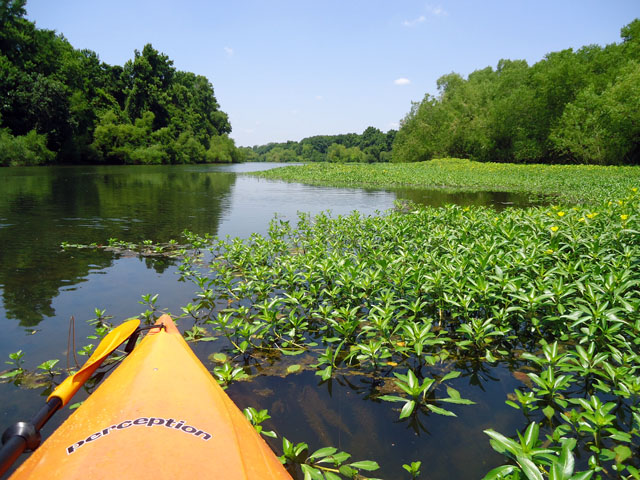
That being said, there are some habitat types that are indeed conveniently sampled by kayak. Swampy areas with soft and flocculent bottoms come to mind, and especially aquatic macrophytes, either the submergents like Elodea and Hydrilla, or floating emergents like water lilies, pondweeds, and Ludwigia (above). Mats of such vegetation can sometimes float over treacherous bottoms, and I can't think of any better method to sample the little pulmonates and hydrobiids they often shelter unless from a low, shallow-draft boat like a kayak.

The idea of tying a dipnet onto the stern of my kayak was pretty obvious. I took a triangular kick net off its pole because it fit under those big black cargo bands on the stern of my particular brand of kayak, but I suppose a D-shaped net head would have advantages as well.

When I brought my first net samples into my kayak, however, I discovered that there was really no place to sort through them except in my lap. And if I was holding my net with one hand and picking through its contents using forceps with the other, where would I perch the little vials I was trying to transfer my little pulmonates and hydrobiids into? And what to do with my paddle?

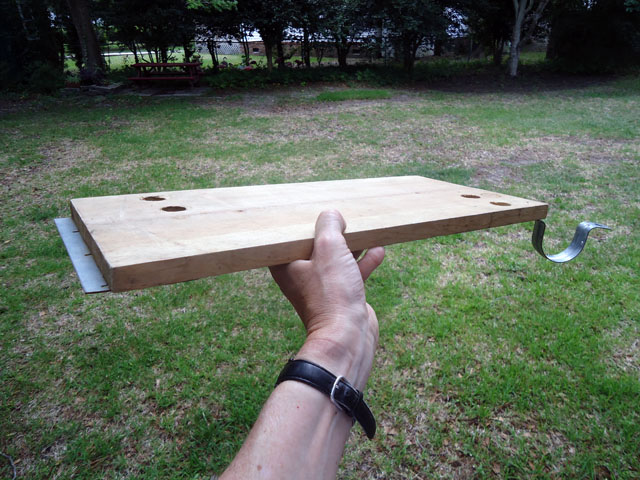
So I cut myself a 20” sorting table out of 1x10” board, and drilled a couple holes in it to hold 21x70 mm vials. On one edge of the board I attached a metal flange, which hooks under the lip of my kayak. And on the other corner I attached a metal bracket, which holds my paddle.

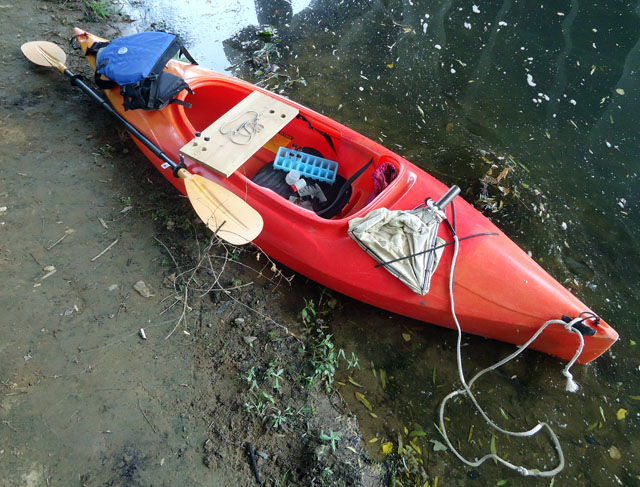
The paddle is actually supported both by the bracket on the corner of my sorting table and by a coat hanger I’ve bent into a hook and attached to the bow of my kayak (visible in the Ludwigia shot above - click for larger). Thus the weight of the paddle on the one edge of my table keeps the metal flange on the other edge firmly hooked under the kayak lip.

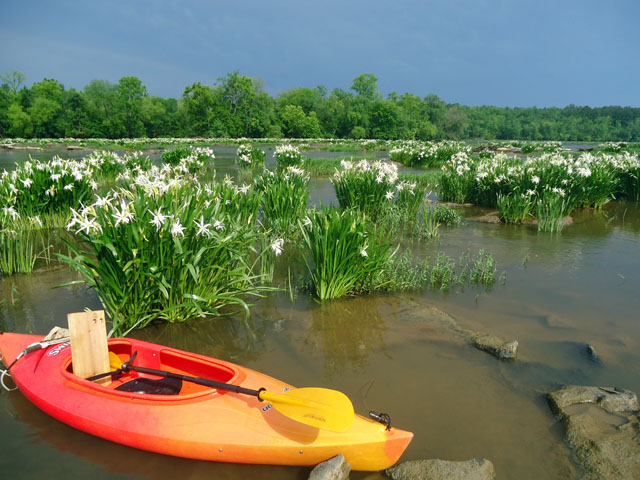
The picture below shows the sorting table in place, counter-weighted by the paddle (click for larger). I keep extra vials in an ice cube tray underneath my seat. I always wear forceps on a string around my neck, regardless of whether I am on land or sea. When I’m not sampling I slide the sorting table behind my seat, where it doubles as a backrest. (I took the factory-installed backrest out of the kayak several years ago.) The nice photo of spider lilies on the Catawba River at the top of this post shows the table in its stowed position.

That's really all the advice I've got, except for the usual, generic reminders about a life jacket, a hat, and sunscreen. Oh, and paddle upstream first. I'm serious about that.