Dr. Rob Dillon, Coordinator


Tuesday, August 7, 2012

The Lymnaeidae 2012: Fossarine Football

Editor's Note.  This essay was subsequently published as Dillon, R.T., Jr. (2019b)  The Lymnaeidae 2012: Fossarine football.  Pp 57-66 in The Freshwater Gastropods of North America Volume 2, Essays on the Pulmonates.  FWGNA Press, Charleston.

In June we reviewed the 2010 paper by Ana Correa and her colleagues synthesizing 15 years of effort (by several independent research groups) to develop gene trees for the Family Lymnaeidae [1].  Reasoning from known levels of interpopulation divergence in Lymnaea stagnalis, it appeared to us that approximately 5% sequence divergence may be expected among conspecific lymnaeid populations sharing the same continent, and 10% between continents.  By that "stagnalis yardstick," the gene tree of Correa seemed to evince approximately 19 species worldwide.  That's approximately what Bengt Hubendick would have suggested in 1951 [2].

Correa and her colleagues were not, however, primarily motivated by an academic interest in the evolution of the Lymnaeidae.  Their explicit motive was to develop a "phylogenetic framework" upon which to "analyze how susceptibility to infection by Fasciola hepatica and F. gigantica has evolved [3]."  Liver flukes of the genus Fasciola cause significant losses of livestock worldwide, and (especially in Latin America) may be sporadically recorded in human populations as well.

And so we should not be surprised that Correa and colleagues followed their 2010 study with a second study published in 2011 [4], focusing on the neotropical lymnaeid fauna, almost all of which are what we here in temperate North America traditionally call "fossarines."

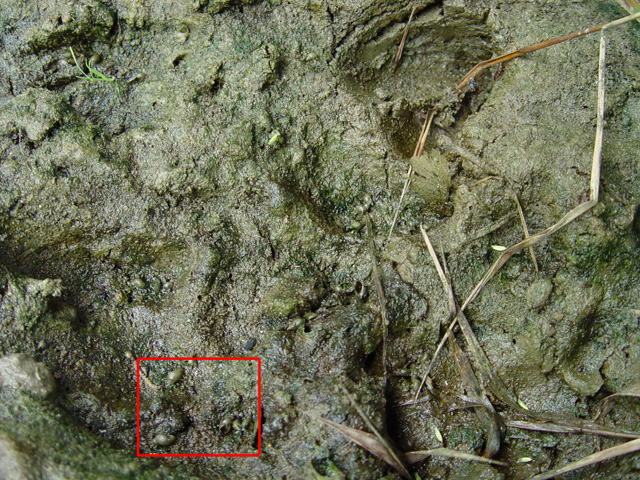
The fossarines are small-bodied lymnaeids typically found living amphibiously at the edges of ditches, ponds, and quiet backwaters.  They are common inhabitants of wet pastures and the trampled margins of riverbanks where livestock come to water, and as such have become the most important hosts of fascioliasis.  Click the figure above and spot the deer hoof print [5].

European populations of this type are usually identified simply as "Galba" truncatula.  But here in North America their taxonomy is much messier.  The Burch/Baker system [6] lists approximately 12 species of "Fossaria" in two subgenera, the bicuspid subgenus "Bakerilymnaea" with cubensis, bulimoides, and several others, and the tricuspid subgenus "Fossaria s.s." with humilis, modicella, parva, obrussa, and several others, including truncatula from Europe.  Hubendick lumped all our North American tricuspid nomina under humilis, keeping two names for our bicuspid populations: cubensis in the east and bulimoides in the west.  He also admitted truncatula to the North American fauna, extending only through Alaska and a bit of Canada. 

In South America Hubendick recognized viator (which he found difficult to distinguish from cubensis), cousini, and pictonica, a nomen that seems to have become lost.  But in contrast to the situation in temperate North America, the taxonomy of the South and Central American Lymnaeidae has not remained on ice for 30 years.  Rather, the availability of funding for fascioliasis research in the tropics has led to the description of a welter of new species, including neotropica, shirazensis, and meridensis, which have been added to the older nomina cubensis, viator/viatrix, cousini, and truncatula as well.

In recent years a malacological football match seems to have developed between French and Spanish teams working on the systematics of these little critters.  And in the spirit of full disclosure, I should confess that I have not spent the entire game on the sidelines.  In 2008 I was contacted by Prof. Dr. S. Mas-Coma (Universidad de Valencia) to furnish topotypic L. humilis for sequencing work, which led to my post of 25June08 [7] informally "restricting" the type locality of L. humilis to Owego, New York.  Ultimately I sent Dr. Mas-Coma samples of both Charleston cubensis and L. humilis from Owego.  And in 2009 I sent samples of Charleston cubensis to Dr. Philippe Jarne (CNRS Montpellier) as well [8].

So just as we asked in June for Correa's 2010 paper, we might reasonably ask today for Correa's paper of 2011.  Do we know enough about the biology of the little fossarine lymnaeids to make any sense of all the sequence data that have accumulated in recent years?  The quick answer is, no.  If you've stumbled onto this essay looking for any actual enlightenment regarding the systematics or evolution of the Lymnaeidae, quit now.

Those of you still with me may recall that my June application of our "stagnalis yardstick" to the fossarine branch of Correa's 2010 gene tree returned two groups, which I labeled with three Hubendick-era names, the bicuspid "cubensis" and the tricuspid "humilis/truncatula."  Does that fossarine branch comprise three genuinely distinct taxa, two, or one?  Let's fish topotypic CO1 sequences out of GenBank for these three old, well-established specific nomina, BLAST them against the entire NCBI nucleotide database, apply our stagnalis yardstick, and see.  And we might as well see where all those other (primarily neotropical) taxa fall as well, while we're at it.

For Lymnaea cubensis I used AM49009, collected from Cuba and sequenced by Bargues et al [9].  For L. humilis I used FN182197, collected by myself from the (newly restricted) type locality at Owego, New York, and also sequenced in the Bargues / Mas-Coma lab [10]. For L. truncatula I used EU818799, collected from Germany [11] and sequenced by Albrecht and colleagues [12].  I then ran simple BLAST searches from each of those three topotypic sequences and noted percent sequence divergence across the entire set of matches returned as "significant" by the search tool.  The results are shown graphically in the figure below.


Using truncatula as a query sequence, the BLAST search returned 14 sequences in the 96-100% similarity range, all labeled by their collectors as truncatula. In the 90-93% similarity range there were 26 sequences, including one truncatula, all five cousini, all four humilis, all three shirazensis, six (of eight) viator/viatrix, three (of the seven) neotropica, and four unidentified.

Querying from humilis, the BLAST tool returned the three other humilis CO1 sequences in GenBank matching in the 99-100% range.  Matching in the 90-94% range were all 16 truncatula, all seven neotropica, all five cousini, all three shirazensis, two (of the five) cubensis, and the four unidentified.

Looking down from cubensis, BLAST returned 15 sequences in the 95-100% similarity range: the other four cubensis, six (of the seven) neotropica, four (of the eight) viator/viatrix, and the single bulimoides sequence [15] in the database.  In the 90-94% range were just eight sequences: the other four viator/viatrix, two (of 16) truncatula, one (of five) cousini, and one (of four) humilis.

So the bottom line is that fossarine populations called truncatula in Europe and humilis in North America demonstrate the same level of sequence divergence we have observed between populations of L. stagnalis universally considered conspecific on both continents.

Then if one considers those 16 + 4 sequences together, there is some evidence suggesting that humilis/truncatula may be conspecific with the cubensis-type nomina shown red in the figure above, if one thinks of humilis/truncatula and cubensis as inhabiting separate continents.  Some of the 21 cubensis-type sequences demonstrate divergence in the 5-10% range from the 20 humilis/truncatula sequences, others are more divergent.  But if one thinks of both humilis and cubensis as sharing a continent, which I suppose I do, then one probably ought to interpret the relationships depicted above as supporting the two-species model, weakly.

In any case, the present analyis contains very little evidence supporting any of the other nominal species shown in the figure above, expecially bulimoides [15], neotropica, and viator/viatrix, all of which demonstrate less than 5% sequence divergence from cubensis.  This introduces the further complication that D’Orbigney’s 1835 nomen viator is an older name than Pfeiffer’s 1839 cubensis.  I would change the name at the top of the FWGNA page from cubensis to viator if I believed in DNA sequence data, which I do not.

Correa and colleagues [4] go beyond believing in sequence data to a belief in gene trees, a strict and demanding faith indeed.  While concurring with us that cubensis, neotropica, and viator/viatrix appear conspecific, their 2011 analysis suggested to them as many as five “species” of fossarines: truncatula, humilis, cubensis, cousini, and (surprise!) a new species from Columbia and Venezuela, which (I feel sure) will reach description soon.  They concluded “that conchological and anatomical characters are uninformative [13] to identify closely related species of Lymnaeidae, and that DNA-based approaches should be preferred.”

Yes, trying to advance the ball downfield entirely by head-butting will rarely score points, and so the foot should be preferred.  Or, how about using our hands?

As far as I can determine, nobody has ever tried to rear any New World population of fossarine snails in culture, much less gather the first datum on their mating system.  Several excellent studies of European truncatula have returned evidence of preferential self-fertilization [14], but I am not aware of any study involving humilis, cubensis, or the scores of genetically similar nominal species of the Americas, temperate or tropical.  So big international research teams continue to fill the journals with forests of gene trees, while simple questions about the basic biology of the snails themselves go unaddressed.  Such is the sad state of The Lymnaeidae, 2012.


Notes

[1] The Lymnaeidae 2012: Stagnalis yardstick [4June2012]

[2]  The Classification of the Lymnaeidae [28Dec06]

[3] Come on, guys!  In the entire sample of 51 taxa analyzed by Correa et al (2010), only two have ever been demonstrated refractory to infection by Fasciola.  Susceptibility is generally distributed all over the entire lymnaeid phylogeny.  Look at the little colored balls here: [Correa 2010 tree]
I hate to be cynical, but it's hard to see how research in this direction is going to solve the global fascioliasis problem.

[4] Correa, A.C., J.S. Escobar, O. Noya, L.E. Velasquez, C. Gonzalez-Ramirez, S. Hurtrez-Bousses & J-P. Pointier (2011)  Morphological and molecular characterization of Neotropic Lymnaeidae (Gastropoda: Lymnaeoidea), vectors of fasciolosis.  Infection, Genetics and Evolution 11: 1978-1988.  [Open Access]

[5] Photo taken in September of 2008 at a muddy pool in Owego, NY, the type locality of Lymnaea humilis.

[6] The classification of the Lymnaeidae adopted by Burch for his (1989) "North American Freshwater Snails" was a modification of the system developed by Baker (1911, 1928).  For more background, see my post of [28Dec06].

[7] Malacological Mysteries I: The type locality of Lymnaea humilis [25June08]

[8]  This transaction may have led, in some complicated way, to an error in the 2010 paper by Correa et al.  In her Table 1, Correa gave the collection locality for Lymnaea humilis as "USA, Charleston (South Carolina)."  No, the three GenBank accession numbers she cited all corresponded to the sequences Bargues & Mas-Coma obtained from my samples of Owego, New York [10].  There are no L. humilis populations in Charleston!  That was the entire point of my 25June08 essay.

I understand that the North American situation regarding cubensis and humilis is confusing.  But it troubled me to discover that the single fact about which I had any independent information in the Correa 2010 paper was completely bass-ackward wrong.

[9] Bargues, M.D., P. Artigas, R.L. Mera y Sierra, J.P. Pointier & S. Mas-Coma (2007)  Characterisation of Lymnaea cubensis, L. viatrix and L. neotropica n. sp., the main vectors of Fasciola hepatica in Latin America, by analysis of their ribosomal and mitochondrial DNA.  Ann. Trop. Med. Parasitol. 101: 621-641.

[10] Bargues, M.D., P. Artigas, R.T. Dillon & S. Mas-Coma (unpubl.) Molecular characterization of Lymnaea humilis (= L. modicella), a major fascioliasis vector in North America, and evaluation of the usefulness of nuclear rDNA and mtDNA markers for Lymnaeidae.

[11] Although there were quite a few truncatula sequences in GenBank, most authors gave no data on collection locality, which as I noted in June, drives me nuts.  Albrecht and colleagues [12], thank heaven, reported their collection site as "Germany: Thuringia, Erfurt-Bindersleban, spring of Nesse River."  I have no idea how close this might be to the actual type locality, given by Muller as "Thangelstedt, near Weimar, Germany," but we'll make it do.

[12] Albrecht, C.,  C. Wolff, P. Gloer & T. Wilke (2008)  Concurrent evolution of ancient sister lakes and sister species: the freshwater gastropod genus Radix in lakes Ohrid and Prespa.  Hydrobiologia 615: 157-167.

[13]  The Correa et al. 2011 paper also included a nice dataset on penial morphology, but really very little on the shell - just simple length and width.  And none of the European workers ever seem to examine radular morphology.  I have no idea why not.

[14] Meunier, C., S. Hurtrez-Bousses, R. Jabbour-Zahab, P. Durand, D. Rondelaud & F. Renaud (2004)  Field and experimental evidence of preferential selfing in the freshwater mollusc Lymnaea truncatula (Gastropoda: Pulmonata).  Heredity 92: 316-322.  Trouve, S., L. Degnen, F. Renaud & J. Goudet (2003)  Evolutionary implications of a high selfing rate in the freshwater snail Lymnaea truncatula.  Evolution 57: 2303-2314.

[15] Note added 13Feb24.  The "single bulimoides sequence" referred to above is spurious, and Lymnaea bulimoides is not a junior synonym of L. cubensis/viator.  For more, see:
  • What is Lymnaea bulimoides [13Feb24]

Monday, July 9, 2012

The Lymnaeidae 2012: A clue

Editor's Note. This essay was subsequently published as Dillon, R.T., Jr. (2019b)  The Lymnaeidae 2012: An important stipulation.  pp 45-50 in The Freshwater Gastropods of North America Volume 2, Essays on the Pulmonates.  FWGNA Press, Charleston.

Plasticity of shell phenotype is such a pervasive phenomenon in our area of research that the topic has become a regular category label on this blog, with nine posts to date and climbing.  We've seen quite a few excellent laboratory studies over the years, beginning with Arthur (1982) on Lymnaea stagnalis and including notable contributions by Lam & Calow (1988) on L. peregra,  DeWitt (1998) and Auld & Relyea (2011) on Physa, Hoverman & Relyea (2007) on Helisoma, Holomuzki & Biggs (2006) on the hydrobiids, and Urabe (1998) and Krist (2002) on the pleurocerids [1].   I've reached a point that I now take the phenomenon for granted.

So, looking back on my posts of April and May regarding the “stagnicoline” lymnaeids of North America [2], I skipped as lightly through the "5 nominal species in the dark-skinny elodes group and 16 nominal species in the pale-broad catascopium/emarginata group" recognized by Burch [3] as I did through the “14 dark, skinny marsh-dwellers and 25 pale, fat river & lake-dwellers” recognized by Baker [4], taking for granted that essentially all of the shell and body color variance upon which this elaborate taxonomy has been hung since the 19th century must be attributable to phenotypic plasticity.  The only question in my mind was whether there might be some cryptic species hiding underneath the phenotypic noise.  About which, I concluded in May, "I just don't think we here in North America have ever caught a clue."

That was hyperbole. 

Of course there must be a genetic component to shell morphology, and of course shell morphology must give us some information about the evolution of the snails bearing them.  Reared in a common environment, lymnaeids, planorbids and physids do not converge on a single dextro-sinistro-planospiral axis of coiling.  Indeed, natural selection is only effective on the component of the variance that is heritable.  If all that shell variance Bengt Hubendick so treasured in the lymnaeid populations of Europe were simply ecophenotypic responses to current or substrate or predation, selection would grind to a halt just as surely as if no variance existed at all.

Thus the paper published late last year by Christer Brönmark and his colleagues at the University of Lund [5] arrives as an especially welcome addition to the worldwide research program on freshwater gastropod evolution.  For here we see an elegant demonstration not just that the shell morphology of lymnaeid snails is subject to great phenotypic plasticity, but also that after all the environmental component of the variance is boiled away, at least some genetic component remains.

Brönmark opened his paper with a demonstration that Swedish populations of Lymnaea peregra/balthica [6] wild-collected from ponds with molluscivorous fish tend to bear lower spired, more rounded shells than populations inhabiting fishless ponds.  He then sampled snails from four ponds with fish and five fishless ponds and reared their three-week hatchlings (20 hatchlings per population) in two treatments for 12 weeks, with fish and without.  When measured on the first principal component of shell morphology (71% of the variance) the progeny of all nine populations responded identically – slender shells in the absence of fish predation and rounded shells in the presence [Figure (a) above, Note 7].  But on the second PC (8% of the variance) the two groups responded differently to the absence of fish; populations originating in ponds with fish (filled diamonds in figure b) developing significantly wider second whorls than populations from fishless ponds (open squares). 

I wish that Brönmark’s paper had come to my attention a couple months ago.  He and his colleagues have offered us a lovely demonstration of apparently heritable and adaptive differences in shell morphology among conspecific populations of lymnaeids separated not by any great distances or barriers, but simply by their selection regimes.  Such a phenomenon can easily explain the observations of Turner & Brady I featured in May, without resorting to a hypothesis of cryptic speciation.  There may be something to that Darwin stuff, after all.


Notes

[1]  These are some of my favorite laboratory studies of shell phenotypic plasticity in freshwater snails.  By no means an exhaustive list:  Arthur, W. (1982) Control of shell shape in Lymnaea stagnalis. Heredity 49:153-161.  Auld, J. & R. Relyea (2011) Adaptive plasticity in predator-induced defenses in a common freshwater snail: altered selection and mode of predation due to prey phenotype.  Evol. Ecol. 25:189-202.   DeWitt, T. (1998) Costs and limits of phenotypic plasticity: Tests with predator-induced morphology and life history in a freshwater snail.  J. Evol. Biol. 11:465-480.  Holomuzki, J. & B. Biggs (2006) Habitat-specific variation and performance trade-offs in shell armature of New Zealand mudsnails.  Ecology 87:1038-1047.  Hoverman, J. & R. Relyea (2007) The rules of engagement: how to defend against combinations of predators.  Oecologia 154:551-560.  Krist, A (2002) Crayfish induce a defensive shell shape in a freshwater snail.  Invert. Zool. 121:235-242.  Lam, P. & P. Calow (1988) Differences in the shell shape of Lymnaea peregra (Muller) (Gastropoda: Pulmonata) from lotic and lentic habitats; environmental or genetic variance?  J. Moll. Stud.  54:197-207.  Urabe, M. (1998) Contribution of genetic and environmental factors to shell shape variation in the lotic snail Semisulcospira reiniana (Prosobranchia: Pleuroceridae).  J. Moll. Stud. 64:329-343.

[2] The Lymnaeidae 2012: Tales of L. occulta [23Apr12]
The Lymnaeidae 2012: Tales from the cryptic stagnicolines [10May12]

[3] Burch, J. B. (1989) North American Freshwater Snails. Hamburg, MI: Malacological Publications.

[4] Baker, F. C.  (1911) The Lymnaeidae of North and Middle America, Recent and Fossil. Special Publication, no. 3. Chicago: Chicago Academy of Natural Sciences.

[5]  Brönmark, C., T. Lakowitz, and J. Hollander. 2011. Predator-induced morphological plasticity across local populations of a freshwater snail. PLoS ONE 6 (7):e21773.  [Open access]

[6]  Some European authorities have recently resurrected the Linnean nomen “balthica” to apply to the snail everybody for 200 years has called L. peregra, despite the fact that Linnaeus (1758) gave the habitat of his Helix balthica as the littoral zone of the Baltic Sea.  Since Linnaeus used the genus Helix for land snails, my guess would be that balthica was probably what we today call a Littorina.   Hubendick simply dismissed the nomen as, “Probably no Lymnaea.”   But you be the judge:  "H. testa imperforata ovata acuminata, rugis elevatis, apertura ovata amplicata."  (Systema Naturae pg. 775).

[7] This is the left half of Figure 2 from Brönmark et al. (reference above).  "Reaction norms of shell morphology in Radix balthica from the common garden experiment."     

Monday, June 4, 2012

The Lymnaeidae 2012: Stagnalis yardstick

Editor's Note. This essay was subsequently published as Dillon, R.T., Jr. (2019b)  The Lymnaeidae 2012: Stagnalis yardstick.  pp 51-56 in The Freshwater Gastropods of North America Volume 2, Essays on the Pulmonates.  FWGNA Press, Charleston.

Bengt Hubendick was a genius in the way Picasso was a genius.  It’s not that he didn't make mistakes.  They just didn't matter, because that wasn't the point.

At left [1] is a “mean photograph” of Lymnaea peregra from Hubendick’s 1951 monograph.  Here he has photographed 20 shells from a single population in Sweden, overlain the negatives, and developed a single print.  Hubendick’s point here is variance.  Variance is the stuff of evolution.

And what has become of our science today?  In April [2] we touched briefly on the 2010 paper by Ana Correa and her colleagues, synthesizing 15 years of research on molecular evolution in the Lymnaeidae [3].  Essentially every one of the 53 tips on Correa’s tree was labeled with a different specific nomen. There was no estimate of intraspecific sequence variance whatsoever.

Nor am I able to find any such estimate anywhere in the entire heap of 21 papers on lymnaeid molecular phylogenetics stacked like cordwood on my desk this afternoon [4].  All 21 seem to adhere strictly to what might be called the “U1s2nmt3 Rule.”  Workers usually sequence one individual per population, sometimes two, and never more than three.  And they usually sequence one population per nominal species, sometimes two, and never more than three.  Apparently there has been some international conference of bonehead tree jocks where a U1s2nmt3 Rule was proposed and adopted without debate, to which I was not privy.

But gene trees are (at best) weak, null hypotheses of population relationships [5].  They require control and calibration, no different from any other measurement technique in the toolbox of evolutionary biology.  When applied to estimate the genetic relationships among a set of populations unknown to us, we first need an estimate of the variance within populations, and then between populations within species.

So in April I asked the rhetorical question, “Do we know enough about the biology of the lymnaeid snails to make sense out of all the sequence data published in recent years by Remigio, Bargues, Mas-Coma, Pfenninger, Streit, Jarne, Pointier, and others?”  The answer is, “Maybe we know enough about Lymnaea stagnalis.”

Back in the Glory Days of the Modern Synthesis, Hubendick suggested that the lymnaeid fauna of North America might share as many as three species with that of Europe. And much less problematic than L. palustris, about which we have obsessed during the months of April and May, was Lymnaea stagnalis.

Lymnaea stagnalis is such a striking snail that there has apparently never been any question, from the birth of American malacology to the present day, that the big honkin’ lymnaeids with the concave apex and the flaring lip crawling around in our northern lakes must match the big honkin’ lymnaeids with the concave apex and the flaring lip crawling around in lakes throughout northern Europe. 

In the 20th Century L. stagnalis became a popular laboratory model for neurobiologists, parasitologists, and physiologists of all stripes, to the point that my simple search of the NCBI PubMed database (for example) yielded 1,344 hits.  Lymnaea stagnalis may surpass Biomphalaria glabrata (1,222 hits) for the mantle of “best known freshwater gastropod.”

So I went fishing in GenBank for L. stagnalis sequences in an effort to calibrate the Correa gene tree.  My initial hope was to analyze the same set of genes used by Correa and colleagues – 16S, ITS1 and ITS2 – but I found no ITS sequences for L. stagnalis from the American side of the pond.  The eight sequences for 16S in GenBank (from four sources) included four Canadian and four European, I think [6], but there were some irregularities in those data, which gave me pause.

The best dataset in GenBank seemed to be that for CO1, in any case, with four Canadian and eight European sequences from six different sources, all over 600 bp in length, so that’s what I focused on.  The figure above shows a neighbor-joining tree based on simple percent sequence differences among four CO1 sequences from Manitoba, six from Germany (I think) and one each from Sweden and France (Click for larger).  The scale bar is a bit misleading, but divergence within continents ranged up to about 5%, with divergence values between continents in the 7-9% range.

That’s sort-of consistent with the 16S situation, but the 16S sequences were only in the 400-450 bp range, and the divergence didn’t look nearly as clean as in the CO1 data I’ve figured.  The GenBank accessions suggested that Correa and colleagues may have obtained a 16S sequence in an L. stagnalis sampled from France that matched one of Remigio’s Manitoba sequences at 100%.  Meanwhile the maximum divergence across the whole set of eight was between Remigio’s Canadian and Italian sequences, at 13%.

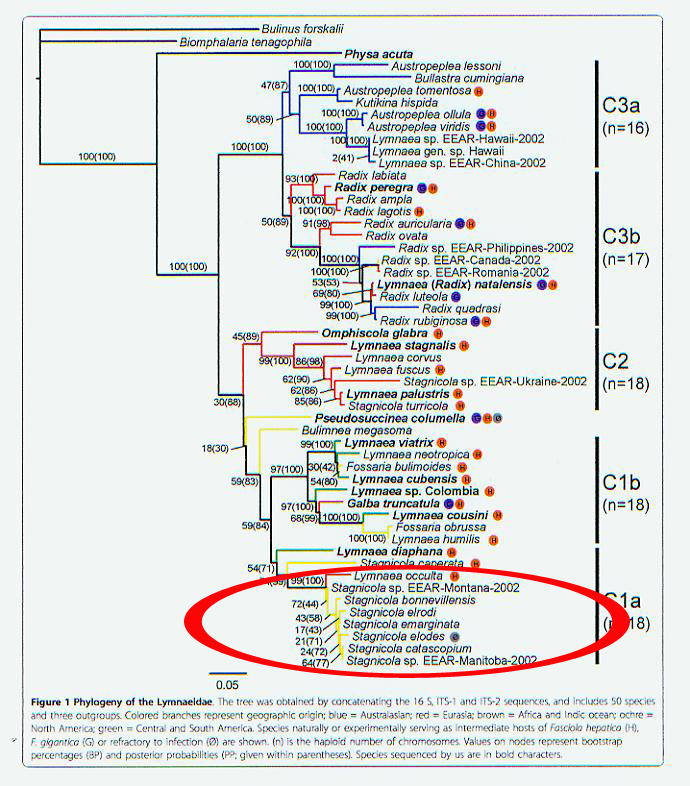
In any case, if we re-examine the Correa tree using 5% expected sequence divergence within-continent [4] and 10% between, we obtain the groupings I’ve labeled on the right margin in the figure below (Click for larger).  From North America (that yellowish color in Correa’s figure, hard to distinguish) we see one group comprising nominal catascopium, emarginata, elodes and the “occulta” sample from Poland we mentioned in April.  We also note that individual samples of caperata, megasoma, and columella were distinctive – no surprises there.  And there’s evidence for a “Radix” population up in Canada matching Eurasian luteola – that’s interesting.

The two other North American groups suggested by Correa’s gene tree include the little mud-dwelling lymnaeids we here tend to call “fossarines.”  The situation with L. humilis and L. cubensis will, I think, bear closer examination.  But I’m clean out of patience with this subject for today, and I suspect the attention of my readership may be wearing thin as well.  So let’s sign off with what should be a standard disclaimer for inquiries of this sort.

A species is a population or group of populations reproductively isolated from all others.  Gene trees may or may not reflect reproductive isolation [7].  So the N = 8 groups (and N = 11 singletons) I have marked on Correa’s gene tree are not “species,” even though I have labeled them that way.  There’re just gene sequences.  More about which next time…


Notes

[1] Plate 2, Figure 3 from Hubendick, B. (1951)   "Recent Lymnaeidae, Their Variation, Morphology, Taxonomy, Nomenclature and Distribution.  Kungl. Svenska Vetenskapskademiens Handlingar. Fjarde Serien Band 3. No. 1. Stockholm: Almquist & Wiksells Boktryckeri AB.

[2] The Lymnaeidae 2012: Tales of L. occulta [23Apr12]

[3] Correa, A. C., J. S. Escobar, P. Durand, F. Renaud, P. David, P. Jarne, J-P Pointier, and S. Hurtrez-Bousses (2010)  Bridging gaps in the molecular phylogeny of the Lymnaeidae (Gastropoda: Pulmonata), vectors of fascioliasis.  BMC Evolutionary Biology 10: 381.  Open access here: [html]

[4] In fairness, Correa and colleagues (Infection, Genetics & Evolution 11: 1978-1988) published a “DNA barcoding analysis” in 2011 similar in spirit to the L. stagnalis study I have developed above.  Their combined analysis of sequence divergence across multiple studies and multiple species yielded a “barcoding gap” (presumably marking the boundary between intraspecific and interspecific variability) around 6%, quite consistent with my within-continent estimate.  Correa et al. (2011) did not examine an intercontinental subset, however.

[5] Gene Trees and Species Trees [15July08]

[6] Most of the sequences I inspected in GenBank were missing locality data! A few authors supplied information regarding the site of collection in the “source” field.  But most just entered “source = mitochondria.”  Duh.

[7] What is a Species Tree?  [12July11]

Thursday, May 10, 2012

The Lymnaeidae 2012: Tales from the cryptic stagnicolines

Editor's Note. This essay was subsequently published as Dillon, R.T., Jr. (2019b)  The Lymnaeidae 2012: Tales from the cryptic stagnicolines. pp 37-43 in The Freshwater Gastropods of North America Volume 2, Essays on the Pulmonates.  FWGNA Press, Charleston.

Kip Brady is a Teacher of Science at New Philadelphia High School in eastern Ohio, and an all around nice guy.  In 2008 he hooked up with our good friend Andy Turner of Clarion University, initially attracted by the potential of freshwater gastropods as tools for the classroom.  Soon Kip became involved with Andy on an NSF "Research Experience for Teachers" study of freshwater gastropods and leaf litter processing at the Pymatuning Laboratory of Ecology (1).

But their study involved several populations of dark, marsh-dwelling stagnicoline lymnaeids that have proven extremely difficult to identify (Above, 2).  The variety of Lymnaea elodes that Andy & Kip consider "typical" in NW Pennsylvania has a rather slender shell, with an estimated mean adult width: height ratio around 0.37.  But in Hartstown Marsh (east of Pymatuning Reservoir) they found a "robust" variety V2, demonstrating a mean adult shell W:L ratio around 0.44 (3).

Andy and Kip showed samples of these two varieties to me at the 2009 NABS meeting in Grand Rapids, but I'm afraid I wasn't much help.  The difference in the body whorl was more striking to my eye than the W:L ratio, but both shell types seemed within the normal range of variation one sees in populations called L. palustris in Europe or L. elodes here.  I suggested breeding studies, which in retrospect wasn't very practical advice.

So Kip decided to try a simple common garden experiment, carrying pure populations through multiple generations in a uniform environment.  He collected four populations of dark, marsh-dwelling lymnaeids from northwestern Pennsylvania differing in their W:L ratios, divided them into twelve 300-gallon cattle tanks, cultured them for three years, and re-examined the second generation born in the tanks.  While three of Kip's populations converged on a uniform shell morphology (Conley, Osgood, and Killbuck), the robust V2 population from Hartstown Marsh remained distinct (Below, 4).

Let's recap, shall we?  Had we asked Frank Collins Baker back in 1911 to estimate the number of stagnicoline species in North American waters, he would have suggested about 14 dark, skinny marsh-dwellers and 25 pale, fat river & lake dwellers.  But in 1951 Hubendick lumped all our dark/skinny marsh-dwellers under the European nomen L. palustris, and our pale/fat lake-dwellers under L. catascopium, with L. emarginata as a question mark (5).  Then in 1959, Maria Jackiewicz distinguished as many as five cryptic species under European L. palustris on anatomical grounds, one of which she described as L. occulta.  The range of that species (under the name L. terebra) has recently been shown to extend across the top of Europe and Asia to the Bering Land bridge.  And recent DNA sequence data reflect striking genetic similarity between an individual L. occulta/terebra sampled from Poland and individual L. elodes, L. emarginata, and L. catascopium sampled from Montana, Michigan, and Ontario (6).

Now comes the news that at least two cryptic species of dark/skinny marsh-dwelling stagnicolines are lurking in the marshes of Northwestern Pennsylvania.  Maybe this isn't news at all?  Maybe this is exactly what we should have expected had research in America kept pace with research in Europe?  Might one of Andy and Kip's varieties be L. palustris, as Hubendick suggested 60 years ago, and the other L. occulta/terebra?  If that's true, there must be twenty names here in North America, including elodes, catascopium and emarginata, that would have priority over the European nomina occulta and terebra.

So maybe F. C. Baker was right about the diversity of our stagnicoline fauna way back in 1911, and we should never have looked to Europe at all?  No, I don't think so. 

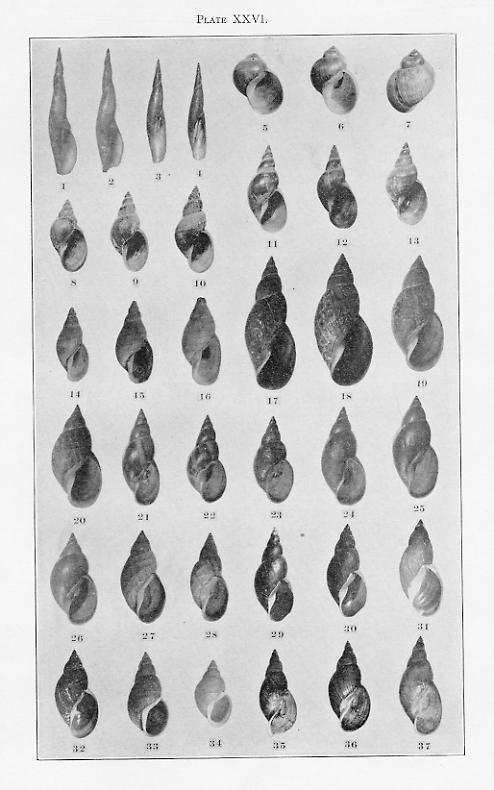
At left is a detail from Plate XXVI of Baker's 1911 monograph, showing shells he labeled "Galba palustris."  The similarity between this image and the photo above is striking, isn't it?  If you click the image you can see Baker's entire plate (7), showing shells from six populations of nominal G. palustris, numbered 17 - 37.  While most of the 21 shells depicted look like robust-V2 individuals, to my eye figures 17, 22, 23, 29, 33 and 35 appear to show typical-V1.  And figures 20, 26 and 34 are getting very close to L. catascopium, aren't they?  Many of Baker's other stagnicoline plates look similarly mixed, to my eye, including his plate XXXIV of "Galba" elodes.

Thumbing through the 162 pages of text and 18 plates that F. C. Baker dedicated to his 39 nominal species of stagnicolines, I just don't think we here in North America have ever caught a clue about the lymnaeid fauna that covers half our continent.

So now it's the 21st century.  Might modern DNA sequence data cast some light on this question?  Tune in next time...


Notes

(1) Brady, J. K & A. M. Turner (2010) Species-specific effects of gastropods on leaf litter processing in pond mesocosms.  Hydrobiologia 651: 93-100. [PDF available from Andy Turner's site].

(2) This montage made from photos kindly provided by Dr. Andy Turner.

(3) Statistical inference on ratios like this is real funky.  I understand that Andy & Kip are planning to re-run their analyses using ANCOVA.

(4) This image courtesy of Kip Brady.

(5) The Classification of the Lymnaeidae [28Dec06]

(6) The Lymnaeidae 2012: Tales of L. occulta [23Apr12]

(7) Plate XXVI from Baker (1911).  Figures 1 - 16 show L. haldemani, bulimoides, obrussa and petoskeyensis not important for our story.  Figures 17 - 37 are Galba palustris, with 17-20 from Alpena MI, 21-26 from Halma MN, 27-28 from Fort Erie NY, 29-32 from Charlotte NY, 33-34 from Ebenezer NY, and 35-37 from Windsor, ON.  Baker noted, "Figures 17 - 26 are excellent examples of spire variation."

Monday, April 23, 2012

The Lymnaeidae 2012: Tales of L. occulta

Editor's Note. This essay was subsequently published as Dillon, R.T., Jr. (2019b)  The Lymnaeidae 2012: Tales of L. occulta.  pp 29-35 in The Freshwater Gastropods of North America Volume 2, Essays on the Pulmonates.  FWGNA Press, Charleston.

We last reviewed the classification of the Lymnaeidae on 28Dec06 (1).  And faithful readers may remember that I am a big fan of Bengt Hubendick's 1951 work of genius, demonstrating that the worldwide Lymnaeidae "possesses great morphological uniformity, while there is a wide range of variation within the various species (2)."  Hubendick recognized about a dozen species in North America, which he saw no reason to subdivide (3), placing them all in the typical genus "Lymnaea."  Meanwhile other workers have continued to carry 50-60 North American lymnaeid species over from the era of Frank Collins Baker, recognizing as many as seven genera.  The system we have adopted for use in the FWGNA project is a compromise, accepting Hubendick's broad concept of the genus, while retaining the seven intermediate-level taxa as subgenera.

Has there been any progress since Hubendick?  The quick answer is yes, but not much here.

In a career spanning over 50 years, Poland's Maria Jackiewicz made a significant contribution to our understanding of the European Lymnaeidae (4).  And it materializes that the large, dark, marsh-dwelling populations which Hubendick lumped under the name "Lymnaea palustris" in Europe may comprise as many as five cryptic species, distinguishable by detail of reproductive morphology.  Jackiewicz rescued several names from synonymy under palustris and described one species afresh in 1959, "Galbaocculta (Figured above left, 5).  Her thinking on the higher classification of the Lymnaeidae has continued to evolve over the years, but as of 1998 she had three of these cryptic species (including palustris and occulta) in a subgenus Stagnicola and two of these species grouped with L. stagnalis in the (typical) subgenus Lymnaea (6).

In 2008 an important asterisk was added to the work of Jackiewicz by Vinarski & Gloer (7).  They demonstrated that populations previously referred to L. occulta in northern Europe range across Russia from the Baltic Sea to the Bering, and that the species seems to have first been described from Siberia as L. terebra (Westerlund, 1885).  All the way to the Bering land bridge, but not over it?  Indeed?

Meanwhile, back in North America, Hubendick was not able to distinguish any of our dozens of nominal species of dark, skinny, marsh-dwellers from European L. palustris either, but he did separate our pale, broadly-shelled inhabitants of exposed environments as either L. catascopium (Say 1817) or L. emarginata (Say 1821).  And H. J. Walter (1969) could not distinguish emarginata from catascopium (Right below, 9).  In an 102-page tour-de-force, Walter (8) disassembled a large sample of Michigan L. catascopium all the way down to the nuts and bolts, polished each part to a lustrous sheen, and re-assembled the whole into a sparkling wonderland of basommatophoran imagery. 
 
And in a brief sidebar that I think may prove stunningly prescient, Walter wrote, "A lymnaeid recently discovered in Poland, and described as a new species (Lymnaea occulta Jackiewicz, 1959), undoubtedly is of advanced stagnicoline character (like L. catascopium); one may suspect that it is an American species introduced into Europe."  So the pale, broadly-shelled, inhabitant of exposed environments we call L. catascopium here in North America is anatomically indistinguishable from the dark, slender-shelled inhabitant of marshes called L. occulta in Europe and L. tarebra across Siberia? Indeed?

But despite the contributions of H. J. Walter, research on the lymnaeid populations generally referred to Stagnicola (at the full genus rank) here in North America has, well, stagnated.  J. B. Burch reverted to the Baker system in his 1982 "North American Freshwater Snails," recognizing 5 nominal species in his dark-skinny "Stagnicola elodes group" and 16 nominal species in his pale-broad "Stagnicola catascopium/emarginata group (10)."  And that’s where we’ve sat for 30 years.

Which is not to say that no research has been published.  The first gene trees were constructed for the Lymnaeidae in 1997 by the North American researchers Remigio & Blair (11), and I’ve tossed at least twenty additional papers onto the stack with Remigio in the last 15 years, almost entirely European in origin, many of them execrable, beneath citation.  The phylogeny suggested by a gene tree is not a predictor variable; it is a response (12).  Do we know enough about the biology of the lymnaeid snails to make sense out of all the sequence data published in recent years by Remigio, Bargues, Mas-Coma, Pfenninger, Streit, Jarne, Pointier, and others?

We will address that question more fully in a future post.  But for now I will introduce just one little snippet from an ML tree based on a concatenation of 16s, ITS-1 and ITS-2 published by Correa and colleagues in 2010 (13).  The sequence divergence across all seven North American stagnicoline samples shown above - including Michigan elodes, catascopium and emarginata - is less than 5% (Click to see the whole tree).  And no more than a few percent distant from the North American stagnicolines is a sample of L. occulta from Poland (14).  Correa and colleagues hypothesized that "L. occulta was actually introduced in Europe from North American populations."  Indeed?


Notes

(1) The Classification of the Lymnaeidae [28Dec06]

(2) Hubendick, B. (1951)  Recent Lymnaeidae.  Their variation, morphology, taxonomy, nomenclature and distribution.  Kungliga Svenska Vetenskapsakademiens Handlingar Fjarde Serien 3: 1 - 223.

(3) Hubendick did consider the limpet-shaped North American taxon Lanx sufficiently distinct to warrant recognition at the genus level.  But Walter (Ref 8) wrote, "the limpet-like lymnaeids are more closely related to some species of "Stagnicola" than are some species of "Stagnicola" to each other, and therefore I must reject the taxa Lancinae and Lanx."

(4) Jackiewicz has probably published at least 10 -15 papers on the European stagnicolines in her career, but the most accessible to a North American audience is probably:
Jackiewicz, M. (1998)  European species of the family Lymnaeidae (Gastropoda, Pulmonata, Basommatophora).  This was published as a stand-alone volume of Biologica Silesiae, but is usually cited as a serial, Genus 9: 1 – 102.

(5) This photo was scanned from a useful handbook by Gloer & Meier-Brook (1994) Susswassermollusken.  Deutscher Jugendbund fur Naturbeobachtung. 136 pp.

(6) Jackiewicz has recently appeared as a coauthor on papers using the new lymnaeid genus "Catascopia."  See  Meier-Brook, C., & M. D. Bargues (2002)  Catascopia, a new genus for three Nearctic and one Palaearctic stagnicoline species (Gastropoda: Lymnaeidae).  Folia Malacologica 10: 83-84.

(7) Vinarksi, M. V. & P. Gloer (2008)  Taxonomic notes on Euro-Siberian freshwater molluscs.  3. Galba occulta Jackiewicz, 1959, is a junior synonym of Limnaea palustris var. terebra Westerlund, 1885.  Mollusca 26:175-185.  Can be downloaded from www.malaco.de here: [pdf]

(8) Walter, H. J. (1969) Illustrated biomorphology of the "angulata" lake form of the basommatophoran snail Lymnaea catascopium Say.  Malacological Review 2: 1 - 102.

(9) This specimen of L. catascopium was collected from Oneida Lake in upstate New York.

(10)  J. B. Burch's North American Freshwater Snails was first published in 1982 by the U.S. Environmental Protection Agency, then as a serial in the journal Walkerana, and then finally (1989) as a stand-alone book.  (Malacological Publications, Hamburg, MI).

(11) Remigio, E. A. & D. Blair (1997)  Molecular systematics of the freshwater snail family Lymnaeidae (Pulmonata: Basommatophora) utilising mitochondrial ribosomal DNA sequences .  J. Moll. Stud. 63: 173-185.

(12) Gene Trees and Species Trees [15July08]
But see "What is a Species Tree?" [12July11]

(13) Correa, A. C., J. S. Escobar, P. Durand, F. Renaud, P. David, P. Jarne, J-P Pointier, and S. Hurtrez-Bousses (2010)  Bridging gaps in the molecular phylogeny of the Lymnaeidae (Gastropoda: Pulmonata), vectors of fascioliasis.  BMC Evolutionary Biology 10: 381.  Open access here: [html]

(14) None of the eight sequences on this particular branch of the tree is original with Correa et al.  The North American sequences are from Remigio and the L. occulta sequence is from M. D. Bargues and colleagues.

Monday, March 19, 2012

Toward the Scientific Ranking of Conservation Status – Part III

Note: This essay was ultimately published as FWGNA Circular No. 1 (19Mar12).

Thank you all for your comments on my posts of December and January, regarding my new method for assigning conservation status ranks (1). Almost all of you addressed your emails to me personally, rather than posting comments to the blog. But I do think some of the points you raised are of sufficiently general interest to warrant sharing.

Many of you commented regarding the obvious sampling biases in the relative abundances of the freshwater gastropods listed on Table 1 in my January post (2). Here’s a cute example:
Maybe "commonness" is actually "commonly seen in the field without a microscope-ness." Large things (elephants, Oprah, etc.) tend to be noticed more than tiny things (hydrobiids, lawyer's souls, etc.)
Yes, I agree that the conservation ranks I suggested back in January do indeed reflect sampling biases against small-bodied species, and against species that are difficult to identify, and against species unusual or cryptic in their habitat.

My biological intuition suggests to me, for example, that the most common freshwater gastropod species in southern Atlantic drainages may actually be either Physa acuta or Ferrissia fragilis. The Physa abundances in Table 1 are certainly biased downward by taxonomic difficulties – several species (all common) cannot be distinguished as juveniles, and hence no Physa of any species can sometimes be tallied in samples where physids most certainly do occur. The abundance of the large-bodied Campeloma decisum was probably biased upward in the casually-collected samples we obtained from museums, and the small-bodied Ferrissia fragilis biased downward in the quantitative (or semi-quantitative) macrobenthic data we obtained from natural resource agencies. Limpets are rarely recovered from kick-samples.

But such routine sampling biases, irritating though they may be, are nevertheless random with respect to the object for which these data were tabulated. There is no reason to suspect that species warranting conservation concern are different in their body size, habitat choice, or taxonomic nuisance than more common species.

Much worse, from the standpoint of our purposes here, must be conservation-biased oversampling, the sampling error in favor of rare species generated as a consequence of the misbegotten system under which we currently labor. For today we first identify our putatively endangered species by pseudoscience, and then secondarily fund directed surveys to hunt that anointed subset specifically.

In the early 1980s, for example, Hugh Porter was funded by a North Carolina Wildlife Resources Commission grant to survey Lake Waccamaw (3). When I visited the NC Museum of Natural Sciences in 2005, there were so many lots of the (apparently endemic) Lake Waccamaw Floridobia (cataloged as "Cincinnatia sp."), differing only by transect number, that I simply closed the drawers and moved on (4). The (just 4) records of Waccamaw Floridobia shown in January Table 1 result from my own (arbitrary, but admittedly subjective) culling efforts.

Footnote #5 of my January post bears further attention in this regard. To compile my Table 1, I footnoted “We have screened any date-duplicates from the databases we have obtained from secondary sources, including museums and state natural resource agencies, as well as any nearly-neighboring collections, such as those taken upstream and downstream of single bridges.” This exercise was much more complex than my footnote made it sound, but was rendered necessary by overly-intensive sampling, often brought on by narrowly-directed surveys like Porter’s.

The situation regarding the endemic hydrobiid fauna of Georgia is similar. Fred Thompson has surveyed this fauna exhaustively, lodging in the Florida Museum of Natural History (for example) 49 records of Notogillia sathon and 29 records of Spilochlamys turgida from five small counties in central Georgia (5). Our colleague Charles Watson was also awarded a USFWS grant to survey this same fauna in 1995 (6), lodging 5 records of Notogillia and 4 records of Spilochlamys in the NCSM . These records I have boiled down to the 22 and 15 shown in Table 1, respectively, almost certainly every accessible spot where every Notogillia and Spilochlamys currently in existence can be sampled.

Meanwhile, January Table 1 showed just 16 records of Fontigens nickliniana, an ecologically-similar hydrobiid common in every hardwater spring in western Virginia (ranging all the way to Michigan, if you can believe it, Note 7) and hence attracting no interest from funding agencies or conservationists.

Io fluvialis must (literally) be the poster-child for conservation-biased oversampling (witness crawling to the left in the FMCS logo above). The snails are as spectacular on the hoof as any freshwater gastropod worldwide, but populations are currently restricted to the Clinch, Powell, Holston and Nolichucky Rivers in western Virginia and East Tennessee. The raw database I received in 2005 from Brian Watson, my colleague at the Virginia Fish & Game, included 128 (mostly historical) records of Io from Virginia alone, to which 54 records were added from directed surveys. I culled these records as best I could, but reference to the map at left (detail – click for larger) suggests that the 42 records ultimately remaining in our database continue to represent a gross over-estimate of the abundance of Io relative to the other 37 freshwater gastropods inhabiting East Tennessee River drainages.

The FWGNA survey we released in August found Pleurocera clavaeformis to be the most common freshwater gastropod in East Tennessee drainages, represented by 289 records as against our 42 records of Io. But my simple search of the Global Biodiversity Information Facility this morning returned 456 “occurrences” of Io fluvialis in the museums of the world, and just 204 occurrences of Pleurocera (“Elimia” or “Goniobasis”) clavaeformis (8).

So here’s my bottom line for the month of March. Not only is the method I proposed back in January scientific, it will be more effective in ranking species for conservation priority than the current system as developed by NatureServe. What is needed, now more than ever, is a continental survey of our freshwater gastropod fauna, conducted in a manner that is objective with respect to conservation status. Welcome to the FWGNA project… 14 years old, and still toddling forward (9).

Notes

(1) Toward the Scientific Ranking of Conservation Status:
Part I - [12Dec11]
Part II – [9Jan12]

(2) Table 1 - The 57 species of freshwater gastropods inhabiting the southern Atlantic drainages of the United States, ranked by their abundances in the FWGNA database 1/2012. [PDF]

(3) For references to Hugh Porter’s research see my post:
Crisis at Lake Waccamaw [16July10]

(4) My search of the online database at the NC Museum of Natural Sciences this morning only returned nine records of “Cincinnatia sp.” from Lake Waccamaw. That’s just a small fraction of their actual holdings, if my 2005 notes are correct. [NCSM]

(5) The Florida Museum of Natural History online database can be accessed here [FLMNH].

(6) Watson, C. (2000) Results of a survey for selected species of Hydrobiidae (Gastropoda) in Georgia and Florida. In Freshwater Mollusk Symposia Proceedings, Part II, eds. Tankersley, Warmolts, Watters, Armitage, Johnson & Butler, pp. 233 - 244. Columbus: Ohio Biological Survey.

(7) Hershler, R., Holsinger, J. & Hubricht, L. (1990) A revision of the North American freshwater snail genus Fontigens (Prosobranchia: Hydrobiidae). Smithsonian Contributions to Zoology, 509, 1-49.

(8) For more about the GBIF see:Freshwater Gastropod Databases Go Global! [26May09]

(9)  I initially made Parts I and II of this series available as a pdf separate back in January.  That document was updated on 19Mar2012 to FWGNA Circular No. 1.

Friday, February 3, 2012

The Peril of Clairvoyance in the Freshwater Gastropoda

I feel compelled to call the attention of our group to the video clip below, which aired on Comedy Central's "Colbert Report" 3Jan12, the night of the Iowa caucuses [1]. You may need to hit the "unmute" button at the lower right corner of the screen:


So I gather that from an audience perspective, that was pretty funny. But was anybody thinking about the snail?

I am 95% sure that "Megyn Shelly," the brunt of the hilarity in Mr. Colbert's cruel prank, was a young adult Pomacea bridgesii [2] - the South American ampullariid that has risen to such popularity with aquarium hobbyists in recent years. I believe that's the variant with the albino body but pigmented shell [3].

So of course "Megyn" could not move when placed under the heat of Mr. Colbert's swirling spotlights - freshwater gastropods are notoriously immobile when suddenly transported into the terrestrial environment. In fact, she was holding her breath, fearing for her life. As Colbert and his heartless audience mocked and scorned! How could such a travesty be perpetrated?

I would speculate that Mr. Colbert suffers from a dearth of malacological expertise in his staff of comedy writers. So my guess would be, judging from the podia, that the part of Megyn Shelly was originally written for a land snail. And that only after plans were made, and cucumbers assembled, was some young intern tasked to call the local pet shops and audition a star for the show. On a short time line.

But I am not sure, even in New York City, that one can find a living land snail for pickup on short notice. Those things are pretty much all potential agricultural pests, every one of them, and the interest in the pet trade must be very close to negligible. One might order Helix aspersa from a biological supply company, but such an approach would have been no help to our young intern, who needed a star for the show that very evening.

So the talent agent at the pet shop on the other end of the telephone might well have responded to her renewed entreaties, "We've got some decent-sized aquarium snails we could sell you this afternoon." And by such a scenario, victimized by malacological fashion, USDA regulation, and cruel fate, I should speculate that our luckless ampullariid found herself dewatered on national television, to the general hilarity.

I know you read this blog, Colbert, and I have a prophecy for you. At the present writing (February 3) only four candidates remain in the running for the Republican presidential nomination. You endorsed Herman Cain right here on the CofC campus January 20, but Herman Cain endorsed Newt Gingrich eight days later. I predict this wave will carry Newt Gingrich to a victory in November.

A Gingrich presidency will cast a shadow over your rich, liberal, New York media establishment no different from the darkest hour of the McCarthy Era, Colbert! Megyn may have seen her low-water mark on your television show that fateful night of January 3. But you have seen your high.


Notes

[1] The clip can be viewed in a slightly larger format back at the Comedy Central mother ship here [Comedy Central].

[2] Is the common aquarium pet now being referred to P. diffusa? I saw an oral presentation from Ken Hayes at the AMS in July that suggested a huge amount of revision on the horizon for the Ampullariidae, including yet another name change for the invasive populations we're now calling P. insularum. But I haven't seen anything published since 2007. Have I missed a paper? Ken or Rob, would you care to enlighten us?

[3] There's a very nice website dedicated to apple snails in the aquarium run by a dedicated hobbyist named Stijn Ghesquiere here [applesnail.net]. The site features a cute (and credible) "hypothesis" regarding the genetic basis of the various color forms seen in P. bridgesii. But I do wish somebody would undertake a good, old-fashioned, Mendelian breeding study! And publish something formal.