Dr. Rob Dillon, Coordinator


Wednesday, February 6, 2019

Ferrissia fragilis (Tryon, 1863)

Editor’s Note – This essay was subsequently published as: Dillon, R.T., Jr. (2023c)  Ferrissia fragilis (Tryon, 1863).  Pp 207 – 214 in The Freshwater Gastropods of North America Volume 7, Collected in Turn One, and Other EssaysFWGNA Project, Charleston, SC.

At 9:30 on the starry but moonless night of April 16, 1863, seven armored gunboats under the command of Admiral David Porter, accompanied by three army transports and a steam ram, began a stealthy voyage down the Mississippi under the guns of Vicksburg.  Water-soaked bales of hay were stacked around their boilers and pilot houses, and coal barges lashed to their starboard flanks.  At 11:10 PM, all hell broke loose [1].

Wikimedia Commons
On the evening of April 20, four days later, the regular biweekly meeting of the California Academy of Natural Sciences convened at 622 Clay Street, San Francisco, seven members present, Dr. Trask in the chair.  Dr. Cooper communicated the description of a new mollusk, recently discovered by Rev. Joseph Rowell in the waters of the Feather River, Gundlachia californica [2].  Images of the little limpet, “length about sixteen one-hundredths of an English inch,” showed a shell apex distinctly different from the embryonic shell origin.  Philip Lutley Sclater, Esq., of London was elected a corresponding member, three species of reptiles from San Mateo added to the cabinet, and the Academy adjourned.

Shortly after 5:00 on the evening of May 2, 1863, the troops on the right flank of General Joseph Hooker’s army at Chancellorsville, VA, stacked their rifles and began to prepare their suppers.  They were amused to see large numbers of deer and rabbits break out of thickets to the west and come bounding toward them.  The men cheered and waved their caps at the startled forest creatures, until the next thing they saw froze the laughter in their throats.  Total casualties at the end of the battle were 3,500 killed and 19,000 wounded.

May 2, Just before dawn.  Wikimedia commons
A bit more than two weeks later, on the afternoon of May 26, 1863, The Academy of Natural Sciences of Philadelphia convened for its regular weekly meeting, 19 members present, Mr. Lea in the chair.  The agenda was lengthy: 9 papers presented and ordered to be published, including an ambitious contribution by T. B. Wilson & J. Cassin proposing a third kingdom of life, the Primalia.  Mr. George W. Tryon read a paper describing seven new species of freshwater gastropods, finishing with Ancylus fragilis [3].  The 4 millimeter limpet, apex elevated, acute and “curved backwards,” had been sent to him from California by Rev. J. Rowell.

On June 3, 1863, General Robert E. Lee began to concentrate his army of 75,000 at Culpeper, in preparation for an invasion northward.  And on the morning of June 8, Union General Alfred Pleasonton probed south across the Rappahannock with six brigades of cavalry, approximately 10,000 horsemen, to gauge Lee’s disposition.  Around noon Pleasonton encountered a roughly equal force of confederate cavalry under Gen. Jeb Stuart at Brandy Station.  Sabers, pistols, and carbines flashing in the sun, the largest cavalry engagement ever fought on American soil was underway.

Cavalry Charge Near Brandy Station, by Edwin Forbes.
Two weeks later, on the afternoon of June 17, the Boston Society of Natural History convened at Tremont Street, Prof. Wyman in the chair.  Mr. Stimpson read a paper on the genus Gundlachia, in which he counted five species, including G. californica, described just two months prior [4].  He went on to describe a sixth species, G. meekiana, collected from the vicinity of Washington DC, similar in all respects to G. californica, but with a less ovate aperture.  One additional paper was read, two communications received, six donations to the museum logged, and the Society adjourned.

Admittedly, the little brown pulmonate limpet that we today call Ferrissia fragilis is not the most striking element of the North American malacofauna.  It is, however, the fourth most common freshwater gastropod in the Eastern United States, behind Physa acuta, Campeloma decisum, and Menetus dilatatus [5].  Populations of Ferrissia fragilis are ubiquitous on aquatic vegetation and organic debris in every lake, pond, and riverine backwater nationwide, Canada to Mexico, sea to shining sea.  Including at the mouth of Pennypack Creek, in north Philadelphia.

Why do you suppose that these exceptionally abundant and wide-ranging little gastropods were completely overlooked by every American biologist working in every puddle of fresh water for half a century, and then simultaneously discovered by three completely separate societies of learned men, meeting in San Francisco, Philadelphia, and Boston, during a single eight-week period of 1863?  What might account for the sudden, passionate interest among young well-born gentlemen of the urban North in freshwater limpets?  I will leave that question to the speculation of my readership.

The Bartow County Yankee Killers [6]
I will, however, take a paragraph to remind you all of several previous essays touching upon Ferrissia fragilis [7].  You may recall, from my essays of 10June09 and 9Nov12, that the freshwater limpets were a particular research interest of Bryant Walker’s (1856 – 1936), and that the definitive monograph was contributed by Paul Basch in 1963 [8].  Both Walker and Basch recognized Ferrissia fragilis as a widespread and important element of the North American malacofauna, and listed californica (Rowell 1863) and meekiana (Stimpson 1863) as junior synonyms of fragilis (Tryon 1863).  And you may also remember my essay of 8Dec10 reviewing the excellent work of Andrea Walther and colleagues [9] synonymizing several additional well-known names under fragilis, including walkeri (Pilsbry & Ferris 1906) and mcneilli (Walker 1925).  So that today, the FWGNA Project recognizes just two species of Ferrissia: rivularis and fragilis.

Up until recently it has been quite easy to ignore the extraordinarily trivial and obscure detail that the meeting of the California Academy which heard the description of G. californica preceded the meeting of the ANSP which heard the description of A. fragilis by five weeks.  And that Rowell's publication preceeded Tryon's by six.  For some reason that I cannot fathom, however, here in 2019 it has become less easy.

The issue of the American Malacological Bulletin freshly arrived on my desk last month included a research note announcing the “discovery of the freshwater limpet, Ferrissia californica (Rowell, 1863)” on the Island of Montserrat [10].  Tryon’s nomen “fragilis” does not appear in title, abstract, key words, or the first five paragraphs of its introduction.

Do systematic biologists of the 21st century feel some heightened sense of obligation to the Rev. Rowell, now asleep in Christ for 100 years?  Have our oaths to uphold the International Code of Zoological Nomenclature suddenly become more solemn?  Is the iron fist of the ICZN Commission grown more fearsome?

I do not know.  I am neither priest nor scribe nor Pharisee, I am a scientist.  The names I assign to populations of freshwater gastropods are hypotheses of evolutionary relationship – my best hypothesis, without compromise.  If I find that more than one name has been assigned to a population or group of populations, each of which conveys the same evolutionary hypothesis, I will select the name that, in my judgement, conveys my hypothesis to the broadest audience. 

The best name for North American freshwater limpets with an eccentric shell apex is Ferrissia fragilis (Tryon, 1863).  The letter of some legalistic code about which I was not consulted, administered by some commission I do not recall electing, does not enter into the calculation.

But let me hasten to make another point, and to make it as forcefully as I have made the previous one.  I would not presume to impose my selection of any scientific name on anyone else.  In fact, I earnestly hope that other scientists will develop other hypotheses about the evolutionary relationships of the populations I refer to Ferrissia fragilis.  Such a situation would be the mark of an active science.  And if it is the judgement of some other worker that Rowell’s nomen californica transmits information more effectively than Tryon’s fragilis, far be it from me to second-guess.

I have no problem with synonyms.  I do not think that taxonomic synonyms necessarily lead to scientific confusion, any more than I expect the college dean to become confused if I tell him to kiss my peachy-pink posterior or my rosy-red ass, on the way out the door.  Synonyms are pervasive in the English language, and we are richer for it.

Indeed, I think it will be a service to preserve both names.  So just this morning I have added Rowell’s “Ferrissia californica” directly under the header “Ferrissia fragilis” at the top of my FWGNA page.  And entered the nomen into the list of synonyms available from the website pull-down.  And written the present essay, wherein both names are connected.  In this fashion, the future generation of graduate students, perhaps naïve about the fragilis/californica situation, will be able to google-up and connect their disparate literatures.

And finally.  Difficult though it may be to understand [11], some non-negligible fraction of my colleagues have, from time to time, associated into committees to develop formal lists of accepted or approved names that we, “the community,” will be sanctioned to apply to the diverse biota of this, our great country.  I would suggest that all members of such committees re-read the first six paragraphs of the present essay.  And get a life, every one of you.


Notes

[1] This account of the action at Vicksburg, together with those of Chancellorsville and Brandy Station following, are extracted from Shelby Foote’s (1963) classic The Civil War, A Narrative.  Volume II, Fredricksburg to Meridian. Vintage Books, 988 pp.

[2] Rowell, J (1863) Description of a new Californian Mollusc.  Proceedings of the California Academy of Sciences Series 1, 3: 21 – 22.

[3] Tryon, G. W. (1863) Descriptions of new species of fresh water Mollusca, belonging to the families Amnicolidae, Valvatidea, and Limnaeidae; inhabiting California.  Proc. Acad. Natl. Sci. Phila. 15: 147 – 150.

[4] Stimpson, W. (1863) Malacozoological Notices No. 1, On the genus Gundlachia.  Proc. Boston Nat. Hist. Soc. 9: 249 -252.

[5] This result is from 18,974 records of 99 species in four regions: the Atlantic, the Ohio, East Tennessee, and (very preliminarily) The Cumberland.  Download the presentation here:
  • The freshwater gastropods of The Ohio: An interim report [27June17]
[6] From left, Daniel, John, and Pleasant Chitwood of Company A, 23rd Georgia Infantry.  Daniel and John were captured at Chancellorsville on May 2, 1863.  This image scanned from Miller, W J. & B. C. Pohanka (2006).   An Illustrated History of the Civil War.  Barnes & Noble.

[7] My previous essays on Ferrissia:
  • Just One Species of Ferrissia [10June09]
  • Two Species of Ferrissia [8Dec10]
  • Bryant Walker’s Sense of Fairness [9Nov12]
[8] Basch, P.F. (1963) A review of the recent freshwater limpet snails of North America (Mollusca: Pulmonata). Bull. Mus. Comp. Zool. Harvard Univ. 129: 399–461.

[9] Walther, A. C., J. B. Burch and D. O’Foighil (2010) Molecular phylogenetic revision of the freshwater limpet genus Ferrissia (Planorbidae:Ancylinae) in North America yields two species: Ferrissia (Ferrissia) rivularis and Ferrissia (Kincaidilla) fragilis. Malacologia 53: 25-45.

[10] Coote, T, K. A. Schmidt, R. E. Schmidt, & E. R. McMullin (2018) Discovery of the freshwater limpet, Ferrissia californica (Rowell, 1863) (Gastropoda: Planorbidae), from streams of Montserrat, West Indies, a new addition to the Caribbean fauna.  American Malacological Bulletin 36: 291 – 295.

[11] I myself probably do understand it, however.  I think committees form to standardize the names of the diverse elements of the American biota to facilitate governmental regulation.  And with governmental regulation comes governmental funding.  I don’t want to be cynical – I’m pretty sure my colleagues on such committees think that they are furthering the cause of conservation, and that whatever taxpayer’s dollars might be expended on their salaries are well-justified.  I used to think that, too.

Monday, January 14, 2019

The best estimate of the effective size of a gastropod population, of any sort, anywhere, ever

Editor’s Note – This essay was subsequently published as: Dillon, R.T., Jr. (2023c)  The best estimate of the effective size of a gasttropod population, of any sort, ever.  Pp 185 – 193 in The Freshwater Gastropods of North America Volume 7, Collected in Turn One, and Other EssaysFWGNA Project, Charleston, SC.

First, a quick refresher on week #4 of your population genetics class.  One of the assumptions of Hardy-Weinberg equilibrium is that population size is effectively infinite.  If that assumption is met (together with all the other ones) gene frequencies will not change.  But if the population is small, gene frequencies will change by sampling error, for the same reason that if I flip a fair coin three times, there is a 25% chance of all heads or all tails.  That phenomenon is called “genetic drift.”

So, suppose we were standing on the edge of a huge field of peas, say 100,000 plants, polymorphic at the seed color locus – green and yellow – meeting all the Hardy-Weinberg assumptions (no selection, no migration, random mating and all that, Note 1).  And suppose we sampled 100 plants, and shucked a bunch of pods, and estimated the frequencies [2] of the green and yellow genes in the remaining 99,900.  And then we waited a year, let all 99,900 plants reproduce, cover the field with a new generation, and sampled another 100.  And we didn’t obtain exactly the same gene frequencies in year 2 that we did in year 1.

Much of the reason that the year-2 gene frequencies didn’t match the year-1 frequencies would certainly be our own sampling error – that we sampled a finite number from year 1 and a finite number from year 2.  But part of that allele frequency variance (new term) might also be due to the sampling error of the peas themselves – only a finite number of peas reproduced to yield the year-2 population.  Might we have been wrong about that 99,900 estimate?  Maybe, effectively, there weren’t 100,000 peas in the field at all?

The Duck Pond at Quarterman Park
So effective population size (Ne) is the size of an idealized population that demonstrates the same allelic frequency variance as the population under study.  There are many possible reasons why Ne is always less than or equal to N, the headcount (or stem count) population size.  Often much less.

Well, I hate to be pedantic, but there’s another (equivalent, but somewhat more difficult) definition of Ne.

Suppose we were to sample 100 peas from our population at a single date but analyzed gene frequencies at two polymorphic loci, not just one.  So, say seed color (green/yellow) and seed shape (wrinkled/smooth).  There is no reason to expect any relationship between seed color and seed shape – knowing green shouldn’t allow you to predict wrinkled.  That is true regardless of whether the seed color locus and the seed shape locus are on the same chromosome or not, because (in a large, randomly-breeding population) crossing-over would ultimately erase any initial relationship between the alleles.

But what if you did find a relationship between seed color and seed shape in the pea field?  This is often called “gametic phase disequilibrium” to distinguish it from the (hard) linkage disequilibrium you might discover between loci on the same chromosome using a controlled cross.  That would mean that the population wasn’t infinitely large and randomly-breeding.

So finally.  Effective population size is the size of an idealized population that demonstrates the same allelic frequency variance or the same gametic phase disequilibrium as the population under study.  Geeze, that turned out to take longer to explain than I imagined when I started this essay eight paragraphs ago.  I appreciate your forbearance.

Effective population size is a parameter in every model of theoretical population genetics ever published, neutral or otherwise.  That number is really, REALLY important.  And also, really difficult to obtain.

I only know of ten estimates of Ne in gastropod populations ever published, in total, for all environments: two marine, four terrestrial, and four freshwater [3].  And frankly, many of those ten are pretty darn spurious.

OK, I’m going to change subjects entirely here.  But don’t forget all the boring population genetics stuff you had to slog through above, because you’re going to need it again, shortly.

I taught Genetics Laboratory 305L at The College of Charleston for 33 years.  And Investigation #9 in my Genetics 305L lab manual was “The analysis of genetic polymorphism in a natural population using allozyme electrophoresis.”  I needed a sample of 31 individual somethings from some polymorphic population for each section, which toward the latter half of my career [4], became three sections per semester, two semesters per year, that’s N = 186 somethings.  And after years of messing around with pleurocerid snails and Mercenaria hard clams, those somethings became Physa acuta.

Now my second-favorite population of Physa in the world [5] inhabits the Duck Pond at Quarterman Park in North Charleston.  Amy Wethington and I first sampled that population (“NPK”) in 1990 in conjunction with our study of sea island biogeography [6], and I knew it was polymorphic at three allozyme-encoding loci: Isocitrate dehydrogenase (Isdh, 3 alleles), 6-phosophogluconate dehydrogenase (6pgd, two alleles) and Esterase-3 (Est-3, two alleles, Note 7).

So, in May of 2009 I collected my first big sample of Duck Pond Physa for the students working on Genetics Lab Investigation #9.  In many respects the one-hectare pond at Quarterman Park is perfect Physa habitat – shallow, quiet, and very rich, fed by runoff from the neighborhood.  Every day the kids bring bags of stale bread to feed the ducks, which they empty and throw into the pond with all the other picnic garbage.  Occasional whiffs of sewage.  Physa paradise.

Physa paradise
Only three factors keep that pond from becoming a block of Physa solid enough to walk across.  One is the flocks of ducks and geese, which probably prefer the Physa over the bread.

A second is the general lack of habitat.  Some 15 – 20 years ago the City of North Charleston undertook a complete renovation of the Duck Pond, draining it and shoring up the walls with bulkheads.  So, the modern pond has no vegetation of any sort, nor indeed any littoral zone.  Physa are common only on the floating allochthonous debris and garbage that accumulates at the eastern end, by the drain, and rather rare elsewhere.

And a third is the summer maximum temperatures, which can be brutal.  The City of North Charleston also installed a couple fountain pumps during those renovations a few years ago, but during the hot months, I feel certain that all aerobic life must be confined to the top centimeter or two of the pond.  And concentrated at the eastern end.

All those stipulations registered, I had no problem collecting several hundred Physa at the Quarterman Park Duck Pond in the spring of 2009.  I knelt on the walkway at the eastern end of the pond and hand-plucked Physa off the floating debris.  Or sometimes I found it easier to wash higher concentrations of snails off large sticks and bread bags into my bucket.  The entire sample didn’t take more than 30 minutes to collect.

And in the fall of 2009, the students enrolled in my three sections of Genetics Lab 305L estimated gene frequencies at three loci in 93 of them.  And ditto for another N = 93 in the spring of 2010.  And I went back to the Duck Pond to fetch more.

This went on for seven years, from 2009 to 2015.  The actual date of the sampling varied a bit from year to year, depending on the density of the snail population, which in turn, seemed to vary with the weather.  I could always find at least a few Physa in the Duck Pond – any day, 12 months per year.  But to collect the hundreds I needed annually, I needed a bloom.

After a few years of experience, I began to notice a relationship between Physa blooms and the blooming of the azaleas.  In the Charleston area, as I am sure elsewhere, azaleas bloom in response to a pulse of warmth and sunshine – the stronger the pulse, the more brilliant the display.  The bloom typically takes place in March here and lasts for several weeks.  My annual observations suggested that the Physa bloom at the Quarterman Park Duck Pond typically commenced around the week the azaleas dropped their flowers – in early to mid-April.  The population typically expanded through May, contracted in June, and died back almost entirely in the summer.

The only exception happened in 2012, when no Physa bloom occurred at all.  The spring of 2012 was exceptionally hot in Charleston – the mean March temperature (65.3 degrees F) the second-highest value in the 80-year record of the National Weather Service.  I was never able to make a collection that year.  I visited the pond every couple weeks from March to July, and could always find a few snails, but never in the quantity that would prompt me to get on my knees and start washing bread bags into buckets.

So I was relieved of my duties at the College of Charleston in February of 2016, and ultimately banned from campus for a Woodrow Wilson quote [8], bringing my study to an end with the 2015 field season.  The paper reporting the results obtained by myself and my team of 540 undergraduates was published early last year in Ecology and Evolution, citation from Note [9] below.


I should thank my good friend and former student Dr. John Robinson for putting me onto a really excellent freeware resource called “NeEstimator,” developed by Chi Do and colleagues [10].  The software calculates effective population size using both allelic frequency variance (which are called “two-sample methods”) and gametic phase disequilibrium (“one-sample methods”).  All the statistics and other gory details are available in my paper.

The bottom line turned out to be that Ne for the Physa population at the Quarterman Park Duck Pond was infinite in 2009 and 2010, dipped in 2011 to somewhere around Ne = 100, dipped again between 2011 and 2013 to around Ne = 50, popped up to around Ne = 200 in 2014, and then rebounded to infinite again in 2015.  These results are remarkably consistent across both my one-sample and the two-sample analyses, which are independent, and really tend to strengthen their mutual credibility.

I suppose the first explanation that might occur to one would be a population bottleneck in the 2012 year.  But bottleneck effects are notoriously long-lasting… once allelic diversity is lost, it takes many, many generations to regain it.

I think the key factor in the volatility of Ne demonstrated in this study may be cryptic population subdivision.  In retrospect, the striking dip in apparent population census size I observed in 2012 may have been localized at the east end of the pond, and its subsequent recovery due to immigration from elsewhere within a Physa population subdivided by distance.

Some of the most influential studies of population subdivision published ever have been conducted using land snail models. Cain and Currey (1963) described small-scale variation in the frequencies
of shell color morphs in the English land snail Cepaea as “area effects,” attributing the phenomenon to genetic drift [11].  Could freshwater gastropod populations perceive their environments much differently than Cepaea?

At minimum, these results should be received as a cautionary tale by those researchers, including yours truly, a sinner, who would represent the evolutionary relationships between populations by single samples, even as large as 200, even with multiple polymorphic loci, collected from single sites at single dates.

And as for the practice of sampling individual genes from individual snails from individual populations to represent an entire biological species?  That’s just plain White-House-stupid.


Notes

[1] I know that garden peas are self-pollinating.  Give me this one, for the sake of the example, OK?  Geeze, you must have really irritated your tenth-grade biology teacher.

[2] And I also realize that, because of dominance, you’d have to assume HWE to get gene frequencies at the seed color locus in garden peas.  Doggone it, now you’re beginning to piss me off.

[3] See the introduction section of my paper from note [9] below for the references.

[4] From 1983 into the mid-1990s, I only taught one section per semester – perhaps 15 students.  But the number of lab sections I taught per semester increased from two to three in the latter half of my career, as my lecture sections were assigned to adjunct faculty more sensitive to the self-esteem of the customers.

[5] My first-favorite Physa population inhabits the pond at Charles Towne Landing State Park.  See:
  • To Identify a Physa, 1989 [3Oct18]
  • Albinism and sex allocation in Physa [5Nov18]
[6] Dillon, R.T., and A.R. Wethington (1995) The biogeography of sea islands: Clues from the population genetics of the freshwater snail, Physa heterostropha. Systematic Biology 44:401-409.  [PDF]

[7] Dillon, R.T., and A.R. Wethington (1994) Inheritance at five loci in the freshwater snail, Physa heterostropha. Biochemical Genetics 32:75-82. [PDF]

[8] Who Decides What Must Be on a Syllabus?  Inside Higher Ed, 8Aug16.  [html]

[9] Dillon, R. T. (2018) Volatility in the effective size of a freshwater gastropod population.  Ecology and Evolution 8: 2746 - 2751. [https://doi.org/10.1002/ece3.3912]  [PDF]

[10] Do, C., Waples, R., Peel, D., Macbeth, G., Tillett, B., & Ovenden, J.  (2014) NeEstimator v2: Re-implementation of software for the estimation of contemporary effective population size (Ne) from genetic data. Molecular Ecology Resources, 14, 209–214. https://doi.org/10.1111/1755-0998.12157

[11] Cain, A. J. & Currey, J. D. (1963) Area effects in Cepaea. Phil. Trans. R. Soc. London Series B 246: 1-81.  Cain, A. J. & Currey, J. D. (1968) Studies on Cepaea III: Ecogenetics of a population of Cepaea nemoralis (L) subject to strong area effects.  Phil. Trans. R. Soc. London Series B: 253, 447-482.  Ochman, H., J. S. Jones & R. K. Selander (1983) Molecular area effects in Cepaea.  PNAS 80: 4189 – 4193.

Thursday, December 6, 2018

To Identify a Physa, 2000

Editor’s Notes – This is #5 in a series on our modern progress toward an understanding of the systematic biology of the North American Physidae.  The present essay will best be appreciated by readers who are familiar with my previous essays on 1971, 1975, 1978, and 1989, linked from footnote [1] below.

This essay was subsequently published as: Dillon, R.T., Jr. (2023c)  To Identify a Physa, 2000.  Pp 177 – 184 in The Freshwater Gastropods of North America Volume 7, Collected in Turn One, and Other EssaysFWGNA Project, Charleston, SC.

When did it dawn on me that the weedy populations of sinistral pulmonates I had called “Physa anatina” as a high school student in 1971 and “Physa hendersoni” as a college student in 1975 and “Physa heterostropha pomilia” when Amy Wethington and I began our research program in 1989 might actually be the same as the Physa acuta invasive across the rest of the known world?  And where did that idea come from?  Here 20 years later, I don’t know.

I probably read my first papers about Old World Physa acuta in connection with research for my book for Cambridge University Press [2].  I remember seeing speculations in the early-1990s [3] that invasive populations of P. acuta in Africa might have originated in America.

And I do remember receiving the copy of Süsswassermollusken [4] from my friend Peter Glöer in early 1995, with the picture of “Physella heterostropha (Say, 1817)” on the cover.  Inside on page 65, Peter figured both Physa acuta at top and Physa heterostropha at bottom, writing “spread by aquarium hobbyists” about the former and “carried from North America” about the latter, noting that the two species “can be confused.”  Peter reported populations of both species throughout Germany.  Hmmm.

The cover of Süsswassermollusken [4]
My best guess is that the idea to test whether American Physa heterostropha (at least) might be the same species as European Physa acuta were born in early 2000, during my correspondence with Dr. Roy Anderson, an amateur of professional caliber working in Northern Ireland.  Roy wanted confirmation of his recent discovery of North American Physa gyrina in the Old Country, which I was gratified to be able to supply [5].  And he also sent me some preserved Physa acuta from Flintshire, the first I had ever personally examined, and I just could not see any difference between his European snails and the Charleston-area populations I had been calling Physa heterostropha.

Amy Wethington and I (with undergraduate Ed Eastman) had performed our first experimental tests of reproductive isolation (RI) among populations of Physa heterostropha and P. gyrina quite early, around 1990, inspired by the mate choice tests not uncommonly undertaken with fruit flies [6].  Amy left Charleston in 1992, but by early 1999, I had developed an NSF proposal to test both prezygotic and postzygotic RI among a variety of physid populations, albeit all American.

Meanwhile, after sojourns in Bloomington and Lexington, Amy had arrived at the University of Alabama to work on her Ph.D. with Dr. Chuck Lydeard.  And in early 2000, Chuck and I hatched a plan to resubmit my freshly-rejected NSF proposal on reproductive isolation in Physa, featuring a graduate research assistantship for Amy.

So the summer of 2000 found Amy travelling all about the United States, collecting Physa for her Ph.D. research.  She visited Philadelphia (the type locality of P. heterostropha), New Harmony (the type locality of P. integra), Douglas Lake Michigan (for an especially well-studied P. integra population), and (of course) Charleston, for our especially, especially well-studied P. heterostropha [7].

And in August of 2000, I set up our first crosses to test for postzygotic reproductive isolation among those four American populations of Physa, working with two excellent College of Charleston undergraduates, Matt Rhett and Tom Smith.  In September our good friend Dr. Philippe Jarne sent us a sample of Physa acuta from France, and in October a sample arrived from Ireland, courtesy of Roy Anderson. 
 
I wrote, in an October 2000 email to Amy and Chuck in Tuscaloosa, “Our breeding experiments have such a beautiful design that it is impossible to imagine that we simply blundered into it.”  We had three estimates of intraspecific RI: Philadelphia heterostropha x Charleston heterostropha, New Harmony integra x Douglas Lake integra, and French acuta x Irish acuta.  We also had (what I imagined to be) three estimates of interspecific RI: Philadelphia heterostropha with New Harmony integra, New Harmony integra with French acuta, and Philadelphia heterostropha with French acuta.  And (of course) we had our six incross controls [8]. 

Each experiment (and each control) involved ten pairs of snails, so at one point we had (3 + 3 + 6) x 10 = 120 breeding pairs of Physa, each yielding as much as an egg mass per day.  Every embryo had to be counted, and every viable hatchling.  And every cup – not just the adults but their eggs and hatchlings – had to be changed and fed weekly.  Some fraction of the F1 were reared to run gels to verify the outcross, and some additional fraction crossed to confirm F1 fertility.  Tom and Matt worked like field hands.

And what we found was nothing.  No reproductive isolation whatsoever.  No delay in parental maturity, no reduction in parental fecundity, no reduction in F1 survivorship, and no evidence of F1 sterility, in any of those six outcrosses, relative to incross controls.  None of those six populations of Physa could tell each other apart any better than we could.

Looking back on it, our greatest accomplishment in the summer and fall of 2000 may have been the rigor we brought to the documentation of nothing.  Not merely nothing, but really most sincerely nothing.  Which is the most difficult result of all [10].

No RI between Physa acuta and P. virgata [14]
The paper by Dillon, Wethington, Rhett & Smith [11] was published in Invertebrate Zoology in 2002.  In it we spun a charming yarn, hypothesizing that Physa of American origin were introduced by transatlantic shipping into the bustling port of Bordeaux around the turn of the 18th century, to be described from the River Garonne by a Frenchman twelve years before Thomas Say, the first American Conchologist, gave any attention to the crappy little critters here at home.  We called Physa acuta (Draparnaud 1805), now understood as a North American native, invasive on five other continents, “the most cosmopolitan freshwater gastropod in the world.”

The year 2002 also saw the funding of our NSF proposal, “Phylogeny of physid snails (Basommatophora: Physidae) and evolution of reproductive isolation,” now by Lydeard, Dillon, and Ellen Strong.  And the remainder of the physid fauna of the United States (most of it, anyway) followed in (what now seems to be) rapid succession: experiments with Physa gyrina [12] and its cognates in the Midwest [13], P. acuta cognates in the southwest [14], and the surprisingly complex situation with pomilia and carolinae back home in the southeast [9, 15].  I have previously reviewed the phylogeny ultimately proposed by Wethington & Lydeard in 2007 [16], and the summary work we published all together on the evolution of reproductive isolation in the North American Physidae in 2011 [17].

But the 200-year logjam of physid systematics was broken worldwide in the summer of 2000.  And the results ultimately published by Dillon, Wethington, Rhett and Smith in 2002, supplemented by Lydeard and colleagues in 2016 [18], have subsequently inspired a gratifying profusion of follow-up research, including the population genetics of Bousset, Jarne and colleagues [19], the reproductive biology of Janicke, David and colleagues [20], the insights on life history evolution offered by the entire French gang [21], such biogeographical works as those of Albrecht & Vinarski [22] and the recent parasitological survey of Ebbs, Loker, and Brant [23].

I was around ten or twelve years old when freshwater gastropods of the genus Physa first came to my attention, crawling about in marginal pools of the South River behind my house.  I assumed that somebody must be able to identify them, no different from seashells or land snails, but I didn’t know who.  By the age of 20 I was sampling Physa from the Upper New River for my first peer-reviewed publication, and I thought I knew who.  I was a mid-career scientist before I realized that the who who could identify those weedy little things was going to have to be me.

Wisdom is more than knowing what you know, and indeed, more than knowing what you don’t know.  Wisdom is knowing what is knowable and knowing what is known and being able to do the subtraction.


Notes

[1] Previous posts in this series:
  • To Identify a Physa, 1971 [8Apr14]
  • To Identify a Physa, 1975 [6May14]
  • To Identify a Physa, 1978 [12June14]
  • To Identify a Physa, 1989 [3Oct18]
[2] Dillon, R. T., Jr. (2000) The Ecology of Freshwater Molluscs.  Cambridge University Press, England. 509 pp. [html]

[3] Brackenbury T & Appleton CC 1991. Effect of controlled temperatures on gametogenesis in the gastropods Physa acuta (Physidae) and Bulinus tropicus (Planorbidae). J. Moll. Std. 57: 461-470. Hofkin B, Hofinger D, Koech D, & Loker E 1992. Predation of Biomphalaria and non-target molluscs by the crayfish Procambarus clarkii: implications for the biological control of schistosomiasis. Ann. Trop. Med. Parasitol. 86: 663 – 670.

[4] Glöer, P., and C. Meier-Brook (1994) Süsswassermollusken.  Deutscher Jugendbund fur Naturbeobachtung.  11.erweiterte Auflage.  136 pp.

[5] Anderson, R. (1996) Physa gyrina (Say), a North American freshwater gastropod new to Ireland, with a key to British Isles Physidae. Irish Naturalists’ Journal 25: 248-253.

[6] Wethington, A. R., E. R. Eastman, and R. T. Dillon.  (2000)  No premating reproductive isolation among populations of a simultaneous hermaphrodite, the freshwater snail Physa.  Pp. 245 - 251 in Freshwater Mollusk Symposium Proceedings (Tankersley, Warmolts, Watters, Armitage, Johnson & Butler, eds.)  Ohio Biological Survey, Columbus.

[7] See last month’s post:
  • Albinism and sex allocation in Physa [5Nov18]
[8] Why this elaborate and labor-intensive design?  If you had asked me 20 years ago, I would have guessed that all six of our outcrosses would return evidence of at least some reproductive isolation, but that the amount between nominal species would be comparable to the amount within.  That’s the result generally obtained with fruit flies.  And in fact, we had already seen evidence of hybrid sterility between what we thought, at the time, were local populations of P. heterostropha.  Those local populations turned out to be bona fide species [9].  And the worldwide invasive, not so much.

[9] For more about our mid-1990s experiments with Physa carolinae, see:
  • TRUE CONFESSIONS: I described a new species [7Apr10]
  • The heritability of shell morphology in Physa h^2 = 0.819! [15Apr15]
[10] Long-time readers may now be able to appreciate, dimly, my reaction to Dr. J. B. Burch’s “Dixie Cup” remark of 2010.  See:
  • The Mystery of the SRALP: Dixie Cup Showdown [2Apr13]
The community of systematic biology drives a speciation ratchet – easily finding differences, never not finding them.  Fame, and perhaps even fortune, accrues to the wanton cataloger of dubious new species, dazzling in their number, rare in their incidence, direly imperiled, and distinguishable only by him, for a fee.  Obscurity at best, opprobrium at worst, is dealt to those of us who devote our careers to cleaning up what can only be a tiny fraction of the mess. 

[11] Dillon, R. T., A. R. Wethington, J. M. Rhett and T. P. Smith (2002) Populations of the European freshwater pulmonate Physa acuta are not reproductively isolated from American Physa heterostropha or Physa integra.  Invertebrate Biology 121: 226-234.  [PDF]

[12] Dillon, R. T., C. E. Earnhardt, and T. P. Smith. (2004) Reproductive isolation between Physa acuta and Physa gyrina in joint culture.  American Malacological Bulletin 19: 63 - 68.  [PDF]

[13] Dillon, R. T., and A. R. Wethington. (2006)   No-choice mating experiments among six nominal taxa of the subgenus Physella (Basommatophora: Physidae).  Heldia 6: 41 - 50.  [PDF]

[14] Dillon, R. T., J. D. Robinson, T. P. Smith, and A. R. Wethington (2005) No reproductive isolation between freshwater pulmonate snails Physa virgata and P. acuta.  The Southwestern Naturalist 50: 415 - 422.  [PDF]

[15] Dillon, R. T., J. D. Robinson, and A. R. Wethington (2007) Empirical estimates of reproductive isolation among the freshwater pulmonates Physa acuta, P. pomilia, and P. hendersoni.  Malacologia 49: 283 - 292.  [PDF] Dillon, R. T. (2009) Empirical estimates of reproductive isolation among the Physa species of South Carolina (Pulmonata: Basommatophora).  The Nautilus 123: 276-281.  [PDF] Wethington, A.R., J. Wise, and R. T. Dillon (2009) Genetic and morphological characterization of the Physidae of South Carolina (Pulmonata: Basommatophora), with description of a new species.  The Nautilus 123: 282-292.  [PDF]

[16] Wethington, A.R., & C. Lydeard (2007) A molecular phylogeny of Physidae (Gastropoda: Basommatophora) based on mitochondrial DNA sequences.  Journal of Molluscan Studies 73: 241 - 257 [PDF]. For more, see:
  • The Classification of the Physidae [12Oct07]
[17] Dillon, R. T., A. R. Wethington, and C. Lydeard (2011) The evolution of reproductive isolation in a simultaneous hermaphrodite, the freshwater snail Physa.  BMC Evolutionary Biology 11:144 [html] [PDF].  For more, see:
[18] Lydeard C, Campbell D, Golz M. (2016) Physa acuta Draparnaud, 1805 should be treated as a native of North America, not Europe. Malacologia 59:347–50.

[19] Bousset, L., P-Y. Henry, P. Sourrouille, & P. Jarne (2004) Population biology of the invasive freshwater snail Physa acuta approached through genetic markers, ecological characterization and demography. Molec. Ecol., 13: 2023-2036.  Bousset, L., J-P. Pointier, P. David, and P. Jarne (2014) Neither variation loss, nor change in selfing rate is associated with the worldwide invasion of Physa acuta from its native North America. Biological Invasions 16: 1769-1783.

[20] Janicke, T., P. David, and E. Chapuis (2015) Environment-dependent sexual selection: Bateman's parameters under varying levels of food availability.  American Naturalist 185: 756-768. Janicke, T., N. Vellnow, T. Lamy, E. Chapuis, and P. David (2014) Inbreeding depression of mating behavior and its reproductive consequesnces in a freshwater snail. Behavioral Ecology 25: 288 - 299.  Janicke, T., N. Vellnow, V. Sarda and P. David (2013) Sex-specific inbreeding depression depends on the strength of male-male competition.  Evolution 67: 2861-2875.

[21] Chapuis E., Lamy T., Pointier J.-P., Segard A., Jarne P., David P. (2017). Bioinvasion triggers rapid evolution of life-histories in freshwater snails. American Naturalist 190: 694 – 706.

[22] Albrecht C, Kroll O, Moreno Terrazas E, Wilke T. (2008) Invasion of ancient Lake Titicaca by the globally invasive Physa acuta (Gastropoda: Pulmonata: Hygrophila). Biol Invasions. 11:1821–6. Vinarski MV. (2017) The history of an invasion: phases of the explosive spread of the physid snail Physella acuta through Europe, Transcaucasia and Central Asia. Biol Invasions 19:1299–314.

[23] Ebbs, E. T., E. S. Loker and S. V. Brant (2018) Phylogeny and genetics of the globally invasive snail Physa acuta Draparnaud 1805, and its potential to serve as an intermediate host to larval digenetic trematodes.  BMC Evolutionary Biology 18: 103.


Monday, November 5, 2018

Albinism and Sex Allocation in Physa

Editor’s Note – This essay was subsequently published as: Dillon, R.T., Jr. (2023c)  Albinism and Sex Allocation in Physa.  Pp 169 – 175 in The Freshwater Gastropods of North America Volume 7, Collected in Turn One, and Other EssaysFWGNA Project, Charleston, SC.

Last month we reviewed, in personal and anecdotal fashion, the events leading up to (what has turned out to be) a thirty-year research program on the North American Physidae [1].  And when we left the story, in the summer of 1989, the entire second floor of the College of Charleston Science Center was in danger of being overwashed by a sea of 10 oz disposable cups of snails.

On July 25, 1989, our good friend and former student Amy Wethington wrote this in her research notebook: “Found albinos (or what at least thought was albinos) in the following cups.”  She then went on to list six culture vessels, some prefaced by the number 15, others prefaced by the numbers 27 and 29.

These numbers corresponded to isofemale lines.  The culture vessel labelled "15-06," for example, was the sixth sibship laid by female number 15, of the 30 we had isolated for our sperm storage experiment.  And inside culture vessel 15-06, Amy had found at least one snail that was entirely unpigmented, body and shell, with unpigmented eyes.  All were juveniles or subadults at the point of their identification.  Amy carefull lifted each of the albino snails out of the cups in which they were born and separated them by line.

Amy’s discovery opened an entirely new research direction for us, which extended over ten years and ultimately yielded her MS degree from The College and six papers in peer-reviewed journals.  These papers were not directly relevant to the question that had nagged me since my high school days, the actual identity of the snails now covering every square inch of benchtop in the College of Charleston genetics lab.  But they armed Amy and me with important insights into the biology of our study organism – insights that would become vital as our research program unfolded.

Pop quiz everybody!  What is a complementation test?  Most of you probably heard that term in your undergraduate genetics class, and figured you’d never need it again.

A complementation test is a genetic cross conducted to determine whether phenotypic variants are allelic.  So for example, Amy had discovered albinos in three different lines of Physa, each founded by single isolated females collected some weeks previous from a neighborhood pond – Number 15, Number 27, and Number 29.  In late August, she found albinos in isofemale line Number 7 as well. 

Are all of these snails albinistic for the same reason?  In other words, do they all have mutations at the same step in the biochemical pathway leading to pigmentation?  Then the best hypothesis would be that they are all “allelic,” homozygous recessive for alleles at the same locus.  Or might they have mutations at different steps in the pigment pathway?  In which case they are non-allelic; more than one locus is involved. 


 So Amy was ultimately able to develop pure albino cultures from all four isofemale lines: 7, 15, 27, and 29.  And by the time school was starting again in the fall of 1989, we had begun our complementation tests.  And – how cool is this – one of those lines turned out to be fixed for an albinism gene different from the other three.  When we crossed line-7 albinos with any other albino culture, they “complemented” each other – we obtained wild-type F1.

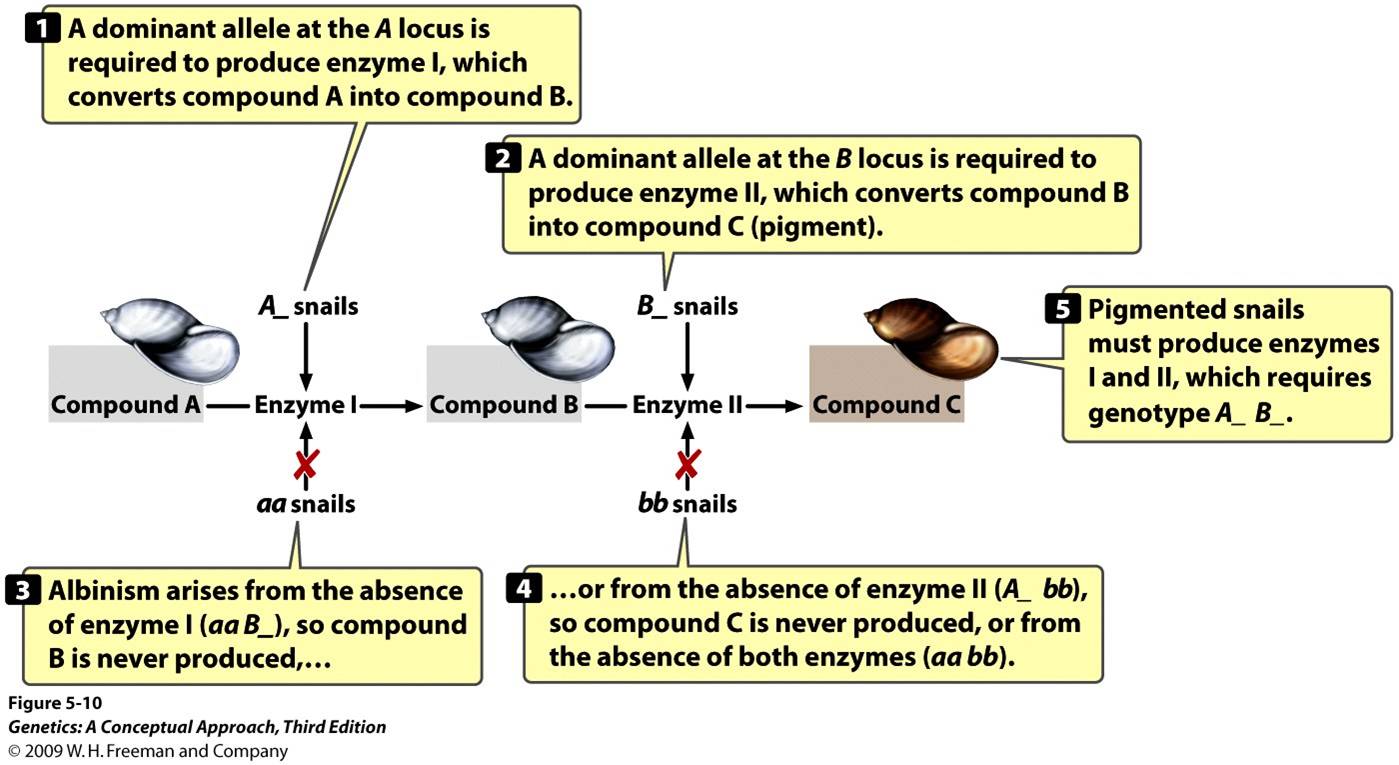
And here’s another little dose of your old genetics professor kicking in. During the second week of my Junior-level Genetics class, we review the phenomenon of epistasis – where one locus masks a second.  When Amy and I intercrossed the F1 offspring from our 7 x 15, 7 x 27, or 7 x 29 hybrid lines, we obtained a 9:7 ratio of pigmented to unpigmented F2, the classic signature of reciprocal recessive epistasis.  Amy and I published that paper in the Journal of Heredity in 1992 [2]. 

I’ll never forget the morning in the fall of 2002, ten years later, when a colleague brought a copy of the brand new textbook by B. A. Pierce, Genetics: A Conceptual Approach, into my office.  Pierce had selected our results on albinism in Physa to illustrate the concept of epistasis.  Just to see the diagram reproduced above, reproduced as Figure 5.10 in a genetics textbook used by thousands of college students, was the biggest thrill I have ever enjoyed with my pants on.

Amy and I used the albinism genes as tools to study a broad swath of reproductive biology in Physa, ultimately yielding the papers footnoted [2] through [7] below.  The most interesting study, I think, is the one on protandric hermaphroditism which we published in the Proceedings of the Royal Society in 1993 [3].  The experimental setup was as clever as I can get.

Imagine two individual Physa fixed for albinism at different loci – call one “7-experiment” and the other “29-challenge.”  The 7-experiment snail is a mature adult; he has been reared in isolation, and is now self-fertilizing, yielding (of course) albino progeny.  The 29-challenge snail is a hatchling… maybe just a couple weeks old – still very juvenile.

Introduce the 29-challenge snail into the cup with the 7-experiment snail for one day, and then separate them again.  Initially, no change is expected.  The 7-experiment snail should continue to lay self-fertilized eggs, and the 29-challenge snail lays no eggs at all.  Then do that again, at week two.  And do that again, at week three.  And so forth.  When the 7-experiment snail begins to lay pigmented eggs, we know that the 7-experiment snail has matured as a female.  And when the 29-challenge snail begins to lay pigmented eggs, we know that the 7-experiment snail has matured as a male.


The experiments that Amy and I conducted according to this design ultimately showed that Physa are “protandric hermaphrodites.”  Male reproductive maturity was reached at mean age of 5.7 weeks in our culture conditions, with female reproductive maturity added at a mean age of 7.3 weeks.  And reared in isolation, our Physa delayed self fertilization to a mean age of 22 weeks; certainly at a significant cost to fitness in the wild.

At our sample sizes we were also able to detect low frequencies of all sorts of wonderful reproductive variance, including autosterility, outcross male-sterility, outcross female-sterility, and outcross double-sterility.  Although most snails matured first as male and then as female, we discovered a few cases of simultaneous development, a couple female-first snails, and some snails that passed through brief periods of self-fertilization before outcrossing as females.  It’s amazing that anybody knows this.  Or cares, come to think about it.

We completed several other interesting studies involving those complementing albino lines from 1990 to 1992, when Amy graduated and left Charleston - our (1996) study of gender choice and gender conflict (Amy’s MS thesis, footnote 5) and our (1997) estimates of lifetime fitness and inbreeding depression [6].  And we still had at least one or two cool experiments mapped out on the Genetics Lab chalkboard.  But alas.  After a couple years in culture, all our albino lines seemed to quit outcrossing.  And by the mid-1990s, they had died out, victims of inbreeding depression, I feel sure.

But a couple nice young undergraduate students and I published one last albino paper in 2005 [7], which I still remember with considerable fondness.  Walking along the edge of our pond at Charles Towne Landing in September of 2002, I happened to discover an adult albino Physa – the first I had ever seen in many years of observation.  Assuming (what must be) a very low background frequency of albinism in the wild population, it is reasonable to guess that that this single albino snail had already been wild-inseminated by a homozygous pigmented partner.

All the experiments we had done in the previous 10 – 12 years had involved lab lines in culture.  So Tommy McCullough and Charles Earnhardt and I isolated this single snail, whom the students named “White Fang,” in a 10 oz cup [8].  She laid 109 eggs over the next week, which hatched into 30 viable pigmented offspring, and 6 albinos.  We advanced her to a second cup and got similar results.  And so forth, on until February of 2003, when White Fang finally went up to Fort Yukon.

Totaled over our 20 weeks of observation, White Fang laid 1,566 eggs, which hatched into 550 viable hatchlings, of which 35 were albinos, for an effective self-fertilization rate of 6.4%.  This is the best estimate of self-fertilization in any (mixed-mating) population of pulmonate snails of which I am aware [9]. 


And as of week 20, White Fang was still laying pigmented and albino eggs at the same frequency that she was producing them at week 1.  Finally we had answered the sperm-storage question that had prompted this entire research program, back when Amy and I got our start in 1989.  Arbitrary adult Physa sampled from wild populations apparently do not ever run out of allosperm, even if isolated.  They are inseminated for life.

Well, by 2005, our Physa project had diverged in all sorts of fresh directions.  Which brings us back to the main theme of this series of essays.

Notice that in all those papers Amy and I published using our albino lines in the 1990s, we were still referring to our study organism as “Physa heterostropha pomilia.”  But by 2005, White Fang was identified as an individual “Physa acuta.”  What happened?  To be continued!


Notes

[1] To Identify a Physa, 1989 [3Oct18]

[2] Dillon, R.T. and A.R. Wethington (1992) The inheritance of albinism in a freshwater snail, Physa heterostropha. Journal of Heredity 83:208-210. [PDF]

[3] Wethington, A.R., and R.T. Dillon (1993) Reproductive development in the hermaphroditic freshwater snail, Physa, monitored with complementing albino lines. Proceedings of the Royal Society (London) B 252:109-114.  [PDF]

[4] Dillon, R.T., and A.R. Wethington (1994) Inheritance at five loci in the freshwater snail, Physa heterostropha. Biochemical Genetics 32:75-82. [PDF]

[5] Wethington, A.R., and R.T. Dillon (1996) Gender choice and gender conflict in a non-reciprocally mating simultaneous hermaphrodite, the freshwater snail, Physa. Animal Behaviour 51: 1107-1118.  [PDF]

[6] Wethington, A.R., and R. T. Dillon. (1997) Selfing, outcrossing, and mixed mating in the freshwater snail Physa heterostropha: lifetime fitness and inbreeding depression. Invertebrate Biology 116: 192-199.  [PDF]

[7] Dillon, R. T., T. E. McCullough, and C. E. Earnhardt. (2005) Estimates of natural allosperm storage capacity and self-fertilization rate in the hermaphroditic freshwater pulmonate snail, Physa acuta.  Invertebrate Reproduction and Development 47: 111-115.  [PDF]

[8] Had one of the undergraduates recently read Jack London’s (1906) novel?  I don’t know.  But I am pretty sure that the name “White Fang” was supposed to be ironic.

[9] Yes, two undergraduates and I got a paper published in an international journal with 20 plastic cups, a teaspoon of fish food, and one, single snail.  You really don’t need big grants to do good science.  You don’t need any money at all.  That’s what I have always told myself, pretty much every year over my entire career, as my grant proposals have been rejected.

Wednesday, October 3, 2018

To Identify a Physa, 1989

Editor’s Note – This essay was subsequently published as: Dillon, R.T., Jr. (2023c)  To Identify a Physa, 1989.  Pp 163 – 168 in The Freshwater Gastropods of North America Volume 7, Collected in Turn One, and Other Essays FWGNA Project, Charleston, SC.

Faithful readers of this blog may remember a series of essays I posted in the spring of 2014, occasioned by the death of Dr. George A. Te [1].  In those essays I chronicled the development of our understanding of the systematics of the North American Physidae through the years 1971, 1975, and 1978.  Beyond that date, however, I let the subject drop.

Let’s pick that story up again, shall we?  What will follow, over the next few months, will be an awkwardly-personal series of essays in which I share trivial tidbits, poorly-recalled anecdotes, and quasi-factual reminiscences about the progress that my colleagues and I have been able to make toward a fuller understanding of the evolutionary biology of the Physidae over the last 30 years.
Mate choice experiments
And colleague number one, from the humble beginnings of this research effort to the present day, has been my good friend, Dr. Amy R. Wethington.

Amy arrived at The College of Charleston in the fall of 1988, initially as a graduate student in our marine biology program.  But she realized, rather quickly, that her undergraduate training in biochemistry from Clemson had not prepared her for graduate studies in Biology.  So by the spring of 1989, she was an undergraduate biology major at The College, working with me on the genetics of the commercially-important hard clam, Mercenaria.  And one afternoon our conversation somehow turned to the subject of freshwater gastropods [2].

A couple years previously another graduate student and I had discovered a population of the tropical planorbid, Biomphalaria, in an ornamental pond at Charles Towne Landing State Park, right around the corner from my home in the West Ashley suburbs [3].  So, I suggested to Amy that we might undertake a study of sperm storage in Biomphalaria.  Essentially, our idea was to collect a batch of adult snails, isolate them in one-quart Ball jars, collect their eggs serially, hatch and rear their F1 babies, and use polymorphisms at allozyme-encoding loci to determine at what point isolated Biomphalaria depleted their reserves of allosperm (i.e., a partner’s sperm) and switched over to autosperm (i.e., began to self-fertilize).  We even hoped to be able to see multiple insemination and sperm competition, if we could find a couple of good genetic markers.

So on May 16, 1989 Amy and I did indeed drive over the Ashley River bridge to Charles Towne Landing, collect a big batch of adult Biomphalaria, and isolate 30 of them in Ball jars, according to plan.  They laid some egg masses, in a desultory sort of way.  But our allozyme gels revealed disappointingly low levels of genetic variation.  The Charles Towne Landing Biomphalaria population did not seem to demonstrate any high-frequency polymorphisms we could count on.

But thanks be to Providence, we had also collected a big batch of Physa that afternoon at the “CTL pond,” perhaps more out of idle curiosity than anything else.  We referred to them as “Physa heterostropha pomilia (Conrad),” which is what George Te would have called them, had he still been active in the discipline at the time, approximately [4].  Physa (or Physella) heterostropha pomilia was the commonplace identification given to all physids everywhere in the American South in 1989.

And not only were our “Physa heterostropha pomilia” auspiciously polymorphic, they began to reproduce like crazy, most of them laying large, healthy egg masses their first 24 hours in culture.  So, we advanced the parent snails to second jars, and pretty much all of them laid second egg masses during their second days.  And third egg masses during their third days.  And very soon, we were out of jars.

Amy Wethington and charges, May 1989
Well, the jars were a bad idea.  They were too big and too expensive.  And they each had an inch of aquarium gravel in the bottom, which was an even worse idea.  So right around this time I had a conversation (or email exchange?) with our good friend Dr. Margaret (“Peg”) Mulvey.  Peg was working at the Savannah River Ecology Lab at the time, and she had a great deal of experience culturing the medically-important planorbids.  And she suggested 10 oz plastic drinking cups, with disposable Petri-dish lids.

I have read, in much weightier and more learned reviews, that scientific advance is dependent upon the advance of technology.  I have always visualized Mars Rovers and super-conducting super-colliders.  In studies of the evolutionary biology of the Physidae, however, the key technological innovation turned out to be a 10 oz plastic drinking cup.

The photo above is one of my favorite images I have ever snapped.  It shows Amy in the College of Charleston genetics lab in May of 1989, holding a glass jar of Physa, or maybe Biomphalaria, no way of knowing at this point.  Our experiment on sperm storage is just beginning on the bench top in front of her.  At this early date, you can see just a couple of plastic cups scattered around the tabletop.  That’s our scheme to identify multiple insemination and sperm competition written on the blackboard behind her.

Amy and I ultimately carried our sperm storage experiment for 60 days, conducted our allozyme analysis, and were treated to less-than-spectacular results.  Our paper was rejected by two journals, and even initially (Oh, the slings and arrows!) by our third choice, the American Malacological Bulletin.  But Bob Prezant ultimately relented, agreeing to publish the very first Wethington & Dillon collaboration as a “Research Note” in Volume 9 of 1991 [5].

By that date, however, the research program that Amy and I had begun in 1989 had exploded, ultimately to yield 23 peer-reviewed papers [6], a six-figure NSF grant and Amy’s PhD.  And a great deal of (quite gratifying) follow-up research by a variety of colleagues worldwide, still very much ongoing.

And as our Physa research program exploded, so too did our Physa cultures themselves.  The photo below was snapped just a few weeks after the photo above.  A scattering of ball jars remain in evidence, which were the initial containers for the parent snails, now holding their first sibships of offspring.  And hundreds of plastic cups for subsequent sibships.

Amy and charges, July 1989
That’s actually the College of Charleston’s Genetics 311L teaching laboratory now covered in 10 oz cups.  Or, as the chairman of my department often and vocally stipulated, “instructional space, not research space [7].”  Moreover, almost every square inch of bench top in the student research lab down the hall was covered with Physa cultures by the summer of 1989, eliciting pointed half-jokes from my departmental colleagues to the effect that the projects of their own students were being crowded out by gastropods.

In 1908, an obscure physiologist at Columbia University named Thomas Hunt Morgan had exactly the same problem with fruit flies.  He was also using unwieldy glass culture vessels – half pint milk bottles of smushed banana – and he had a small team of dedicated undergraduates helping him as well, bailing against the dipteran tide.  And what Morgan and his students began to notice, as the weeks rolled by, and thousands of fruit flies passed under their scopes, was variation.  Some flies had different eye colors, some had different wing types, and onward so forth.

How analogous might our experience become with the Physa cultures that covered the College of Charleston Genetics Laboratory in the summer of 1989?  Stay tuned.


Notes

[1] Physa systematics in the era of George Te:
  • To Identify a Physa, 1971 [8Apr14]
  • To Identify a Physa, 1975 [6May14]
  • To Identify a Physa, 1978 [12June14]
[2] I'm shocked! Shocked to find that freshwater gastropods are being discussed in this establishment!

[3] Dillon, R.T. and A.V.C. Dutra-Clark (1992) Biomphalaria in South Carolina. Malacological Review 25: 129-130.  [PDF]

[4] As may be recalled from my essay of 12June14 (above), George Te raised the Baker subgenus “Physella” to the full genus level and placed 38 species under it, including heterostropha.  Even back in 1989, I thought that was a bad idea.

[5] Wethington, A.R. and R.T. Dillon (1991) Sperm storage and evidence for multiple insemination in a natural population of the freshwater snail, Physa. American Malacological Bulletin 9: 99-102. [PDF]

[6] This figure is the sum of seven Physa papers by Wethington & Dillon (sometimes with other coauthors), eight by Dillon & Wethington (sometimes with other coauthors), four by Dillon without Wethington, and four by Wethington without Dillon, as of 2018.

[7] When I interviewed at The College of Charleston in the winter of 1982, I was shown Science Center Room 200, the instructional lab where I would be expected to teach Genetics Lab 310L.  The chairman made it clear that a research program was also expected and offered me $5k to start it up.  But in those days, I don’t think there was any “dedicated research space” anywhere at CofC.

That situation was to evolve radically over the next 30 years, to the point that dedicated research space and big-dollar start-up packages were assumed to be essential to attract qualified faculty.  But I never had any.