Dr. Rob Dillon, Coordinator


Wednesday, October 4, 2006

FWS Finding on the Idaho Springsnail

To the FWGNA group:

Most of you will probably recall my series of messages last year regarding the Idaho springsnail controversy - a tangle of competing proposals to delist the federally endangered "Pyrgulopsis idahoensis," or to keep P. idahoensis on the list and add several other very similar Pyrgulopsis populations in Oregon, Washington, and Wyoming. See April 2005, December 2005, and January 2006.

Now it would appear that a decision is finally at hand. This past Thursday, Sept 28, the US Fish & Wildlife Service published in the Federal Register a "Notice of two 12-month petition findings and a proposed rule to delist the Idaho springsnail." A press release was simultaneously issued from the Snake River Office bearing this headline: "Protection Not Warranted for Four Springsnail Species." See below.

I'd guess this pretty much settles the matter. Ahead is yet one more comment period, and a final decision by Interior Secretary Dirk Kempthorne, who (ironically) used to be Governor of Idaho. But in all honesty, the Conservation Community has already spent way too much time on this, "the largest single population of freshwater snails ever documented." North America is home to scores of other freshwater gastropod species much more deserving of protection than the Idaho springsnail. Let's move on.

Speaking of which, the website of the Snake River FWS Office features two other news releases of interest - one having to do with the (much more endangered!) Pyrgulopsis bruneauensis and the other regarding the (undescribed) "Banbury Springs Lanx." If anybody on this list has additional information regarding either of these two species, contact the FWS.

And keep in touch!
Rob


NEWS RELEASE
Snake River Fish and Wildlife Office
1387 S. Vinnell Way, Room 368 • Boise, Idaho 83709
http://idahoes.fws.gov/
September 28, 2006
Contact: Meggan Laxalt Mackey


PROTECTION NOT WARRANTED FOR FOUR SPRINGSNAIL SPECIES
Public Comments Accepted through November 27, 2006 on Service’s Proposal to Delist Idaho Springsnail

The U.S. Fish and Wildlife Service today announced the Idaho springsnail, currently listed as endangered under the Endangered Species Act (ESA), has been found to be the same species as three other groups of freshwater springsnails, none of which warrants protection under the ESA. The Service therefore today published a proposal in the Federal Register to remove the Idaho springsnail from the Federal list of threatened and endangered species.

This decision is based on the new taxonomic information and other available scientific information that resulted in four groups of springsnails being classified as one species, Pyrgulopsis robusta. The four groups of springsnails are the Idaho springsnail that inhabits Idaho’s Snake River, the Harney Lake springsnail in southeastern Oregon, the Jackson Lake springsnail in western Wyoming, and the Columbia springsnail from the lower Columbia River between Oregon and Washington.

“The 1992 listing of the Idaho springsnail as endangered was based on the best information available at that time on the species and the threats it faced,” said Ren Lohoefener, director of the Fish and Wildlife Service’s Pacific region. “New scientific information became available that prompted the Service to closely examine the status and classification of the species and other closely related springsnails. The examination of all the information currently available led us quite clearly to this decision.”

Comments from all interested parties regarding the proposal to delist the Idaho springsnail will be accepted by the Service until close of business November 27, 2006. Requests for public hearings must be received on or before November 13, 2006. Comments may be submitted by e-mail to: fw1srbocomment@fws.gov, by fax to 208-378-5262, or by mail or hand-delivery to the Service’s Snake River Fish and Wildlife Office at 1387 S. Vinnell Way, Boise, Idaho 83709. Please include the title “ISS RIN1018-AU66” in the subject line.

The Service conducted a comprehensive 12-month review of the four groups of springsnails. The Service’s review was prompted by two separate petitions concerning the four springsnails: one petition by the Idaho Governor’s Office of Species Conservation and the Idaho Power Company seeking the delisting of the Idaho springsnail, and another from a group of academics and environmental organizations requesting the listing of all four springsnail populations.

The Service also included in this process a five-year review of the Idaho springsnail, a process required by the ESA for all listed species to determine whether the species is properly classified. The five-year review of the Idaho springsnail is available from the FWS Pacific Region website. Pyrgulopsis robusta is a small (4-6mm) freshwater snail species. It may be found in various habitats from small springs and spring-fed creeks to reservoirs and large river systems. The snails feed primarily on algae, bacteria, fungi, diatoms (small plants), and protozoa (small animals) on the surface of rocks or gravel in the water.

Friday, August 25, 2006

New Book from the AMS

http://universal-publishers.com/book.php?method=ISBN&book=1581129300 To the FWGNA group,

Some of you may remember a cute little booklet published by the American Malacological Union (now the American Malacological Society) entitled "How to Study and Collect Shells." It was born as a 1941 annual report of the AMU, and by its fourth edition of 1974 had grown to 107 pages with two (!) illustrations. The original chapter on freshwater snails was composed by Frank Collins Baker.

In 1999 the AMS began the process of completely updating and expanding that work, under the able leadership of Charlie Sturm, a research associate in the Carnegie Museum Section of Mollusks. I'm pleased to report that the work is now published:

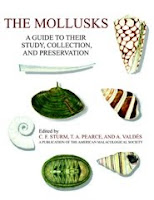
"The Mollusks: A Guide to Their Study, Collection, and Preservation"C. Sturm, T. Pearce, and A. Valdes (eds.)
Universal Publishers, Inc., Boca Raton, FL. xii + 445 pp. 101 ill.
An early proof copy of my Chapter 21 on freshwater gastropods has been available from the FWGNA web site since 2003. But there are 31 chapters in total, including chapters on collecting and cleaning shells, archival methods, digital and film imaging, dredging, taxonomic methods and molecular techniques. There are chapters covering all seven extant classes of mollusks (yes, even the Aplacophora and Monoplacophora) from all environments, including the fossils. The chapter on freshwater mussels is by Kevin Cummings & Art Bogan, and the chapter on non-unionoid freshwater bivalves is by Alexi Korniushin. No malacological library will be complete without a copy of this book!

The bargain price is just $35.95, or two for $71.90. The American Malacological Society is a not-for-profit organization. Revenue from the book will help defray the costs of our scientific program, student scholarships and grants. The AMS will earn more if the book is ordered from the publisher than through commercial ventures such as Amazon.com or Barnes&Nobles.com. Thus, I would encourage you to order directly from the publisher:

Direct any questions to Charlie Sturm at doc.fossil@gmail.com
Thank you all for your support of American malacology!
And we'll keep in touch,
Rob

Wednesday, July 26, 2006

Springsnails of The Blue Ridge

Editor’s Note – This essay was subsequently published as: Dillon, R.T., Jr. (2019c) Springsnails of the Blue Ridge.  Pp 211 - 215 in The Freshwater Gastropods of North America Volume 3, Essays on the Prosobranchs.  FWGNA Press, Charleston.

I was born and raised in Waynesboro, Virginia, where the Chamber of Commerce likes to advertise that “The Skyline Drive meets the Blue Ridge Parkway.” The Skyline Drive runs 105 miles north from Waynesboro through the Shenandoah National Park to Front Royal, generally at 1-2,000 ft. elevation. South from Waynesboro the Blue Ridge Parkway extends another 412 miles through the mountains to Asheville, North Carolina, at elevations rising to 6,000 feet.
.
I spent many a lazy summer day in my youth picnicking with family on the SKD and the BRP, and not a few warm evenings at the overlooks with my girlfriend. One of my favorite spots was the visitor center at Humpback Rocks (BRP mile 5.8), where latter-day pioneers live in an authentic log cabin and farm the rocky hillside (Photo above). The tiny, hand-hewn springhouse on that property must have stood unchanged for 200 years (Photo below).
.
No surface water enters or leaves the springhouse at BRP mile 5.8. Water seeps up through the rocks, travels in complete darkness for about 3 feet, then seeps back into the earth and disappears. (A narrow PVC pipe has been installed to keep the path from becoming muddy.) But if you crawl through the door, grab a wet rock, pull it out into the sunlight and turn it over, you may be lucky enough to discover a scattering of tiny white hydrobiids, Fontigens orolibas (Hubricht), the spring snail of the Blue Ridge (The white snail below).
.
My attention was first called to this remarkable animal by the wonderful 1990 monograph of Hershler, Holsinger, and Hubricht, “A revision of the North American freshwater snail genus Fontigens” (Smithsonian Contrib. Zool. 509). To tell you the truth, I don’t know which is more amazing – the fieldwork of Leslie Hubricht, the scholarship of Bob Hershler, or the biology of the snails they have teamed up to document. The authors reviewed nine Fontigens species in their work, including four species from the Commonwealth of Virginia, meticulously documenting hundreds of remote and scattered populations.

So one fine morning not too long ago I set off up the Skyline Drive in my pickup truck, HH&H monograph in my lap and topo maps on the seat beside me, determined to visit as many populations of F. orolibas as I could before the sun went down. The habitats I sampled ranged from proper springs with good water flow down to wet seeps in grassy or marshy high meadows many miles from the nearest permanent water. The photo below shows a typical spring, at a visitor cabin operated by the National Park Service down the mountain below SKD mile 81. I found snails only on the underside of rocks very near such springheads, never in any abundance.

The animals themselves are typically no more than a couple millimeters long and essentially colorless. The figure above shows a 2.9 mm F. orolibas (below) crawling with an individual F. nickliniana, a widespread species found throughout the eastern U.S. in valley springs and spring runs. Fontigens nickliniana does not share the retiring habit of F. orolibas, and seems unafraid to crawl about quite brazenly on the open streambed. The body color difference is striking.

I was ultimately able to visit seven of the sites listed by HH&H as habitats for Fontigens orolibas – a pretty full day, but only 20% of the total sites they recorded. And I’m pleased to report successful collections of F. orolibas from five of them. The other two sites had been capped and the water diverted. But given the ephemeral nature of natural snail populations and their habitats, I think the confirmation of 5/7ths of any list of historical freshwater snail records is reassuring.

The little boy from Waynesboro who played hide-and-seek in the springhouse at Humpback Rock forty years ago knew, even then, that he wanted to be a professional biologist when he grew up. I’m not sure why, but a combination of “Wow, how interesting!” and “Man, that’s pretty!” played a big role. Spending a warm summer day hunting tiny populations of mysterious animals, scattered across the crest of the ancient Blue Ridge, it’s not hard to feel the wonder again.

Keep in touch,
Rob

Monday, June 26, 2006

Freshwater Gastropods in State Conservation Strategies - The West

To the FWGNA group:

As most of you will recall, last month I surveyed a set of 10 comprehensive wildlife conservation strategies recently published by states of the southern U.S. I ranked each state by the number of freshwater gastropods on its list of species "prioritized for conservation," relative to its total number of priority species. The resulting ratio, it seems to me, might give some measure of the importance of freshwater gastropods to the overall conservation efforts of each state, and hence (perhaps) the likelihood that grant funding might be available.

This month I've done an identical survey for 12 states of The American West. But before reading any further, I'd challenge each of you to make a prediction. Clearly there is more fresh water in the South than in the West. In which region do you think freshwater snails will attract greater conservation concern?

The answer is in the West, by far. The list below shows that two of the 12 western states did not include any freshwater gastropods in their conservation plans: Montana and Washington. This is identical to the south, where two of 10 states excluded the freshwater snails: Louisiana and Mississippi. But three western states listed eye-poppingly large numbers of freshwater gastropods - 74 (28.1% of all species!) in Nevada, 45 (16.1%) in Wyoming, and 23 (11.7%) in Utah. Among southern states, only Alabama hit the double-digits (11.1%). The average percent freshwater gastropod species on state lists of special conservation concern was 0.070 in the West but only 0.026 in the South.

The difference is largely attributable to endemic hydrobiids. Nevada's 74 freshwater gastropod species of special priority included 61 Pyrgulopsis and 11 species of other hydrobiid genera, almost all narrowly restricted to individual desert springs. Utah's 23 species included 14 hydrobiids, California's 35 included 21 hydrobiids, and hydrobiids comprised all 14 of Arizona's freshwater gastropod species of greatest conservation need.

Many of the lists of the western states also included pulmonate snails, which are rarely mentioned in the south. Idaho and Oregon, for example, were both about equally split between prosobranchs and pulmonates.

A most interesting contrast emerged between the states of Wyoming and Montana. According to the authors of Wyoming's Conservation Strategy, only 44 of that state's 279 species (of all taxa) were listed because of specific, known conservation needs. They stated, "The remaining 235 have been included primarily due to a lack of key data necessary to assess their conservation status." That subgroup of 235 taxa included essentially the entire freshwater gastropod fauna of Wyoming, 45 species in total. In striking contrast, Montana listed only 60 species of all taxa, including no freshwater snails at all. By way of explanation, the authors of the Montana Strategy wrote, "Most invertebrates were not included in the assessment due to lack of data.

"Below are the 12 states of the American West, ranked by the conservation concern they directed toward their freshwater gastropod faunas. As I mentioned last month, some states do appear to be accepting outside proposals for grants to study their species of greatest conservation need. Good luck to all of you!

And keep in touch,
Rob

Friday, May 26, 2006

Freshwater Gastropods in State Conservation Strategies - The South

To The FWGNA group,

A bit over five years ago the U.S. Congress created the State Wildlife Grants Program, charging every state in the union to develop a "Comprehensive Wildlife Conservation Strategy" by October, 2005, as a condition for claiming a share of the money. All 50 states did, in fact, meet that deadline, and the CWCS documents that resulted are now available on state DNR web sites around the nation. They present an interesting study in contrasts.

I don't think that the federal government provided any formal definition of the words, "comprehensive" or "wildlife." But I've just completed a brief survey of the CWCS documents published by ten southeastern states, and I'm pleased to report that eight of the ten included freshwater gastropods among wildlife species considered worthy of special conservation concern.

In my review I recorded the total number of all species in all taxa listed by each state, as well as the number of freshwater gastropod species singled out for conservation priority. It seems to me that the ratio of freshwater gastropods-to-total-species might provide some estimate of the importance each state accords to its freshwater gastropod fauna, and perhaps, the likelihood that one of us might win some funding.

Here are the ten southeastern states, ranked by the conservation concern they directed toward their freshwater snails. The number in bold is the number of freshwater gastropod species listed, with total species (of all taxa) in the denominator that follows. I've also provided links to the relevant sites on the web pages for all ten state wildlife agencies:
As one might have predicted, the state of Alabama leads Dixie with freshwater gastropods accounting for a whopping 11.1% of all that state's "species of greatest conservation need." I think the total of 4.8% for Tennessee is also eye-catchingly high. South Carolina, Louisiana, and Mississippi are notably low, but this should not be taken as any slight toward the conservation agencies of those states. The South Carolina situation, for example, is complicated by the inclusion of marine species (including many mollusks!) which inflated the numerator.

It is interesting to note that fully half of the ten states I surveyed were cited as "Leaders" in the state wildlife conservation planning process by the Defenders of Wildlife, in an independent review commissioned by the Doris Duke Charitable Foundation. Of the 12 states earning such recognition nationwide, five were in the South: Florida, Georgia, North Carolina, Tennessee, and Virginia. See the report:
http://www.defenders.org/statewildlifeplans/

I would encourage each of you to contact whoever has been involved with developing the CWCP in your state to see what sort of funding opportunities might be available. Although many states are earmarking their State Wildlife Grant money for within-agency use, I do know that some states have been accepting outside proposals.

So good luck, and keep in touch!
Rob

Thursday, April 20, 2006

Surveying the Heartland

Editor’s Note. This essay was subsequently published as: Dillon, R.T., Jr. (2019d) Surveying the Heartland.  pp 207 - 209 in The Freshwater Gastropods of North America Volume 4, Essays on Ecology and Biogeography.  FWGNA Press, Charleston.

If you had to pick one state to represent the entire freshwater mollusk fauna of North America, how about Iowa? Bounded by the Mississippi River on the east, with its western third in the Missouri drainage and its northern half pocked by prairie potholes of glacial origin, I can't think of a better place to sample the American heartland. And so the article by our colleague, Tim Stewart, in the most recent American Malacological Bulletin (21:59-75), "The freshwater gastropods of Iowa (1821 - 1998): species composition, geographic distributions, and conservation concerns" arrives as a most welcome contribution.

Tim did an extraordinarily thorough job of surveying both the published literature and the electronically-available museum collections in compiling the data for this paper. Lumping several nominal Campeloma species and several nominal species of the lymnaeid subgenus Fossaria into single categories, as well as combing the various synonyms of Physa acuta, Tim documented 49 freshwater gastropod species in Iowa. He also eliminated 6 species that seem to have been reported falsely.

It is interesting to compare Tim's list to the only other previously-existing database of which I am aware, that of NatureServe. My query to the NatureServe Explorer database this morning returned a list of 44 freshwater gastropod species from in Iowa which, paring down the Campeloma, Fossaria, and Physa and eliminating dubious entries, reduced to just 38. The 11 species missed by NatureServe appear to be a random subsample of the fauna: 2 Valvata, 3 lymnaeids, 2 physids, 2 planorbids and 2 ancylids.

Tim briefly reviewed the natural history of Iowa, as it has been developed from a tallgrass prairie to a breadbasket 95% under cultivation. Broadly examining collection records for trend, he found evidence that as many as 25 of the 49 Iowa freshwater snail species may warrant some conservation concern.

The problem with a literature-based approach is, admittedly, the difficulty of controlling for trends such as a decline in the publication or curation of malacological collections. What is needed, of course, are fresh data, and not just in Iowa. Tim concluded his discussion with a call for a "comprehensive field survey to determine which species are truly endangered in this state." And in fact, he assures me personally that such a survey is already underway. Amen, brother!

Keep us posted,
Rob

Subject: Reasonable expectations for NatureServe
Date: Thu, 27 Apr 2006
From: "Dillon, Robert T. Jr."
To: FWGNA group

I might need to correct a misunderstanding from my message of 4/20/06, "Surveying the Heartland." I did not mean to imply anything negative regarding the on-line database maintained by NatureServe. Science is the construction of testable models about the natural world. The NatureServe database constitutes such a model, where essentially no other models exist, and thus makes a valuable contribution.

Any biologist with a minimum of field experience will understand, I hope, that continent-scale distribution maps such as those provided by NatureServe must be based on the broad ranges of the organisms involved, which come from general reviews, large monographs, and regional surveys. Such maps cannot possibly duplicate the precision of a more finely-detailed inventory, such as that for an individual state. So I should hope that nobody would be surprised to read that the results of Tim Stewart's intensive survey of Iowa didn't precisely match expectation from NatureServe's broadly-drawn national ranges.

Nor in fact is it reasonable to expect that the NatureServe database will be kept meticulously current. In addition to his freshwater snail duties, our good friend Jay Cordeiro of NatureServe is also in charge of freshwater mussels, terrestrial gastropods, crayfish, fairy shrimp, clam shrimp, tadpole shrimp, mayflies, stoneflies, caddisflies, and odonates. I myself can't update the freshwater gastropods of South Carolina any more than about annually. Jay is doing a great job. And hey, we're snail people - we can wait.

Finally, it is not reasonable to expect that the NatureServe list (or the list Tim Stewart developed from his more detailed study, for that matter) will accurately reflect the true freshwater snail fauna of Iowa. Neither estimate has been confirmed by any recent field work. And there are some systematic biases in literature review as a method of biotic inventory - removing a dubious record is more difficult than adding one, for example.

Philosophers of science tell us that the true number of freshwater gastropod species is everywhere either trivial or unknowable. But certainly, all the models we've got today can be refined.

So let's get busy!
Rob

Thursday, March 23, 2006

Pacific Northwest Gastropod Workshop

To the FWGNA group,

I'm pleased to report that The Xerces Society has organized a workshop on the freshwater gastropods of the Pacific Northwest at the University of Montana, Missoula, coming up right around the corner May 11 - 14. The leader will be yours truly! See their website for further details.

Jeff Adams of The Xerces Society really twisted my arm to become involved with this workshop. I think the idea is a great one, but I personally have zero field experience in that part of the world. I'm hoping that the participants will bring lots of specimens, locality data, and field observations with them to Missoula. Perhaps we can learn something together.

The registration fee is just $100, and will include an identification manual currently under development. I'd encourage any of you interested in northwestern freshwater gastropods to consider attending.

And I'll see you in May!
Rob