Dr. Rob Dillon, Coordinator


Wednesday, February 25, 2009

Charles Darwin, Freshwater Malacologist

Editor's Note - Shortly after I posted this email, our good friend Aydin Orstan contacted me with a suggestion that we might add Darwin's research with land snails and collaborate on a larger paper.  This was ultimately published as Orstan & Dillon (2009) Charles Darwin the Malacologist. Mollusc World 20: 4 - 6 [PDF].

Charles Darwin, whose 200th birthday the world has just celebrated, may have been the last complete biologist. His research interests spanned the entirety of the life sciences as they were known in his day, from his "Monograph on the Subclass Cirripedia" (1851) through his "Descent of Man" (1871) to "The Power of Movement in Plants" (1880). Darwin’s first publication (1839) was a ripping-good adventure story featuring "atmo-spheric dust with infusoria (1)." And his last publication, a four-paragraph communication appearing in 1882 just two weeks before his death, was a work of freshwater malacology (2).

In fact, Darwin first touched on freshwater mollusks in his (1859) "Origin of Species." Early in the chapter he entitled "Geographical Distribution – Continued," Darwin observed, "Some species of fresh-water shells have very wide ranges, and allied species which, on our theory, are descended from a common parent, and must have proceeded from a single source, prevail throughout the world. Their distribution at first perplexed me much." But Darwin then went on to relay a number of anecdotes regarding the attachment of juvenile freshwater mollusks to the feet and feathers of waterfowl, concluding his lengthy paragraph with "Sir Charles Lyell informs me that a Dytiscus (3) has been caught with an Ancylus firmly adhering to it."

Darwin’s fascination with dispersal and biogeography brought him back to the subject of freshwater malacology again in 1878 (4), with a charming anecdote about a surprisingly large unionid mussel found attached to the toe of a duck shot in Danversport, Massachusetts (figure at left). And it reached full flower in 1882, with his "On the Dispersal of Freshwater Bivalves (5)."

Darwin opened this, the last paper he would publish before his death, with "The wide distribution of the same species, and of closely-allied species of freshwater shells must have surprised every one who has attended to this subject." After reviewing his observations of 1859 and 1878, Darwin wrote, "I am now able to add, through the kindness of Mr. W. D. Crick, of Northampton, another and different case. On February 18 of the present year, he caught a female Dytiscus marginalis, with a shell of Cyclas cornea (6) clinging to the tarsus of its middle leg." Darwin went on to relay additional data about this now most illustrious of all fingernail clams, which was large (0.45 inch), viable (dropping from the bug only after five days) and fertile (bearing two juveniles). He then added several anecdotes about other individual sphaeriids found attached to the digits of amphibians, and finished with the charming observation that "my son Francis, while fishing in the sea off the shores of North Wales, noticed that mussels were several times brought up by the point of the hook."

Darwin concluded his 1882 work, "there can, I think, be no doubt that living bivalve shells must often be carried from pond to pond, and by the aid of birds occasionally even to great distances." This point may seem a bit trivial to us today, perhaps even quaint (7). But Darwin’s central thesis, that all these creatures have diverged from a single common ancestor, required that they have originated at a single point, and dispersed throughout the world. If a convincing case could be built for freshwater mollusks, surely to be ranked among the most disadvantaged of the world’s dispersers, perhaps the remainder of the worldwide biota might fall into line.

There’s an interesting postscript to the story of Charles Darwin’s career as a freshwater malacologist. The "Mr. W. D. Crick of Northampton" who sent Darwin his report of the fingernail clam pinched on the water bug leg was Walter Drawbridge Crick (1857-1903), the grandfather of Francis H. C. Crick, who (with James Watson & Maurice Wilkins) shared the 1962 Nobel Prize for elucidating the structure of DNA (8).

At the outset of this essay, I characterized Charles Darwin as “the last complete biologist.” Chief among the reasons that there can be no more such protean figures must be the 20th century explosion of molecular biology, which has expanded our discipline in directions Darwin could never have imagined. It is a source of some inspiration to me that one can trace a path from Darwin to DNA through the great man’s last paper, and the humble discipline of freshwater malacology.

Notes

(1) Yes, Chapter 1 of Darwin’s “Voyage of the Beagle” included a passing note about “infusoria” (primarily diatom frustules) in dust accumulated while on shipboard.

(2) I’ve taken a bit of license with this paragraph. Darwin had a couple publishing credits prior to his (1839) “Voyage,” and several posthumous papers after his 6 April 1882 paper on freshwater bivalve dispersal. Darwin’s complete bibliography, including PDF downloads of the papers mentioned here, is available at Darwin Online.

(3) Dytiscus is a genus of large, predatory water bugs. Although spending the great majority of their lives swimming gracefully through the water column, they may on occasion take to the wing, flying like balsa-wood airplanes with old rubber bands.

(4) Darwin, C. (1878) Transplantation of shells. Nature 18: 120-121.

(5) Darwin, C. (1882) On the dispersal of freshwater bivalves. Nature 25:529-530.

(6) The genus Cyclas has since been synonymized under Sphaerium. Today this common European "fingernail clam" is generally referred to as Sphaerium corneum.
.
(7) It is not, however. See the classic paper:W. J. Rees (1965) The Aerial Dispersal of Mollusca, Proc. Malac. Soc. London 36: 269 - 282.

(8) We must acknowledge an article in the February 2009 issue of National Geographic for calling our attention to this remarkable coincidence: Ridley, M. (2009) Modern Darwins. National Geographic 215: 56 - 73.

Friday, January 23, 2009

The Freshwater Gastropods of Indiana

Editor’s Note. This essay was subsequently published as: Dillon, R.T., Jr. (2019d) The Freshwater Gastropods of Indiana.  Pp 215 - 218 in The Freshwater Gastropods of North America Volume 4, Essays on Ecology and Biogeography.  FWGNA Press, Charleston.

Kudos go to our colleague Mark Pyron and his students Jayson Beugly, Erika Martin and Matthew Spielman for their thorough survey of the freshwater gastropods of Indiana, appearing in the most recent American Malacological Bulletin (1). No big surprises here, but a job well done!

Physiographically, Indiana can be divided into three regions from north to south: the Great Lakes plains, the till plains, and the southern low plateau (which glaciation did not reach.) Rivers in a northern sliver of the state flow north to the Great Lakes, but the great majority of the state drains south through the Kankakee/Illinois or the Wabash/Ohio systems. Prehistorically the entire state would have been covered with mixed woodland, grassland, and wetland, but today 98% of Indiana has been converted to agriculture. Industrial regions have sprung up in the north and central.

Goodrich & van der Schalie (2) published a nice survey of the entire molluscan fauna of Indiana in 1944, and both the University of Michigan Museum of Zoology and the Ohio State Museum have substantial Indiana holdings today. Pyron's initial review of these historical records led him to expect a freshwater gastropod fauna of 39 species, nothing (to my eye) especially rare or surprising. He and his students then designed a survey of 123 ponds, lakes, rivers and streams around Indiana, covering all drainages and physiographic provinces, revisiting 86 sites for which historical data were available. They documented 36 freshwater gastropod species (3) – missing several that might have been expected from historical records, but discovering a few species not previously listed. Pyron concluded that "the majority of the freshwater gastropod taxa in Indiana are of local conservation concern."

This is the third squarish Midwestern state to be surveyed in recent years, and one is tempted to begin looking for patterns. Shi-Kuei Wu and colleagues (4) published a big monograph of the Missouri freshwater gastropods in 1997 which, boiling off 17 synonyms, listed 39 valid species. Our colleague Tim Stewart (5) had a nice 2006 paper in the AMB reporting 46 species of freshwater gastropods in Iowa (6). Both the Missouri and the Iowa inventories relied on historical records, and in fact, Tim developed his Iowa list without fresh field surveys of any sort. Thus the fair comparison would be with the total fauna of Indiana developed by Pyron - historic as well as modern - a list of 40 species (7).

The figure at left above is a Venn diagram of Midwestern States, using rectangles rather than circles, each state oriented geographically and scaled in proportion to its surface area (8). The most striking feature of this diagram to my eye is an effect of latitude (or perhaps physiography), making the Indiana/Iowa pair far more similar than either state is to Missouri.

Indiana has four unique species - almost entirely pleurocerids (including Leptoxis praerosa, Pleurocera canaliculata, and Pleurocera semicarinata "obovata"). Iowa has five unique species - almost entirely northern pulmonates (including Lymnaea catascopium "emarginata", L. megasoma, L. haldemani, and Physa skinneri). The two states share an impressive 35 freshwater gastropod species – 20 that also occur in Missouri and 15 that do not.

The Missouri fauna is characterized by 12 unique species of freshwater gastropods, including three pleurocerids and seven endemic hydrobiids of the Ozark Plateau. But as its diversity rises by extension into a new physiographic province, Missouri's fauna also declines by the subtraction of quite a few northern elements common in Iowa and Indiana, for example Lymnaea stagnalis, Helisoma campanulata, Aplexa and several Valvata. Thus although the largest of the three states, in net effect Missouri finishes with the shortest faunal list.

Meanwhile, back in Muncie, I'm pleased to report that our colleague Mark is busily developing an FWGNA-style website to disseminate the results of his Indiana survey more fully. And he’s thinking about collaborating and expanding this effort into the surrounding states of the upper Mississippi watershed. Exciting developments, to which we can all look forward!

Notes

(1) Pyron, M., J. Beugly, E. Martin, and M. Spielman (2008) Conservation of the freshwater gastropods of Indiana: Historic and current distributions. Am. Malac. Bull. 26: 137-151. [download PDF]

(2) Goodrich, C. and H. van der Schalie (1944) A revision of the Mollusca of Indiana. Am. Midl. Natur. 32: 257-326.

(3) Pyron's estimate of 36 extant species included four species reported by E. H. Jokinen (2005) Pond mollusks of Indiana Dunes National Lakeshore: Then and now. Am. Malac. Bull. 20: 1 - 9.

(4) Wu, S-K, R. D. Oesch and M. Gordon (1997) Missouri Aquatic Snails. Missouri Department of Conservation, Jefferson City. Natural History Series 5: 1 - 97.

(5) Stewart, T. W. (2006) The freshwater gastropods of Iowa (1821-1998): Species composition, geographic distributions, and conservation concerns. Am. Malac. Bull. 21: 59-75.

(6) Stewart listed 49 species, but here I combine Lymnaea exilis under L. palustris, Helisoma truncata under H. trivolvis, and Laevapex diaphanus under L. fuscus.

(7) Pyron's complete Indiana list included 41 species, but again I have combined Lymnaea exilis under L. palustris.

(8) Indiana 36,000 mi2, Iowa 56,000 mi2, Missouri 70,000 mi2.

Wednesday, December 17, 2008

Non-plants, Non-pests, and Non-sense at the USDA

Editor’s Note – This essay was subsequently published as: Dillon, R.T., Jr. (2019d) Non-plants, Non-pests, and Non-sense at the USDA.  Pp 125 - 130 in The Freshwater Gastropods of North America Volume 4, Essays on Ecology and Biogeography.  FWGNA Press, Charleston.

The essay that follows is based on a diary I kept this past summer chronicling my extended efforts to obtain an importation permit for living freshwater snails from Europe. Any of you who anticipate similar needs in the future will find tidbits of helpful advice scattered about below. Otherwise, the piece is humbly offered for your entertainment.

----o----

“Thank heaven I know somebody on the inside,” I remember thinking to myself as I dashed off a quick email to my friend Jim Smith at the USDA-APHIS-PPQ-CHPST-PEREL. “Otherwise this could become a real pain.”

I had just resolved, earlier that afternoon, to try to import a sample of living freshwater gastropods into the United States through the front door. Heaven knows I’ve done it through the back door all my life – sometimes in my luggage, sometimes in brown packages accompanied by less than candid paperwork. I remember smuggling Lymnaea peregra out of Hungary in a 3-dram vial of lake water, tucked into my sock. But this time, I resolved to myself, I am going to do this thing right.

But my initial foray into the forest of American bureaucracy had ended in utter defeat. I knew I needed a permit, but what type, and from where? If Planorbarius corneus, the European snail I wished to import, hosted some medically-important parasite, I should need to go to the CDC. If the snails were endangered I’d need to go to the FWS. And if they were agricultural pests, I’d require a permit from the USDA. But P. corneus (below) has no medical or agricultural importance, nor is it the object of any conservation concern. To what agency would a befuddled biologist turn?
After browsing around the various cabinet-level websites, I resolved to begin my inquiry at the USDA. This brings us to the top of our story, and a series of cordial emails with our good friend Jim Smith of the United States Department of Agriculture – Animal and Plant Health Inspection Service – Plant Protection and Quarantine – Center for Plant Health Science and Technology – Plant Epidemiology and Risk Assessment Laboratory in Raleigh, NC.

Yes, Jim assured me, I’d come to the right agency. And the necessary paperwork would be their PPQ form 526, “Application for Permit to Move Live Plant Pests or Noxious Weeds.” Apparently approval of such an application by the USDA is required to “move” any “live non-vertebrate animal,” regardless of whether such animal is a plant pest or not. I understand that there is an initiative within the USDA-APHIS-PPQ-CPHST-PERAL to rename PPQ-526, “Application for Permit to Move Live Plant Pests and Live Plant Non-pests or Live Non-Plant Pests and Live Non-Plant Non-Pests,” but it’s tied up in red tape.

My buddy Jim indicated that his Permits Unit prefers On-line submission of the Form 526. For this I would need to obtain a “level 2” account through the USDA “eAuthentication” website.
I’m sure all of us have applied for on-line accounts many times in our lives – it’s a regular indignity of life in the 21st century. But the USDA system is the worst I have ever seen. In addition to a username and a PIN, one must specify a 9 – 12 character password with letters and non-letters with caps and non-caps but without dictionary words. The system rejects passwords with even short, unintended dictionary words, so the password must be carefully designed to be entirely non-word. And in addition to supplying one’s mother’s maiden name, one must answer five additional questions about one’s high school and high school mascot and high school mascot’s mother’s maiden name.
The second-most irritating aspect of my application for a on-line account with the USDA was that the agency specified very clearly that my real, genuine name in their system must match the name on my government-issued photo ID (i.e., drivers’ license), but there was no way to make their system accept the suffix, “Jr.”

But the first-most irritating thing about the process was that, after I’d finally entered my personal information and my high school mascot and received a confirming email and replied to that email to “activate my account,” I was still not authorized to conduct electronic business with the USDA. I was instructed to present myself in person with photo ID in hand at a “USDA Service Center.” And I was cautioned, “We recommend that you call ahead to ensure that an employee trained as a Local Registration Authority (LRA) will be available to provide the service at the time you plan to visit the Service Center.”

I’ve been filing my taxes on-line with the IRS for years without ever presenting myself in person. But just for the privilege of applying for a permit to import 30 snails in a plastic coke bottle, I found myself driving 40 minutes to the edge of town for examination by a trained USDA-APHIS-PPQ-LRA. All the while wondering how this person might handle the “Jr” issue.

On that score, I need not have worried. Lenora, the LRA on duty at the USDA North Charleston Service Center was quite efficient and very nice. The most important thing to her was that the address on my photo ID matched the address in their on-line system. This was my home address, not my business address (to which the dangerous snails would be delivered), but if that were to become a problem, I resolved to deal with it later. I felt a twinge of optimism on my 40 minute drive back to The College, printer page identifying me as a “Validated Level 2 Customer” tucked safely into my brief case.
That afternoon I boldly attacked the aphis.usda.gov website, hitting “apply for a permit” then “apply for a PPQ permit” then “apply on-line for a PPQ 526.” This took me to the login screen, which worked! “Welcome to ePermits, your one-stop Source for Agricultural Permitting.” And what might the first screen be? Please enter your address.

The system remembered my simple name (“Robert Dillon”) with no middle initial, my email address, and absolutely nothing else. I had to re-enter all my contact info, telephone numbers, and institutional affiliation. Then “create application” then “Plant Protection and Quarantine” (again) then “PPQ 526” (again!)

The on-line version of the PPQ 526 is called, “Permit to Move Live Plant Pests, Biological Control Agents, Bees, Parasitic Plants, or Federal Noxious Weeds,” a somewhat expanded title that still doesn’t include what I actually wanted it to do. There were seven steps to complete the process, which took me about an hour.

The most interesting step of the application process was entitled, “Articles.” This is the single unmodified noun that the USDA-APHIS-PPQ has adopted to describe all the pests, biological control agents, bees, plants, weeds, non-pests, non-weeds and non-bees that it regulates. Here the applicant finds search boxes that will allow him to “find regulated article by scientific name” or “find regulated article by category.”

On a whim I pulled down the list of categories to “Invertebrate Pests – Mollusks” and found a short and peculiar list of 66 gastropods. Yes, most were indeed pest land snails and slugs. But the marine Strombus spp, Turbo spp, and Cypraea spp? Thank heaven for the USDA, or our shores should become infested with cowries.

And yes, I found a smattering of freshwater gastropods in the “Invertebrate pests – mollusks” list, including Physa acuta and 7 species of Pomacea. And – wonder of wonders – I found the entry “Planorbis corneus!” What is the chance that, in a nearly-random sample of 66 gastropods from a worldwide fauna of ten-to-the-6th, one might find precisely the European freshwater snail species one was interested in? But (Alarm bells dimly ringing!) in 1806 most Europeans seem to have followed Froriep in adding two syllables to the genus nomen. Today my snail is generally identified as “Planorbarius corneus.” Might this tiny discrepancy scotch the deal?

Step 6 of the application was, “Attachments.” My good friend Jim suggested to me that “a separate page describing exactly how you wish to import, the suggested uses of the organism, and why it is not a risk to US environment or agriculture helps speed the process.” So I did.

After clicking the “submit” button Jim went on to suggest that I give the permits unit approximately a week to process my application, then contact Ms. Carmen Soileau of the Biotechnology Regulatory Service (USDA-APHIS-BRS). “She will be the one analyzing your permit, and can answer any questions.” So I did that too.

In comparison with the ordeal of filing an application, the remainder of the process was relatively painless. I did receive (almost immediately) a confirmation that my application number P526-080415-010 had been submitted. No problems developed, and in only 9 days I was alerted to download a “letter of no jurisdiction” from my own little corner of the USDA web site.
 
I received neither a permit, nor a non-permit, from the USDA. Rather, my “letter of no jurisdiction” turned out to be a simple statement, signed by Ms. Soileau, stating that “an import permit is not required.” I was advised to “include this letter with each shipment into the United States, in order to facilitate movement and inspection by Customs and Border Patrol Officers.” If not, I presume, the authorities would not know that the importation of my non-plant non-pests is not non-permitted.

We’ll keep in touch,
Rob

Wednesday, November 26, 2008

Review: Field Guide to the Freshwater Mollusks of Colorado

Editor’s Note. This essay was subsequently published as: Dillon, R.T., Jr. (2019d) Field Guide to the Freshwater Mollusks of Colorado.  Pp 211 - 214 in The Freshwater Gastropods of North America Volume 4, Essays on Ecology and Biogeography.  FWGNA Press, Charleston.

Kudos are due to Mardy Nelson Harrold and Rob Guralnick for their charming little (4 x 6”) book, A Field Guide to the Freshwater Mollusks of Colorado, now available as a free PDF download from the Colorado Division of Wildlife. The authors have pioneered a new model for publication in our line of work, and I personally find some inspiration in the effort.

Our good friend Rob Guralnick has been at the University of Colorado Museum since Shi-Kuei Wu retired in 2000. Mardy Nelson Harrold was his M.S. student and Leigh Anne McConnaughey, who illustrated the new Field Guide, is his wife. Rob tells me that their work was primarily targeted toward the needs of CDW field biologists, but they also hoped that the avid fishing community might become interested.

To that end Harrold & Guralnick have produced a beautifully illustrated and cleanly formatted guidebook with 7 pages of introduction in the front, 8 pages of reference material at the back, and 111 pages of identification manual in the middle, covering 25 freshwater gastropod and 16 bivalve species of Colorado. Each species is allotted a pair of facing pages for a brief description, habitat and range notes, and colorful illustrations of the shell, both magnified and life size. Higher taxonomic groups are also introduced with a couple pages of general biological background, and all the species in each group marked with distinctive thumb tabs for easy reference.

Conspicuous by their absence from the Field Guide are literature citations, synonymies, dichotomous keys, anatomical notes, and distribution maps. The scientific name does lead the common name – this isn't quite a bird book yet. But clearly, Harrold & Guralnick are not looking inward toward the Academy, but rather outward, toward an interested and engaged public at large.

The authors dedicated their work to Dr. Shi-Kuei Wu. And it should be clear that A Field Guide to the Freshwater Mollusks of Colorado could not even have been contemplated without the collections that Shi-Kuei stewarded at the University of Colorado Museum for so many years, and the Inventory of Colorado freshwater mollusks he published in 1989 (1).

Shi-Kuei’s 1989 Inventory did feature detailed distribution records and a more complete review of the literature, but is currently out of print. This poses an interesting question. Why didn't Harrold & Guralnick simply update Wu (1989), rather than starting fresh? Might it have been possible for the present authors to preserve Wu’s more scholarly approach, boil his large dot-maps down to shaded figures of a more manageable size, add their lovely illustrations and formatting, and expand the appeal of this new work to amateurs without subtracting any of the utility for professionals?

Maybe not. At some point, formal scholarship becomes off-putting to the general public. And with respect to the taxonomy and systematics of freshwater gastropods, I fear that we professional malacologists may have barreled through the off-put point a hundred years ago. As Exhibit A, I give you the Physidae.

Shi-Kuei’s Colorado Inventory listed eight species of Physa - anatina, cupreonitens, elliptica, gyrina, heterostropha, integra, skinneri, and utahensis. The Harrold & Guralnick Field Guide sets aside P. “skinneri(2) and substitutes Physa acuta and Physa gyrina for the remainder, clean and simple, without explanation or comment.

The actual rationale behind the author’s decision to fold Wu’s elliptica, heterostropha, integra, and utahensis into P. gyrina, and to subsume Wu’s anatina, cupreonitens, and gyrina under P. acuta, was the subject of my email to this group last month (3). But how many of you reading my words right now actually had the patience to wade through the tortuous message I sent on October '08, "Backwards Snails Backwards?" Admit it - most of you hit the delete button last month, didn't you?

There are about 175 addresses in my email address book under the FWGNA tab, roughly 50% academic, 25% agency or other professional, and 25% private individual. So I’d guess I've got at least 50 readers right now (maybe 174!) who would have been perfectly happy never to know that somebody used to think there were eight species of Physa in Colorado, and really don't care why somebody else now thinks there are only two ... well, three actually, but we'll let it go. The Harrold & Guralnick Field Guide is for you.

In the final analysis, it’s hard to gauge the size of the audience to which A Field Guide to the Freshwater Mollusks of Colorado will appeal. But whatever the size that audience may be, I’d like to think that it could grow. Rob tells me that his book has won a couple trade association awards, and the first printing (of more than 1,000 copies) is nearly gone. So viewed perhaps not so much as a scientific monograph, but rather as an outreach effort, the Field Guide of Harrold & Guralnick is to be highly commended.

Notes

(1) Wu, Shi-Kuei (1989) Colorado Freshwater Mollusks. Natural History Inventory of Colorado 11: 1 - 117. University of Colorado Museum, Boulder.

(2) Physa skinneri is a junior synonym of P. jennessi, which is indeed a distinct and valid species. But since Wu (1989) reported skinneri from just five sites in Colorado, I think Harrold & Guralnick can be excused for excluding it.

(3) Malacological Mysteries II: Backwards Snails Backwards!  [14Oct08]

Tuesday, October 14, 2008

Malacological Mysteries II: Backwards Snails Backwards!

Editor's Note.  This essay was subsequently published as: Dillon, R.T., Jr. (2019b)  Malacological mysteries: Backwards snails backwards!  Pp 157-164 in Freshwater Gastropods of North America Volume 2, Essays on the Pulmonates.  FWGNA Press, Charleston.

Quite a few malacological mysteries have their origins in the life and work of Thomas Say, the "Father of American Malacology" (1). From his high perch among the founders of the Academy of Natural Sciences in Philadelphia, Say described many of the most widespread and familiar mollusks in the New World. Yet, as we saw in our June '08 essay on Lymnaea humilis (2), his descriptions were spare, his figures few and poor, and his original collections lost. So in this, the second installment of an occasional series, we'll pick up our magnifying glasses and sleuth our way through another dark and tangled maze, tracking the true identity of Say's mysterious Physa heterostropha. Along the way we'll encounter another striking example of the incompatibility between science (the construction of testable hypotheses about the natural world) and law (as represented by the international code of zoological nomenclature.)

The biology will not be at issue here. The best evidence available at present suggests that two morphologically variable species of the genus Physa range across the length and breadth of North America, one bearing a convex shell apex and a two-part penial sheath, the other bearing a concave shell apex and a one-part penial sheath (3). Both have been described and re-described many times, accumulating dozens of aliases in the process.

The concave species was first described by Draparnaud in 1805, not here in America where it is native, but rather as an introduced species in France. The earliest name for this physid, which I have nominated (4) as "the world's most cosmopolitan freshwater gastropod," is Physa acuta. The second-oldest name available for American physids is Thomas Say's (1817) Physa heterostropha (5), which F. C. Baker (6) nominated to the post of "most misunderstood mollusk in America." And the third-oldest name is Say's (1821) Physa gyrina (7), clearly and unambiguously bearing a convex shell apex.
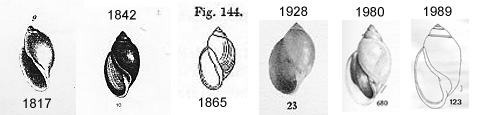
Thomas Say's written description of "Lymnaea" (later Physa) heterostropha (8) stated that the apex is "acute," which might suggest that he was holding a shell of the concave species in his hand on that fateful day in 1817. But his small and poorly-detailed figure (at only 17 mm certainly intended as a 1:1 representation) appears to show a convex apex (at far left above). And the type locality ("Delaware River") might be inhabited by either species.

If the nomen "heterostropha" is correctly applied to the species of American physid with a concave apex, it is a junior synonym of acuta, and disappears. But if heterostropha is applied to the convex physids, it would be the senior synonym of gyrina, and by priority the correct name for a species of freshwater snail widespread across North America.

Modern scholarship has cast doubt on whether Say's type specimens actually remain in the collection of the Academy of Natural Science in Philadelphia. But there exist today not one but two very old lots of Physa heterostropha in the ANSP collections which for many years were believed to have originated with Thomas Say (9). They bear no data of any sort beyond their Latin binomena, and they contain specimens bearing both concave and convex apexes.

The first monographic review of the American Physidae was that of S. S. Haldeman (1842), Say's successor at the ANSP (10). Haldeman figured 19 Physa heterostropha shells on two plates, including (to my eye) six with convex apexes and 13 with concave. The next monograph was that of Binney (1865) who (apparently quite randomly) selected one shell with a very concave apex and figured it over the label, "Physa heterostropha, from Say's type" (11).

Frank Collins Baker was the first to document the striking difference in the penial morphology of the concave and the convex physids, working in Wisconsin in 1928 (6). He gathered 5 species of the former group into the subgenus Physodon, bearing a one-part penial sheath, leaving 15 convex species in the subgenus Physella (s.s.), with penial sheaths divided into two parts. Baker tentatively listed heterostropha among the Physella (s.s.), on the basis of the convex shells of the specimens he had personally collected in the Philadelphia area. He did not consider that the species ranged into Wisconsin, however, and hence admitted no direct observations of its penial morphology.

Our modern concepts of the physid taxa are largely due to the work of George Te (12), as reproduced in Burch's (1980) "North American Freshwater Snails" (13). Although the origin of Te's sample of P. heterostropha is not clear, his concept of the species as bearing a concave apex and a one-part penial sheath has come to predominate in the years that have followed. This is the understanding of P. heterostropha that my colleagues and I brought to our research synonymizing heterostropha under P. acuta (4).

But there is yet one additional coil in the serpentine history of America's most misunderstood mollusk. For astute readers will note that at no time during its first 172 years in the scientific literature did anybody formally designate a lectotype for Say's Physa heterostropha.

That solemn duty was assumed by Shi-Kuei Wu in his (1989) inventory of the freshwater mollusks of Colorado (14). Wu wrote, "The two type lots housed at the Academy of Natural Sciences of Philadelphia was actually (sic) mixed lot (together with Physa gyrina) and had not been positively identifiable (Baker, 1964). After examining these two type lots, I have concluded that this confusion can best be rectified if the specimen figured by Haldeman (1842) on Plate 1, fig. 10 in his monograph should be designated as lectotype. That specimen (ANSP 280031) is hereby so designated."

It is not clear why Wu picked the tenth of Haldeman's 19 figures of P. heterostropha, nor is the match between Wu's lectotype and Haldeman's #10 especially convincing, as can be seen in the group figure above (labeled 1842 and 1989). It is quite clear, however, that Wu selected an extremely convex specimen, effectively synonymizing gyrina under Physa heterostropha. And in identifying the other specimens in the mixed lots - those with concave apexes - as "Physa gyrina," he introduced a new confusion that I don't think existed prior to 1989. He got the backwards snails completely backwards.

Wu went on to recognize eight species of Physa in Colorado, about half of which he reversed. He assigned the names gyrina and anatina to concave shells, while in the larger community those names are typically associated with convex populations, and assigned the names heterostropha and integra to convex shells, when most workers would associate those names with concave populations. This confusion carried into the 1997 "Missouri Aquatic Snails" book of Wu, Oesch and Gordon (15), which included 12 species of Physa, gyrina re-interpreted to its original position with the convex group but heterostropha and anatina still backward. And at least one allozyme paper was also published with the backwards snails backwards, that of Liu in 1993 (16).

I am not an attorney, but my reading of the International Code of Zoological Nomenclature suggests to me that Wu's (1989) type designation may be valid. His concept of heterostropha is defendable all the way back to 1817, and given its not-infrequent use in the subsequent literature, would seem unlikely to be overturned on appeal. But as a scientist, it seems clear to me that the name "heterostropha" has become worse than useless - it is an actual impediment to our understanding of the evolutionary history of an important group of organisms. To substitute an ambiguous name like "heterostropha" for the much cleaner name "gyrina" makes no practical sense.

So the bottom line is that I intend to call the concave species acuta, the convex species gyrina, and consign heterostropha to the dustbin. Add another line to my lengthy rap sheet in the file cabinet at the ICZN squad room. And when the taxonomy police come to surround the building with guns and dogs, well, let's just say ... They'll never take me alive!


P.S. From Gary Rosenberg
Date: Tue, 28 Oct 2008 13:32:25 -0400
To the FWGNA group:

Those of you with an unquenchable thirst for malacological mystery may enjoy my email exchange with Gary Roseberg below, regarding the type of Physa heterostropha. In our latest twist, The Butler (yours truly) has been cleared of all charges. But the mystery deepens. Did Thomas Say's holotype ever reside in the ANSP? If not, what deceived such clever investigators as W. G. Binney, H. A. Pilsbry, and H. B. Baker? And if so, what has become of that type material today? Has there been foul play?

Only The Shadow knows
Rob

Subject: Re: Backwards Snails Backwards!
Date: Tue, 14 Oct 2008 14:34:22 -0400
From: "Gary Rosenberg"
To: "Dillon Jr., Robert T"

ICZN Police! Come out with your head up!

I'm please to inform you, Dr. Dillon, that the charges against you have been dismissed. The lectotype designation by Wu has no standing, because there is no evidence that the Haldemann material was studied by Say. ANSP 280031 was donated by Haldemann, and is labeled as Haldemann's types. This means that they are Haldemann's figured specimens, not types of earlier named species.

Best wishes,
Gary

Subject: RE: Backwards Snails Backwards!
Date: Tue, 14 Oct 2008 14:47:08 -0400
From: "Dillon Jr., Robert T"
To: "Gary Rosenberg"

Dear Gary,

Good to hear from you, old buddy.

So do you have any idea why everybody for 150 years considered that particular lot or lots to have been Thomas Say's, and conversely, how we have now decided that it isn't? And when did this reversal of opinion occur? Is this your own insight, or that of some other scholar, and on what evidence was this conclusion based? Has some sort of "retraction"of H. B. Baker been published, or is this just an informal understanding?

Thanks for the reprieve,
Rob

Subject: RE: Backwards Snails Backwards!
Date: Tue, 14 Oct 2008 18:12:59 -0400
From: "Gary Rosenberg"
To: "Dillon Jr., Robert T"

Hi Rob,

>>>So do you have any idea why everybody for 150 years considered that particular lot or lots to have been Thomas Say's... We don't even know that; we don't know what lots people were referring to, as explained further below. >>> and conversely, how we have now decided that it isn't? And when did this reversal of opinion occur? Is this your own insight, or that of some other scholar, and on what evidence was this conclusion based? Has some sort of "retraction" of H. B. Baker been published, or is this just an informal understanding?
This is my own interpretation. Unfortunately, Baker didn't state the catalog numbers of the lots he thought came from Say. Haldemann's figured specimens were not catalogued until 1962 (hence numbers in the 280,000s). I don't know if they were in the collection before then, but other Physas of that vintage was catalogued around 1915. (We didn't start assigning catalogue numbers here until the 1890s.) It is strange that the Haldemann material was catalogued so late. It could be that it resurfaced later, or it might have been left in the collection uncatalogued because it contained multiple species. Then, it preparation for Baker's type catalogues, numbers were assigned later.
The Haldemann material was originally glued onto boards, with specimens arranged as figured on the plates. Most of the specimens have since been removed from the boards (which are kept with ANSP 280031). There are two lots from Haldemann containing material he identified as P. heterostropha, one for plate 1, the other for plate 2. It is possible that Baker (1964) meant these lots when he referred to our having two lots from Say. But our catalog does not state that these are type lots and the labels do not state that they are types of particular species. Yet specimens from the same set of boards were catalogued at the same time and were entered as types in our catalogue.
Haldemann did not state that he had examined material of P. heterostropha from Say, but he did note Say connections for several other species. For example, Haldemann obtained specimens of P. gyrina and L. caperata from Mrs. Say and he examined L. obrussa, Amnicola lustrica and Paludina transversa in the Academy's collection. If Say's material was at the Academy, it would have been unusual for Haldemann to combine it with his own.
So I conclude:
a) There is no evidence that Haldemann had access to Say's material of P. heterostropha. Wu's (1989) lectotype designation is therefore invalid.
b) The only evidence that Haldemann's lots of P. heterostropha are the two lots that Baker referred to is that they are no other Say lots that he might have been referring to. So either there are two lots now missing from the ANSP collection, or Baker was referring to the Haldemann material.
c) Binney (1865) refers to types of P. heterostropha at ANSP and illustrates one. Pilsbry (1894, "Critical list of mollusks collected in the Potomac Valley. PANSP 46: 11-31) refers to "the type". These specimen(s) can no longer be identified. If they correspond to the Haldemann material they are not types; if they are correspond to other lots, they have been lost. Either way, no type material exists for P. heterostropha.
d) If Says' description is not sufficient to identify the species, then a neotype is needed. By the way, the type locality is not the Delaware; Say (1817) said "Inhabits the Delaware river and many other waters of the United States....", so a neotype could come from anywhere in the US.
Maybe this should be written up formally?
Best wishes,
Gary

Notes

(1) The Wikipedia entry on Say would benefit from a contribution by the malacological community.

(2) Malacological Mysteries I: The type locality of Lymnaea humilis. [25Jun08]

(3) Wethington, A.R. & C. Lydeard (2007) A molecular phylogeny of Physidae (Gastropoda: Basommatophora) based on mitochondrial DNA sequences. Journal of Molluscan Studies 73: 241 - 257. A PDF download is available from our October '07 on the classification of the Physidae.

(4) Dillon, R. T., A. R. Wethington, J. M. Rhett and T. P. Smith. (2002) Populations of the European freshwater pulmonate Physa acuta are not reproductively isolated from American Physa heterostropha or Physa integra. Invertebrate Biology 121: 226-234. [PDF]

(5) Say, T. (1817) The article, "Conchology" from the 4th volume of the American edition of Nicholson's British Encyclopedia of Arts and Sciences, Philadelphia.

(6) Baker, F. C. (1928) Freshwater Mollusca of Wisconsin, Part I, Gastropoda. Bull. Wisc. Geol. Natur. Hist. Survey, no. 70. Madison: University of Wisconsin Press. I published an appreciation of F. C. Baker in November '06.

(7) Say, T. (1821) Descriptions of Univalve Shells of the United States. Journal of the ANSP 2:172.

(8) "Lymnaea heterostropha - Shell sinistral, subovated; color, pale yellow, chestnut or blackish; whorls four, the first large, the others very small, terminating rather abruptly in an acute apex; aperture large, somewhat oval, three-fourths of the length of the shell, or rather more; within of a pearly lustre, often blackish; lip a little thickened on the inside, and tinged with dull red." (Say, 1817)

(9) Baker, H. B. (1964) Type land snails in the Acady of Natural Sciences of Philadelphia, Part III. Limnophile and thalassophile Pulmonata. Proc. Acad. Nat. Sci. Philadelpha 116: 149 - 193.

(10) Haldeman, S. S. (1842) A monograph of the Freshwater Univalve Mollusca of the United States, Physadae. E. G. Dorsey, Philadelphia. 40 pp.

(11) Binney, W. G. (1865) Land and Fresh Water Shells of North America, Part II. Pulmonata Limnophila and Thalassophila. Smithsonian Misc. Collections No. 143. 161 pp.

(12) Te, G. A. (1978) The systematics of the family Physidae (Basommatophora: Pulmonata). Ph. D. Dissertation, University of Michigan. 325 pp

(13) Burch, J. B. (1980, 1982, 1989) North American Freshwater Snails. Malacological Publications, Hamburg, MI.

(14) Wu, Shi-Kuei (1989) Colorado Freshwater Mollusks. Natural History Inventory of Colorado, Number 11. 117 pp.

(15) Wu, Shi-Kuei, R. D. Oesch & M. E. Gordon (1997) Missouri Aquatic Snails. Missouri Department of Conservation, Natural History Series Number 5. 97y pp.

(16) Liu, H-P. (1993) Diagnostic genetic loci for species in the genus Physella. Malac. Rev. 26: 1 - 8.

Friday, September 19, 2008

Invaders Great and Small

Editor’s Note – This essay was subsequently published as: Dillon, R.T., Jr. (2019d)  Invaders great and small.  Pp 29 - 32 in The Freshwater Gastropods of North America Volume 4, essays on Ecology and Biogeography.  FWGNA Press, Charleston.

Although we strive to maintain a broadly American perspective, some regionalism is bound to creep into any project involving such profoundly local creatures as freshwater mollusks. Looking back over my posts in the last several years, I fear I may have focused on invasions by spectacular viviparid and ampullariid gastropods in the southeast (1), while neglecting equally important offensives launched in the north and west by a smaller-bodied but far more numerous army, that of Potamopyrus antipodarium.

The "New Zealand Mudsnail," (or simply "NZMS") was first reported in North America in the mid-1980s, from the Snake River of Idaho. Our colleagues Dave Richardson, Dan Gustafson, Billie Kerans, and others have developed a marvelous web-based resource to track the spread of this critter in the West, as well as to catalog the burgeoning literature regarding all aspects of its biology [link turned off]. There is also a NZMS Conference, which had its fifth meeting in 2007.

Although the natural habitat of the NZMS is generally considered to be the muddy margins of lakes and rivers, in the media it is almost always associated with pocket change. The photo above is from the Washington Department of Fish and Wildlife.

The biggest news for 2008 has been the spread of P. antipodarium into Lake Michigan. NZMS populations were first reported in Lake Ontario in 1991, and in Lake Erie in early 2005 (2), so the arrival of the snail in the other Great Lakes would seem a foregone conclusion. But the Lake Michigan discovery (3) was picked up by the Associated Press, and in mid-August I found myself reading a quote from our good friend Kevin Cummings (of the Illinois Natural History Survey) in the Charleston (SC) Post and Courier.

The other big news from the NZMS front seems to be the spread of the snail into northern California and southern Oregon. In late 2007 Potamopyrgus was reported in Lake Shasta, and in early 2008 populations were discovered in the Umpqua and Rogue Rivers, prompting the usual hand-wringing in the newspapers locally.

Is it possible to predict (4) biological invasions of this sort? The 3 mm Potamopyrgus reproduces parthenogenetically and grazes on algal cells and fine organics in the cold, clear trout streams of the Yellowstone region. What ecological characteristics might this "mud snail" share with a 70 mm "apple snail," laying eggs on emergent vegetation, consuming whole macrophytes in stagnant ponds near Myrtle Beach? All the important variables, it seems to me, can be collapsed into two - one of the organism and one of the environment.

Successful invaders must have "weedy" life history adaptations. Although there are many correlates of weediness, I suggested in my book (5) that the key variable might be relative reproductive allocation. Populations allocating energetic resources to reproduction greater than one order of magnitude beyond expectation for their body size I called "R-adapted," for "Ruderal" (6). Although I'm not aware of any direct data, I suspect that both Potamopyrgus and Pomacea are R-adapted.

The other factor is easy to state but much more difficult to measure than reproductive allocation. Successful invaders must find resources available for exploitation. Thus invasive species tend to be ecologically different in some significant respect from (initially far more numerous) native populations with which they might otherwise compete. In the golden days of community ecology this was called the "empty niche hypothesis", although ultimately the definition of the word "niche" became confused. In any case, it is clear that Pomacea could not have invaded the ponds in Myrtle Beach if all the macrophytes had already been eaten by Manatees.

So it seems to me that the two characteristics successful invaders tend to share are that they are weedy and different. All the exotic freshwater mollusks we have seen spread across the United States in the last century - Potamopyrgus, Pomacea, Bellamya, Melanoides, Bithynia, and yes, certainly Corbicula and Dreissena - seem to have high reproductive capabilities (relative to their body sizes) and are strikingly different from the native North American freshwater molluscan fauna that they have joined.

So am I going to step forward with a prediction of North America's next foreign invader? Nope. To do that, I'd want to be familiar with the freshwater molluscan faunas of five other continents. And I don't even know our own yet!

Notes

(1) I have written at least three posts on the Pomacea invasion, most recently August '08. My most recent update on the Bellamya invasion was in October '05.

(2) Levri, E.P, A. A. Kelly and E. Love (2007) The invasive New Zealand mud snail (Potamopyrgus antipodarium) in Lake Erie. J. Great Lakes Res. 33: 1-6.

(3) The benthic samples were taken in 9/07 by workers at the INHS Lake Michigan Biological Station, but apparently not processed until earlier this summer.

(4) We've got a paper currently in review that covers this subject very broadly: Cowie, R. H., D. G. Robinson, R. T. Dillon, Jr., and J. W. Smith. Alien non-marine snails and slugs of priority quarantine importance in the United States.  Published in 2009: [pdf]

(5) See Chapter 4 in: Dillon, R. T., Jr. (2000) The Ecology of Freshwater Molluscs. Cambridge University Press.

(6) This is not to be confused with the little-r of "r and K selection."

Thursday, August 14, 2008

Two Dispatches from the Pomacea Front

Editor’s Note – This essay was subsequently published as: Dillon, R.T., Jr. (2019d)  Seven dispatches from the Pomacea front.  Pp 19 - 28 in The Freshwater Gastropods of North America Volume 4, essays on Ecology and Biogeography.  FWGNA Press, Charleston.

In May we reported the discovery of a population of South American apple snails (Pomacea insularum) in a residential subdivision near Myrtle Beach, South Carolina, extending the range of that invasive pest about 500 km north. This month we update our report with both good news and bad. We also report another surprise addition to the fauna of South Carolina, the native Florida apple snail (Pomacea paludosa), not typically considered to be an invasive species.

"I Was Scared for The Kids"

The bad news is that our Pomacea insularum introduction in the Myrtle Beach area has turned out to be much more extensive and longstanding than we originally reported, with several additional populations discovered in residential areas during the months of June and July, as well as on a golf course. As of 8/1/08, biologists from the SC Department of Natural Resources had found evidence of infestation in 35 ponds and water bodies (PDF map). The good news is that the DNR has moved promptly and efficiently to eradicate the snails, and we are fairly confident of success.

Media attention seems to have played an important role in mobilizing public sentiment. In late June, an invasion by "harmful snails" or "worrisome snails" was the subject of several television news stories and reports in the Myrtle Beach Sun News (1), and at least one article in The State (2) newspaper in Columbia. Reports specifically mentioned a threat of meningitis, and included quotes like, "There's thousands. They're all over," and "I was scared for the kids." Notice the heavy rubber glove on the hand holding the snails in The Sun News photograph at left. This seems to have prompted the general citizenry of the Myrtle Beach area to inspect all the local ponds and ditches, and to contact the DNR with requests for eradication. Our colleagues at the South Carolina Aquatic Nuisance Species Program have responded with an aggressive program of copper sulfate application, and we do hope that the problem is coming under control.


Pomacea paludosa in South Carolina?

Yes, it's true! Earlier this week our DNR colleague David Knott and I visited Spring Island, a private golf and country club community south of Beaufort, SC, at the invitation of Dr. Chris Marsh of the Spring Island Trust. Thanks also to Tony Mills for serving as tour guide. We confirmed small but apparently well-established populations of the native Florida apple snail, P. paludosa, in two golf course ponds. That's David bravely bare-handing a sample at left. Note that the egg masses of P. paludosa are much whiter (and the individual eggs much larger) than those produced by the South American species introduced near Myrtle Beach (See the PDF flier from the SCDNR for several nice illustrations.)

Pomacea paludosa is primarily an inhabitant of the Florida Everglades, ranging as far north as springs by the Flint and Ocmulgee Rivers in south Georgia (3). It has never been considered "invasive." In fact, populations of P. paludosa seem to have been declining for years, as water flows have been disturbed, wetlands drained for development, and genuinely invasive species (such as P. insularum) spread through Florida. But Chris thinks it most likely that the Spring Island population of P. paludosa was introduced on aquatic vegetation when the golf course was constructed in the early 1990s. This does call into question the meaning of the word, "invasive," doesn't it?


Notes

(1) "Worrisome Snail Spreading to Two More Horry Subdivisions" Myrtle Beach Sun News, 3July08.If the direct link to the newspaper site above doesn't work, a copy of the article is available from the FWGNA.

(2) "Harmful Snails Invade South Carolina" The State (Columbia) 22June08.If the direct link to the newspaper site above doesn't work, a copy of the article is available from the FWGNA.

(3) Thompson, F. G. (1999) An Identification Manual for The Freshwater Snails of Florida. Walkerana 10(23): 1 - 96. Online version 2004.