Dr. Rob Dillon, Coordinator


Friday, October 16, 2015

To Only Know Invasives

Editor’s Note – This essay was subsequently published as: Dillon, R.T., Jr. (2019d) To Only Know Invasives.  Pp 63 - 71 in The Freshwater Gastropods of North America Volume 4, Essays on Ecology and Biogeography.  FWGNA Press, Charleston.

I’ve never compiled any statistics, but it is my impression that the most common category of inquiry I find delivered to my email inbox on any long-term basis probably bears the modifier “invasive” on the subject line.  Such messages are usually requests for identification of putatively exotic freshwater gastropods, with jpeg images attached.  Sometimes these inquiries come from professional biologists working with agencies, and other times just from ordinary concerned citizens.  I always try to help.

So a couple years ago I receive a variant of the typical email described above, from a NOAA biologist in the Great Lakes area.  The attached jpeg image depicted a couple beach worn shells of the common pleurocerid Pleurocera semicarinata livescens.  And in the body of his message the biologist confessed, amidst other routine background matter, “I really only know the invasives.”  He was quite certain that these freshwater gastropods were not Bithynia, or Bellamya, or Potamopyrgus.  But he didn’t know what they were.

And this struck me as a sad way of looking at the world.  One is reminded of a clinical practitioner who never leaves the hospital – only knowing the sick, never meeting the well. 

But in a larger sense, the existence of a biologist, or an agency, or indeed multiple governmental agencies, who “only know invasives” has become an article of public policy in recent years.  The Nonindigenous Aquatic Nuisance Prevention and Control Act of 1990 established a body called the “Aquatic Nuisance Species Task Force,” with representation from 13 federal agencies, which in turn established a National Nonindigenous Aquatic Species Information Center “to collect, analyze, and disseminate information about the presence and distribution of nonindigenous aquatic species and their effects.”  That Center is currently located at the US Geological Survey’s Southeast Ecological Science Center in Gainesville, Florida [1].

The most visible product of the USGS Information Center has been the development of the Nonindigenous Aquatic Species database, which can, under some circumstances, be a useful resource, if you understand its limitations, which are extensive.  Do open this site in a new window and check it out, if you’re not familiar with it already:


The USGS-NAS tracks a staggering 44 species (or categories of species) of freshwater gastropods: 11 ampullariids, 8 viviparids, 3 thiarids, 7 miscellaneous prosobranchs, 7 planorbids, 5 physids, and 3 lymnaeids.  Of this extensive list only 32 are exotic; 12 species or categories are native to North America, but have expanded their ranges so recently or so dramatically, possibly by human agency, as to attract the attention of The Feds.  Current distributions of these 44 species are displayed as good quality dot maps which are zoomable and clickable, to see the underlying records.  Public users are allowed to add records to the database through a process that is not terribly difficult or onerous, which certainly has a downside, but which (on the whole) I think is good.

The site is, however, a taxonomic mess.  It reminds me of my son’s bedroom, when he was nine years old.  Stuff is thrown around everywhere, and it would be very difficult to find anything you might want in there, if (hypothetically) you wanted to find it, and most of the stuff you can see when you pass by the open doorway is just junk, and should be thrown out.

USGS-NAS chinensis
For example, the USGS-NAS collects data on four separate categories of the Asian Mystery Snail: Cipangopaludina japonicaCipangopaludina chinensisCipangopaludina chinensis malleata, and "Cipangopaludina species.”   The most current science suggests, however, that just two species of mystery snail have been introduced to North America, best identified as Cipangopaludina japonica and Cipangopaludina chinensis.  It is very difficult for laymen, or indeed most field biologists, to distinguish japonica from chinensis.  In fact, both of the thumbnail photos of shells adorning the clickboxes for chinensis and japonica on the USGS-NAS website depict chinensis [2].

I really don’t trust the species-level identifications upon which any of the four Cipangopaludina maps are based, and would advocate combining all those data into a single map that simply shows “Cipangopaludina species.”   If the mission of the USGS-NAS database is indeed to disseminate information about the “distribution of nonindigenous species and their effects,” B. chinensis and B. japonica are ecologically equivalent [3], and combining them would make sense.

USGS-NAS "japonica"
(not, actually)
The situation is much more complicated in the Ampullariidae, I fear.  It is not entirely clear how many exotic species of Pomacea have been introduced into US waters, but the best hypothesis at this writing is probably four: Pomacea maculata (aka insularum) which is the most common, Pomacea canaliculata (bona fide) which is very similar but more rare, Pomacea diffusa (aka bridgesii) which is smaller and not as voracious, and Pomacea haustorum, which is much larger and rare.  I myself am not sure I could distinguish maculata from canaliculata (bona fide) in the field, although their egg masses are distinctive [4].

So users of the USGS-NAS database will find these four differently-sized pies cut into seven differently-sized pieces: maculata, canaliculata, diffusa, bridesii, haustorum, cumingi, and “Pomacea species.”  Again, I really don’t trust any of the identifications upon which any of the resulting maps are based, and would advocate collapsing the categories ecologically, into “Exotics that do eat macrophytes” (maculata, canaliculata, haustorum, and probably “species”) and “Exotics that do not” (diffusa, bridgesii, and cumingi).

I have similar misgivings about almost all the pulmonate groups.  Lymnaea auricularia can be identified unambiguously, but the distinction between “Planorbella duryi” and “Helisoma species” gives me pause, and just the thought of clicking on some of those physid links scares me to death.  What the heck is exotic “Physella species?”  Some of the things in my 9-year-old son’s bedroom did not warrant close examination.

But to be clear, I am not criticizing the hard-working public servants who are doing their best to administer the USGS Nonindigenous Aquatic Species database.  They are trying to play baseball in a bluegrass jam session, bless their hearts [5].

And the most important feature of the USGS-NAS database is not the maps, but rather the ready
availability of the data upon which the maps are based.  Some of the USGS records are ancient extractions from vague literature reports, while others are rigorously documented and vouchered at major museums.  As long as we users can right-click and judge the quality of the records ourselves, I can’t see how any damage can be done.  And some benefit might certainly be had.

So what fraction of the USGS-NAS data might be useful for the FWGNA project?  And should we move to incorporate it?

At this point I should register a scruple.  The primary goal of the FWGNA project has always been to survey the distribution and abundance of the North American freshwater gastropod fauna, as objectively as possible.  Early on we identified a phenomenon I called “conservation-biased oversampling" [6] which is the (self-defeating) tendency for agencies to conduct surveys directed toward putatively-endangered species.  And I have consistently tried to avoid incorporating data which might reflect such bias in the FWGNA database, albeit with mixed success.

The USGS-NAS database very clearly demonstrates a related phenomenon, which I hereby dub “invasion-biased oversampling.”  I suppose if the USGS ran a parallel site, where biologists might upload data on the native species of freshwater gastropods they found in addition to the nonindigenous species recorded at each site, such a bias would not be a problem.  But they don’t, so it is.

With that dab of balm applied to my tender conscience, last week I spent a few hours fishing around in the USGS-NAS database [7], looking for good-quality freshwater gastropod records that might reasonably be added to the FWGNA.  I focused on the Atlantic-drainage fauna of the nine-state region from Georgia to the New York line, the region with which I am most familiar.  I disqualified the Cipangopaludina records, the Pomacea records, and any weirdo pulmonate records for the reasons outlined above.  This left me with just the four taxa it is harder to mess up: Viviparus, Bithynia, Potamopyrgus, and Melanoides.

USGS-NAS V. georgianus
Well actually, Viviparus is a bit problematic.  The NAS database contains 235 records in total: 227 of Viviparus georgianus, 7 of Viviparus viviparus and 1 of Viviparus subpurpureus.  The distinction between (the putatively native) V. georgianus and (the European) V. viviparus simply is not clear [8], but lumping those two categories and sorting geographically, I was able to extract 10 records.  Three of those records corresponded to populations already in the FWGNA database.  Four referred to Viviparus populations in the Potomac River near Washington, of which I was already aware, but which I have been unable to confirm.  The other three records were from the 1970s, not vouchered or accompanied by sufficient data [9].

The USGS-NAS database also contains (a very similar) 247 records of Bithynia tentaculata, of which 9 fall in our study area.  All nine of these records refer to the Potomac River Bithynia population already well-documented in the FWGNA database.

Although the USGS-NAS database contains a whopping 1,210 records of the New Zealand Mud Snail, Potamopyrgus antipodarium, only one, single record falls within our nine-state study area.  That would be the population in Spring Creek, Centre County (PA) with which we are already quite familiar [10].

Similarly, the 94 records of Melanoides tuberculata in the USGS-NAS database also include but a single observation in our study area.  But it is a good one.  Record #153847 reports a 2001 collection of M. tuberculata in the small coastal town of Southport, NC.  Zooming the USGS map inward shows the collection site at Bonnetts Creek, near the entrance to the “Olde Southport Subdivision.”  And reference to the online database at the North Carolina State Museum shows a lot of 82 Melanoides tuberculata shells collected in Southport on 27Jan06 under catalog number 40541.  Super – can’t beat that.

Although I have seen secondary reports of Melanoides in North Carolina [11], this is the first well-documented, bona fide record of that species I have ever seen north of Florida, east of Texas.  So the
USGS-NAS Melanoides
USGS-NAS database can, at least occasionally, serve for the effective dissemination of “information about the presence and distribution of nonindigenous aquatic species” as it was designed to do, even to such a specialist as myself.

But let me conclude this month’s essay with another anecdote from the old mail bag.  A couple years ago I got an email from a colleague in Europe asking a simple question.  He wanted an estimate of the number of freshwater gastropod species in the US Great Lakes.  I was gratified to be able to answer promptly, and I did.  I said I didn’t know [12].   So my European correspondent wrote me back incredulous, and asked, “Do you mean to tell me that the US Government charges 13 Federal Agencies to record and monitor the latitude, longitude, date and sex of every pallid 5 mm European gastropod that sets foot onto American shores, but spends not one nickel and gives not one rip about any of its own native species whatsoever?”

Yes, I told him that was indeed the case, and suggested that we might either swap faunas, or swap governments, to solve the problem.  That former solution seems to be in the works.


Notes

[1] The actual legislative and regulatory history is much more complicated than this.  The 1990 act was amended and expanded by the 1996 “National Invasive Species Act,” and a body called the “National Invasive Species Council” was also created by Executive Order in 1999.  Exactly why the Nonindigenous Aquatic Species database landed in the US Geological Survey, as opposed to the Fish & Wildlife Service, or the USDA Department of Pests and Weeds, or the Coast Guard, or the Corps of Engineers (both of which were explicitly charged in the 1990 act) I have no idea.

[2] I do feel considerable sympathy for our long-suffering civil servants here.   It amazes me how often freshwater mollusk invasions are not single-species efforts, but rather seem to result from conspiracies of multiple species nearly indistinguishable from each other.  The zebra mussel / quagga mussel invasion is a prominent example, of course, as is the situation with the purple-Corbicula and the white-Corbicula.

[3]  Community Consequences of Bellamya Invasion [18Dec09]

[4]  Although the distribution data are vintage 2006, there are excellent illustrations of the various Pomacea species and their egg masses in a colorful PDF flyer available from the Florida Fish & Wildlife Commission:
  • Non-Native Applesnails in Florida [pdf]
[5] Science and Public Policy are not compatible, but they’re not incompatible either.  They’re two entirely different things.  See any of my essays under the menu item “Science and Public Policy” at right above for more.

[6] Toward the Scientific Ranking of Conservation Status – Part III [19Mar12]

[7] I simply blocked and copied from the “Collection Info” page(s) for each species of interest, then pasted into an excel spreadsheet.  I could have gotten a lot more data if I had requested a “custom query” from the NAS staff, but screw it.

[8] The original footnote I posted here in October of 2015 remarked that it seemed possible to me "that all the Viviparus populations that have spread throughout the American North and Midwest in recent decades may be a cryptic invasion of the European V. viviparus."  But I cautioned that "no actual data have been brought to bear on the question as yet."  Some actual data were ultimately published five years later, however, and the cryptic invasion hypothesis was not supported.  See:
  • A Gene Tree for the Worldwide Viviparidae [9Mar21]
[9] These three records from the 1970s got the sticky-note treatment.  I marked the creeks involved with sticky-notes on my Maryland map book.  Next time I’m in the area…

[10] Potamopyrgus in US Atlantic drainages [19Nov13]

[11]  Anderson, T. K. (2004) A review of the United States distribution of Melanoides tubeculatus (Muller, 1774), an exotic freshwater snail.  Ellipsaria 6: 15-18.

[12] This quote comes from Mark Twain’s (1875) Old Times on the Mississippi.  The dialogue between The Captain and the author continues:
“You—you—don’t know?"  The captain mimicked my drawling manner of speech. “What do you know?”
“I—I—nothing, for certain.”
“By the great Caesar’s ghost, you don’t know enough to pilot a cow down a lane.”

Tuesday, September 22, 2015

5:57 of Physa!


I stopped by to see our good friend Bobby Martin of Martin Microscope at the Society For Freshwater Science meeting in Milwaukee this past May. And we got to talking, and one thing led to another. And two months later, out popped a six minute video of an individual Physa acuta crawling around in circles. Enjoy!


Thursday, September 3, 2015

The Lost Thesis of Samantha Flowers

Warning.  The essay below is the fifth in a five-part series on species relationships in the enigmatic North American “stagnicoline” lymnaeids.  I will assume that you have read all four of my previous posts.  In addition, I also make explicit references to two essays in my 2012 series on this same subject, [10May12] and [4June12].  In fact, it would probably help if you started with my [20Nov06] essay on F. C. Baker, and read my [28Dec06] essay on the classification of the Lymnaeidae as well.  Stand back, I’m going to try Science! [1]

Subsequently published as Dillon, R.T., Jr. (2019b)  The lost thesis of Samantha Flowers.  Pp 95-106 in Freshwater Gastropods of North America Volume 2, Essays on the Pulmonates.  FWGNA Press, Charleston.


Insofar as I was able to determine from my vantage point 820.64 miles south of Ann Arbor, Samantha made good progress on her thesis research through the 2012-13 academic year, and into the field season following.  I was pleased to see the abstract of a talk she gave at the AMS meeting in The Azores in July of 2013, although I myself was unable to attend.  And on 15Aug13 I received a very upbeat email from her, my first in over a year.  She reported that she was “currently on the last leg of my Master's journey, prepping a manuscript to recount my arduous tale of stagnicoline systematics that should be wrapped up within the next month or two.”  She also promised to keep me posted “for when the sequences are thrown up on GenBank [2].”  And that was to be the last I ever heard from her.

As that “month or two” stretched into 2014, with no reply to my repeated emails, I began to worry that something might be amiss with our promising young malacologist.  Googling around on the University of Michigan website, I was able to confirm that Samantha did indeed defend her thesis, “Inferences into species delimitation of Nearctic Stagnicola using geometric morphometric and phylogenetic methods,” on November 15, 2013.  The outcome I was unable to determine.  But surely, I thought, if her thesis were successfully defended and signed, it must ultimately appear for download (or purchase?) through some public outlet somewhere, yes?

No.  After more than a year of watchful waiting, in January of 2015 I finally emailed her major advisor, Tom Duda, to inquire about the fate of Samantha and her thesis.  Tom confirmed that Samantha’s 2013 defense was indeed successful, and that he himself was surprised not to find her thesis uploaded to the University of Michigan’s “Deep Blue” server.  Apparently The University does not have firm rules regarding the deposition of MS theses.  And Tom further confessed, “In the past we have requested that theses and dissertations be deposited in our Mollusk Division library, but regret that it was my oversight (in combination with her rapid departure and her not responding to emails after she left) that got in the way of this happening with Samantha.”

And in fact, as our conversation developed, it materialized that Tom did not have a clean, final copy of Samantha’s thesis himself.  He had apparently returned his only copy to her with written comments, and she disappeared.  I suggested that he might check with some of the other members of her committee, and he was able to locate a “near final form” version which he shared with me in April.  But Tom has asked me not to distribute the document any further, since the version from which I am working still has some errors.

Samantha’s Thesis [3] is a blockbuster. Her results simultaneously reinforce a large and growing body of research confirming the dramatic ecophenotypic effects of habitat on freshwater gastropod shell morphology, and shatter 200 years of set notions about systematic relationships in the North American stagnicolines.  Let’s digest her work in five steps.

First, Samantha’s CO1 sequence data suggest two biological species.  Perhaps some of you will recall the review of interpopulation sequence divergence in L. stagnalis I posted on the FWGNA blog in [4June12].  There I argued that the general rule-of-thumb estimate of 5% CO1 divergence often observed among biological species of pulmonate snails seems applicable to within-continent comparisons of lymnaeid populations worldwide.  This is not a law, it is a very broad-brush guideline [4].

So below I’ve reproduced a (rather heavily-edited) version of Samantha’s “Collapsed Bayesian-inferred CO1 tree,” with state and province abbreviations marking samples from ME = Maine, MI = Michigan, MB = Manitoba, and so forth.  Setting aside the single Lymnaea arctica sequence that Samantha mined from the Barcode of Life Database [5], the ABGD prior max distance bars at right seem to suggest the two clusters of stagnicolines I have labelled “V1” and “V2”.  Although the pairwise sequence differences between these two groups apparently do not consistently reach 5%, an eyeball estimate from Samantha’s scale bar, together with the plot of pairwise genetic distances Samantha offered elsewhere in her thesis, suggests to me that they probably often do.

Note that I have modified the noun “species” with the adjective “biological” here.  This is because populations of the two putative species seem to occur sympatically, at least in some cases.  More under my fourth point, below.

Second, the distinction between these two putative biological species does not coincide with taxonomic tradition, as historically based on shell morphology.  Samantha classified each of the individual snails she sampled for her C01 analysis using geometric morphometrics, digitizing their shell outlines with the large set of sliding landmarks [6] shown in the colorful figure I have reproduced at the top of this essay [7].  She recognized four nomina by shell fatness – identifying the green and red categories as emarginata, the gold as elodes and the blue as exilis.  The gold was an unfortunate color choice – nearly invisible between the red and blue in her figure. 


But in any case, the correct way to define any of these nominal taxa would have been by reference to populations sampled from their type localities.  God Knows I Tried to help Samantha with this critical component of her thesis, but for a variety of reasons, it just didn’t work out.  So I have deleted Samantha’s specific names from the CO1 tree above [8] and substituted simple color coding according to her morphometric analysis [10].  And it will be obvious that the four color categories do not correspond to the two putative biological species.  Cluster V2 shows all four colors, and cluster V1 shows three of the four.

Third, the putative biological species do coincide with Brady & Turner’s V1/V2 taxonomy.  Here I’ll ask you to open my essay of [10May12] in a separate window, and refresh your memory regarding Brady & Turner’s “cryptic stagnicoline” populations from NW Pennsylvania.  Although all four of the B&T populations inhabited fishless marshes, and all four bore dark, skinny shells typical of elodes, their “Hartstown Marsh” population demonstrated a consistently larger (and perhaps more “flat-sided”) body whorl than their Conley, Osgood, and Killbuck populations.  Kip Brady’s common garden experiments suggested that this body whorl difference seemed to be heritable.

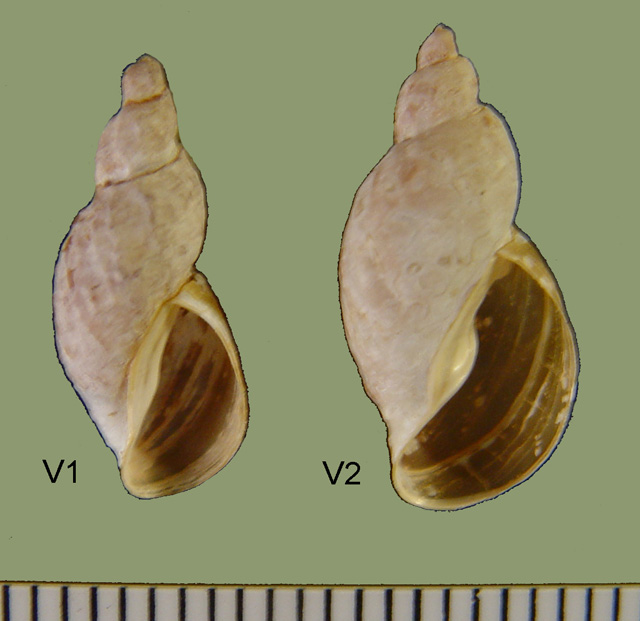
Brady & Turner [11] considered that their Conley, Osgood, and Killbuck populations demonstrated “typical” L. elodes shell morphology, and called them V1.  They called their Hartstown Marsh population V2.  See note [12] for an interesting story about the example specimens figured at right below.

I forwarded samples of all four B&T populations to Samantha in July of 2012 [13].  And sure enough, samples from the Hartstown population (marked as PA-h on my version of Samantha’s CO1 tree) appeared genetically distinct from the Conley, Osgood, and Killbuck samples (marked PA-c,o and PA-k).  So although subtle, there does appear to be a shell morphological correlate to C01 sequence divergence between the two putative species.  The key character does not seem to be the traditional fat/skinny dichotomy, but rather the relative size of the body whorl [14].

Fourth, evidence suggests that the traditional taxonomy of North American stagnicolines may have been based on shell characters largely ecophenotypic in their origin.  The best example, ironically, comes from Douglas Lake, the home of the University of Michigan Biological Field Station.  Samantha sampled 4 individuals from the waters of Douglas Lake itself, all of these being classified as “emarginata-ovate” by her morphometric criteria, which I have marked with green letters “d” in the C01 tree above.  This small sample included three individuals belonging to putative biological species V2, and a single individual belonging to putative species V1.  Samantha also sampled 8 individuals from “Douglas Lake Pools,” presumably marginal ponds not directly connected to the lake itself.  All of these individuals were classified as exilis by Samantha’s morphometrics, and are marked with blue letters “d” above.  This included 6 individuals classified as putative species V2, and 2 classified as species V1.

Thus Samantha’s data suggest that two biological species of stagnicoline lymnaeids seem to co-occur sympatrically in Douglas Lake, both bearing fat shells of emarginata morphology in the main lake, and both bearing skinny shells of exilis morphology in marginal pools.  We search the world over, and sometimes the answers we seek are right on our own doorsteps.

And fifth, we do not actually know the correct names for either of the putative biological species.  Here I must pause, and wipe a tear from my eye.  For some reason known but to God, Samantha did not sequence that sample of topotypic L. catascopium I gave her in June of 2012.  Was this tragic oversight related to some sort of funky decision-making late in her research, regarding the taxonomy to be employed in her thesis as a whole?  See note [8] below for more.

In any case, as I have repeatedly emphasized (to Samantha, and to you all as well!), catascopium (Say 1817) is the oldest name available for any North American stagnicoline population.  One of Samantha’s two putative biological species almost certainly must be catascopium by definition, and the correct name of the other species depends.

So what to do?  Almost all of Samantha’s pale/fat snails, which might conventionally be identified as catascopium, were classified as V2.  This set included the sample I sent her from Maine, graphed as a big green triangle at the top of her C01 tree.  And almost all of Samantha’s V1 individuals demonstrated the dark/skinny shell morphology conventionally associated with elodesSo let us provisionally call the V2 species Lymnaea catascopium, leaving the name Lymnaea elodes for putative species V1.  This is admittedly a judgement call, but seems most consistent with the taxonomy currently employed by workers in the field.

Have I beat this horse long enough?  Let me conclude with two recommendations for further study.  First, the hypotheses advanced here can be tested with a good genetic survey of the stagnicoline populations inhabiting the Douglas Lake area.  Somebody needs to use microsatellites, or old-fashioned allozymes, or even older-fashioned breeding studies, to test the hypothesis that two reproductively isolated stagnicoline species are sympatric in that lake, not corresponding to the traditional fat catascopium / skinny elodes dichotomy, but rather corresponding to the new V1 elodes / V2 catascopium dichotomy.  And second, somebody needs to go back up the Delaware River and fetch us some more topotypic catascopium.  And find us some topotypic elodes at Lake Canandaigua, while shopping around in Yankeeland for lymnaeids anyway.  Not it.


Notes

[1] This catch phrase comes from the online comic, xkcd.com.  And although the xkcd logo shows a stick-figure scientist flamboyantly flourishing a beaker and a calculator, real science is at least as much theoretical as applied.  To be quite precise, science is the construction of testable models about the natural world.  This essay is real science.  Stand back.

[2] Not only did Samantha ultimately fail to make her MS thesis available from any public outlet, she also failed to “throw up” any of her sequence data on GenBank.  Alas.

[3] Flowers, S. L. (2013)  Inferences into species delimitation of Nearctic Stagnicola (Gastropoda: Lymnaeidae) using geometric morphometric and phylogenetic methods.  M.Sc. Thesis, University of Michigan, Ann Arbor.

[4] Two disclaimers.  First, gene trees are NOT species trees!  They are weak, null models of population relationship.  And second, there is no cut point for species-level sequence divergence that isn’t more exception than rule.  See, for example:
  • Phylogenetic Sporting and the genus Laevapex [20July07]
  • Gene Trees and Species Trees [15July08]
  • The Snails The Dinosaurs Saw [16Mar09]
  • What is a Species Tree? [12July11]
[5] Lymnaea arctica was one of the (only approximately ten) North American lymnaeids that Hubendick (1951) considered specifically distinct.  I wish I knew more about the taxon.  Might arctica demonstrate genetic affinities with the Old World palustris/corvus/fuscus group?  But I went over to the “Barcode of Life” database to see if I could find the PPCHU85 arctica sequence that Samantha analyzed in her CO1 tree, and came up dry.  Very frustrating.

[6] Samantha really should have digitized more than the shell outlines.  In particular, the relative sizes of the shell whorls, especially the body whorl, seem to contain a great deal of heritable information in freshwater gastropod populations [14], which may be difficult to recover without landmarks on the suture lines or aperture.  See for example:
  • Dunithan A, Jacquemin SJ, Pyron M (2012) Morphology of Elimia livescens (Mollusca: Pleuroceridae) in Indiana, U.S.A. covaries with environmental variation. Am Malac Bull 30:127–133.
  • Dillon, R. T., S. J. Jacquemin & M. Pyron (2013)  Cryptic phenotypic plasticity in populations of the freshwater prosobranch snail, Pleurocera canaliculata.  Hydrobiologia 709: 117-127.  [PDF]
  • Dillon, R. T. & S. J. Jacquemin (2015)  The heritability of shell morphometrics in the freshwater pulmonate gastropod Physa.  PLoS ONE 10(4) e0121962. [PDF]
[7] Samantha’s original Figure 5 had a nasty little error in its legend, which I have fixed by deleting her legend in its entirety.

[8] Although Samantha did not explicitly cite any reference works to support her taxonomy, it is my impression that her choices of the category names emarginata-ovate, emarginata-narrow (“canadensis”), elodes and exilis follow the 1992 work of Burch & Jung [9]. Whatever the origin, her taxonomy is most unfortunate.  For unexplained (indeed unexplainable) reasons, Samantha seems to have dropped the oldest specific nomen available for stagnicoline lymnaeids, catascopium (Say 1817), from her methods and results sections in favor of emarginata (Say 1821).  But (I’m guessing here) the decision may have come late in her project?  Because a couple samples remain identified as “catascopium” in her draft Table 1, with purple coding in her draft Figures 10, 11, and 12.  What a mess.

[9] Burch, J. B. & Jung, Y. (1992) Freshwater Snails of the University of Michigan Biological Station Area.  Walkerana 6(15): 1 – 218.

[10] It is my broad-brush impression, based on nothing more than inspection of the figures in Samantha’s draft thesis, plus the sets of stagnicoline shells figured by Burch and Jung, that samples our Michigan colleagues tend to call emarginata-narrow (“canadensis”) and elodes may tend to represent putative species V1, and the samples our colleagues call emarginata-ovate or exilis may tend to represent V2,  But since Samantha didn’t digitize the shell aperture or suture lines, the distinction was not recovered by her morphometrics.  So let’s just focus on Samantha’s color coding, and set her taxonomy aside to the extent possible.

[11] Brady, J. K & A. M. Turner (2010) Species-specific effects of gastropods on leaf litter processing in pond mesocosms.  Hydrobiologia 651: 93-100.

[12] For several weeks during the spring and early summer of 2012, I held cultures of the four B&T populations here in Charleston, dissecting samples to hunt for anatomical distinctions that I ultimately did not find. During that period both the Killbuck (V1) and Hartstown (V2) populations laid eggs.  These I hatched and reared for quite a few months in my standard plastic aquarium boxes, at densities that were certainly too high, largely neglecting them, changing their water infrequently.

In any case, my results seem to confirm those of Kip Brady.  My standard culture water here in Charleston is almost certainly much softer than that to which stagnicoline lymnaeids are usually adapted, yielding the chalky appearances of the two example shells figure above.  Yet the V1 offspring did indeed seem to develop relatively smaller body whorls than the V2 offspring.

[13] And here’s another little confusion.  Unknown to me, Kip Brady sent Jack Burch samples from a couple of his stagnicoline populations several years prior to my shipment to Samantha.  Kip never heard anything further.  But apparently 5 of Kip’s earlier samples were sequenced at some point along with 8 of the individuals I sent to Samantha in 2012, and all 13 appear graphed side-by-side in Samantha’s C01 tree, under two different labelling schemes.

[14] Body whorl differences of this subtle sort seem to be quite heritable in freshwater pulmonates as a general rule.  In fact, body whorl differences were the way we initially distinguished Physa carolinae from Physa acuta back in 2009 [15].  For more, see:
  • The Lymnaeidae 2012: A clue  [9July12]
  • The heritability of shell morphology in Physa h^2 = 0.819  [15Apr15]
[15] Wethington, A.R., J. Wise, and R. T. Dillon (2009) Genetic and morphological characterization of the Physidae of South Carolina (Pulmonata: Basommatophora), with description of a new species.  The Nautilus 123: 282-292.  [PDF]

Wednesday, August 19, 2015

The Type Locality of Lymnaea elodes

Editor’s Note.  This is the fourth installment of what I think will turn out to be a five-part series on the tangled species relationships of the North American stagnicolines.  It’s not essential, but you might find it helpful to read my essays of [22June15], [14July15], and [29July15] before proceeding onward.

Subsequently published as Dillon, R.T., Jr. (2019b)  The type locality of Lymnaea elodes.  Pp 87-93 in Freshwater Gastropods of North America Volume 2, Essays on the Pulmonates.  FWGNA Press, Charleston.

Last month I noted that Thomas Say described two “stagnicoline” lymnaeids in 1821, the (pale, fat) Lymnaeus emarginatus from “lakes of Maine” and the (dark, skinny) Lymnaeus elodes [1].  Say was much more precise about the type locality of the latter species, specifying that it “Inhabits Canandaigua Lake.”  And apparently he considered his Lymnaeus elodes so distinct that he did not feel called to distinguish it from any other North American freshwater gastropod [2].  The figure below was scanned from Say’s 1830 “American Conchology” [3].

From my (perhaps selfish?) perspective almost two centuries later, vague type localities such as that for emarginata seem preferable to specific ones, such as that for elodes.  So much has changed here in the United States, over the last 194 years, that references to specific type localities may well have been rendered obscure, or the environment radically altered, and its biota extinct.  But vague type localities would seem to afford a modern researcher, such as myself, some wiggle room.
  
So as the vagaries of my 2012 field season played out, late July was scheduled for an extensive survey of northern Pennsylvania, home ported at the University of Pittsburgh’s Pymatuning Laboratory of Ecology [4].  And I calculated that at least one of my excursions out of PLE might take me within striking distance of the elodes type locality on Lake Canandaigua.

And once again I had done some homework – this time, a bit more thoroughly.  Digging around in the older literature I was pleased to unearth a charming paper written in 1932 by my hero [5] F. C. Baker: “The Ecology of Say’s Limnaeus elodes [6].”  Regarding the type locality, Baker wrote: 
“It is obvious that a pond or swamp-inhabiting snail would not live in the waters of a large lake like Canandaigua and its exact ecological station must necessarily be sought in a normal habitat near the lake.  No specimen of elodes has ever been found living in the lake.  Many years ago the north end of the lake, where the outlet discharges its surplus waters, was an extensive swamp or marsh inhabited by elodes and other mollusks.  This area has now been drained for building purposes.  The southern end of the lake is also marshy.  It is probable that the specimens from which Say drew up his original description came from the north end of the lake, either in the marshy tract bordering the outlet, or from a beach pool or pond bordering the upper (southern) end of the lake.”
So I arrived at the upper end of the Canandaigua Lake in the late morning of 27July12, launched my kayak from the Woodville Access, and paddled south to prospect for a possible “beach pool or pond bordering.”  My goodness, it was swampy in there, with luxuriant growths of floating and emergent macrophytic vegetation.  I can rarely remember seeing larger populations of Physa acuta or Lymnaea columella.  I also netted a few Gyraulus deflectus and Valvata tricarinata, both of which were interesting to my southern eyes.  But I was looking for elodes habitat, which should be isolated and essentially fishless.  And to quote my own field notes of 7/27/12 verbatim, “If there are any vernal ponds isolated in this vast sea of cat-tails and swamp forest, one could not find them from a kayak.  The only way to find stagnicoline habitat here would be by helicopter.”

So I paddled back to the truck and drove along the western shore of the lake, a distance of perhaps 15 miles, noting (as Baker’s paper had led me to expect) a “very precipitous” shoreline featuring essentially zero habitat for freshwater gastropod populations of any sort. 

And when I arrived at the lower (northern) end of the lake, I again found it as Baker described in 1932, “drained for building purposes.”  More so today, I feel sure.  I did enjoy a lovely stroll in what probably represents the vestigial remains of Baker’s “extensive swamp or marsh inhabited by elodes,” now maintained (rather nicely) by the City of Canandaigua as “Lagoon Park.”  And I was impressed by the aquatic vegetation in the shallow ponds protected within the park, as well as by their large populations of bream, bluegill, and panfish of all sorts.  Pleasant to the eye of the visitor, certainly, but most inhospitable for Lymnaea elodes
Fortunately I had an ace up my sleeve.  The occasion of F. C. Baker’s 1932 paper was not to lament the absence of L. elodes from the southern, western, and northern shores of Canandiagua Lake, but to rejoice in their abundance on the eastern.  He wrote:
“A few years ago, while exploring the east side of the lake, a large beach pond was discovered in which were living many large pond snails of the form known as elodes.  These shells are exactly like Say’s types deposited in the museum of the Philadelphia Academy and like his figures in the American Conchology… The pond (Fig 1) is situated about three miles south of the City of Canandaigua… near a group of summer cottages erected on higher ground southward.”
Baker’s Figure 1 is reproduced above.  What a lovely spot, even in black and white!  Baker described the open pool as covering about three acres, with perhaps two additional acres of “surrounding vegetation” (which he cataloged in detail), ten “species and races” of freshwater gastropods, and three species of pisidiid clams.

So leaving The City of Canandaigua and driving approximately three miles south on the eastern shore of the lake, I encountered, in this order: a “Deep Run Park,” a “Crystal Beach,” and a “Cottage City.”  Deep Run Park was a nice public beach administered by Ontario County (NY), with picnic facilities and plenty of free parking, but no habitat for stagnicoline lymnaeids in evidence.  Cottage City turned out to be a modest community of (primarily) vacation homes dating back to the Victorian era, perched (as Baker indicated) “on higher ground southward.”  And what about that “Crystal Beach” in the middle?

Google Earth does indeed suggest a wooded depression (or vernal pond?) in the region of my map marked “Crystal Beach.”  But alas, I could find no public access.  Here is a photo I downloaded from the Facebook page of the Crystal Beach Betterment Association:

I didn’t see any images depicting marshy or swampy areas on the CBBA page, but comparing the location of their private property to Baker’s (1932) description, it seems likely to me that his pond is (or was) in there somewhere [7].

It also seems likely that with a properly-directed telephone call or two and sufficient lead time, an interested scientist such as myself might wrangle an invitation from the CBBA to explore their property for that elusive topotypic population of L. elodes.  But staring at “No Trespassing” signs as the sun set on Friday evening, 27July12, this particular interested scientist was clean out of luck.

I filed my sad report with Samantha upon return to the Pymatuning Lab that next afternoon.  She did not respond, but perhaps no response was called for.  And in fact, over a year would pass before I heard from Samantha again.  I felt sure that she was very busy up there in Ann Arbor somewhere, cranking out a forest of gene trees, or whatever it is that the young kids do these days.  Coming next time, “The Secret Thesis of Samantha Flowers.”  Stay tuned!

Notes

[1]  Say, T. (1821)  Descriptions of Univalve Shells of the United States.  Journal of the Academy of Natural Sciences 2: 149 – 179.

[2] But it is interesting to note that Thomas Say did realize that his North American elodes was quite similar to European L. palustris, from which he could not, apparently, distinguish it.  At the bottom of his description of L. elodes, Say noted: “This species was found by Mr. A. Jessup; it bears the most striking resemblance to L. palustris.  The variety was found by the same enterprising mineralogist at Morristown, New-Jersey.  I have subsequently received specimens from Mr. S. B. Collins, of New-York, who procured them in a marsh near the Saratoga springs.”  So if (as I fear) the Canandaigua elodes population has subsequently gone extinct, I think a case could be made for either Morristown or Saratoga Springs as a “substitute” type locality.

[3] Say, T. (1830 – 1838ish) American Conchology; or, Descriptions of the Shells of North America.  New Harmony, Indiana, “Printed at the School Press.”

[4] A public acknowledgement of gratitude is here extended to my good friends at The Pymatuning Laboratory of Ecology – Andy Turner, Aaron Stoler, Rick Relyea (who has since moved on) and Chris Davis (currently in charge).

[5] For more on the life and career of this remarkable scientist, see:
  • The Legacy of Frank Collins Baker [20Nov06]
[6] Baker, F. C. (1932)  The ecology of Say’s Limnaeus elodes.  Ecology 13: 286-289.

[7] For the record, here are the coordinates for my best guess on the location of Baker’s pond: 42.8147, -77.2613.  The only other nominee I can find is a shallow pond currently between Deep Run Park and a housing development, 42.8200, -77.2586.

Wednesday, July 29, 2015

The Type Locality of Lymnaea emarginata

Editor’s Note.  This post is the third installment of what I think will turn out to be a five-part series on the tangled species relationships of the American stagnicolines.  It’s not critical, but you might find it helpful to back up and read my essays of [22June15] and [14July15] before proceeding onward.

Subsequently published as Dillon, R.T., Jr. (2019b)  The type locality of Lymnaea emarginata.  Pp 81-85 in Freshwater Gastropods of North America Volume 2, Essays on the Pulmonates.  FWGNA Press, Charleston.

The next two North American stagnicoline lymnaeids to be called to the attention of science, after Lymnaeus catascopium, were L. emarginatus and L. elodes, both described by Thomas Say in 1821 [1, 2].  The figure below, clipped from Say’s “American Conchology”[3], compares the shell morphology of emarginatus (top row) to catascopium (bottom row).  Say wrote that emarginatus “is a somewhat larger, and considerably more ventricose species than L. catascopium, S., and the undulation of the columella is much more profound.”  Say gave the type locality of his emarginatus as “inhabits Lakes of Maine.”

So by great good fortune, in the spring of 2012 my wife won a pair of tickets on Southwest Airlines in a school raffle.  And she began to cast about for potential vacation spots during the first week of July, preferably someplace cool.  And she discovered that Southwest Airlines (if you can believe this) has service to Portland, Maine, from whence (she schemed) we might rent a car to Bar Harbor.  And just as simply as that, her husband had another field trip planned.  This one of a substantially different character than the expedition he detailed in his post of two weeks ago.

So we left our lovely B&B in Bar Harbor on the morning of 5July12, and by early afternoon I was collecting Lymnaea emarginata from Pushaw Lake, about 6-8 miles north of Bangor.  The snails were quite common on rocks in about two feet of water on the west shore of the lake.  It is well that freshwater malacology is not ordinarily so easy, lest everybody should do it.

I had actually done a bit of homework before setting off on this little errand, and so my choice of Pushaw Lake was not entirely arbitrary.  Our good friend Scott Martin reported emarginata populations from four counties in his (quite helpful) 1999 review, “Freshwater Snails (Mollusca: Gastropoda) of Maine [4].”  So I contacted Scott for his specific records, and among the many potential collection sites he forwarded to me was Pushaw Lake, from which Leroy Norton reported “Stagnicola oronoensis” in 1957.  Oronoensis is clearly a synonym of emarginata.

In retrospect, however, I wish I had done more homework than I did.  A closer reading of Scott’s 1999 review would have called my attention to a 1921 paper by O. O. Nylander [5] designating Mud Lake (in remote Aroostook County, 150 miles north of Bangor) as the type locality for Say’s Lymnaeus emarginatus, not Pushaw Lake.  Well, as the whole project turned out, it didn’t matter.

Rob at Pushaw Lake
And my efforts to collect a corresponding population of Lymnaea elodes were much more in keeping with my many years of personal experience in the matter of the pulmonate gastropod sampling.  Scott Martin actually listed six Maine counties for dark/skinny elodes-type stagnicoline populations, but his records were far more vague.  His best locality data were for a “Lymnaea palustris” population at the “Andrascoggin River above Rumford.”  And indeed, I found extensive, seasonal swamps along the right bank of the river in that area, absolutely primo habitat for mosquitos on July 5, but no sign of L. elodes.  The ANSP also holds a couple collections from the vicinity of Portland (Stroudwater and Westbrook) where I did no better.

Well, as the whole project turned out, it didn’t matter.  Oops, am I repeating myself in my old age?  This is a chord I have found myself striking with increasing frequency, as my perspective has matured, these latter years of my career.  What we do ain’t brain surgery, I often tell my students.  It’s just snails.

So I contacted Ms. Samantha Flowers [6] immediately upon my return to Charleston, and she was predictably pleased to hear about the bona fide emarginata population I had collected for her from a “Lake of Maine.”  She suggested that if I could ship the Pushaw emarginata to her alive at the University of Michigan Biological Field Station way up by Douglas Lake, she would be interested in attempting some breeding studies with dark/skinny populations of elodes and exilis from the Michigan area.  Which (of course) I was happy to do, out of my own pocket.

And with my July (2012) shipment to Samantha, I also included ethanol-preserved samples of four dark/skinny stagnicoline populations from NW Pennsylvania, which had been sent to me earlier that same the summer by Kip Brady and Andy Turner.  These were the “cryptic stagnicolines” I first mentioned in my essay of 10May12, and mentioned again last month.  Very mysterious, those populations…

…keep your eye on them!  And tune in next month, as we continue our quest to elucidate the tangled systematics of the enigmatic North American stagnicolines with “The type locality of Lymnaea elodes.”


Notes

[1]  Say, T. (1821)  Descriptions of Univalve Shells of the United States.  Journal of the Academy of Natural Sciences 2: 149 – 179.

[2] To be complete, it might be argued that Thomas Say described as many as five stagnicolines in the work cited above, including elongatus, reflexus, and desidiosus as well as emarginata and elodes.  Say realized that his nomen elongatus was preoccupied, and changed it to umbrosus himself in his "American Conchology" [3].  The identity of desidiosus as a stagnicoline (as opposed to a fossarine) is controversial – see the remarks of Baker (1911, pp 318 – 321).  I’m not sure what happened to reflexa.  The nomen was passed along by Baker (1911, 1928) as perfectly valid for dark, marsh-dwelling stagnicoline populations of very skinny shell morphology, but appears only as a “form” of elodes in Burch (1989).  I don’t know how it got so demoted.

[3] Say, T. (1830 – 1838ish) American Conchology; or, Descriptions of the Shells of North America.  New Harmony, Indiana, “Printed at the School Press.”

[4] Martin, S. M. (1999)  Freshwater Snails (Mollusca: Gastropoda) of Maine.  Northeastern Naturalist 6: 39 – 88.

[5] Nylander, O. O. (1921)  The type localities of Lymnaea emarginata Say and L. ampla Mighels.  Nautilus 34: 77-80.

[6] From this point to the conclusion of the essay, I am assuming that you are familiar with last month’s post,
  • Everything Changed When I Met Samantha [22June15]

Tuesday, July 14, 2015

The Type Locality of Lymnaea catascopium

Editor's Note. This essay was subsequently published as Dillon, R.T., Jr. (2019b)  Malacological mysteries: The type locality of Lymnaea catascopium.  Pp 73-80 in The Freshwater Gastropods of North America Volume 2, Essays on the Pulmonates.  FWGNA Press, Charleston.

Although not explicitly stated, it is traditional to assume that Thomas Say was referring to his home town of Philadelphia when he wrote, in 1817, “Inhabits the Delaware River and many other waters of the United States, in considerable numbers, and may be found plentifully, during the recess of the tide, about the small streams through which the marshy grounds are drained [1].”  Say was describing the habitat of the first “stagnicoline” lymnaeid, Lymnaea catascopium.  Standing on the Philadelphia waterfront in June of 2012, however, I found it nearly impossible to imagine how any self-respecting freshwater gastropod population of any description might ever have inhabited such a place.

Philadelphia 1702, from phillywatersheds.org
The Delaware is reliably fresh but quite tidal at Philadelphia, with a daily range of several feet.  So I gather that in the 18th and early 19th centuries, merchant ships anchored some distance offshore and transmitted their cargos over these "marshy grounds" at high tide by tender.  Then as the years advanced and the technology improved, the river must have been dredged and the fill material dumped directly onshore, creating more land, deepening the harbor, and allowing direct offloading of ships to finger-like cargo docks.  Whatever the historical scenario, however, by June of 2012 it was clear to this particular 21st-century malacologist that his efforts to sample a topotypic population of L. catascopium from the Delaware River must be re-directed upstream.

Philadelphia 1908, from phillywatersheds.org
The Academy of Natural Sciences holds one lot of L. catascopium collected by Charlie Wurtz from Pennypack Creek in 1948.  Pennypack Creek drains an entirely urban (actually, rather post-industrial) catchment inside the Philadelphia city limits, emptying into the Delaware just a few miles upstream from the docks.  And so it was to Pennypack Park that I set my GPS early in the morning of June 11, 2012.

I threw my kayak directly into the Delaware River and paddled upstream through the mouth of the creek into a zone of broad, intertidal mudflats decorated with a dense stand of arrowhead (Sagittaria).  The creek narrowed and deepened substantially as I paddled upstream, looking for the solid substrates I knew that populations of Lymnaea catascopium require.  Soon the air crackled with gunfire, as I passed alongside (perhaps “beneath” would be a better preposition) the Philadelphia Police Academy Firing Range.  After about a mile the creek had shallowed to the point I could get out and walk.

But I found no L. catascopium, nor indeed any habitat.  The steam bed was too muddy.  I found Littoridinops moderately common on floating debris, a few Physa acuta, N=1 Amnicola, and some beer-can limpets, but that was it.  So I paddled back downstream to the truck, loaded my kayak, and drove a couple miles upstream to the Verree Road Bridge.  Pennypack Creek was lovely at that point on a June afternoon, but flashy and low-nutrient, and simply not the kind of place one might expect L. catascopium.

Some nontrivial fraction of the early 19th century prosperity of Philadelphia was due to the network of canals communicating between the Delaware River and the interior of rapidly-expanding America.  In 1832 the Delaware Canal was completed to run 60 miles along the right (descending) bank of the river from Easton to the quaint old town of Bristol, PA, about 15 - 20 miles above Philadelphia.  And the Delaware and Raritan Canal was completed in 1834, connecting New Brunswick, NJ, to Bordentown, and climbing the left (descending) bank of the Delaware.  So on 12 June I checked the historic lock areas around Bristol, and also across the river at D & R Canal Lock #1, at Bordentown.  The latter spot was tough to access but afforded a pretty and diverse habitat with a disappointingly poor freshwater gastropod fauna.  The still-rather-strongly tidal environment is probably a factor.  Just a couple Physa acuta, and a Menetus or two, and I was gone.


The Delaware River passes through the fall zone at Washington Crossing, PA, famous primarily as the type locality of Physa ancillaria (Say, 1825).  Breeding results we published back in 2006 suggested that ancillaria is a fattish shell morph of Physa gyrina [2].  Most interestingly, some allozyme gels we ran in support of that research effort in 2005 returned evidence of low-frequency hybridization between P. gyrina and P. acuta at Washington Crossing – the only place (to this day) where the phenomenon has been documented.  You would think that at least a couple of the numerous historical markers one finds on both sides of the Delaware River at this point would feature such a remarkable finding.  But no.

Both Physa gyrina and P. acuta are common in the rocky pools at Washington Crossing, as they are upstream for several hundred miles.  The Delaware River is one of the few places where the two species are so richly sympatric, in my experience.  Also making an initial (or possibly final?) appearance at the fall line is Pleurocera virginica.  But no evidence of Lymnaea catascopium whatsoever.

The gastropod fauna continued to richen as I collected my way north upstream the next day.  The list lengthened to include Helisoma trivolvis, H. anceps, Gyraulus, Laevapex, both species of Ferrissia, Lyogyrus, and even (ultimately, way up north) Somatogyrus.  The most memorable snapshot from my June 13 field experience was the aquaviaduct at Tohickon Creek – a genuine marvel of 19th century engineering.  Here barges plying the Delaware Canal would have passed through a covered bridge (or trough, maybe a better noun) perpendicular to and 20 feet above the rocky creek below.  I passed through the Delaware Water Gap as the sun set on the third day of my efforts to collect L. catascopium from its type locality.

Tohickon Aqua-viaduct (PA DCNR)
I remember the morning of June 14, 2012 like it was yesterday.  The Delaware River at Milford Beach was low and clear.  Wading a bit over knee-deep on the left bank under some trees I pulled up a length of woody debris and attached thereupon I found N=2 pale lymnaeids about 10 mm shell length.  Juvenile catascopium!  The shell morphology reminded me of (slenderish) Lymnaea columella, which they might easily have been mistaken for, were they sitting on a lily pad in a pond rather than grazing on a stick two feet below the surface of a river.

I really needed a sample of at least 30 individuals to estimate allozyme frequencies.  So I redoubled my efforts in all similar habitats and substrates around Milford Beach over a period of about an hour.  But alas, no additional specimens came to light.  So I drove 25 miles upstream to Shohola Bridge, where two hours’ effort netted an additional N=5 juvenile catascopium.  Further upstream at Metamoras Boat Landing and Dillontown the river did not seem as rich, and I struck out.

Delaware Water Gap
So there I stood on the riverbank, as the sun set on June 14.  Five days and 1,375 miles on the odometer since I left Charleston had yielded the N=7 pale little lymnaeids crawling implacably about in the red, half-gallon thermos jug at my feet.  I’d be lying if I said I wasn’t disappointed.  But the AMS meeting was scheduled to start on Sunday (June 16) back down the river at Cherry Hill, and I still needed to find a population of Lymnaea elodes in the Delaware Valley someplace.  As I turned my pickup south, however, I felt good about at least one thing.  The Delaware River at Milford Beach, Pike County, PA is as close to topotypic for Lymnaea catascopium (Say 1817) as can humanly be located in the modern day.

If my efforts to collect a decent topotypic sample of L. catascopium were less than successful, however, my parallel efforts to find a matching population of L. elodes were an abject failure.  I had several leads.  In fact, the naturalist at Echo Hill Environmental Education Center near Lebanon, NJ, had sent me a sample of L. elodes for identification in December of 2010.  But I stomped all around in the wooded swamp where the specimens were collected, and couldn’t find so much as a shell.

I confess that I may not have been in the best of spirits at the AMS welcome mixer Sunday evening, when up walked our good friend Tom Duda, with a nice young lady in tow.  Tom introduced her as Ms. Samantha Flowers, a new graduate student at the University of Michigan [3].  And Samantha had chosen as her research project – if you can believe this – the evolutionary relationships among the stagnicoline lymnaeids.

Have you seen me?
She related to me, as the conversation unfolded, that she planned to use a variety of approaches, including molecular phylogenetics and geometric morphometrics, and sample as broad a range of catascopium, emarginata, elodes, and exilis populations as time and resources permitted.  I’m not crazy about gene trees, I thought to myself [4], but they do work with small sample sizes.  And what can I myself do with my crappy little sample of N=7 topotypic Lymnaea catescopium except go back up the Delaware again and try to find 23 more?

And such a nice young lady!  So bright, and so eager to learn!  In five minutes not only had I decided to give her my sample of topotypic L. catascopium, I had resolved to help her with the rest of her thesis in any way I could.

The next morning I transmitted my little sample of L. catascopium to Samantha, and told her she could keep my half-gallon thermos jug to carry them home in.  I also promised to her that I would continue to move forward on my original study design, and that I would try to send her additional samples as the summer progressed.  Looking back on it, I wasn’t entirely sure that she appreciated the potential for ecophenotypic plasticity in her chosen study organisms, or indeed that she actually understood the design of the study I (we?) were working on.

In fact, I was not entirely sure she understood the significance of the little sample of snails I handed her that morning.  Thomas Say’s (1817) nomen “Lymnaea catascopium” is the oldest available name for any of the North American stagnicolines.  Which means that regardless of all the other names invented by all the other malacologists to name all the other stagnicoline populations in all the other regions of the United States and Canada, any population matching those N=7 crappy little snails in that red jug must be Lymnaea catascopium by definition.  They were her control.  Every other sample she might acquire would be an experiment.

With the benefit of three years’ hindsight, I think that it was probably too early in Samantha’s professional career for her to take this all in.  But stay tuned!  Coming up next month - the type localities of L. elodes and L. emarginata.

Notes

[1] Lymnaea catascopium was one of a long list of species that Thomas Say described in the entry entitled, “Conchology,” which he contributed to Nicholson’s British Encyclopedia of Arts and SciencesNicholson’s Encyclopedia was published at Philadelphia in three editions: 1816, 1818, and 1819.  I gather that these works are very rare in libraries today.  And I also gather that the "1816 Edition" was actually published in 1817.  I myself only have access to W. G. Binny’s (1858) secondary reference entitled, “Complete Writings of Thomas Say on the Conchology of the United States.”  And Binny only reprints the third (1819) edition.  So that’s where I got the quote above.

[2] Dillon, R. T., and A. R. Wethington. (2006)   No-choice mating experiments among six nominal taxa of the subgenus Physella (Basommatophora: Physidae).  Heldia 6: 41 - 50.  [PDF]

[3] From this point onward in the present essay, I am assuming that you have read last month’s post,
  • Everything Changed When I Met Samantha [22June15]
[4] This is a long-running theme on the FWGNA blog, for example:
  • Gene Trees and Species Trees [15July08]

Monday, June 22, 2015

Everything Changed When I Met Samantha

Editor's Note. This essay was subsequently published as Dillon, R.T., Jr. (2019b)  Everything changed when I met Samantha.  Pp 67-72 in The Freshwater Gastropods of North America Volume 2, Essays on the Pulmonates.  FWGNA Press, Charleston.

Three years ago I posted a series of five essays on this blog entitled, “The Lymnaeidae 2012” [1-5].  My primary motivation was the imminent expansion of the FWGNA project into the Mid-Atlantic States, where I expected that we would come into contact with the range of an enigmatic group of lymnaeids called the “stagnicolines.”  And a couple comprehensive molecular phylogenetic studies had also recently been published that I thought might cast some light on systematic relationships in the group.

Samantha
Looking back on it, however, my “Lymnaeidae 2012” series may have been something of a disappointment for my readership.  I seemed to get distracted from my primary theme by questions regarding the equally enigmatic “fossarine” group in August, and the series sort-of petered out inconclusively.  This is because everything changed when I met Samantha.

Who was Ms. Samantha Flowers?  And where has she gone, long time passing?  Our good friend Tom Duda from the University of Michigan introduced her at the AMS meeting in Cherry Hill in June of 2012, and we kept in touch until August of 2013, at which point she disappeared.  But she left behind a tangled body of potentially important research on the genetics of the stagnicolines, which we will sort through together, as this, our fresh series of essays on the Lymnaeidae unfolds.

So when last we left our story, it may be recalled that the Baker/Burch system for the classification of the North American Lymnaeidae recognizes 21 species of stagnicoline lymnaeids in two subgroups.  The dark-bodied populations of bogs, marshes and vernal ponds bearing slender shells include elodes (Say 1821), exilis (Lea 1834) and three others more recently described.  The pale-bodied inhabitants of open waters, bearing broader, more robust shells include catascopium (Say 1816), emarginata (Say 1821) and 14 others more recently described.

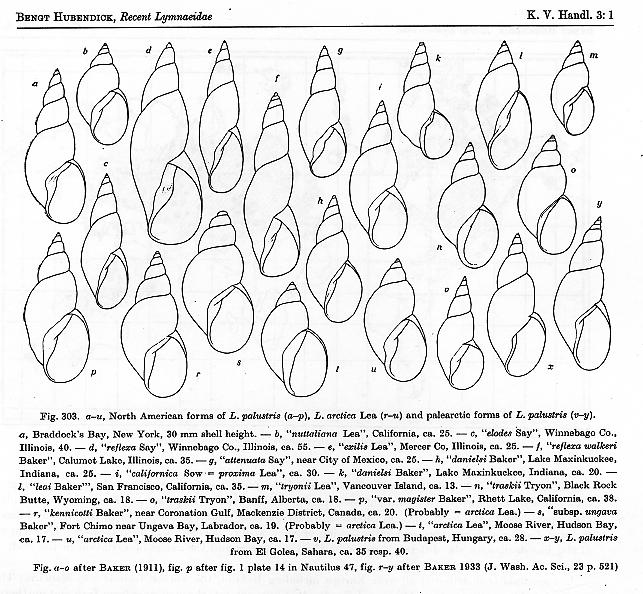
Half of the challenge with which we wrestled in 2012 was the relationship between our New World stagnicolines and those of the Old.  In 1951, my hero Bengt Hubendick synonymized all the dark/skinny species of North America under the European palustris (Muller 1774).  Hubendick’s figure of L. palustris is reproduced below – click for a full-sized version, with caption [6].  But by the 1960s evidence had begun to accumulate that the European palustris is a complex of several cryptic species, distinguishable only by detail of reproductive anatomy.  And in my essay of 10May12 [2], I offered evidence that at least two cryptic species of dark/skinny stagnicolines also seem to inhabit the ephemeral ponds and marshes of NW Pennsylvania.

http://www.fwgna.org/images/hubendick-palustris-lg.jpg
Hubendick Fig 303, Click for full caption
Although I did not mention it at the time, shortly after I published my “cryptic stagnicoline” essay of 10May12, I asked my good friends Kip Brady and Andy Turner to send samples of their enigmatic Pennsylvania populations to Charleston, which I dissected, comparing details of their reproductive anatomy to figures from the European literature.  Alas, I was unable to distinguish any of these populations anatomically, and let the matter drop.  But the cryptic stagnicolines of Brady & Turner turned out to be key to disentangling Samantha Flowers’ research results, when we were finally able to examine them in 2015.  So keep this in the back of your mind.

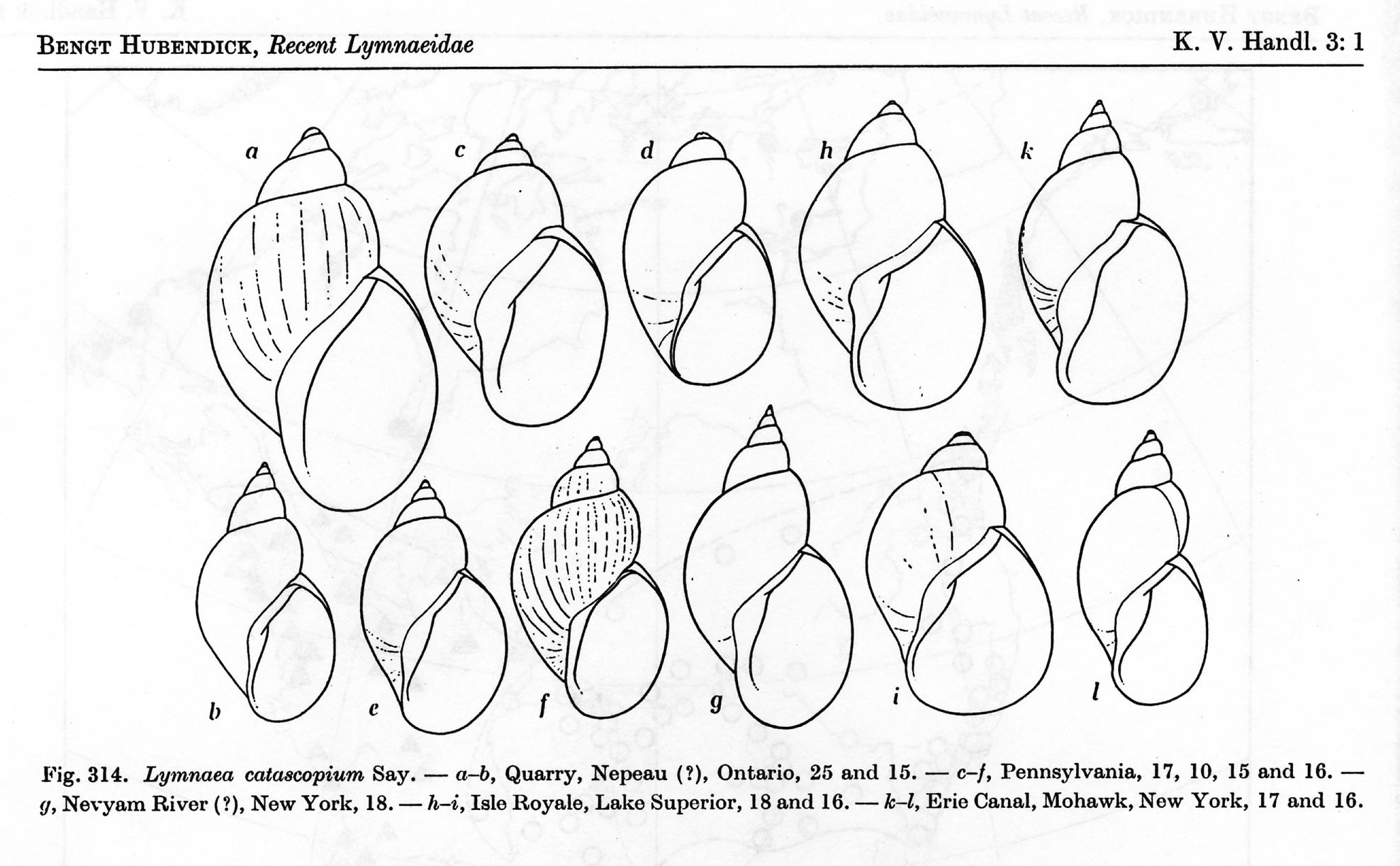
The other half of the challenge to working out the systematic relationships among our American stagnicolines is their great potential for ecophenotypic plasticity of shell.  Given the large body of research results such as those of Christer Bronmark on European Lymnaea peregra (aka “Radix balthica”), it is not inconceivable that the robust shells with enlarged body whorls born by populations we call catascopium or emarginata here in North America arise as an ecophenotypic response to life on solid substrates in open waters, exposed to fish predation [4].  There may be no additively heritable basis for the distinction between the broad, heavy shells of the catascopium/emarginata subgroup and the slender, gracile shells of the elodes/exilis subgroup whatsoever.  Hubendick’s figure of L. catascopium is reproduced below – click for a full sized version, with caption.

http://www.fwgna.org/images/hubendick-catascopium-lg.jpg
Hubendick Fig 314, click for full caption
So with the potential for cryptic speciation and shell ecophenotypic plasticity firmly in mind, in the spring of 2012 I designed a genetic survey of the North American stagnicolines.  My plan was to sample populations from the type localities of the four oldest nomina – catascopium, emarginata, elodes, and reflexa.  And along with each topotypic population, I also hoped to sample a nearby population bearing the opposite shell form.  My hypothesis was that each broad, heavy open-water population would prove most genetically similar to its local slender/gracile marsh-dwelling population.

For example, the type locality of L. catascopium is the Delaware River at Philadelphia, and the type locality of L. emarginata is “Lakes of Maine.”  In 2012 it seemed likely to me that Delaware River catascopium might prove most genetically similar to the populations of (nominal) L. elodes that I expected to find in the marshes of Delaware tributaries in eastern Pennsylvania, and that Maine emarginata might prove most genetically similar to populations of nominal L. elodes sampled from the marshes and vernal ponds of Maine.  I imagine my readership will recognize this study design as the same I have used to confirm “cryptic phenotypic plasticity” in a variety of pleurocerid taxa in recent years [7].

And so I mapped out an itinerary for my 2012 field season.  I set aside six days in June for what (I presciently imagined) might be a challenging quest to re-discover L. catascopium in the Delaware River, and L. elodes in vernal habitats of the Delaware Valley, after which I planned to attend the meeting of the American Malacological Society, conveniently scheduled in the Philadelphia suburb of Cherry Hill (NJ) June 16 – 21.

Everything changed when I met Samantha.  But coming next month… “The type locality of Lymnaea catascopium.”


Notes

[1] The Lymnaeidae 2012: Tales of L. occulta  [23Apr12]
[2] The Lymnaeidae 2012: Tales from the cryptic stagnicolines [10May12]
[3] The Lymnaeidae 2012: Stagnalis yardstick  [4June12]
[4] The Lymnaeidae 2012: A clue [9July12]
[5] The Lymnaeidae 2012: Fossarine Football  [7Aug12]

[6] Hubendick, B. (1951) Recent Lymnaeidae, Their Variation, morphology, taxonomy, nomenclature and distribution.  Kungl. Svenska Vetenskapskademiens Handlingar. Fjarde Serien Band 3, No. 1.  Stockholm: Almquist & Wiksells.
See The Classification of the Lymnaeidae [28Dec06]

[7] Pleurocera acuta is Pleurocera canaliculata [3June13]