Dr. Rob Dillon, Coordinator


Thursday, April 28, 2005

Idaho Springsnail Showdown

Editor’s Note – This essay was subsequently published as: Dillon, R.T., Jr. (2019d) Idaho Springsnail Showdown.  Pp 137 - 140 in The Freshwater Gastropods of North America Volume 4, Essays on Ecology and Biogeography.  FWGNA Press, Charleston.

Last Wednesday the US Fish & Wildlife Service (Boise Office) announced a 90-day comment period on a pair of competing petitions: one to remove Pyrgulopsis idahoensis (the "Idaho springsnail") from the federal endangered species list, the other to retain it and add several additional Pyrgulopsis populations from Wyoming and Oregon. The April 20, 2005 notice in the Federal Register is available as a PDF file from the link below. The purpose of this essay will be to briefly review the recent history of this simmering controversy from the standpoint of an interested outsider, with an eye toward patching a rift I fear may develop within the community more directly involved.

Pyrgulopsis idahoensis was one of five freshwater gastropods from the Snake River watershed added to the federal endangered species list in December, 1992. At that time, the species was believed to be restricted to an 35 mile stretch of the main Snake River below the C. J. Strike Reservoir. But as is too often the case, some fundamental background work on the biology of the animal had yet to be done. Early last year Hershler & Liu (2004a,b) reported that Pyrgulopsis populations conspecific with P. idahoensis inhabit three other regions: the upper Snake River drainage around Jackson Lake, Wyoming, springs scattered among Snake and Great Basin drainages in southeast Oregon, and the Columbia River on the Oregon/Washington border. The populations in the vicinity of Jackson Lake were previously identified as P. robusta while the SE Oregon populations were previously assigned to P. hendersoni. Since the nomen P. robusta (Walker 1908) has priority over idahoensis and hendersoni (both Pilsbry 1933), Hershler & Liu synonymized all these populations under P. robusta.

Last June the State of Idaho, together with the Idaho Power Company, petitioned the Fish & Wildlife Service to remove P. idahoensis from the federal endangered species list. This was followed in August by a petition from several (non-governmental) conservation groups to list the Pyrgulopsis populations from all four of the regions mentioned above. Both petitions referred to the data of Hershler & Liu (2004a), while reaching different conclusions from it. Last week the FWS responded by announcing a status review and a solicitation to the public for comments and information on both petitions.

I would encourage any of our colleagues with data relevant to this issue to communicate with the US Fish and Wildlife Service before June 20. Visit the Snake River FWS link below for further details.

I have a concern of a secondary nature, however, which I think should be addressed within our professional community, rather than through the federal agencies and the various interest groups involved in the pending Idaho springsnail showdown. I perceive some danger that we may begin to fight among ourselves on this issue. I want to point out that we are all on the same team here, and to the extent possible we need to be careful not to antagonize each other.

Bob Hershler and Hsiu-Ping Liu are excellent scientists, and their 2004a paper in The Veliger meets the highest standards of systematic malacology. Any professional who has seen their research findings will respond by referring to all the Pyrgulopsis populations involved in this matter as P. robusta. I am not asserting that this is The Truth, only that the conclusions of Hershler & Liu must become the lead hypothesis, against which any other hypothesis may be tested. Instead, the petition filed by the conservation groups in August continued to refer to these populations as separate species: the Idaho springsnail (P. idahoensis), the Jackson Lake springsnail (P. robusta), the Harney Lake springsnail (P. hendersoni) and the Columbia springsnail (P. spp. A), which has never been recognized as specifically distinct by any professional malacologist. The petition criticized and picked at the work of Hershler & Liu, suggesting that they "overlooked key differences between the four species." Nonsense.

Worse, I understand that Bob Hershler's motives may have been impugned. He and Hsiu-Ping did receive part of their funding from a law firm whose clients include Idaho Power, but to suggest that this affected their scientific judgment is an insult.

There seems to be a confusion widespread among environmental advocates to the effect that "splitting is good, lumping is bad." Taxonomists who split out new species at the drop of a nucleotide are seen as allies in the good fight, while those of us who understand interpopulation variation are painted as soldiers in the service of darkness. The root of this problem is the mixture of science and politics, but I'll resist getting on my high horse about that, for now.

Returning to the western Pyrgulopsis, however, the scientifically responsible (and collegial!) approach for the Conservation Groups would have been to petition for the listing of P. robusta, period. Any confusion regarding the relationship between the nomena "P. robusta" and "P. idahoensis" could have been cleared up in a couple paragraphs of introduction. It's probably not possible, nor possibly even desirable, for these groups to modify their August petition to the FWS at this point. But somebody owes our colleague Bob Hershler and apology. And better communication among all members of the team in the future, OK?


Links & References

Hershler, R. & H-P. Liu (2004a) Taxonomic reappraisal of species assigned to the North American freshwater gastropod subgenus Natricola (Rissooidea: Hydrobidae). The Veliger 47: 66-81.

Hershler, R. & H-P. Liu (2000b) A molecular phylogeny of aquatic gastropods provides a new perspective on biogeographic history of the Snake River region. Molec. Phyl. Evol. 32: 927-937.

US Fish & Wildlife Service. Notice of two 90-day petition findings...Federal Register 70: 20512-20514. [PDF]

U.S. Fish & Wildlife Service, Snake River Office:
http://idahoes.fws.gov/
(See "Service to review status of four springsnail species."

Friday, February 18, 2005

Shell morphology, current, and substrate

Editor's Note #1.  This essay was published as: Dillon, R.T., Jr. (2019b)  Shell morphology, current, and substrate.  Pp 121-126 in Freshwater Gastropods of North America Volume 2, Essays on the Pulmonates.  FWGNA Press, Charleston.
Editor's Note #2.  I subsequently re-identified the planorbid populations inhabiting Wakendaw Lakes as Helisoma scalare scalare on the riprap stones and Helisoma scalare duryi in the weedy ponds.  See my posts of [5Jan21] and [7Feb23]. 

In my post of November 2004 I examined the phenomenon of gigantism in pulmonates, taking as a point of departure the population of Helisoma trivolvis inhabiting an ornamental pond near my Charleston neighborhood. This month I'll develop that theme in an entirely different direction, focusing not on the mean shell diameter achieved by populations of Helisoma in the lowcountry, but on the spire height.


Across the Cooper River east of Charleston lies the suburb of Mt Pleasant, a bedroom community that has witnessed tremendous growth in the several generations since prosperity returned to the Carolina lowcountry. Among the scores of housing developments sprawling across this former patchwork of swampy forests is the subdivision of "Wakendaw Lakes." The photo above shows the low earthen dam constructed to retain the largest of the Wakendaw "Lakes." The nomen "pond" would be more descriptive of this shallow body of water, perhaps 1 - 2 hectares in extent, weedy and protected. It hosts the usual pulmonate fauna of the Charleston area, including a population of Helisoma trivolvis bearing shells that may tend to be a bit more narrow and compressed than we think of as typical (Below, right).
.

Excess water from the pond overflows a standpipe and exits through an open channel perhaps 2 meters wide at the base of the dam, then runs no more than 3 - 4 meters before disappearing into a culvert under the road. I gather that there must be substantial groundwater input to the pond, for the flow in the channel is mild but constant year round. Residents tell me that the current can be extreme in times of storm. The engineers who built this small work thoughtfully lined the entire four meters of channel with granite rip rap stones to forestall erosion.

Grazing on the stones in the moderate current one can find a population of Helisoma with the very peculiar shell morphology shown above left. The animals are often so obliquely coiled as to violate the definition of planispiral, effectively retaining the shell morphology normally associated with juveniles. But several years ago I ran a batch of allozyme gels comparing the populations above and below the dam, and was able to confirm that all the Wakendaw animals belong to a single randomly-breeding population of H. trivolvis.
.
Once again, I think the best explanation for this phenomenon lies in ecophenotypic plasticity. The planispiral shell borne by typical H. trivolvis in lentic waters enfolds an air bubble, which the snails use to regulate their buoyancy as they graze on floating or emergent vegetation. The narrow aperture of typical trivolvis may function as a defense against smaller predators (such as minnows) that might seek to snatch the snail's body from inside its shell. But a narrow, planispiral shell is worse than useless in a lotic environment. Thus individual H. trivolvis born on rocks in flowing water might retain a lower, broader shell to present less drag in the current, and a wide aperture enfolding a broad foot with which to cling. And again I emphasize, no genetic divergence need be involved.
.
.
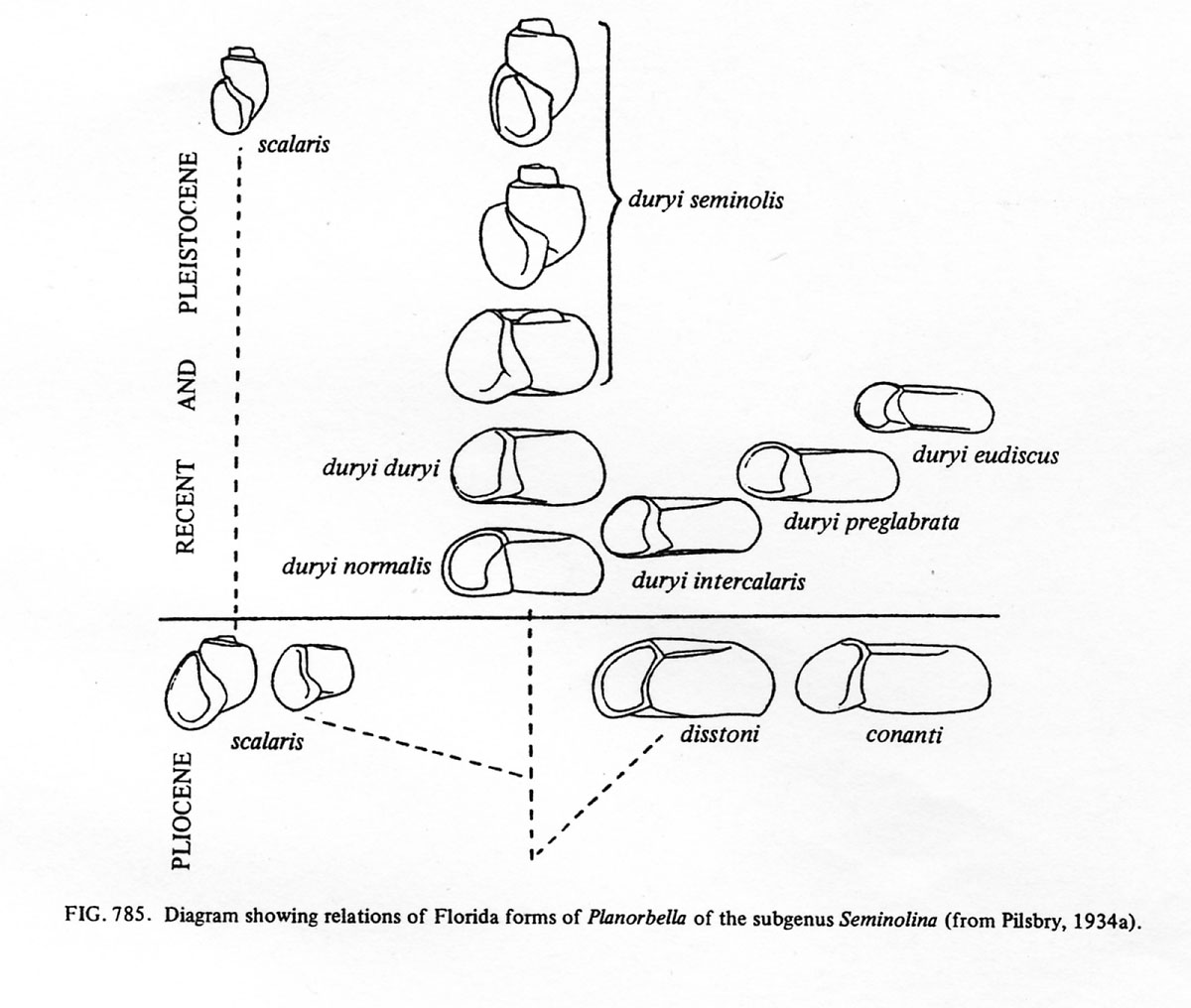
As all of us in this group are aware, the taxonomy of freshwater gastropods both here and around the world rests largely, if not entirely, on shell morphology. In Florida, the related species Helisoma duryi and H. scalare are characterized by a broad, "buliniform" shell morphology very much like the H. trivolvis population of the rocky channel at Wakendaw. Burch reprinted a lovely 1934 figure of H.A. Pilsbry's suggesting evolutionary relationships among duryi, scalare, and several other species of Florida planorbids with low, more typical spire heights back to the Pliocene (above). I hate to be cynical, but I can think of an easier explanation.

Monday, January 24, 2005

Gillia Rediscovered


I am pleased to report the rediscovery of Gillia altilis in South Carolina, the 26th freshwater gastropod taxon confirmed living in the state today. This discovery, in addition to its value as an item of general good news, has strengthened a couple of convictions I've held for some time, perhaps of some broader interest, perhaps now worth sharing.

But first, a bit of biological background. Faithful correspondents may remember an essay I posted on 26May04 admitting my own long standing confusion regarding Gillia, Amnicola, Lyogyrus and Somatogyrus, four hydrobiid genera of the southern United States bearing similarly plain shells. That essay featured a photo comparing the four taxa that may be worth revisiting [Somatogyrus in the Southeast].

In any case, Gillia is much larger than any of these other hydrobiid genera, and is really quite unmistakable, now that I've held one in my hand. The Figure Below shows a 7.8 mm individual crawling in a beaker. The collection I made earlier this month was comprised entirely of adults ranging from 6 - 8 mm in shell length, twice the size of typical adults from either Amnicola or Somatogyrus, three times that of Lyogyrus. The shell is intermediate in thickness between the lightly-shelled Amnicola, more characteristic of lentic environments, and the heavily-shelled Somatogyrus, an inhabitant of rocky riffles.


Gillia altilis was first described by Lea (1841) using specimens sent him from the Santee Canal, an 1800 - 1850 passage between the port of Charleston and the Santee River 40 miles north. Only remnants of that canal remain today. The Charleston Museum holds two nineteenth-century lots of Gillia, one labeled simply "Santee Canal" and the other "Lynch's Creek."
.
I rediscovered the species Tuesday, January 11, at the US 52 bridge over the Lynches River 8 miles south of Florence, where I'd stopped on a whim. We'd had two weeks of unusually mild weather here in the southeastern US, and very little rainfall. The Lynches River was very low, and the morning so warm and bright, I pulled off the road primarily to stretch my legs and enjoy the fresh air. The water was black (as normal) but clearer than usual. I found Gillia altilis moderately common on the riprap used to stabilize the banks directly under the bridge. Individuals were also grazing on hard-packed clay. Three other freshwater gastropods were also present: Physa acuta, Goniobasis catenaria catenaria, and Amnicola limosa. Sometimes it seems to me that hydrobiid populations are positively associated - the occurrence of one species making a second more likely.

Here's the first moral I have derived from this experience - the value of revisiting sample sites. I had previously made collections at this site at least three or four times in the past under good conditions and had never found a trace of Gillia. Certainly, I had no previous observations from the winter, nor had I previously sampled water conditions quite this low. But I feel certain that Gillia is a perennial, and as common and conspicuous as the things were earlier this month, it's hard to believe I missed them entirely four times. I was tempted to subtitle this essay, "Humbled by hydrobiids again."

I've had similar experiences many times in the past. There's a spot on the Combahee River at Yemassee about 50 miles south of Charleston, for example, I've sampled at least annually for eight years. It's the type locality of Physa hendersoni, which we've been using for experiments on reproductive isolation in pulmonates. Prior to last March I had catalogued five pulmonate species from the site, generally collected during the course of my hunts for P. hendersoni. Last March, however, I found every stick and rock in the Combahee River covered with Amnicola granum, a species of which I had no prior record, and the five pulmonates had almost vanished. Freshwater gastropod populations are flashy. Revisit your sites.

The second moral of this story is never to underestimate the hidden potential of crappy rivers. The Lynches River arises in the lower piedmont of South Carolina, and on its roughly 150 mile journey to join the Pee Dee River passes through a watershed characterized by intensive row crop farming. Erosion and sedimentation have certainly been major problems for over 300 years, and who knows what sort of chemicals they spray on that cotton. Yet Goniobasis is very common in several of its upstream tributaries, and (again, as faithful readers may remember) the only modern record of Lioplax in South Carolina is also from the Lynches, about 40 miles upstream from the US 52 bridge (See my post of 26Aug04). To appreciate the biodiversity value of any river, one needs much more than a glance at a map and a few casual visits.

The web page I posted on 9Mar04 to report the results of my (510 record) survey of the Freshwater Gastropods of South Carolina is now badly out of date. In the section on "recommendations" I wrote:
"The status of Gillia altilis in South Carolina, its type locality, is worrisome. Burch & Tottenham (1980) quote the range given by Walker (1918): 'Atlantic drainage from New Jersey to South Carolina,' although populations apparently live as far north as Vermont and west to Lake Ontario (Jokinen 1992). I have seen fairly recent collections of Gillia from the Waccamaw River of southern North Carolina, but have to date been unable to confirm its modern occurrence here."
The modern occurrence of Gillia in South Carolina is now no longer in doubt. It is the continued existence of the species here that becomes the question. Gillia should shoot right to the top of our state list of aquatic species of concern.

Monday, November 29, 2004

Gigantic Pulmonates

Editor's Note #1.  This essay was published as: Dillon, R.T., Jr. (2019b)  Gigantic pulmonates.  Pp 113-120 in The Freshwater Gastropods of North America Volume 2, Essays on the Pulmonates.  FWGNA Press, Charleston.
Editor's Note #2. I subsequently re-identified the planorbid population inhabiting this "fancy landscape pond" as Helisoma scalare duryi.  See my posts of [5Jan21] and [7Feb23].

The fancy landscape at the office park near my home in Charleston features a narrow pond, perhaps three meters deep and over 100 meters long, with concrete lining and a natural earth base. It is inhabited by our three local pulmonate weeds (Physa acuta, Helisoma trivolvis, and Lymnaea columella) as well as by mosquito fish, tadpoles, and a variety of macrophytes both submerged and emergent. This pond has long served as the water source for my laboratory cultures of pulmonates, and as such I have visited it approximately every two weeks for 6 - 8 years.

About a month ago the pond was drained for cleaning. A crew subsequently spent quite a few days shoveling leaves, mud, vegetation and organic debris from the basin, leaving a few shallow pools scattered on a clean mud bottom. The photo at left above shows the drying pond at its lowest end, with the concrete standpipe that ordinarily regulates water depth in the background. A high-resolution close up of one of the drying pools with Helisoma trivolvis (both the living and the dead) much in evidence, can be downloaded [here]. As the figure below illustrates, the individual Helisoma were exceptionally large.
.
A similar phenomenon also seems to occur occasionally in the Physa acuta population inhabiting the main pond at Charles Towne Landing State Park. I have many years of casual observations on this population, which has served as my source of control snails for experiments on the reproductive biology of Physa since 1988. In culture, P. acuta from this population reach maturity at about 6 mm shell length (seven weeks post hatch), and have never grown larger than about 12 mm when reaching the end of their life at 12 - 13 months of age (Wethington & Dillon 1993, 1997). For years I never saw an individual larger than about 12 mm in the wild. But on a casual visit in March, 2001, I discovered that the population was comprised almost entirely of gigantic individuals, 15 - 20 mm in shell length (below).


What might cause such sporadic cases of gigantism? Growth is indeterminate in all the basomatophoran pulmonates of which I am aware. But since growth rate slows dramatically at onset of reproduction, maximum size effectively becomes a function of size at maturity. Following Charnov and similarly minded evolutionary biologists from the 1980s and 1990s, I have suggested that size at maturation in pulmonates may be a function of survivorship schedule (Dillon 2000: 140 - 149).

In both my local Helisoma population and my local Physa population, gigantism appeared in the fall or winter and was not associated with parasitism. Both populations seemed stressed by low water, and probably severe temperatures. But neither population appeared to be starving, at least in the long term. And perhaps most strikingly, in neither population were eggs or juveniles in evidence. It is my hypothesis that gigantism in pulmonates may be prompted by some environmental perturbation postponing, perhaps even canceling, reproductive maturity.

Such a perturbation, although perhaps ongoing as gigantic individuals are observed, must have begun earlier in the season, when maturation would in an ordinary year have taken place. Its effect would be to improve survivorship above expected levels, perhaps through an unusual reduction in predation, parasitism, or disease. Did something kill the predators that ordinarily live in the ponds with my gigantic pulmonate populations without adversely affecting the snails themselves, triggering a growth spurt?

And do systematic malacologists have a history of being fooled by gigantism? About 300 km up the coast from where I write this essay is the home of Helisoma ("Planorbella") magnifica, a pulmonate of truly gigantic proportions (Figure below from plate 96 of Baker). Long feared extinct, a couple scattered populations of H. magnifica were re-discovered in 1988 near Wilmington, North Carolina, by Bill Adams and Andy Gerberich. The subsequent history of this species, tragic and comic by turns, is a tale best left for another day, and another teller. I know that a sample of H. magnifica was held in culture for a number of years, and that at least occasionally, magnifica adults bore offspring subsequently identified as H. trivolvis, with which magnifica co-occurs. The morphology of H. magnifica does not suggest simple gigantism of H. trivolvis, however, the magnifica shell being much more boxy and broad than the trivolvis shells shown above. The extent to which the shape of the pulmonate shell may be influenced by environmental cues is another topic upon which we might chew in the future.


For what its worth, our colleague Art Bogan and his colleagues (2002) reported mtDNA sequence divergence in the 4 - 9% range between a sample of four H. magnifica and sample of 9 H. trivolvis collected in Union County, a couple hundred kilometers west of Wilmington. Given Art's observation that sequence divergence within conspecific Helisoma populations ranged over 3%, however, a comparison of magnifica to a trivolvis population with which it co-occurs would have been much more cogent. But regardless of the status and fate of H. magnifica, the existence of great phenotypic plasticity in shell morphology should remain foremost in the minds of all of us struggling with the taxonomy and classification of freshwater pulmonates.


References
  • Adams, W.F. & A. G. Gerbeich (1988) Rediscovery of Planorbella magnifica in southeastern North Carolina. Nautilus 102: 125-126.
  • Baker. F. C. (1945) The Molluscan Family Planorbidae. University of Illinois Press, Urbana.
  • Bogan, A.E., M. Raley, & J. Levine (2002) Conservation status of the magnificent ramshorn, Planorbella magnifica (Pilsbry, 1903), endemic to the lower Cape Fear River Basin, North Carolina. Abstract, American Malacological Society, Charleston.
  • Dillon, R. T., Jr. (2000) The Ecology of Freshwater Molluscs. Cambridge University Press.
  • Wethington, A. R. & R. T. Dillon (1993) Reproductive development in the hermaphroditic freshwater snail, Physa, monitored with complementing albino lines. Proc. R. Soc. Lond. B 252: 109 - 114. [pdf]
  • Wethington, A. R. & R. T. Dillon (1997) Selfing, outcrossing, and mixed mating in the freshwater snail Physa heterostropha: lifetime fitness and inbreeding depression. Invert. Biol. 116: 192-199. [pdf]

Wednesday, October 27, 2004

Proceedings of the Charleston Symposium


As you may recall, the 2002 meeting of the American Malacological Society here in Charleston featured a symposium entitled, "The Biology and Conservation of Freshwater Gastropods." Our colleague Amy Wethington organized a related special session at that same meeting, "Pulmonates in the Laboratory."

Now (at long last!) I'm pleased to report that 12 papers from those two sessions have reached publication in the American Malacological Bulletin, Volume 19: 31 - 144. A table of contents is provided below.Single issues of the AMB are available from the office of the Editor-in-Chief: Dr. Janice Voltzow, Department of Biology, University of Scranton, Scranton, PA 18510-4625. The cost: $40 for members, $48 for non-members. Email Janice for more details: voltzowj2@Scranton.edu


Thanks to all of you on this list who were involved in bringing this symposium to successful fruition.


----------- AMB 19:31-144 (14Oct04) ---------------
  • Dillon, R. T., Jr. The biology and conservation of freshwater gastropods: Introduction to the symposium.
  • Richards, David C. & Dianne C. Shinn Intraspecific competition and development of size structure in the invasive snail, Potamopyrgus antipodarum.
  • Mower, Christina B. & Andrew M. Turner Behavior, morphology, and the coexistence of two pulmonate snails with molluscivorous fish: A comparative approach.
  • McCarthy, Thomas M. Effects of pair-type and isolation time on mating interactions of a freshwater snail, Physa gyrina (Say, 1821).
  • Brown, Kenneth M., and Paul D. Johnson Comparative conservation ecology of pleurocerid and pulmonate gastropods of the United States.
  • Dillon, Robert T., Jr., Charles E. Earnhardt, and Thomas P. Smith Reproductive isolation between Physa acuta and Physa gyrina in joint culture.
  • Dillon, Robert T., Jr., & Robert C. Frankis High levels of mitochondrial DNA sequence divergence in isolated populations of the freshwater snail, Goniobasis.
  • Stewart, Timothy W. & Robert T. Dillon, Jr. Species composition and geographic distribution of Virginia's freshwater gastropod fauna: A review using historical records.
  • Britton, David K., & Robert F. McMahon Environmentally and genetically induced shell shape variation in the freshwater pond snail Physa (Physella) virgata.
  • McMahon, Robert F. A 15-year study of intrapopulation, interannual shell-shape variation in a freshwater, pulmonate limpet population (Pulmonata: Basommatophora: Ancylidae).
  • Glaubrecht, Matthias Leopold von Buch's legacy: Treating species as dynamic natural entities, or Why geography matters.
  • Wethington, Amy R. & Robert Guralnick Are populations of physids from different hot springs distinctive lineages?
And forthcoming in the next AMB:
  • Jokinen, Eileen H. Pond mollusks of Indiana Dunes National Lakeshore: Then and now.

Tuesday, September 28, 2004

Goniobasis and Elimia


The freshwater ceritheacean family Pleuroceridae is generally reckoned to encompass seven North American genera. Although the names for six of these genera are widely agreed upon, the name of the largest genus has become controversial in the last 20 years. Here I review the history of the genus name Goniobasis and its recently resurrected synonym, Elimia. I conclude that Elimia should have been suppressed, but that at this juncture the loss of either name would result in more confusion than retaining both.
  1. The genus Elimia was proposed by H & A Adams (1854) without type designation. Since the 16 species contained in the genus were extremely diverse, including what today would be recognized as three different genera (Goniobasis, Pleurocera, and Lithasia), the genus was not accepted by contemporary workers. It was specifically rejected by Haldeman (1863).
  2. The genus Goniobasis was proposed by Lea in 1862 with a description sufficient to distinguish the group.
  3. The first monograph of the American Pleuroceridae ("Strepomatidae") was that of Tryon (1873). He recognized Goniobasis as a natural group. Regarding Elimia, he wrote: "We quote the full lists of species given by Messrs. Adams, in order that the insufficiency of their genera may become more apparent from the incongruous assemblage of shells of which they have composed them." (pg xii)
  4. Pilsbry & Rhoads (1896) revived Elimia, designating acutocarinata as type by virtue of its first listing in the alphabetical arrangement of H & A Adams. But Pilsbry used Goniobasis for the three species of that group covered in his 1896 paper, and in many subsequent papers (e.g., Pilsbry 1916). He himself never used the genus Elimia.
  5. Hannibal (1912) designated osculata (Lea 1862) as the type species of Goniobasis.
  6. The North American mollusks were reviewed by Walker (1918). Walker used Goniobasis, writing (Pg 149): "Dr. Pilsbry has more recently decided that Goniobasis should be restored to its former position as a generic term, on the ground that Elimia was a composite group."
  7. The family Pleuroceridae was next monographed by Goodrich, in a series of papers published from 1922 - 1944 (e.g., 1936, 1940, 1942). Goodrich used Goniobasis. Although the literature continued to contain occasional references to Oxytrema (Raf.) and rare uses of Elimia, almost all workers followed Goodrich through the next 50 years.
  8. The literature contains, I believe, about four or five instances of the genus Elimia between 1918 and 1978 in total. I would estimate the usage of Goniobasis during this 60-year period to be one or two per year. A review of the Zoological Record 1970 - 1979 shows 13 instances of Goniobasis, 3 of Oxytrema, and none of Elimia.
  9. Burch (1979) resurrected Elimia for his (1980, 1982) monograph "North American Freshwater Snails." He wrote (1982:271), "Elimia H & A Adams 1854 is used in place of its better known synonym Goniobasis Lea 1862." Burch (2001) subsequently added, "Since Elimia H. & A. Adams 1854 has clear priority over Goniobasis Lea 1862, an appeal could have been made by me (or someone else) to the International Commission on Zoological Nomenclature in an attempt to conserve the name Goniobasis. But having knowledge of - and in fact participating in - the long battle to get the genus name Pleurocera conserved to fit its common usage convinced me that such an endeavor to save the use of the junior synonym Goniobasis would be futile, and in any event would take an inordinate amount of time, and certainly try the patience of malacologists."
  10. No consensus has followed. The Zoological Record for the period 1980 - 1989 reported 29 uses of Goniobasis and 9 uses of Elimia, and for the period 1990 - 2000 reported 10 uses of Goniobasis and 37 uses of Elimia. The classification of Vaught (1989) used Goniobasis, and that of Turgeon et al. (1998) used Elimia. The U.S. Endangered species list uses Elimia.
As the clear choice of Haldeman, Tryon, Pilsbry, Walker, Goodrich, and almost every other professional malacologist for over 100 years, the nomen Goniobasis has been attached to a great and valuable literature. The nomen Elimia, which should have been suppressed 25 years ago, has nevertheless also become attached to a significant literature. The loss of either name at this point would be unconscionable. Thus it seems to me that both names ought to remain in currency, and that authors preferring Goniobasis should refer to "Elimia" in their text, while authors preferring Elimia also refer to "Goniobasis."

Those of us who are familiar with the English language have come to accept, in fact even expect, synonyms. If I ask for or request a soda or a pop with my hot dog or frank I will get or receive the same thing. Synonyms are a stable component of daily communication, and do not necessarily lead to confusion. So regarding Goniobasis or Elimia, as my daughter used to say, "Whatever!"

References

Adams, H. and A. Adams. 1853 - 58. The genera of recent Mollusca; arranged according to their organization ( 3 Vols.). John Van Voorst, London.
Burch, J. B. 1979. Genera and subgenera of Recent freshwater gastropods of North America (North of Mexico). Malacological Review 12:97-100.
Burch, J. B. 1982. North American freshwater snails: identification keys, generic synonymy, supplemental notes, glossary, references, index. Walkerana 4:1-365.
Burch, J. B. 2001. On the genus name Goniobasis (Elimia - Gastropoda: Pleuroceridae) and other recent nomenclatural inconsistencies. Walkerana 12:97-105.
Burch, J. B. and J. Tottenham. 1980. North American freshwater snails: species list, ranges, and illustrations. Walkerana 3:1-215.
Goodrich, C. 1936. Goniobasis of the Coosa River, Alabama. Misc. Publ. Mus. Zool. Univ. Mich. 31:1-60.
Goodrich, C. 1940. The Pleuroceridae of the Ohio River system. Occas. Pprs. Mus. Zool. Univ. Mich. 417:1-21.
Goodrich, C. 1942. The Pleuroceridae of the Atlantic coastal plain. Occas. Pprs. Mus. Zool. Univ. Mich. 456:1-6.
Haldeman, S. S. 1863. On Strepomatidae as a name for a family of fluviatile Mollusca, usually confounded with Melania. Proc. Acad. Nat. Sci. Phila. 15: 273 - 274.
Hannibal, H. 1912. A synopsis of the Recent and Tertiary freshwater Mollusca of the California Province, based upon an ontogenetic classification. Proc. Malacol. Soc. Lond. 10:112-211.
Lea, I. 1862. Description of a new genus (Goniobasis) of the family Melanidae and eighty-two new species. Proc. Acad. Nat. Sci. Phila. 14:262-272.
Pilsbry, H. 1916. Goniobasis in western Pennsylvania. Nautilus 30:4-5.
Pilsbry, H. and S. Rhoads. 1896. Contributions to the Zoology of Tennessee, Number 4, Mollusca. Proc. Acad. Nat. Sci. Phila. 1896:487-506.
Tryon, G. W., Jr. 1873. Land and Freshwater Shells of North America. Part IV, Strepomatidae. Smithsonian Miscellaneous Collections, vol. 253. Washington, DC.
Turgeon, D., J. et al. 1998. Common and Scientific Names of Aquatic Invertebrates from the United States and Canada: Mollusks. Special Publications, vol. 26. American Fisheries Society.
Vaught, K. 1989. A Classification of the Living Mollusca. American Malacologists, Melbourne, FL.
Walker, B. 1918. A Synopsis of the Classification of the Freshwater Mollusca of North America, North of Mexico. Misc. Pubs., vol. 6. University of Michigan Press, Ann Arbor.

Thursday, August 26, 2004

Lioplax in South Carolina


Every year about this time I deliver a lecture to my Biology 111 students entitled, "The Scientific Method." I always emphasize that this may be the most important lecture of their careers as scientists. And I begin by defining "science" as the construction of testable models about the natural world, accenting the word testable. A model need not be correct - in fact, it is commonly argued that no model of the natural world can ever be proven correct. But I always try to drive home to the freshmen that any hypothesis, theory or model of nature that is testable, verifiable, or falsifiable can make a contribution to science. Anything else is screwing around with a lab coat on.

Judging from subsequent examinations, however, I've been forced to conclude that the minds of college freshmen are generally focused elsewhere on the first day of class. And to judge from the quality of the typical paper published in the literature of evolutionary biology today, there are precious few opportunities to make up the missed material between the freshman year and the Ph.D. I suspect there's something about DNA sequence data in particular that promotes clueless data-dredging, but I digress.


Earlier this summer my faith in the scientific method was refreshed by an email from Ms. Laura Kirk, Park Interpreter at Lee State Natural Area near Bishopville, SC. She reported collecting a snail from the nearby Lynches River unidentifiable through the dichotomous key I published on my brand new "Freshwater Gastropods of South Carolina" web site, not matching any of the photos or descriptions I had posted. She attached a photo of the beast, which after some correspondence I came to realize was Lioplax subcarinata (above). Hers was the first modern record of the species in this state.

The March 9 Version of my FWGSC web site, which was still up (as of August 24, 2004, but badly in need of revision), constituted a testable model of the natural world. I stated that there are 24 freshwater gastropod species in South Carolina. And in a matter of two months, a scientist with whom I had no prior contact disproved that hypothesis, bringing the total to 25. (There may now be a 26th species as well, but that's another story.)

This Saturday just past I traveled to Lee State Natural Area and was able to collect a large sample of Lioplax from the Lynches River. The river is perhaps 10 meters across in this region of the state, rather steeply incised into its banks. Fallen trees and woody debris constitute the only solid substrate. The water is generally turbid but has fairly good flow, over a bottom of sand and mud (below.)

The Lioplax were burrowing in extremely flocculent mud in backwater eddies. "Burrowing" is a poor word for it, because the mud was very loosely aggregated in these pools, and would seem to require almost no extra expenditure of energy to penetrate. The snails seemed more "suspended in" than "burrowing through" the substrate. I made my collection by wading knee-deep into 4 cm of water and feeling with my hands.

The animals looked much like Campeloma, with very pale body coloration. They were unusually small for viviparids, none larger than 16 mm in shell length. But my examination of four individuals ranging from 12 mm to 15 mm showed all to be mature, one male and three females bearing early-stage embryos. Their shells bore spiral cords of varying strength, some quite fine.

The relevant paragraph on the "Recommendations" page of the present (9Mar04) version of my FWGSC site reads as follows: "There may be cause for some conservation concern regarding Lioplax subcarinata. This fairly large and conspicuous species is restricted to Atlantic drainages, nominally ranging from New York to South Carolina (Clench 1962). But Lioplax seems to have been extirpated from New York (Jokinen 1992), and we have been unable to confirm its presence here at the southern terminus of its range as well. Lioplax does seem at least locally common in North Carolina and Virginia, however, so the situation may not as yet be critical."

Although the penultimate sentence of that paragraph will obviously require some modification, I think the other sentences remain okay as they currently read, at least for the present. I still suspect that there may be some cause for conservation concern regarding Lioplax, depending on its abundance through the meat of its range to the north. Stay tuned!