Dr. Rob Dillon, Coordinator


Saturday, September 17, 2005

Pomacea in Georgia


Expanding on the theme of my post last month, this morning's newspaper carried an Associated Press article with the following headline: "Snails Threaten Georgia Wetlands." Georgia DNR is reporting the discovery of a reproducing population of invasive Pomacea in ponds and streams of the Alabaha River system, a tributary of the Satilla in SE Georgia. Although not actually in the drainage of the Okefenokee Swamp, officials are concerned that the snail might be spread 20 miles south to the Swamp and cause significant environmental damage. A press release from the Georgia DNR-Wildlife Resources Division (upon which the AP article was based) is appended below.

The article refers to Pomacea as the "channeled apple snail," which is a good, descriptive common name. Elsewhere in the world the critter is more commonly called the "golden apple snail," because (at least initially) many of the populations were albinistic. The snail has become a terrible pest in Hawaii and throughout east Asia where rice and taro are grown. Breeding populations have also become established in Florida, Texas, and California. I've appended a few web references below the Georgia DNR article if you'd like to learn more.

Meanwhile, we here in Charleston are once again manning the southern breastworks. First Sherman and now this. Perhaps we'll have a bit more time to prepare for this invasion than the last.

-------------
Ga Wildlife Resources Division News Story
BLACKSHEAR, Ga. (9/13/2005)
Invasive South American Snails Breeding in South Georgia

It’s just the kind of tourism Georgia doesn't need. Recent surveys conducted by the Georgia Department of Natural Resources, Wildlife Resources Division (WRD) have documented breeding populations of a large, invasive species of snail native to South America. During a recent search, WRD biologists removed 79 of the channeled apple snails and 151 egg masses from a pond in Pierce County in a span of less than four hours.

A live snail found near the Alabaha River in Pierce County in early 2005 was identified as a channeled apple snail. The specimen was the first of its kind discovered in the state. Since then, live apple snails and eggs have been found in several ponds and streams in the Alabaha River system, a tributary of the Satilla River in Southeast Georgia.

"These snails have a voracious appetite for aquatic plants, which many native species depend on for foraging and shelter," said WRD Wildlife Biologist Brett Albanese. Shells of channeled apple snails can reach a width of more than two inches and a height of three inches, and are yellowish to brown in color. Channeled apple snails have established populations in at least six Florida counties, and breeding populations of the species also exist in Texas, California and Hawaii.

Initial findings of the snails in Georgia raised speculation that the specimens might have been aquarium pets released into the wild, but the subsequent discovery of a large population in a popular fishing spot may indicate otherwise. "We now suspect that these snails may have hitched a ride into Georgia on a fishing boat that had been in Florida waters, where the apple snail has also been introduced," said WRD Fisheries Technician Chad Sexton.

The discoveries were of particular interest to biologists because of the invasive nature of the species. An array of problems can arise when pet owners or fishermen introduce non-native species into Georgia’s waters. Non-native or nuisance species can be spread when anglers release live bait into the water or move between water bodies without cleaning boats and trailers.

The WRD Fisheries Management Section and the WRD Nongame Wildlife and Natural Heritage Section have been working to monitor the spread of apple snails in the Alabaha River system. They are experimenting with trapping and manually harvesting adult snails from ponds and streams and manually removing the egg masses from trees. "Although the track record for eradicating non-native species is not promising, biologists hope that they can halt or slow the spread of these snails in South Georgia," Albanese said. "One reason for optimism is that we can target two life stages of the snails ­ both the eggs and the adults ­ for removal."

Conservation agencies nationwide are working to stop the spread of non-native aquatic plants and animals, citing concerns about the potentially harmful impact to native species. "The wrong organism in the wrong place can eat or out-compete native species, which can have serious impacts on an entire aquatic community. Invaders can also spread non-native diseases," Sexton said.

For more information about aquatic nuisance species, visit http://www.protectyourwaters.net/ or http://www.gofishgeorgia.com/. Additional information on identifying apple snails is available at http://www.applesnail.net/. Georgia residents who think they have found an apple snail should collect it, photograph it and provide detailed locality information to WRD Fisheries Management in Waycross at (912) 285-6094, or WRD Headquarters at (770) 918-6400. Citizens should also be on the lookout for the apple snail’s bright pink eggs, which are laid on trees and shrubs above the waterline.


--------------------
On-line Pomacea References:


Addendum, 21Sept05

To the FWGNA group:

Our thanks are due to Bob Howells for the update on Texas Pomacea copied below. Bob has also sent me three nicely-produced fliers on the subject, which are now available for download from the FWGNA site.

Bob is most smitten by recent DNA evidence suggesting that his Texas Pomacea are not true P. canaliculata, as have been introduced throughout the Pacific, but rather something else. Given the ease with which these animals can be cultured, however, I think it would be a shame to jump to such a conclusion without controlled breeding experiments. I understand that TX/HI Pomacea crosses are next on Ken Hayes' to-do list. Right, Ken?

Keep in touch!
Rob

-----------------------------
Subject: RE: Pomacea in Georgia
Date: Mon, 19 Sep 2005 08:32:37 -0500
From: "Robert Howells" Robert.Howells@tpwd.state.tx.us
To: "Rob Dillon" dillonr@cofc.edu

Rob,
Thanks for the heads up on the most recent applesnail information. There are a few points of interest. (1) We (TPWD/USDA/etc.) heard about the first Pomacea collections in Georgia last Spring…literally during a USDA applesnail meeting being held at that time in Houston. However, additional specimens have turned up in Georgia more recently. (2) Rob Cowie and his associates have determined that the large channeled Pomacea we have in the U.S. (those tested so far…) are not true P. canaliculata like those in Hawaii and in the Philippines. (3) The ANSD article was rewritten extensively by the editor and without my knowledge or approval. It contains some completely false information. Never cite it!!!! (4) I have gotten together with Alex Karatayev and Lyubov Burlakova (SFASU) and Romi Burks and one of her students (SWU) and drafted a chapter for a book by Ravi Joshi on Ampullariidae. We have addressed all the species of Ampullariidae in North America (there was actually a Canadian introduction a while back). Joshi expected the book out sometime this fall. Our chapter has a lot of photographs and range maps as well as a lot of new information on Texas populations being generated by the academic folks in Texas. (5) Attached are some handouts related to Pomacea in Texas that update status and terminology.

Bob H.

---------------------
Howells, R. G. (2005) Exotic Applesnails in Texas Waters [PDF]
Howells, R. G. (2005) Invasive Applesnails in Texas: Status of these harmful snails through spring 2005 [PDF]
Howells, R. G. (2005) Channeled Applesnails: Recommendations to Prevent Their Spread [PDF]

Thursday, August 11, 2005

Ampullariids Star at Asilomar


I am pleased to report that the annual meeting of the American Malacological Society, held in late June at the Asilomar Conference Center near Monterey, CA, was a great success. The registered attendance of about 150 well-assorted malacologists combined to present 120 papers and posters, including 10 on freshwater snails, as appended to the end of this message. Abstracts are available from the AMS web site:
http://www.malacological.org/

The quality of the papers was generally excellent. And on Monday morning June 27, Yoichi Yusa of Nara Women’s University (yusa@cc.nara-wu.ac.jp) may have presented the most important research results I have ever heard in my 29 years of scientific meetings.

Although most mollusks are gonochoristic (sexes separate), great mystery has long surrounded molluscan mechanisms of sex determination. There have been a couple scattered reports of sex chromosomes in prosobranch gastropods. The research of Stan Allen, Ximing Guo and their colleagues in the 1990s suggested that sex determination in (partially protandric) oysters seems to be controlled by a single locus with a dominant male allele. But population sex ratios are often way off 1:1 in the Mollusca, and sometimes the bias may be attributable to differential growth or survivorship in the sexes, or partial protrandry, and sometimes it clearly isn’t.

At Asilomar Yusa described an impressive series of breeding experiments strongly suggesting that gender in Pomacea canaliculata is controlled by a small number of additive sex-determining genes, apparently scattered through the genome, inherited from both parents. Such an oligogenic sex determining mechanism has never before been suggested for the Mollusca. It seems clear to me that sex ratios might easily vary from 1:1 in this situation, especially in populations subject to drift and bottlenecks, such as many freshwater prosobranch snails. The evolutionary implications are profound.

While we’re on the subject of the Ampullariidae, I should also report that Ken Hayes (working with Rob Cowie at the University of Hawaii – Manoa, khayes@hawaii.edu) has been sequencing the daylights out of the family. He has (to this point) sampled somewhere around 9 – 13 Pomacea species from the Americas, as well as representatives of the genera Marisa, Asolene, Lanistes and Pila. His database currently includes about 435 individual CO1 sequences, from 40 populations in their native ranges and 80 introduced populations.

The big headline (from my outside perspective) is that Ken seems to find that sequence methods are useful in discriminating Pomacea species. Freshwater and terrestrial gastropods both typically show great intrapopulation sequence variation, to the point that the distinction between populations known to constitute valid biological species may be swamped. But Ken reports that the mean maximum intraspecific sequence divergence in his Pomacea data set is around 5%, while mean minimum interspecific divergence is around 10%, suggesting that sequence data may prove to be a useful tool for specific diagnosis in the Ampullariidae.

Although the various Pomacea species are not terribly difficult to culture, I don’t believe that Ken has breeding data of sufficient quality to absolutely confirm the biological status of his nominal species groups. Thus his sequence data, strictly speaking, remain uncalibrated. But he reassures me that anatomical morphology supports the specific distinctions being made by his CO1 sequences in all cases where they’ve looked. Regardless, it’s nice to see sequence data find some application not dependent on the tenuous assumptions of phylogenetic reconstruction.


--------------

Freshwater gastropod presentations at AMS 2005, Asilomar:
  • Robert T. Dillon, Jr., John D. Robinson, and Amy R. Wethington. Empirical Estimates of Reproductive Isolation Among the Freshwater Pulmonate Snails Physa acuta, P. pomilia, and P. hendersoni.
  • Kenneth A. Hayes. Preliminary phylogenetic assessment of invasive apple snails in Asia and beyond.
  • Cynthia G. Norton and Jennifer M. Bronson. The relationship between body size, growth, and egg production in the hermaphroditic freshwater snail, Helisoma trivolvis.
  • Robert S. Prezant and Eric J. Chapman. Temporal Community Structure and Biodiversity of Malacofauna from an Urban New Jersey Pond.
  • David C. Richards, C. Michael Falter, Gary T. Lester, Ralph Myers. Mollusk Survey and Basic Ecological Studies in Hells Canyon, Snake River, USA.
  • Ellen E. Strong. New morphological data for Pleuroceridae (Gastropoda, Cerithioidea): implications for monophyly and affinity of the family.
  • Andries Ter Maat, Cora Montagne-Wajer and Joris M. Koene. The year of the pond snail.
  • Lori Tolley-Jordan. Impacts if urbanization on the biodiversity of the imperiled snail fauna (Gastropoda: Prosobranchia: Pleuroceridae) of the Cahaba River, Alabama, USA.
  • A.R. Wethington, M.K. Smith, G. Oliveira, F. Lewis, and D.J. Minchella. Genetic Structure of Biomphalaria glabrata populations sampled from a schistosomiasis endemic region.
  • Yoichi Yusa. Genetics of Sex Ratio Variation in the Apple Snail, Pomacea canaliculata.

Thursday, June 23, 2005

New Zealand Mudsnail Conference


The introduction of the "New Zealand mud snail" (Potamopyrgus antipodarium) into steams of the American West has been attended by a blossoming of interest in what was already perhaps the best-known freshwater prosobranch. Our colleagues in Montana deserve special commendation for their remarkable research efforts in this regard.

Below is an announcement for the 4th (yes, fourth!) NZMS Conference, scheduled for Bozeman in mid-August. There's still time to submit an abstract, but hurry! Contact Dave Richards directly for more details.

And follow some of those links from the conference web site given below if you want to be impressed at the state of our knowledge on Potamopyrgus!


---------------
From: "David Richards" davidr@montana.edu
To: "Rob Dillon" DillonR@cofc.edu
Subject: 4th NZMS Conference
Date: Tue, 3 May 2005 09:39:12 -0600

Just a reminder the 4th New Zealand Mudsnail Conference will be held August 16-18, 2005at Montana State University, Bozeman, MT. For more info go to: http://www.esg.montana.edu/aim/mollusca/nzms/con4.html

Call for papers ends June 30. So get your abstracts in by then!!

Hope to see you all there!
David Richards
Ph.D.Research Ecologist,
EcoAnalysts Inc.
406.580.7816
davidr@montana.edu

Monday, May 9, 2005

Ivory-billed Freshwater Gastropods


Congratulations are in order for our colleagues Jeff Garner of the Alabama DCNR and Stephanie Clark of the University of Alabama! Last week The Nature Conservancy announced that both researchers have recently rediscovered freshwater gastropods previously feared extinct. An article from The Birmingham News is appended below.

Jeff collected Goniobasis vanuxemiana and G. lachryma diving in the Coosa River below the Logan Martin Dam east of Birmingham. Stephanie found Clappia cahabensis in the Cahaba River south of Birmingham, closer to Tuscaloosa. Their discoveries were unrelated but highly coincidental - both occurred last year and were reported independently at the annual Alabama Mollusk Meeting. TNC's decision to issue a combined press release last week was prompted by the big Ivory-billed Woodpecker buzz.

Good job to all involved!


------[The Birmingham News 3May05]-----------

Biologist, student find 3 snails thought to have been extinct
Coosa, Cahaba Rivers turn up prizes the discovery of snails believed to have been wiped out by human actions
Tuesday, May 03, 2005
KATHERINE BOUMA
Birmingham News staff writer

Three snails listed as extinct have been rediscovered in Alabama's rivers, the Nature Conservancy plans to announce today.

Jeff Garner, the Alabama Department of Conservation and Natural Resources' mollusk biologist, rediscovered the cobble elimia and the nodulose Coosa River snail on a stretch of the Coosa that remains free-flowing between Lake Logan Martin and Neely Henry Lake. And Stephanie Clark, a postdoctoral student from Australia, found a Cahaba pebblesnail in the Cahaba River in Bibb County.

Alabama is recognized as the globe's most densely populated home of mollusks - the snails and mussels that dot the beds of rivers, the acres of white shells that gave Muscle Shoals its name. The state also is known to be the nation's top spot for extinct and imperiled mollusks. Of 174 species of aquatic snails to occur here, 39 are presumed to be extinct.

The Coosa River is home to hundreds of aquatic animals, making it a global hot spot for snails and mussels. For that reason, it also has a more lethal distinction - the site of the largest extinction in the history of the United States.

From 1917 to 1967, dams were built along the length of the Coosa River until it became a series of reservoirs. Dozens of fish, mussels and snails that evolved to live and breed in the fast-flowing water on the shoals and riffles of the Coosa reefs lost their niche. Animals were drowned, cut off from each other or stuck in water so dirty that they could not reproduce, biologists say.

In recent years, scientists have discovered some species hiding in the "headwaters" of the dams, the streams between reservoirs where the Coosa still retains some of its original habitat. So Garner went diving below Lake Logan Martin and found two species that hadn't been spotted since the dams changed the river. Garner knew immediately what the small, brownish spirals were. "One of these I found is pretty distinctive," Garner said. "I've always said it was my favorite snail - I hated it was extinct. It sort of has teardrops around the periphery."

Clark, who began postdoctoral research at the University of Alabama last year, didn't know immediately what she was looking at. But she knew it was unusual. She was accompanying a graduate student to the Cahaba River National Wildlife Refuge in Bibb County when she began wandering around looking in the usual spots a biologist would look for river snails. "Behold, there was this oddball snail under a rock," Clark said. "I didn't know that I'd found an extinct one straightaway, but I knew I'd found something that I hadn't seen before."

The Cahaba pebblesnail, a round, yellow snail only about a quarter of an inch in length, hadn't been spotted since 1965. "That these things are being found is a surprise, but it's not shocking," said Paul Hartfield, an endangered species biologist for the U.S. Fish and Wildlife Service in Jackson, Miss. In the past 15 years, scientists have turned their attention to the snails of Alabama. The study of mollusks had dwindled to nearly nothing by the early 1970s, with students lured away to sexier, high-tech fields, he said. Then after the passage of two federal laws, the Endangered Species Act and the Clean Water Act, the field was in demand again, he said. It took until the 1990s for the science to mature and for great numbers of experts to begin looking for the snails that once covered Alabama's river bottoms.

In recent years, Garner has found several species believed to have been extinct, including a snail in the Locust Fork, a mussel in the Alabama River and a mussel in the Tennessee River. Clark last month collected two snails she believes have never been recorded. "The number of people who are capable of looking grows every day," Hartfield said. "This is a big basin when it was just me out there looking for snails and driving over from Mississippi for four or five days. Now what do we have? We have grad students from Australia."

However, some spots had been surveyed before but only recently have snail hunters had any luck, said Paul Freeman, a freshwater ecologist for the Nature Conservancy of Alabama, the land conservation group that secured the Cahaba refuge for preservation. He believes that may have something to do with cleaner water and better habitat brought by three decades or more of environmental laws. "Folks had been looking for these critters," Freeman said. "It's not just an artifact of people not looking."

Although he believes rapid growth in the river basins has negated many of the improvements, Hartfield said it may not be a coincidence that Alabama Power Co. has managed for good river habitat in the stretch where the two Coosa snails were found. He said their survival will depend on the continued goodwill of the company. He said he only wished more Americans realized the value of mussels and snails, which filter water, clean river bottoms and serve as food for birds, small mammals and aquatic animals. "Those snails and mussels have a lot to do with quality of life for the people of Alabama," he said.

E-mail: kbouma@bhamnews.com 1965.

Thursday, April 28, 2005

Idaho Springsnail Showdown

Editor’s Note – This essay was subsequently published as: Dillon, R.T., Jr. (2019d) Idaho Springsnail Showdown.  Pp 137 - 140 in The Freshwater Gastropods of North America Volume 4, Essays on Ecology and Biogeography.  FWGNA Press, Charleston.

Last Wednesday the US Fish & Wildlife Service (Boise Office) announced a 90-day comment period on a pair of competing petitions: one to remove Pyrgulopsis idahoensis (the "Idaho springsnail") from the federal endangered species list, the other to retain it and add several additional Pyrgulopsis populations from Wyoming and Oregon. The April 20, 2005 notice in the Federal Register is available as a PDF file from the link below. The purpose of this essay will be to briefly review the recent history of this simmering controversy from the standpoint of an interested outsider, with an eye toward patching a rift I fear may develop within the community more directly involved.

Pyrgulopsis idahoensis was one of five freshwater gastropods from the Snake River watershed added to the federal endangered species list in December, 1992. At that time, the species was believed to be restricted to an 35 mile stretch of the main Snake River below the C. J. Strike Reservoir. But as is too often the case, some fundamental background work on the biology of the animal had yet to be done. Early last year Hershler & Liu (2004a,b) reported that Pyrgulopsis populations conspecific with P. idahoensis inhabit three other regions: the upper Snake River drainage around Jackson Lake, Wyoming, springs scattered among Snake and Great Basin drainages in southeast Oregon, and the Columbia River on the Oregon/Washington border. The populations in the vicinity of Jackson Lake were previously identified as P. robusta while the SE Oregon populations were previously assigned to P. hendersoni. Since the nomen P. robusta (Walker 1908) has priority over idahoensis and hendersoni (both Pilsbry 1933), Hershler & Liu synonymized all these populations under P. robusta.

Last June the State of Idaho, together with the Idaho Power Company, petitioned the Fish & Wildlife Service to remove P. idahoensis from the federal endangered species list. This was followed in August by a petition from several (non-governmental) conservation groups to list the Pyrgulopsis populations from all four of the regions mentioned above. Both petitions referred to the data of Hershler & Liu (2004a), while reaching different conclusions from it. Last week the FWS responded by announcing a status review and a solicitation to the public for comments and information on both petitions.

I would encourage any of our colleagues with data relevant to this issue to communicate with the US Fish and Wildlife Service before June 20. Visit the Snake River FWS link below for further details.

I have a concern of a secondary nature, however, which I think should be addressed within our professional community, rather than through the federal agencies and the various interest groups involved in the pending Idaho springsnail showdown. I perceive some danger that we may begin to fight among ourselves on this issue. I want to point out that we are all on the same team here, and to the extent possible we need to be careful not to antagonize each other.

Bob Hershler and Hsiu-Ping Liu are excellent scientists, and their 2004a paper in The Veliger meets the highest standards of systematic malacology. Any professional who has seen their research findings will respond by referring to all the Pyrgulopsis populations involved in this matter as P. robusta. I am not asserting that this is The Truth, only that the conclusions of Hershler & Liu must become the lead hypothesis, against which any other hypothesis may be tested. Instead, the petition filed by the conservation groups in August continued to refer to these populations as separate species: the Idaho springsnail (P. idahoensis), the Jackson Lake springsnail (P. robusta), the Harney Lake springsnail (P. hendersoni) and the Columbia springsnail (P. spp. A), which has never been recognized as specifically distinct by any professional malacologist. The petition criticized and picked at the work of Hershler & Liu, suggesting that they "overlooked key differences between the four species." Nonsense.

Worse, I understand that Bob Hershler's motives may have been impugned. He and Hsiu-Ping did receive part of their funding from a law firm whose clients include Idaho Power, but to suggest that this affected their scientific judgment is an insult.

There seems to be a confusion widespread among environmental advocates to the effect that "splitting is good, lumping is bad." Taxonomists who split out new species at the drop of a nucleotide are seen as allies in the good fight, while those of us who understand interpopulation variation are painted as soldiers in the service of darkness. The root of this problem is the mixture of science and politics, but I'll resist getting on my high horse about that, for now.

Returning to the western Pyrgulopsis, however, the scientifically responsible (and collegial!) approach for the Conservation Groups would have been to petition for the listing of P. robusta, period. Any confusion regarding the relationship between the nomena "P. robusta" and "P. idahoensis" could have been cleared up in a couple paragraphs of introduction. It's probably not possible, nor possibly even desirable, for these groups to modify their August petition to the FWS at this point. But somebody owes our colleague Bob Hershler and apology. And better communication among all members of the team in the future, OK?


Links & References

Hershler, R. & H-P. Liu (2004a) Taxonomic reappraisal of species assigned to the North American freshwater gastropod subgenus Natricola (Rissooidea: Hydrobidae). The Veliger 47: 66-81.

Hershler, R. & H-P. Liu (2000b) A molecular phylogeny of aquatic gastropods provides a new perspective on biogeographic history of the Snake River region. Molec. Phyl. Evol. 32: 927-937.

US Fish & Wildlife Service. Notice of two 90-day petition findings...Federal Register 70: 20512-20514. [PDF]

U.S. Fish & Wildlife Service, Snake River Office:
http://idahoes.fws.gov/
(See "Service to review status of four springsnail species."

Friday, February 18, 2005

Shell morphology, current, and substrate

Editor's Note #1.  This essay was published as: Dillon, R.T., Jr. (2019b)  Shell morphology, current, and substrate.  Pp 121-126 in Freshwater Gastropods of North America Volume 2, Essays on the Pulmonates.  FWGNA Press, Charleston.
Editor's Note #2.  I subsequently re-identified the planorbid populations inhabiting Wakendaw Lakes as Helisoma scalare scalare on the riprap stones and Helisoma scalare duryi in the weedy ponds.  See my posts of [5Jan21] and [7Feb23]. 

In my post of November 2004 I examined the phenomenon of gigantism in pulmonates, taking as a point of departure the population of Helisoma trivolvis inhabiting an ornamental pond near my Charleston neighborhood. This month I'll develop that theme in an entirely different direction, focusing not on the mean shell diameter achieved by populations of Helisoma in the lowcountry, but on the spire height.


Across the Cooper River east of Charleston lies the suburb of Mt Pleasant, a bedroom community that has witnessed tremendous growth in the several generations since prosperity returned to the Carolina lowcountry. Among the scores of housing developments sprawling across this former patchwork of swampy forests is the subdivision of "Wakendaw Lakes." The photo above shows the low earthen dam constructed to retain the largest of the Wakendaw "Lakes." The nomen "pond" would be more descriptive of this shallow body of water, perhaps 1 - 2 hectares in extent, weedy and protected. It hosts the usual pulmonate fauna of the Charleston area, including a population of Helisoma trivolvis bearing shells that may tend to be a bit more narrow and compressed than we think of as typical (Below, right).
.

Excess water from the pond overflows a standpipe and exits through an open channel perhaps 2 meters wide at the base of the dam, then runs no more than 3 - 4 meters before disappearing into a culvert under the road. I gather that there must be substantial groundwater input to the pond, for the flow in the channel is mild but constant year round. Residents tell me that the current can be extreme in times of storm. The engineers who built this small work thoughtfully lined the entire four meters of channel with granite rip rap stones to forestall erosion.

Grazing on the stones in the moderate current one can find a population of Helisoma with the very peculiar shell morphology shown above left. The animals are often so obliquely coiled as to violate the definition of planispiral, effectively retaining the shell morphology normally associated with juveniles. But several years ago I ran a batch of allozyme gels comparing the populations above and below the dam, and was able to confirm that all the Wakendaw animals belong to a single randomly-breeding population of H. trivolvis.
.
Once again, I think the best explanation for this phenomenon lies in ecophenotypic plasticity. The planispiral shell borne by typical H. trivolvis in lentic waters enfolds an air bubble, which the snails use to regulate their buoyancy as they graze on floating or emergent vegetation. The narrow aperture of typical trivolvis may function as a defense against smaller predators (such as minnows) that might seek to snatch the snail's body from inside its shell. But a narrow, planispiral shell is worse than useless in a lotic environment. Thus individual H. trivolvis born on rocks in flowing water might retain a lower, broader shell to present less drag in the current, and a wide aperture enfolding a broad foot with which to cling. And again I emphasize, no genetic divergence need be involved.
.
.
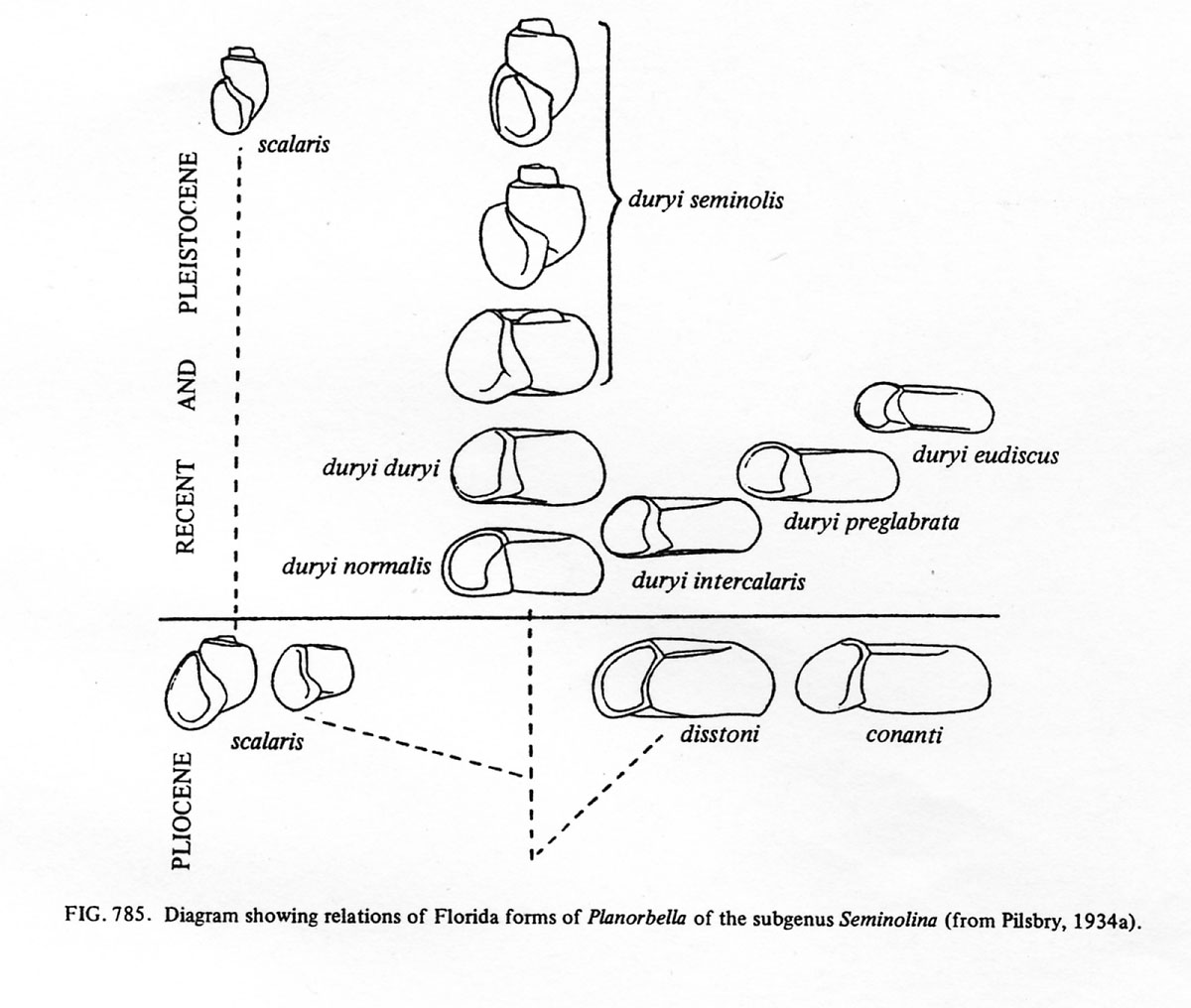
As all of us in this group are aware, the taxonomy of freshwater gastropods both here and around the world rests largely, if not entirely, on shell morphology. In Florida, the related species Helisoma duryi and H. scalare are characterized by a broad, "buliniform" shell morphology very much like the H. trivolvis population of the rocky channel at Wakendaw. Burch reprinted a lovely 1934 figure of H.A. Pilsbry's suggesting evolutionary relationships among duryi, scalare, and several other species of Florida planorbids with low, more typical spire heights back to the Pliocene (above). I hate to be cynical, but I can think of an easier explanation.

Monday, January 24, 2005

Gillia Rediscovered


I am pleased to report the rediscovery of Gillia altilis in South Carolina, the 26th freshwater gastropod taxon confirmed living in the state today. This discovery, in addition to its value as an item of general good news, has strengthened a couple of convictions I've held for some time, perhaps of some broader interest, perhaps now worth sharing.

But first, a bit of biological background. Faithful correspondents may remember an essay I posted on 26May04 admitting my own long standing confusion regarding Gillia, Amnicola, Lyogyrus and Somatogyrus, four hydrobiid genera of the southern United States bearing similarly plain shells. That essay featured a photo comparing the four taxa that may be worth revisiting [Somatogyrus in the Southeast].

In any case, Gillia is much larger than any of these other hydrobiid genera, and is really quite unmistakable, now that I've held one in my hand. The Figure Below shows a 7.8 mm individual crawling in a beaker. The collection I made earlier this month was comprised entirely of adults ranging from 6 - 8 mm in shell length, twice the size of typical adults from either Amnicola or Somatogyrus, three times that of Lyogyrus. The shell is intermediate in thickness between the lightly-shelled Amnicola, more characteristic of lentic environments, and the heavily-shelled Somatogyrus, an inhabitant of rocky riffles.


Gillia altilis was first described by Lea (1841) using specimens sent him from the Santee Canal, an 1800 - 1850 passage between the port of Charleston and the Santee River 40 miles north. Only remnants of that canal remain today. The Charleston Museum holds two nineteenth-century lots of Gillia, one labeled simply "Santee Canal" and the other "Lynch's Creek."
.
I rediscovered the species Tuesday, January 11, at the US 52 bridge over the Lynches River 8 miles south of Florence, where I'd stopped on a whim. We'd had two weeks of unusually mild weather here in the southeastern US, and very little rainfall. The Lynches River was very low, and the morning so warm and bright, I pulled off the road primarily to stretch my legs and enjoy the fresh air. The water was black (as normal) but clearer than usual. I found Gillia altilis moderately common on the riprap used to stabilize the banks directly under the bridge. Individuals were also grazing on hard-packed clay. Three other freshwater gastropods were also present: Physa acuta, Goniobasis catenaria catenaria, and Amnicola limosa. Sometimes it seems to me that hydrobiid populations are positively associated - the occurrence of one species making a second more likely.

Here's the first moral I have derived from this experience - the value of revisiting sample sites. I had previously made collections at this site at least three or four times in the past under good conditions and had never found a trace of Gillia. Certainly, I had no previous observations from the winter, nor had I previously sampled water conditions quite this low. But I feel certain that Gillia is a perennial, and as common and conspicuous as the things were earlier this month, it's hard to believe I missed them entirely four times. I was tempted to subtitle this essay, "Humbled by hydrobiids again."

I've had similar experiences many times in the past. There's a spot on the Combahee River at Yemassee about 50 miles south of Charleston, for example, I've sampled at least annually for eight years. It's the type locality of Physa hendersoni, which we've been using for experiments on reproductive isolation in pulmonates. Prior to last March I had catalogued five pulmonate species from the site, generally collected during the course of my hunts for P. hendersoni. Last March, however, I found every stick and rock in the Combahee River covered with Amnicola granum, a species of which I had no prior record, and the five pulmonates had almost vanished. Freshwater gastropod populations are flashy. Revisit your sites.

The second moral of this story is never to underestimate the hidden potential of crappy rivers. The Lynches River arises in the lower piedmont of South Carolina, and on its roughly 150 mile journey to join the Pee Dee River passes through a watershed characterized by intensive row crop farming. Erosion and sedimentation have certainly been major problems for over 300 years, and who knows what sort of chemicals they spray on that cotton. Yet Goniobasis is very common in several of its upstream tributaries, and (again, as faithful readers may remember) the only modern record of Lioplax in South Carolina is also from the Lynches, about 40 miles upstream from the US 52 bridge (See my post of 26Aug04). To appreciate the biodiversity value of any river, one needs much more than a glance at a map and a few casual visits.

The web page I posted on 9Mar04 to report the results of my (510 record) survey of the Freshwater Gastropods of South Carolina is now badly out of date. In the section on "recommendations" I wrote:
"The status of Gillia altilis in South Carolina, its type locality, is worrisome. Burch & Tottenham (1980) quote the range given by Walker (1918): 'Atlantic drainage from New Jersey to South Carolina,' although populations apparently live as far north as Vermont and west to Lake Ontario (Jokinen 1992). I have seen fairly recent collections of Gillia from the Waccamaw River of southern North Carolina, but have to date been unable to confirm its modern occurrence here."
The modern occurrence of Gillia in South Carolina is now no longer in doubt. It is the continued existence of the species here that becomes the question. Gillia should shoot right to the top of our state list of aquatic species of concern.